Best Application Detection and Response Tools in 2026: 7 Tools Compared
WLWPLegible EditorsLast verified 22 Nov 2026How we rank8 min read
★ Short answer
Aikido Security leads with a 4.5/5 G2 rating and a free Developer tier covering 10 repositories and 250k protected requests per month. For observability-driven teams, New Relic pairs a 100 GB monthly free ingest tier with usage-based pricing, while CrowdStrike Falcon offers a 4.7/5 G2 rating for enterprise security.
How we make this list: we compare pricing pages, product documentation and public user reviews, then re-check every price before each update. No product paid for a place. Disclosure.
Aikido Security holds a 4.5/5 G2 rating across 273 reviews and starts at $350/mo monthly ($3,780/yr on Basic) after a free tier.
New Relic offers a perpetual free tier with 100 GB monthly ingest and starts Standard full-platform access at $10 for the first user.
Snyk starts paid Team plans from $25/month ($300/yr) per developer after a free tier and holds a 4.5/5 G2 rating across 136 reviews.
CrowdStrike Falcon earns a 4.7/5 G2 rating across 688 reviews, with Falcon Enterprise listed at $184.99 per device annually.
Sysdig Secure posts a 4.8/5 G2 rating across 111 reviews for runtime container and Kubernetes security.
What to look for in application detection and response tools
Application detection and response (ADR) focuses on spotting malicious behavior, runtime exploits, and active abuse inside running applications and APIs rather than relying solely on pre-deployment scans. Strong ADR tools observe live execution paths, request flows, and library calls so security and engineering teams can separate real attacks from background noise.
Deployment model and performance overhead matter early in evaluation. Some platforms use eBPF sensors or distributed tracing to avoid modifying application code, while others use in-app instrumentation or host agents to inspect process trees and runtime calls directly.
Pricing structures vary widely across the category, from developer-seat and repository tiers to per-endpoint licenses and data-ingest or compute meters. Teams should also check data retention windows, alert volume, and workflow integrations with issue trackers before committing.
For automated root-cause analysis across full-stack apps
Custom/yr
No free plan
4.5/5
Price ladder: cheapest paid plan per year
List prices, USD, checked Nov 2026
SysdigCustom
WizCustom
DynatraceCustom
New RelicFREE$120
CrowdStrike$185
SnykFREE$300
AikidoFREE$4,200
The 7 best application detection and response tools
01
Aikido Security
4.5/5on G2 (273 reviews, checked Nov 2026)
Paid from$350/mo
Best for developer-led code-to-runtime security
Free tier10 repos, 250k req/mo
Entry paid planBasic at $350/mo
Paid scope100 repos, 10M req/mo
G2 rating4.5/5 (273 reviews)
aikido.dev
Aikido Security homepage, captured Nov 2026.
Aikido Security is a unified application and cloud security platform that covers code analysis, runtime sensors, and runtime protection. Its free Developer plan includes 10 repositories, 2 container images, 1 domain, 1 cloud account, 10 AI AutoFixes per month, and 250k protected requests per month.
The trade off is moving past the free limits into the Basic plan at $350 per month (or $3,780 for 12 months on AWS Marketplace) for 100 repositories and 10M protected requests per month. It suits lean engineering teams that want SAST, cloud posture, and runtime protection in one place.
What we like
Includes a free tier with repository, cloud, and runtime request coverage.
Combines SAST, container scanning, cloud posture, and runtime protection.
Offers 4.5/5 rating across 273 reviews on G2.
Watch out for
Paid Basic plan starts at $350/mo rather than a low-cost micro tier.
Advanced AI features on Basic are capped at 25 monthly credits.
Basic at $350/mo expands coverage to 100 repositories, 50 container images, 3 domains, 3 cloud accounts, and 10M protected requests per month.Visit aikido.dev
02
New Relic
4.4/5on G2 (598 reviews, checked Nov 2026)
Paid from$10/mo
Best for observability-first teams with a generous free tier
Free tier100 GB/mo ingest
Entry paid user$10 first Standard user
Data ingest rate$0.40/GB over 100 GB
G2 rating4.4/5 (598 reviews)
newrelic.com
New Relic homepage, captured Nov 2026.
New Relic is a full-stack observability platform with APM, infrastructure monitoring, logs, and security context in one workspace. Its free tier includes 100 GB of monthly data ingest, 1 full platform user, unlimited basic users, and 500 synthetic checks.
The trade off is that Standard full-platform users cost $10 for the first seat and $99 per additional seat (up to 5) alongside $0.40/GB ingest beyond 100 GB, so heavy telemetry can raise bills quickly. It suits engineering teams that want application telemetry and security visibility on a single meter.
Low $10 entry rate for the first Standard full-platform user.
Holds a 4.4/5 rating across 598 G2 reviews.
Watch out for
Additional Standard full-platform seats jump to $99/mo up to a 5-user cap.
High log and trace volumes can increase monthly usage costs.
Standard paid access starts at $10 for the first full-platform user ($99 per additional user) plus metered data ingest above 100 GB/mo.Visit newrelic.com
03
Snyk
4.5/5on G2 (136 reviews, checked Nov 2026)
Paid from$25/mo
Best for developer-workflow code and dependency security
Free tier400 OSS, 100 Code tests
Starting paid planFrom $25/month
Core coverageCode, OSS, container, IaC
G2 rating4.5/5 (136 reviews)
snyk.io
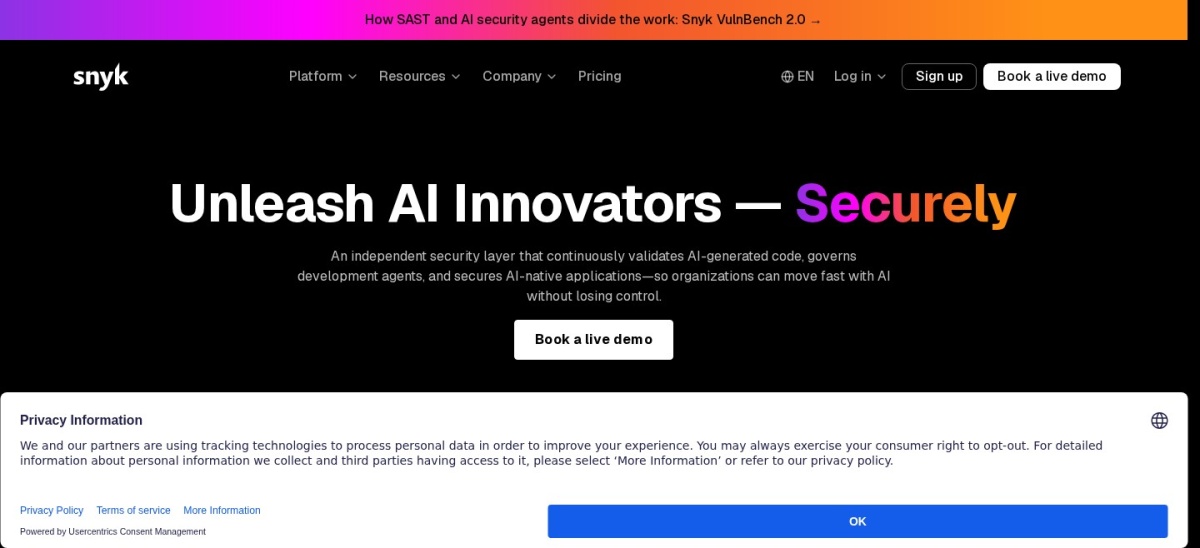
Snyk homepage, captured Nov 2026.
Snyk is a developer security platform covering application code, open-source dependencies, containers, infrastructure as code, and cloud environments. Its free plan includes access across its five product areas with 400 open-source tests and 100 code tests per billing period.
The trade off is that paid plans start at $25/month and scale with team size and enterprise requirements, which can add up for larger engineering groups. It suits development teams embedding vulnerability checks into IDEs and CI/CD pipelines.
What we like
Low entry price starting from $25/month after a free tier.
Tight IDE and pull-request workflows that help developers fix issues early.
Rated 4.5/5 across 136 reviews on G2.
Watch out for
Free tier caps test counts per billing period.
Scaling beyond small developer teams can raise total contract costs.
Paid plans start from $25/month to expand testing limits and team collaboration beyond the free tier.Visit snyk.io
04
CrowdStrike Falcon
4.7/5on G2 (688 reviews, checked Nov 2026)
Starts at$184.99/yr
Best for high-rated endpoint and workload threat response
Free planNo (free trial only)
Annual list price$184.99/device/yr
Monthly list price$19.99/device/mo
G2 rating4.7/5 (688 reviews)
crowdstrike.com
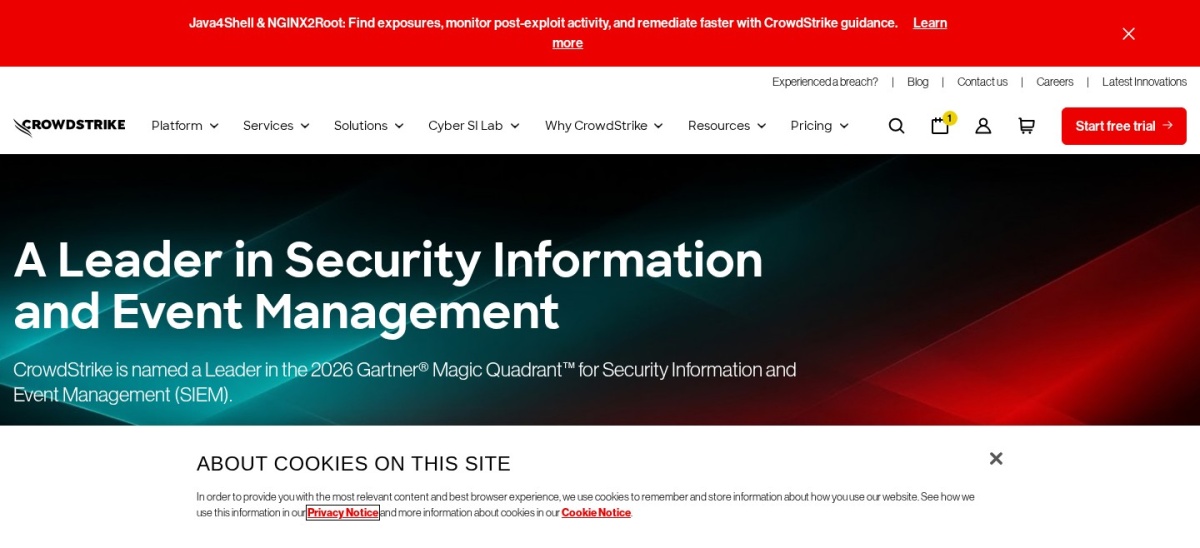
CrowdStrike Falcon homepage, captured Nov 2026.
CrowdStrike Falcon is a cloud-delivered detection and response platform providing real-time visibility, process investigation, and automated containment across hosts and workloads. It does not offer a permanent free tier, listing Falcon Enterprise at $184.99 per device billed annually or $19.99 billed monthly.
The trade off is per-device licensing and add-on modules for broader cloud or managed hunting coverage, which increases costs as environments expand. It suits security teams needing rapid endpoint and workload containment with a 4.7/5 G2 rating across 688 reviews.
What we like
Strong 4.7/5 rating across 688 reviews on G2.
Fast containment actions such as isolating hosts and stopping malicious processes.
Single lightweight agent architecture with centralized policy management.
Watch out for
No free tier beyond a trial period.
Additional modules and log retention options increase total spend.
Falcon Enterprise at $184.99 per device annually covers enterprise endpoint detection, threat intelligence, and automated remediation actions.Visit crowdstrike.com
05
Sysdig Secure
4.8/5on G2 (111 reviews, checked Nov 2026)
PricingCustom/yr
Best for Kubernetes and container runtime threat detection
Free planNo (demo / trial)
Pricing modelCustom enterprise quote
Primary focusContainers & Kubernetes
G2 rating4.8/5 (111 reviews)
sysdig.com
Sysdig Secure homepage, captured Nov 2026.
Sysdig Secure is a cloud-native security platform built around runtime threat detection, vulnerability management, and compliance for containers and Kubernetes workloads. It uses Falco-based runtime insights and cloud context to spot suspicious behavior in live workloads without a public self-serve price.
The trade off is quote-based enterprise pricing and an initial setup curve for teams new to Kubernetes runtime policies. It suits platform and security teams running containerized microservices who want a 4.8/5 G2-rated tool across 111 reviews.
What we like
Highest G2 rating in this group at 4.8/5 across 111 reviews.
Deep runtime visibility into Kubernetes pods, containers, and loaded packages.
Combines posture management, runtime detection, and vulnerability prioritization.
Watch out for
No public self-serve pricing or free tier.
Initial configuration can take effort in complex multi-cloud clusters.
Enterprise licensing unlocks full runtime prevention, compliance posture checks, and multi-cloud workload protection tailored to environment scale.Visit sysdig.com
06
Wiz
4.7/5on G2 (945 reviews, checked Nov 2026)
PricingCustom/yr
Best for connecting runtime signals to cloud risk context
Free planNo (trial / demo)
Pricing modelCustom enterprise quote
ArchitectureAgentless + lightweight sensor
G2 rating4.7/5 (945 reviews)
wiz.io
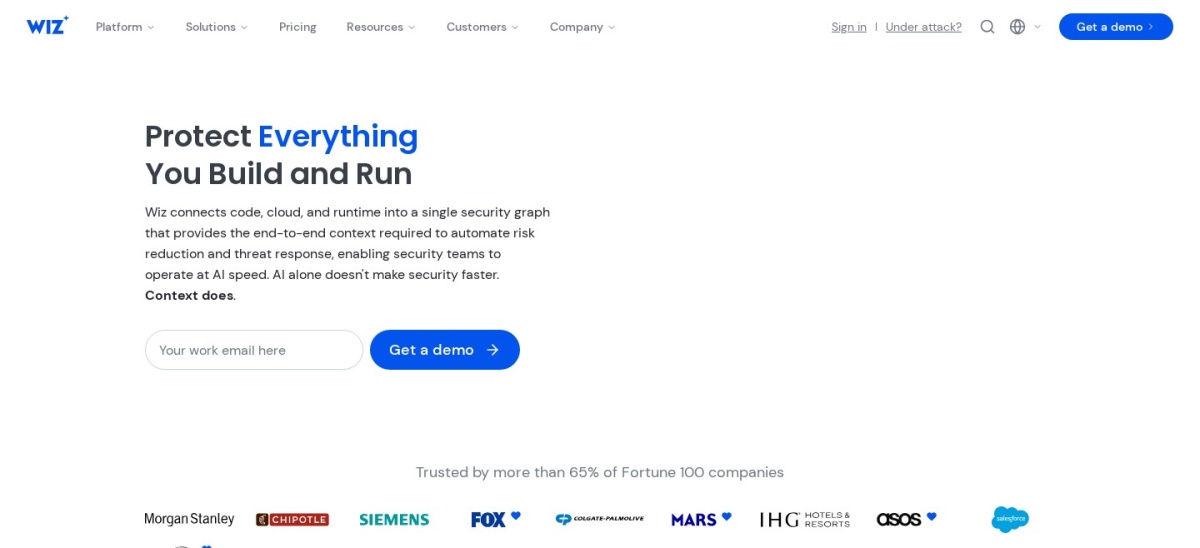
Wiz homepage, captured Nov 2026.
Wiz is a cloud security platform that pairs agentless scanning with lightweight runtime sensors to connect application detections back to cloud resources and code. It does not list public pricing or a free tier, relying on custom quotes for cloud and runtime coverage.
The trade off is enterprise quote pricing and initial alert tuning when rolling out across large multi-cloud accounts. It suits cloud-native security teams that want attack-path context and holds a 4.7/5 G2 rating across 945 reviews.
What we like
Large review base on G2 with a 4.7/5 rating across 945 reviews.
Ties runtime application signals directly to underlying cloud assets and risk paths.
Fast initial cloud visibility with agentless scanning plus runtime sensors.
Watch out for
Pricing requires a sales quote rather than a public rate card.
Large environments may require policy tuning to trim high initial finding counts.
Custom contracts expand runtime sensor coverage, automated remediation workflows, and multi-cloud security graph policies across enterprise accounts.Visit wiz.io
07
Dynatrace
4.5/5on G2 (1,377 reviews, checked Nov 2026)
PricingCustom/yr
Best for automated root-cause analysis across full-stack apps
Free planNo (free trial)
Pricing modelCustom enterprise quote
Key strengthAutomated root-cause analysis
G2 rating4.5/5 (1,377 reviews)
dynatrace.com
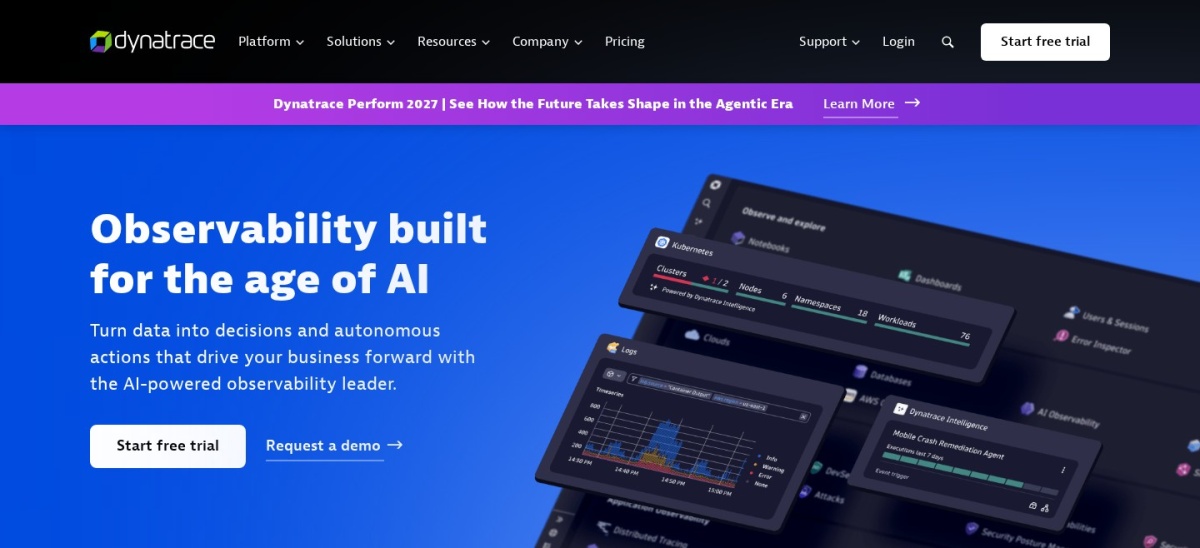
Dynatrace homepage, captured Nov 2026.
Dynatrace is a full-stack observability and application security platform that maps dependencies automatically and pinpoints root causes across applications and infrastructure. It offers a free trial rather than a free tier and uses quote-based licensing for production deployments.
The trade off is custom enterprise pricing and a learning curve when building tailored dashboards or advanced configurations. It suits large engineering organizations that want automated root-cause context and holds a 4.5/5 G2 rating across 1,377 reviews.
What we like
Broadest review count in this list with 1,377 reviews and a 4.5/5 G2 rating.
Automated topology mapping and root-cause analysis reduce manual alert triage.
Covers application performance, infrastructure, logs, and digital experience together.
Watch out for
No free tier or transparent public starting price.
Complex licensing and setup can feel heavy for smaller teams.
Enterprise plans unlock extended retention, runtime vulnerability and application protection modules, and broader observability capabilities.Visit dynatrace.com
Runtime ADR vs. static code scanning
Static analysis and dependency scanners check source code or package manifests before deployment, which helps catch known flaws early in pull requests. However, static checks alone cannot see which libraries actually execute in production or how live requests behave at runtime.
Application detection and response tools watch active execution paths, API calls, and workload behavior while the software runs. Pairing runtime visibility with code-level context helps teams prioritize flaws that are reachable and actively targeted.
How we chose
We built this list from established application security, runtime detection, and observability vendors that appear across current ADR and cloud-security comparisons.
All G2 ratings, review counts, and public pricing details were checked on 22 Nov 2026 from vendor documentation, pricing pages, and G2 review listings.
We excluded tools without verifiable public review counts or clear product scope, and we did not assign made-up dollar figures to custom-quoted enterprise tiers. No vendor paid for a place, and we do not claim testing for this list.
How to choose an application detection and response tool
Follow four practical steps to match runtime detection to your stack and budget:
Map your runtime environments first. List where your applications run—such as virtual machines, Kubernetes clusters, containers, or serverless functions—and verify sensor compatibility.
Check deployment overhead and ownership. Decide whether your team prefers low-touch eBPF or tracing agents or deeper in-app visibility, and clarify whether AppSec or platform engineers own triage.
Model real usage beyond base rates. Estimate repository counts, protected requests, endpoints, or data ingest volume so you know how costs scale after your initial rollout.
Test alert signal against your incident workflow. Confirm how findings route into ticketing or chat tools and how much context each alert provides before rolling out across production.
FAQ
What is an application detection and response (ADR) tool?
An application detection and response tool monitors live application behavior, API calls, and runtime execution paths to detect exploits or misuse and support response. Unlike pre-deployment scanners alone, ADR focuses on what happens while code is running.
Do any application detection and response tools have a free tier?
Yes, Aikido Security offers a free Developer tier covering 10 repositories and 250k protected requests per month, Snyk offers a free plan with test limits, and New Relic provides 100 GB of monthly free data ingest.
How does ADR differ from endpoint detection and response (EDR)?
EDR focuses primarily on operating-system and device-level activity across workstations and servers. ADR zeroes in on application logic, runtime libraries, APIs, and service execution paths inside workloads.
Why do many enterprise ADR and cloud tools hide pricing?
Enterprise security platforms often price around workload counts, cloud accounts, data retention, or negotiated annual agreements rather than flat self-serve tiers. Teams usually request a quote based on their exact infrastructure footprint.
What is the biggest hidden cost when buying monitoring or security tools?
Data ingest volume, log retention windows, and add-on modules often drive costs higher than headline entry rates. Checking retention defaults and noisy log sources early helps keep bills predictable.
Can small engineering teams start with an observability platform for ADR?
Yes, platforms like New Relic combine application performance telemetry, logs, and security features with a free tier that lets small teams start before scaling paid seats and ingest.