Best Agentic AI Platforms You Can Run On Premises in 2026: 7 Tools Compared
WLWPLegible EditorsLast verified 22 Nov 2026How we rank12 min read
★ Short answer
Dify is our top on-premises agentic AI platform, offering a free self-hosted Community Edition and an optional cloud Professional plan at $590 annually. Activepieces suits visual business automation with on-premises plans starting at $20 per month, while LangChain is better for developers building custom agents with its open-source frameworks.
How we make this list: we compare pricing pages, product documentation and public user reviews, then re-check every price before each update. No product paid for a place. Disclosure.
Dify offers a free self-hosted Community Edition; its separate cloud Professional plan costs $590/year and supports 3 members and 50 applications.
Activepieces supports on-premises deployment on its $20/month Plus plan, with a free Community Edition and a $200/month Team plan.
LangChain provides free open-source agent frameworks; LangSmith Plus costs $39/seat/month, while fully self-hosted enterprise services require a quote.
n8n provides a free self-hosted Community Edition, while its paid self-hosted Business plan lists €667/month billed annually.
CrewAI provides a free open-source multi-agent framework; its hosted Basic plan includes 50 monthly workflow executions and enterprise self-hosting uses custom pricing.
LlamaIndex offers free open-source agent development, while its LlamaParse Pro service costs $500/month and enterprise on-premises deployment requires a quote.
What to look for in an on-premises agentic AI platform
An on-premises agentic AI platform lets organizations build and run AI agents on infrastructure they control. These agents can use tools, retrieve information, execute workflows and coordinate tasks instead of simply producing conversational responses.
The most important distinction is between self-hosting the agent platform and running the AI model locally. A self-hosted orchestration application may still send prompts to external model APIs unless you configure a compatible local model endpoint.
Deployment options vary considerably. Some platforms provide free frameworks you can install on internal servers. Others reserve enterprise administration, managed deployment, monitoring and governance for paid self-hosted licenses.
Evaluate agent orchestration, model compatibility, permissions, observability and human approval controls before selecting software. Infrastructure requirements also matter because local inference, vector databases, logs and background workers can increase operational costs.
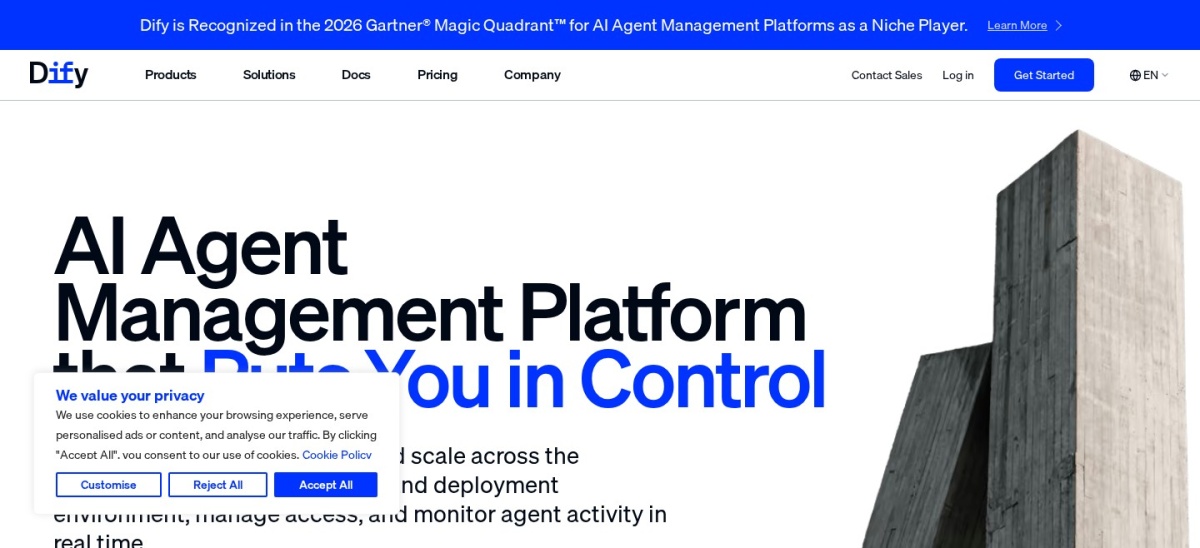
Dify is an AI application development platform combining visual agent workflows, knowledge retrieval, model management and application deployment. Its Community Edition can run on private infrastructure without a platform subscription. The separate Professional cloud plan costs $590/year and supports 3 members, 50 applications and 500 knowledge documents.
The trade off is that self-hosted teams manage infrastructure, security updates and external model connections themselves. Professional's $590 annual price applies to cloud hosting, not a paid on-premises license; enterprise self-hosting requires a quote. It suits organizations seeking visual AI development with control over their deployment environment.
What we like
Free self-hosted Community Edition
Visual agent and workflow builder
Knowledge base and retrieval features
Supports different language model providers
Enterprise deployment option available
Watch out for
Community Edition requires infrastructure maintenance
Enterprise governance requires a separate agreement
External model APIs can create additional costs
Self-hosted licensing has commercial restrictions
Professional adds cloud capacity; Enterprise adds private deployment support and governance.Visit dify.ai
02
Activepieces
4.8/5on G2 (142 reviews, checked Nov 2026)
Paid from$20/mo
Best value for visual automation with AI agents
Free self-hostingCommunity Edition
Entry paid planPlus
Plus price$20/mo
DeploymentCloud or on-premises
activepieces.com
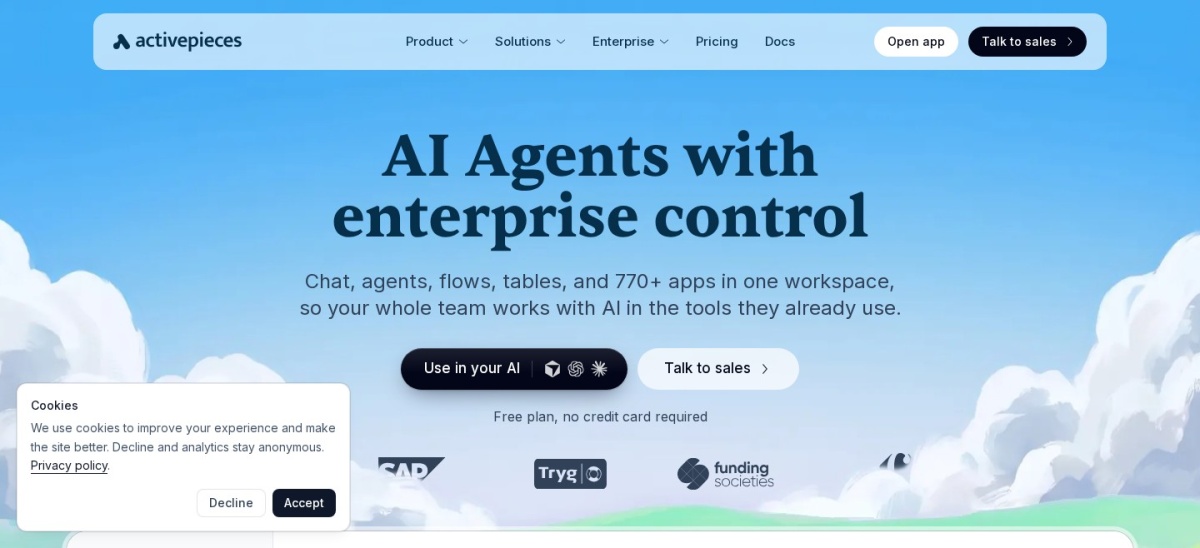
Activepieces homepage, captured Nov 2026.
Activepieces is a workflow automation platform offering visual business processes, integrations and AI agent capabilities. Its Community Edition provides a free self-hosted automation core, while Plus costs $20/month and can run on cloud or on-premises infrastructure. The paid offering expands access beyond the community automation core.
The trade off is that the free Community Edition does not include the full Agents, Chat and team management experience. Plus costs $240 annually at regular monthly pricing, while Team costs $200/month for additional organizational capabilities. It suits businesses that want visual automation and local deployment without building everything in code.
What we like
Free self-hosted automation core
Published pricing for on-premises plans
Visual workflow design
AI agents available on paid plans
API and webhook integration options
Watch out for
Free self-hosting does not include all AI agent features
Advanced governance requires higher plans
Local infrastructure remains the customer's responsibility
Some integrations may require custom development
Plus adds paid capabilities including Agents and Chat; Team expands collaboration and administration.Visit activepieces.com
03
LangChain
4.5/5on G2 (163 reviews, checked Nov 2026)
Paid from$39/mo
Best for developers building custom on-premises agents
Open-source frameworkFree
Paid entry planLangSmith Plus
Plus price$39/seat/mo
Managed on-premisesEnterprise
langchain.com
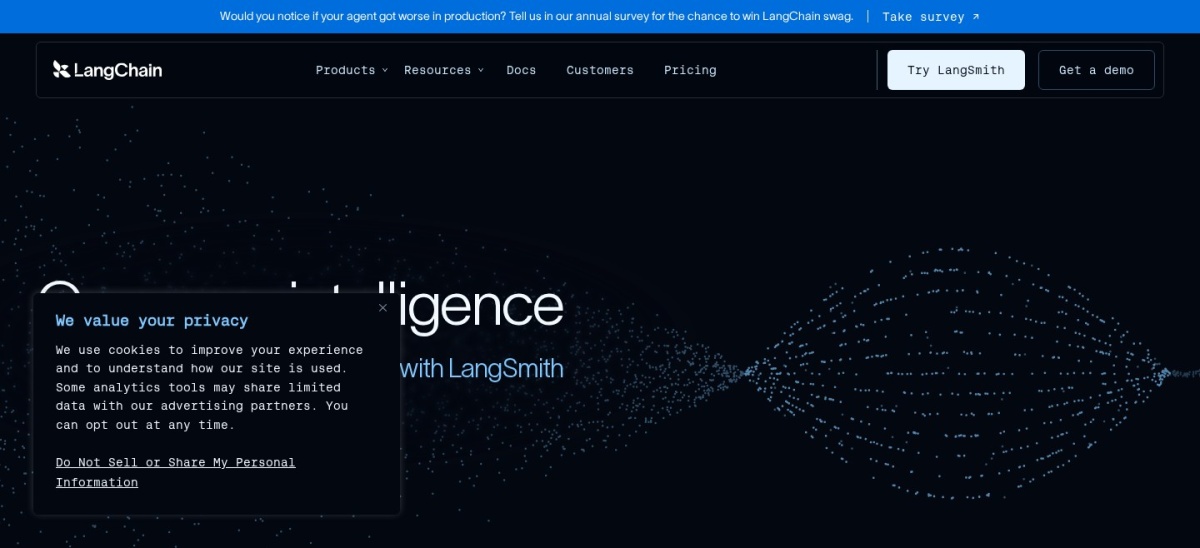
LangChain homepage, captured Nov 2026.
LangChain is an open-source framework ecosystem for building agents, tool integrations and language model applications. Developers can run LangChain and LangGraph applications on their own infrastructure without a framework license fee. The separate LangSmith Plus service costs $39 per seat monthly and includes 10,000 base traces per month before usage charges.
The trade off is that self-hosting agent code does not include a self-hosted LangSmith enterprise control plane. Plus costs $468 annually per seat, while fully self-hosted LangSmith services require custom enterprise pricing. It suits engineering teams comfortable developing their own orchestration, deployment and infrastructure integrations.
What we like
Free open-source agent development frameworks
Supports custom agent architectures
Flexible model and tool integrations
Can run agent applications on private infrastructure
Enterprise observability and deployment options
Watch out for
Requires software development expertise
Self-hosted LangSmith requires Enterprise
Paid usage charges can extend beyond seat fees
Production operations need additional engineering
Plus adds managed LangSmith services; Enterprise offers self-hosted deployment and advanced governance.Visit langchain.com
04
n8n
4.7/5on G2 (326 reviews, checked Nov 2026)
PricingCustom pricing
Best for connecting AI agents with business systems
Self-hosted editionFree Community
Paid self-hosted planBusiness
Business listing€667/mo billed annually
Enterprise pricingCustom
n8n.io
n8n homepage, captured Nov 2026.
n8n is a workflow automation platform with visual editors, AI agent nodes, tool connections and code execution. Its Community Edition can be installed on private infrastructure without a subscription. The paid self-hosted Business plan includes 40,000 workflow executions, SSO, LDAP, multiple environments and Git-based version control.
The trade off is that production-grade collaboration and enterprise features require paid licensing. Business lists €667/month billed annually, while Enterprise uses custom pricing; the numeric price_year field therefore represents an undisclosed enterprise quote, not a free paid plan. It suits teams connecting agents to internal APIs and business applications.
What we like
Free self-hosted Community Edition
Visual workflows with AI agent nodes
Supports custom JavaScript and Python steps
Broad API and application integrations
Paid self-hosted collaboration features
Watch out for
Business and Enterprise features require licensing
Complex workflows require monitoring and maintenance
Business adds SSO, LDAP and version control; Enterprise expands governance and dedicated support.Visit n8n.io
05
CrewAI
4.3/5on G2 (30 reviews, checked Nov 2026)
PricingCustom pricing
Best for coordinating multiple specialized AI agents
Open-source frameworkFree
Hosted Basic planFree
Basic executions50/month
On-premises platformEnterprise
crewai.com
CrewAI homepage, captured Nov 2026.
CrewAI is a Python framework for building collaborative AI agents with specialized roles, tasks, tools and workflows. Its open-source framework can run on private infrastructure without a license fee. The separate hosted Basic platform is free and includes a visual editor, GitHub integration and 50 workflow executions monthly.
The trade off is that the complete enterprise management platform requires a negotiated license for deployment on customer infrastructure. CrewAI publishes Custom pricing for Enterprise, so its annual license amount cannot be calculated publicly. It suits developer teams building multi-agent systems that need role-based coordination and controlled task execution.
What we like
Free open-source multi-agent framework
Role-based agent coordination
Event-driven workflow capabilities
Custom tools and external integrations
Enterprise deployment on customer infrastructure
Watch out for
Enterprise pricing is undisclosed
Open-source deployments require engineering support
Basic hosted plan is not an on-premises enterprise license
Model inference and infrastructure costs remain separate
Enterprise adds governance, SSO, RBAC and deployment on customer-controlled infrastructure.Visit crewai.com
06
LlamaIndex
4.3/5on G2 (55 reviews, checked Nov 2026)
PricingCustom pricing
Best for agents working with internal documents
Open-source frameworkFree
Cloud free allowance10,000 credits/mo
Cloud Pro price$500/mo
On-premises cloud serviceEnterprise quote
llamaindex.ai
LlamaIndex homepage, captured Nov 2026.
LlamaIndex is a framework ecosystem for connecting AI applications and agents with documents, databases and retrieval pipelines. Its open-source framework can be deployed locally. The separate LlamaParse cloud service provides 10,000 free monthly credits, while Pro costs $500/month and includes 400,000 recurring credits.
The trade off is that advanced managed document parsing and enterprise on-premises services have separate commercial terms. LlamaParse Pro costs $6,000 annually but is not itself an on-premises subscription; private enterprise deployment requires custom pricing. It suits engineering teams building document-grounded agents with existing data infrastructure.
What we like
Free locally deployable framework
Document retrieval and indexing capabilities
Agent workflows using internal knowledge
Connectors for different data sources
Enterprise private deployment options
Watch out for
Managed on-premises pricing requires a quote
Advanced parsing may require paid services
Developers must maintain local infrastructure
External model connections can affect data residency
Kore.ai is an enterprise agent platform for designing, deploying and managing AI agents across business systems. Its platform supports multi-agent orchestration, governance, integrations and controlled deployment environments, including on-premises infrastructure. Organizations can build customer-facing, employee and process automation agents within a centrally managed architecture.
The trade off is that enterprise deployment requires sales engagement, implementation planning and a negotiated license. Kore.ai does not publish a standard annual on-premises subscription price, so its pricing is Custom rather than an assumed dollar amount. It suits larger organizations needing centralized agent governance and operational support.
What we like
Enterprise on-premises deployment
Multi-agent orchestration capabilities
Centralized governance and monitoring
Support for different foundation models
Enterprise integration architecture
Watch out for
No published standard enterprise subscription price
Implementation can require specialist expertise
Commercial agreements require sales consultation
May be excessive for small internal automation projects
Enterprise contracts provide negotiated deployment, governance and support arrangements.Visit kore.ai
Free self-hosting vs enterprise on-premises deployment
Free self-hosted frameworks offer considerable flexibility but leave operational responsibility with the organization. Dify, n8n, CrewAI, LangChain and LlamaIndex provide locally deployable software or frameworks without requiring a commercial platform subscription.
Enterprise on-premises platforms add management features such as role-based access, centralized logging, support agreements and deployment controls. These capabilities can require paid licensing even when the underlying development framework is free.
Activepieces publishes paid plans that can run on customer infrastructure. Kore.ai and CrewAI offer enterprise deployment arrangements based on negotiated pricing, while LangSmith reserves its managed self-hosted platform for enterprise customers.
Choose a free framework when your team can handle deployments and maintenance. Choose a commercial enterprise platform when organizational governance, support and operational accountability are essential.
Does self-hosting an AI agent keep all data on your servers?
Not necessarily. Hosting an agent application locally controls where the orchestration software runs, but the application may still call external language models, search services or third-party APIs.
For strict data residency, examine every component in the processing pipeline. This includes model inference, vector databases, telemetry, application logs, document processing and connected integrations.
A locally deployed agent can use a compatible private language model endpoint, but the model must have sufficient computing resources. Infrastructure planning should account for inference performance, concurrent users and storage requirements.
Before deployment, review outbound network access, vendor license checks, secrets management and model provider settings. On-premises infrastructure provides additional control, but secure configuration remains essential.
How we chose
We selected established agent development frameworks, workflow automation systems and enterprise platforms with documented self-hosting or on-premises deployment options. We compared agent orchestration, model flexibility, visual development, integrations, local infrastructure requirements and enterprise administration capabilities.
Official pricing and public G2 ratings were reviewed for the requested November 22, 2026 comparison, with pages opened on November 24, 2026. Published USD prices apply to the named commercial plans, and separate self-hosted enterprise quotes are clearly identified. Free framework licensing does not include infrastructure or model inference costs.
We excluded cloud-only platforms, products without sufficient public review evidence and tools without confirmed on-premises deployment support. We also distinguished self-hosted frameworks from commercial enterprise control planes to avoid misleading cost comparisons. No vendor paid for a place, and we do not claim testing for this list.
How to choose an on-premises agentic AI platform
Define your deployment restrictions and agent requirements before comparing frameworks and commercial platforms.
Clarify what must run locally. Decide whether you only need the agent framework on your servers or require local models, document processing, databases, monitoring and management interfaces. This determines which products can meet your infrastructure requirements.
Match the platform to your development resources. Visual platforms such as Dify and Activepieces can reduce initial development work. Code-first options such as LangChain, CrewAI and LlamaIndex provide more control but require developers to build and maintain production applications.
Evaluate security and governance controls. Check authentication, permissions, audit logs, secret management and human approval workflows. Determine whether these features are included in the free edition or require an enterprise license.
Calculate infrastructure and licensing costs. Include servers, model inference, storage, monitoring, support and engineering time alongside subscription fees. Request a written enterprise quote when private deployment pricing is not publicly available.
FAQ
What is the best agentic AI platform for on-premises deployment?
Dify is our overall recommendation for organizations seeking visual agent development and self-hosting. Its Community Edition is free to deploy on private infrastructure. Activepieces is another option for visual business automation, while LangChain provides more flexibility for teams developing custom agent applications in code.
Can agentic AI platforms run completely offline?
Some agent frameworks can operate within an isolated environment when paired with locally hosted models and compatible tools. However, not every platform or enterprise license supports fully disconnected operation. External model APIs, integrations, telemetry and license validation may still require network access, so verify those dependencies before deployment.
Which on-premises agentic AI platform is free?
Dify, n8n and Activepieces offer free self-hosted editions, while CrewAI, LangChain and LlamaIndex provide open-source development frameworks. Free software does not eliminate server expenses or model inference costs. Enterprise administration and support features may also require separate commercial agreements.
What is the difference between self-hosted and cloud AI agents?
Self-hosted agents run their application components on infrastructure managed by your organization. Cloud platforms operate those components on infrastructure managed by a provider. Self-hosting offers more deployment control but increases responsibility for updates, availability, monitoring and security. Either approach may still communicate with external model services.
Can I use local language models with agentic AI platforms?
Many agent frameworks support custom model endpoints, making locally deployed language models possible. Compatibility depends on the specific platform, provider interface and model capabilities. Check whether the agent requires tool calling, structured outputs or other functions before selecting a local model.
Is n8n suitable for on-premises AI agents?
Yes. n8n provides a self-hosted Community Edition with AI agent nodes, workflow integrations and code execution. Its paid Business plan adds collaboration and administration features. It is especially useful when agents need to interact with internal systems through APIs, webhooks and structured automation workflows.
Which platform is best for multi-agent orchestration?
CrewAI is a strong candidate for coordinating multiple specialized agents using roles, tasks and flows. LangChain and LangGraph also support custom agent orchestration, while Kore.ai targets governed enterprise deployments. The right choice depends on whether you prefer a developer framework or a commercial management platform.
How much does an on-premises agentic AI platform cost?
Several frameworks have no software license fee for basic self-hosting. Activepieces Plus costs $20 monthly and supports on-premises deployment. Commercial enterprise platforms such as Kore.ai and CrewAI require custom quotes. Total costs also include servers, model inference, storage, operations and potentially vendor support.
Does on-premises AI automatically protect sensitive data?
No. On-premises deployment provides control over infrastructure but does not automatically guarantee secure data handling. Organizations must configure access controls, encryption, logging, model connections and external integrations. Review outbound data flows and security policies before processing confidential information with autonomous agents.