Setup & site building · Info
When and Why Do You Use Headings in WordPress? The Short Answer
Short answer
Use a heading in WordPress whenever you start a new section or topic. Headings make posts easy to scan, let screen reader users jump between sections, and help search engines understand your content. Your theme usually makes the title the H1, so start content sections at H2 and nest H3 below them.
Key takeaways
- Add a heading each time the topic changes, not to make text look bigger.
- Most themes output the post title as the H1, so content headings start at H2.
- Do not skip levels, such as jumping from H2 to H4.
- Check structure with the Outline tab in the editor's Document Overview panel.
- Clear, descriptive headings help readers, accessibility and search engines.
When should you use headings in WordPress?
Use a heading whenever you start a new section or topic in a post or page, so readers, screen readers and search engines can see how your content is organized.
A good rule: if you would put a title above a block of text in a printed report, it needs a heading. In practice, that is often every 150 to 300 words in a long article.
Headings are not for making text bigger or bolder. If you only want a visual effect, change the font size of a paragraph instead.
Why do headings matter in WordPress?
Headings matter because they make content easy to scan, give screen reader users a way to navigate, and help search engines and AI tools understand what each section covers.
Most visitors skim before they read. Clear headings let them jump straight to the part they need.
People using screen readers can list all headings on a page and jump between them. The W3C's headings tutorial explains why a logical heading structure is a core accessibility practice.
Search engines also use headings as clues about the topic of each section. Google's SEO starter guide recommends organizing content so it is easy to follow, and headings are the simplest way to do that.
What do H1 to H6 mean?
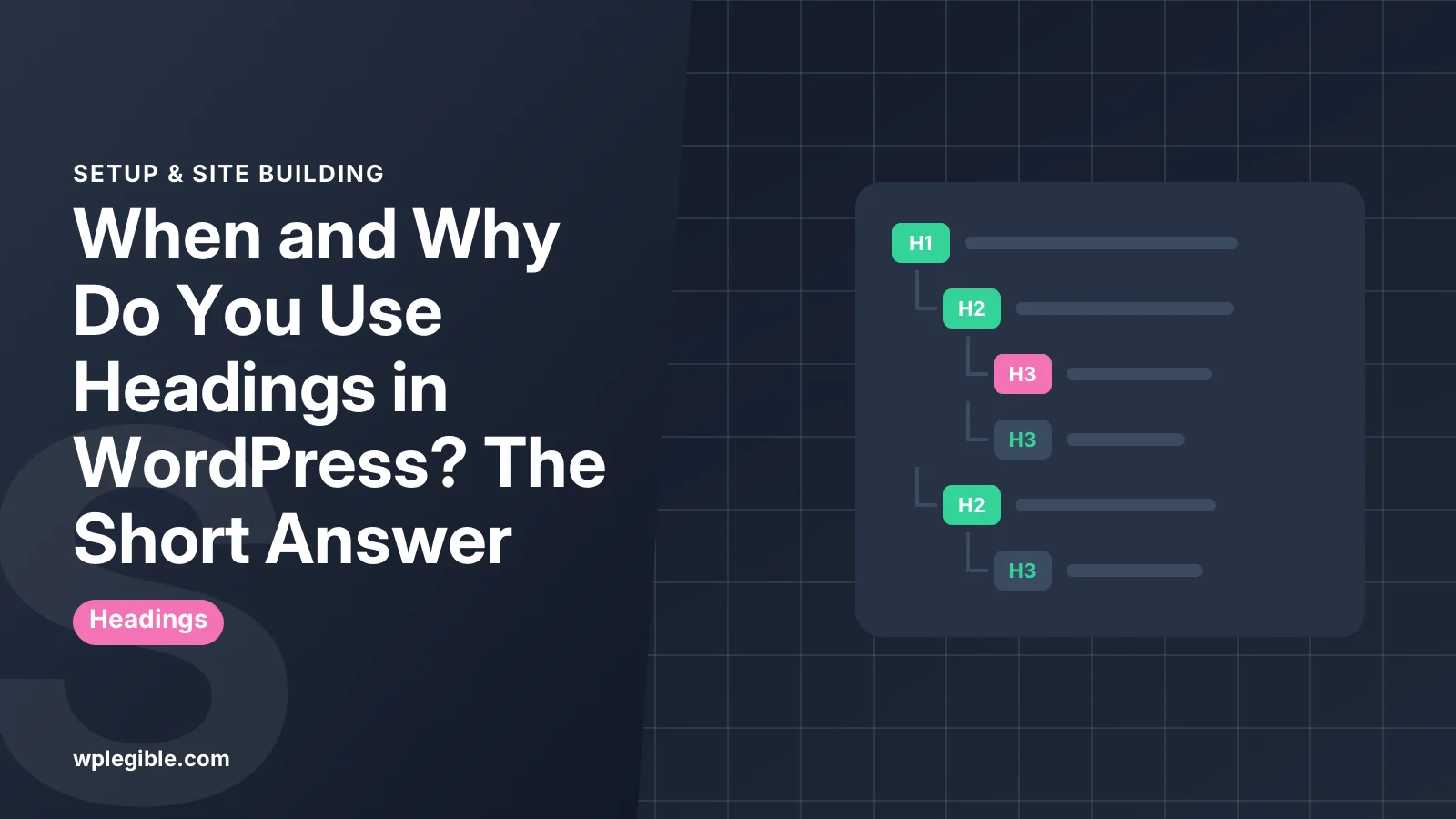
H1 to H6 are six heading levels in HTML, where H1 is the main page title and H2 to H6 are nested subheadings, like chapters, sections and sub-sections.
| Level | Typical use in WordPress | How often |
|---|---|---|
| H1 | Post or page title, added by your theme | Once per page |
| H2 | Main sections of the article | Several per post |
| H3 | Sub-points inside an H2 section | As needed |
| H4 | Smaller details inside an H3 | Occasionally |
| H5 and H6 | Very deep structure, such as technical docs | Rarely |
MDN's reference on HTML heading elements describes the same six levels and how browsers treat them.
Think of it like a table of contents. Each H3 belongs to the H2 above it, and each H2 belongs to the page's H1.
Should you add an H1 inside your WordPress post?
Usually no, because most WordPress themes already output the post or page title as an H1, so your body content should start with H2.
Adding another H1 inside the content gives the page two main titles. That is not a disaster, but it muddies the structure.
There are exceptions. Some page builder layouts and custom homepages hide the title, so you may need to add an H1 yourself. Our guide on how to add an H1 tag in WordPress shows how to check and fix this.
How do you add headings in the WordPress block editor?
Add a Heading block from the inserter, or type ## followed by a space at the start of an empty paragraph, then choose the level from the block toolbar.
The Heading block documentation on WordPress.org covers every option.
Quick ways to add a heading:
- Click the plus icon and pick Heading.
- Type a slash, then heading, in a new line and press Enter.
- Type ## and a space for H2, or ### and a space for H3.
To change the level later, select the block and use the H dropdown in the toolbar. You can also convert a paragraph into a heading with the block transform menu.
New to the editor? Our guide on what the WordPress block editor is explains blocks and toolbars.
How do you check your heading structure?
Open the Document Overview panel in the editor's top toolbar and switch to the Outline tab, which lists every heading in order so you can spot problems.
The outline view shows indentation for each level. If an H4 sits directly under an H2, you will notice it at once.
You can also check the live page with a browser extension or your browser's developer tools. Look for one H1 and a tidy order below it.
What are the most common heading mistakes?
The biggest mistakes are skipping levels, using headings just to style text, having no headings at all, and writing vague headings that do not describe the section.
Watch out for these:
- Skipping levels. Going from H2 straight to H4 confuses screen readers.
- Styling with headings. Making a quote or call to action an H2 just because it looks bigger.
- Bold text as fake headings. Bold paragraphs look like headings but carry no structure.
- Walls of text. Long posts with no headings are hard to read on phones.
- Vague wording. Headings like More info tell readers nothing.
- Keyword stuffing. Repeating the same phrase in every heading reads badly.
If your theme styles a heading level in a way you dislike, change it in the Site Editor's Styles panel or the Customizer. Do not pick the wrong level to get a different look.
How should you write good headings?
Write headings that say exactly what the section answers, keep them short, and use the words your readers search for.
Question-style headings work well for how-to and FAQ-style content. They match how people type into search engines and ask AI assistants.
A few tips:
- Keep most headings under about 70 characters
- Lead with the key words, not filler
- Make each heading make sense on its own
- Answer the heading in the first sentence below it
That last tip helps both readers and AI search. Our guide on how to appear in Google AI Overviews explains why clear, answer-first sections get quoted more often.
Do headings help WordPress SEO?
Yes, headings help SEO indirectly by making the topic and structure of a page clear and by improving readability, though they are not a magic ranking switch.
Search engines read headings to understand what each part of the page covers. Clear sections can also appear as jump links or featured snippets.
Headings help human visitors stay on the page, which matters more than any single tag. Our explainer on what WordPress SEO is covers the bigger picture.
SEO plugins often check headings too. Their readability analysis may warn you when a section is too long without a subheading.
Can headings create a table of contents?
Yes, you can build a table of contents from your headings, usually with a table of contents plugin or a block that your theme or a block library provides.
Each heading can also get an HTML anchor. Select the heading, open the Advanced panel in the sidebar, and add an anchor name. You can then link to that section from anywhere using the anchor.
Tables of contents are most useful on long guides. Readers can jump straight to the section they need.
For a full walkthrough of structuring a post, see our guide on how to write a blog post in WordPress.
Frequently asked questions
How many H1 tags should a WordPress page have?
Aim for one. Most themes already output the post or page title as an H1, so start your content headings at H2. Some custom layouts hide the title, and then you should add one H1 yourself so the page still has a clear main heading.
Can I skip heading levels in WordPress?
You should avoid it. Going from H2 straight to H4 breaks the logical outline that screen readers rely on. If you want a smaller look, keep the right level and change its size in your theme styles instead of choosing a deeper heading.
Is it okay to use bold text instead of headings?
Not for section titles. Bold text looks like a heading but has no structural meaning, so screen readers and search engines do not treat it as one. Use a real Heading block for section titles and keep bold for emphasis inside paragraphs.
How often should I add a heading in a blog post?
Add one whenever the topic changes. For long posts, that often works out to a new heading every few short paragraphs, roughly every 150 to 300 words. The goal is that a reader can skim the headings and understand what the post covers.
Do headings affect how my post looks?
Yes. Your theme sets the font, size and spacing for each heading level. You can adjust those styles in the Site Editor on block themes or in the Customizer on classic themes, so pick the level for structure and handle the look through styles.
Sources
- Heading block WordPress.org
- Headings tutorial W3C Web Accessibility Initiative
- The HTML Section Heading elements MDN Web Docs
- SEO Starter Guide Google Search Central
Is your product missing, or something out of date?
Tell us what to add or correct. We read every note and reply when we need a source. A message does not buy a ranking.
Thanks — we review requests within 3 business days.
Related guides



About the editors
Researched from the primary sources listed above and checked against our editorial rules before publishing.