Backups & maintenance · Info
UpdraftPlus FTP Settings Explained: What Each Option Does
Short answer
UpdraftPlus FTP settings tell the plugin where to upload backups. Enter the FTP server address, the FTP username and password, and a remote folder path the account can write to. Leave passive mode on, then use the test button to confirm login and write access work.
Key takeaways
- FTP server is the host name or IP, without ftp:// or a path.
- Login and password are for the FTP account, not WordPress.
- Remote path is the folder where backups are saved.
- Passive mode usually works best through hosting firewalls.
- Use encrypted FTP or SFTP where possible.
- Store backups on a different server from your site.
What are the UpdraftPlus FTP settings?
UpdraftPlus FTP settings tell the plugin where to send backups: the FTP server address, your login, your password, the remote folder path, and whether to use passive mode, plus a button to test the connection.
FTP is one of the remote storage options in UpdraftPlus. Instead of sending backups to a cloud service like Google Drive, the plugin uploads them to another server you control.
Each field has a specific job. Getting one wrong is the usual reason FTP backups fail, so this guide explains what each option does and what to enter.
If you are setting up UpdraftPlus for the first time, start with our beginner's guide on how to use UpdraftPlus, then come back here for the FTP details.
Where do you find the FTP settings in UpdraftPlus?
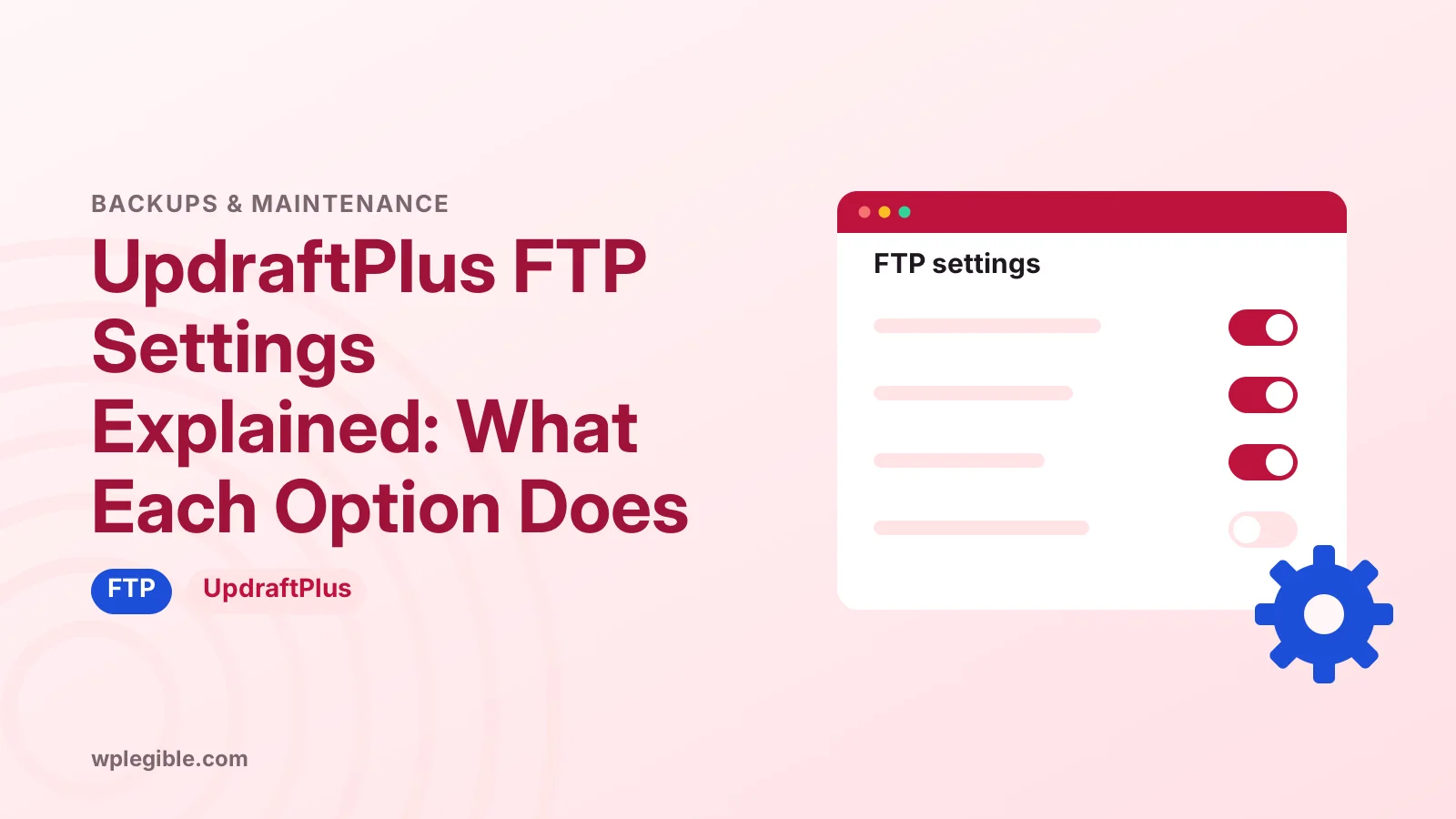
Go to Settings, then UpdraftPlus Backups, open the Settings tab, and choose FTP as your remote storage, which reveals the FTP fields below the storage icons.
After selecting FTP, the form expands. Fill in each field, then save your changes at the bottom of the page.
The test button only works with the values currently in the form. Save first if your version requires it, then test.
Our general guide to UpdraftPlus remote storage setup shows where the storage options sit if you have not opened that tab before.
What does each FTP field mean?
Each field maps to a piece of information your FTP provider gives you, and the table below summarises what to enter.
| Field | What it does | What to enter |
|---|---|---|
| FTP server | Address of the server that stores backups | Host name or IP from your provider |
| FTP login | Username for that server | FTP account username |
| FTP password | Password for that account | FTP account password |
| Remote path | Folder on the server for backups | A folder path the account can write to |
| Passive mode | How the data connection is opened | Usually leave on |
| Test button | Checks login and write access | Click after filling in fields |
The sections below explain each field in more detail, with common mistakes to avoid.
What should you enter in the FTP server field?
Enter the host name or IP address of the server that will store your backups, without ftp:// or a folder path, exactly as your provider shows it.
Examples of valid values are a host name such as ftp.example.com or a plain IP address. Do not include a protocol prefix or slashes.
Important: this should normally be a different server from your website host. Sending backups to an FTP account on the same server does not protect you if that server fails.
Good destinations include a separate hosting account, a network storage device at your office, or a storage provider that offers FTP access.
If your provider uses a non-standard port, check the UpdraftPlus field help or documentation for how to add it, since the default FTP port is 21.
What are the FTP login and password fields?
These are the username and password for the FTP account on the destination server, which your storage provider or host creates for you.
They are not your WordPress login. They are also not usually your hosting control panel login, unless your provider says they are the same.
Create a dedicated FTP account just for backups where possible. Limit it to a single folder so a leaked password cannot expose other files.
If login fails, UpdraftPlus has a help page on what to do when FTP credentials are not working. Check for extra spaces when you paste, and confirm the account is active.
What does the remote path field do?
The remote path is the folder on the FTP server where UpdraftPlus saves backup files, and the FTP account must have permission to create and write files there.
Paths are usually relative to the folder the FTP account opens in. If your account starts in its home folder, a path like backups/mysite creates that structure inside it.
Some providers need an absolute path that starts with a slash. Your provider's documentation will say which style to use.
Tips for the remote path:
- Use a separate folder for each website you back up.
- Avoid putting backups inside a public web folder where they could be downloaded.
- Create the folder in advance if the account cannot create folders.
If you back up several sites to one FTP account, clear folder names make restores much easier later.
What is passive mode and should you use it?
Passive mode changes how the FTP data connection is opened, and it is usually the right choice because it works better through firewalls on web servers.
FTP uses two connections: one for commands and one for data. In active mode, the FTP server connects back to your web server for data, which firewalls often block.
In passive mode, your web server opens both connections, which most hosting firewalls allow.
Leave passive mode on unless your FTP provider tells you otherwise. If uploads hang after login succeeds, the passive or active choice is a common suspect.
cPanel's guide on how to enable FTP passive mode explains the server side if you run your own FTP server.
Does UpdraftPlus encrypt FTP connections?
Plain FTP sends data without encryption, but UpdraftPlus can use encrypted FTP when the server supports it, and SFTP is available through a premium add-on.
Encryption matters. Your backups contain your database, which holds user details and password hashes. Sending them over plain FTP exposes them to anyone watching the connection.
UpdraftPlus's FAQ on which encryption methods are supported for FTP and SFTP lists what each version supports. Check it, because support differs between the free plugin and premium add-ons.
The PHP FTP functions documentation also explains that PHP can open SSL-secured FTP connections when the server and PHP build allow it.
If your provider supports SFTP, it is usually the better choice. SFTP runs over SSH and encrypts everything by default.
How do you test the FTP connection?
Click the test button below the FTP fields, and UpdraftPlus tries to log in and write a small file to the remote path, then reports success or the error it hit.
A success message means login and write access both work. It does not guarantee large backups will upload, but it confirms the basics.
Common test errors and their meaning:
- Login failed: wrong username or password, or account disabled.
- Could not connect: wrong server address, wrong port, or a firewall blocking FTP.
- Could not change directory or upload: remote path wrong or no write permission.
Fix the field the message points to, save, and test again.
Why do FTP backups fail even when the test passes?
Large uploads can time out, hit storage quotas, or be cut off by firewalls even when a small test file works, so check the backup log for the exact error.
UpdraftPlus keeps a log for each backup run. Look for lines about the FTP upload stage to see where it stopped.
Common causes include:
- The FTP account has a storage limit and is full.
- The connection drops partway through large archive files.
- The web host blocks outbound FTP ports.
- The backup stalls because scheduled tasks do not run on a quiet site.
Lowering the archive split size in UpdraftPlus expert settings can help with large uploads. Our guide to fixing an UpdraftPlus backup that failed covers the scheduling side.
Is FTP the best storage choice for UpdraftPlus?
FTP works and keeps backups on hardware you control, but cloud storage like Google Drive, Dropbox or Amazon S3 is usually simpler, more reliable and encrypted in transit.
| Storage | Strengths | Weaknesses |
|---|---|---|
| FTP | You control the server, no cloud account needed | Often unencrypted, depends on another server |
| SFTP | Encrypted, widely supported | Needs premium add-on in UpdraftPlus |
| Google Drive or Dropbox | Easy setup, encrypted, cheap | Storage limits on free accounts |
| Amazon S3 | Very reliable, scalable | More setup, usage billing |
If you choose a cloud option, our guides on backing up WordPress to Google Drive explains the simplest option.
For larger sites, see our guide to backing up to Amazon S3.
What are the best practices for FTP backups?
Use a separate server, a dedicated FTP account limited to one folder, encryption where available, and a regular check that backups actually arrive.
A quick checklist:
- Store backups on a different server from your website.
- Use SFTP or encrypted FTP whenever your provider supports it.
- Give the backup account access to one folder only.
- Keep the remote folder outside any public web directory.
- Watch the backup email reports and check the FTP folder now and then.
- Test a restore from time to time.
General advice on backups is in the WordPress backups documentation. When you need to recover, follow our guide on how to restore a backup with UpdraftPlus.
Frequently asked questions
Can I use my hosting account's FTP for UpdraftPlus backups?
You can, but it is not recommended if it is the same server as your website. If that server fails or is hacked, the backups can be lost too. Use a separate server or a cloud storage service instead.
Should passive mode be on or off in UpdraftPlus?
Leave it on in most cases. Passive mode lets your web server open both FTP connections, which hosting firewalls usually allow. Only switch it off if your FTP provider specifically tells you to use active mode.
Why does the UpdraftPlus FTP test fail?
The error message usually points to the cause. Login failures mean wrong credentials, connection failures mean a wrong address, port or blocked firewall, and upload failures mean the remote path is wrong or not writable by that account.
Is FTP secure enough for WordPress backups?
Plain FTP sends data without encryption, which exposes your database backup in transit. Use encrypted FTP or SFTP where your provider supports it, or choose a cloud destination that encrypts connections by default.
What remote path should I use in UpdraftPlus?
Use a dedicated folder for each site, such as a backups folder with a subfolder named after the site. Keep it outside public web folders and check with your provider whether paths should be relative or start with a slash.
Sources
- What encryption methods are supported for FTP/SFTP? TeamUpdraft
- My FTP credentials are not working, what should I do? TeamUpdraft
- How to enable FTP passive mode cPanel Docs
- FTP functions PHP Manual
- UpdraftPlus plugin WordPress.org
Is your product missing, or something out of date?
Tell us what to add or correct. We read every note and reply when we need a source. A message does not buy a ranking.
Thanks — we review requests within 3 business days.
Related guides
About the editors
Researched from the primary sources listed above and checked against our editorial rules before publishing.