Unreal Engine is the best of the Unity alternatives for high-end 3D, rated 4.5/5 on G2 from 151 reviews and free until a game earns $1 million. Pick Godot for a free open-source engine with no royalties, or GDevelop if you want to build 2D games without code.
How we make this list: we compare pricing pages, product documentation and public user reviews, then re-check every price before each update. No product paid for a place. Disclosure.
Unreal Engine leads on evidence: 4.5/5 on G2 from 151 reviews, the largest review base in this list.
Godot and Defold are completely free with no royalties, no seat fees and no revenue limits.
Unreal is free until a game earns $1 million; CryEngine charges 5% only above $5,000 a year per game.
GDevelop is the cheapest no-code route, with a free plan and Silver at $7.99 a month.
Paid plans run from $7.99 a month for GDevelop Silver to $1,850 a seat a year for Unreal commercial seats.
How do you choose between Unity alternatives?
The first split is 2D or 3D. Engines such as Unreal and CryEngine exist for high-end 3D, while Godot, GameMaker, Construct 3 and Stencyl focus on 2D, and Defold covers both at a smaller scale.
Royalties matter more than the sticker price. Godot and Defold charge nothing at any revenue, Unreal takes 5% only above $1 million in lifetime revenue, and CryEngine takes 5% above $5,000 a year per game.
No-code tools trade control for speed. GDevelop, Construct 3 and Stencyl let beginners ship a 2D game without writing code, but custom mechanics can hit the limits of event sheets and blocks sooner than scripted engines.
Check the publishing limits before you build. Console export needs Enterprise on GameMaker, a porting partner on Godot, and the Studio plan on Stencyl, so confirm the route to your target platforms early. Our guide on building a portfolio site with WordPress shows one way to present finished games.
Unreal Engine is Epic Games' real-time 3D engine for games, film and simulation, with Nanite geometry and Lumen lighting in Unreal Engine 5. It is free to download and use, and games pay a 5% royalty only on lifetime gross revenue above $1 million, with Epic Games Store sales royalty-free.
The trade off is scale and learning curve. The editor is heavy, needs strong hardware, and commercial non-game use above $1 million in annual revenue needs seats at $1,850 per seat per year. It suits studios building high-end 3D games, virtual production or architectural visualisation.
What we like
Best rendering in this list, with Nanite and Lumen
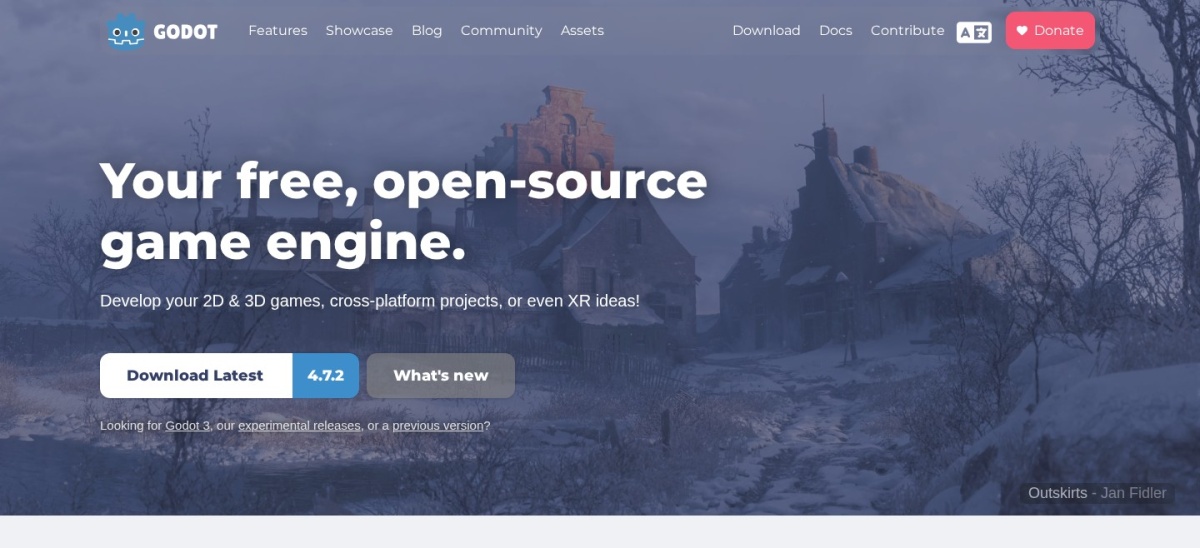
Godot is a free, open-source game engine for 2D, 3D and XR games, run by the non-profit Godot Foundation. It uses a node and scene system, a dedicated 2D engine with pixel-based units, and GDScript plus C# support, with no seat fees, royalties or revenue limits.
The trade off is console publishing, which needs a third-party porting partner such as W4 Games, and a smaller asset store than Unity. It suits solo developers and small teams making 2D games or stylised 3D games who want full control with zero licence cost.
Defold is a free, cross-platform engine for 2D and lightweight 3D games, built around Lua scripting and a visual editor. The Defold Foundation states there is no licensing cost, no royalty and no runtime fee, and the source code is available under a developer-friendly licence.
The trade off is scope. 3D support is basic, there is no visual scripting, and the community and asset library are smaller than Godot's. It suits small teams shipping 2D and mobile games to many platforms who want small builds and a written no-royalty promise.
What we like
Free forever with no royalties or fees
Small, fast builds that suit mobile games
Highest G2 rating in this list, 4.6/5 from 62 reviews
GDevelop is a free, open-source 2D engine that builds games with event sheets instead of code, and exports to web, desktop and mobile. The free plan covers 3 cloud projects and one desktop and Android build a day, and the engine itself costs nothing to use.
The trade off is the subscription for publishing extras. Silver costs $7.99 a month for 50 cloud projects and more builds, and companies above $50,000 in yearly revenue must use Pro at $39.99 a month. It suits beginners and makers who want to ship 2D games without writing code.
What we like
True no-code event sheets for 2D games
Free plan with daily desktop and Android builds
Highest review count in this list on Capterra, 249 reviews
GameMaker is a 2D engine from YoYo Games that pairs drag-and-drop building with GML scripting, and it powered indie hits such as Undertale and Hyper Light Drifter. The free tier includes the full editor for non-commercial use, and Professional is a one-time $99.99 licence for commercial desktop, mobile and web games.
The trade off is consoles. Console export needs the Enterprise subscription at $79.99 a month or $799.99 a year, plus approval from the console platform holder. It suits beginners and indie teams making 2D platformers, RPGs and puzzle games.
What we like
One-time $99.99 licence, no subscription for most games
Drag-and-drop plus GML scripting in one editor
Proven record with shipped indie hits
No royalties on commercial games
Watch out for
Console export needs the $799.99 a year Enterprise plan
Construct 3 is a browser-based 2D engine from Scirra that builds games with event sheets and needs no install. The free edition covers 50 events and 2 layers with web export only, and it is used by more than 250,000 developers a month.
The trade off is price and scope. Personal costs $129.99 a year, businesses must use the $469.99 a seat Business plan, and 3D support is limited. It suits 2D creators who want the most polished no-code workflow and work entirely in the browser.
What we like
Most polished no-code workflow in this list
Runs entirely in the browser, nothing to install
Rated 4.7/5 on GetApp from 328 reviews
No royalties on shipped games
Watch out for
Personal plan is $129.99 a year, dear for hobbyists
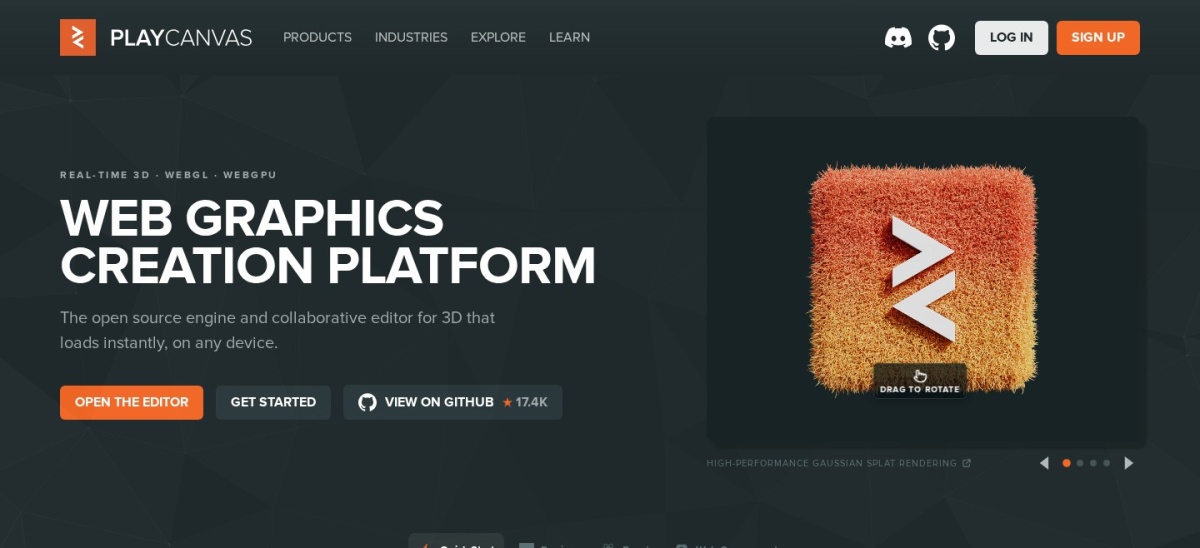
PlayCanvas is a web-first engine for 3D games, product configurators and AR/VR that runs entirely in the browser. The open-source engine and collaborative editor load instantly with nothing to install, and the free plan covers unlimited public projects with 1 GB of storage.
The trade off is that private work costs. Personal is $15 a month for unlimited private projects and 10 GB of storage, and teams need Organisation at $50 a seat a month. It suits developers building browser-based 3D games and visualisations with WebGL or WebGPU.
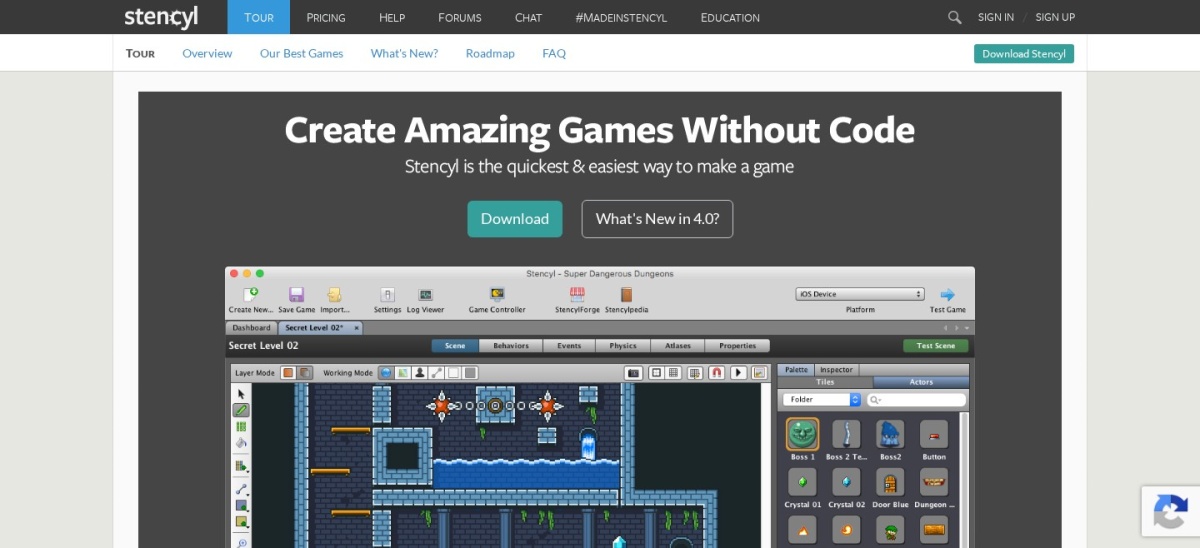
Stencyl is a 2D engine that builds games with drag-and-drop visual blocks, with Haxe code available when a project outgrows blocks. The free Starter plan publishes web games with a Stencyl splash screen, and Stencyl collects no royalties and claims no ownership of games.
The trade off is the yearly bill and reach. Indie costs $99 a year for web and desktop publishing, Studio costs $199 a year to add iOS and Android, and the tool is 2D only. It suits beginners and classrooms making 2D games with visual logic.
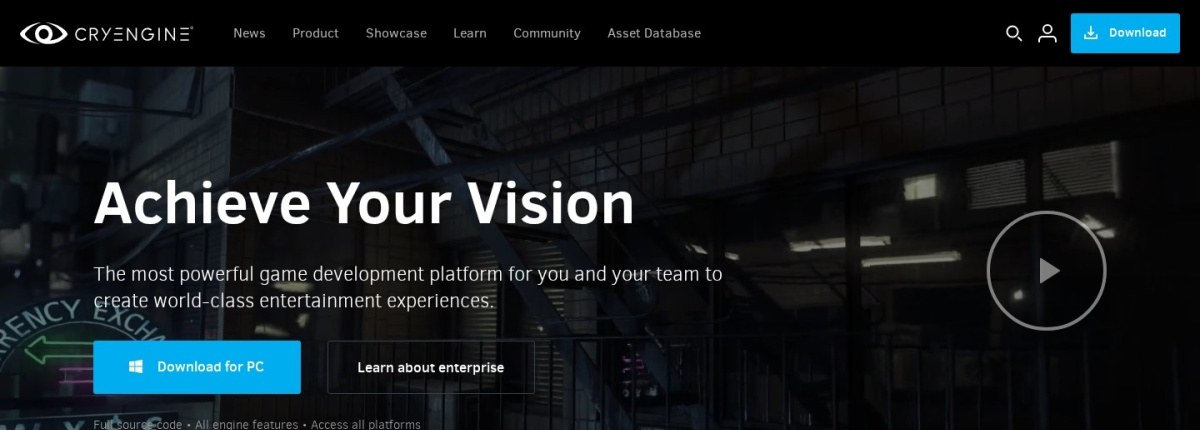
CryEngine is Crytek's high-end 3D engine for photorealistic games and simulations, with real-time lighting, physics and large open-world environments. It is free to download with full source code, and a 5% royalty applies only to gross receipts above $5,000 a year per game.
The trade off is the learning curve and community size. Documentation is thinner than Unreal's, the G2 rating is 3.7/5 from 16 reviews, and fewer third-party tools support it. It suits experienced teams building realistic first-person or open-world 3D games.
What we like
Photorealistic environments and real-time lighting
Free download with full source code
Strong VR support
Low royalty threshold is royalty-free up to $5,000 a year
Watch out for
Lowest G2 rating in this list, 3.7/5 from 16 reviews
Free plans cover the engine itself in most of this list. Unreal, Godot, Defold and CryEngine all let you build and ship without paying anything up front.
Paid plans mostly add publishing and privacy. GDevelop charges for extra cloud builds, PlayCanvas charges for private projects, and Construct 3 charges for desktop and mobile export.
Royalties are the hidden cost to model. A hit game on Unreal owes 5% above $1 million, while the same game on Godot or Defold owes nothing, which changes the bill more than any subscription.
How we chose
We started from the game engines with a public G2 or Capterra rating and a live product, then ranked them by review volume, rating and fit for common Unity work.
Prices come from each vendor's pricing page, checked on 29 November 2026, and ratings come from G2 or Capterra on the same day. Where a vendor shows a sale, the list shows the regular price.
We left out engines with no public rating, such as Buildbox, and Cocos Creator, whose G2 rating rests on only 2 reviews. No vendor paid for a place, and we do not claim to have used these tools ourselves.
How to choose a Unity alternative
Start with the game you want to make, then match the engine to it.
Decide 2D or 3D first. High-end 3D points to Unreal or CryEngine. 2D points to Godot, GameMaker, Construct 3 or Stencyl.
Check the royalty terms. Godot and Defold charge nothing at any revenue. Unreal and CryEngine take 5% above their thresholds, so model a hit game, not just the first month.
Match the tool to your coding comfort. No-code builders such as GDevelop and Construct 3 suit beginners. Scripted engines such as Godot and Defold suit developers who want full control.
Confirm your export targets. Console, mobile and web export differ on every engine, so check them before you commit. A portfolio site is one way to present finished games.
FAQ
What is the best alternative to Unity in 2026?
Unreal Engine is the best Unity alternative for most teams moving from Unity. It is rated 4.5/5 on G2 from 151 reviews, it is free until a game earns $1 million, and it covers high-end 3D, consoles and virtual production.
What is the best free alternative to Unity?
Godot is the best free alternative to Unity. It is free and open source under the MIT licence, with no royalties, seat fees or revenue limits, and it is rated 4.5/5 on G2 from 27 reviews. Defold is the other free pick, rated 4.6/5 on G2.
How much does Unreal Engine cost?
Unreal Engine is free to download and use. Games pay a 5% royalty only on lifetime gross revenue above $1 million, with Epic Games Store sales royalty-free, and commercial non-game use above $1 million a year needs seats at $1,850 per seat per year.
Which Unity alternative is best for beginners?
GDevelop is the easiest starting point. Its event sheets build 2D games without code, the free plan covers 3 cloud projects, and Silver costs $7.99 a month when you need more builds. GameMaker is the other beginner-friendly pick for 2D games.
Unreal Engine vs Godot: which is better?
Unreal Engine wins for high-end 3D, with stronger rendering, a larger community and 151 G2 reviews against Godot's 27. Godot wins on cost and control: it is free with no royalties, lighter to run, and stronger for 2D games.
Is there a Unity alternative with no coding?
Yes. GDevelop, Construct 3 and Stencyl all build 2D games without code, using event sheets or visual blocks. GDevelop is free to start, Construct 3 runs entirely in the browser, and Stencyl charges $99 a year for desktop publishing.
Do Unity alternatives charge royalties?
Some do and some do not. Godot, Defold, GDevelop, GameMaker, Construct 3, PlayCanvas and Stencyl charge no royalties. Unreal Engine charges 5% above $1 million in lifetime revenue, and CryEngine charges 5% above $5,000 a year per game.
SaaS SEO and WordPress specialist with about 8 years of experience. Rakib compares WordPress plugins, themes, hosting and software using public pricing, documentation and user reviews. See how we rank.