TicketSpice is the best software for ticket consignment tracking for most organizers, because its flat fee of ninety-nine cents per ticket and weekly payouts make it simple to hand ticket blocks to sellers and watch them move. Purplepass leads on ratings, while Ticket Tailor is the cheapest per ticket.
How we make this list: we compare pricing pages, product documentation and public user reviews, then re-check every price before each update. No product paid for a place. Disclosure.
TicketSpice leads for most organizers: a flat 99 cents per ticket on its Standard plan, weekly payouts, and promo codes plus affiliate tracking for per-seller reporting.
Purplepass holds the joint-highest rating at 4.9 out of 5 on Capterra from 304 reviews, with a 2.5 percent plus 99 cents per ticket fee for for-profit events.
Ticket Tailor is the cheapest option here, with prepaid credits from 30 cents per ticket and a 4.9 out of 5 Capterra rating from 597 reviews.
Eventbrite costs the most per ticket at scale at 3.7 percent plus $1.79 per ticket plus 2.9 percent processing, and only wins when its discovery marketplace brings new buyers.
RegFox and SimpleTix both cap their per-ticket fees, at $4.99 and $9.99, which protects high-priced tickets from percentage fees that keep growing.
Humanitix adds trackable affiliate codes for per-seller reporting, with a 2.1 percent plus 99 cents per ticket fee and all booking-fee profits going to charity.
How does software for ticket consignment tracking work?
Ticket consignment means handing a seller, promoter or partner a block of tickets to sell, then tracking how many they sold, how many came back unsold, and what each seller is owed.
The fee is the first filter, not the last. A one-dollar difference per ticket is 500 dollars on 500 tickets, so work out the full fee on your ticket price and volume before you commit.
Per-seller reporting decides whether a tool works for consignment. If it cannot show sales by promo code, access code or seller account, you will be reconciling payouts in a spreadsheet. Our guide on the best event check-in app covers the door side of the same events.
Ratings matter more than feature lists. Every tool here holds at least 4.3 out of 5 on G2, Capterra or Trustpilot, and the leaders sit at 4.9 from 597 and 304 reviews. A thin review base, such as Ticketbud at 23 reviews, deserves a harder look before you buy.
Free events are free on most of these tools, but paid tickets always carry a fee. Check whether the fee can be passed to buyers, and whether payouts arrive before or after your event.
TicketSpice is an event ticketing platform that charges a flat 99 cents per ticket on its Standard plan, with no percentage fee on top. Tickets at five dollars or less drop to 49 cents, and Premium and Pro plans cost $1.49 and $1.99 per ticket. It holds a 4.8 out of 5 G2 rating from 425 reviews.
The trade off is the fee stack. Card processing adds 2.9 percent plus 30 cents per transaction, and free-only organizers still pay 99 cents per ticket, so the headline rate is not the whole cost. It still suits venues handing ticket blocks to promoters who want one flat rate.
What we like
Flat 99 cents per ticket with no percentage fee
4.8 out of 5 on G2 from 425 reviews
Promo codes plus affiliate tracking for per-seller reporting
Purplepass is an enterprise-grade ticketing platform built around true-to-scale seating maps for performing arts venues, sports and rodeos. For-profit events pay 2.5 percent plus 99 cents per ticket, nonprofits pay 2.0 percent plus 99 cents, and free events carry no fees. It holds a 4.9 out of 5 Capterra rating from 304 reviews.
The trade off is the percentage. On a high-priced ticket the 2.5 percent fee adds up, and online card processing adds another 3 percent, so a flat-fee tool costs less for expensive seats. It suits venues where reserved seating and seat maps matter more than the lowest fee.
What we like
Highest joint rating here at 4.9 out of 5 on Capterra
Ticket Tailor is an independent ticketing platform that charges a flat per-ticket fee with no percentage taken from revenue. Prepaid credits start at 30 cents per ticket, while pay as you go costs 85 cents per ticket, and free events are free up to 5,000 tickets a year. It holds a 4.9 out of 5 Capterra rating from 597 reviews.
The trade off is the currency. The vendor pricing page defaults to pounds, so United States buyers see 60 pence pay as you go and 22 pence credits until they switch to dollars. It suits small teams with their own audience who want the lowest fee per ticket.
What we like
Cheapest per-ticket fee here from 30 cents with credits
Joint-highest rating at 4.9 out of 5 on Capterra
Discount codes and access codes for seller tracking
Free events free up to 5,000 tickets a year
Watch out for
Pay-as-you-go rate is higher at 85 cents per ticket
4.6/5on Capterra (5,824 reviews, checked Nov 2026)
Pricing3.7% + $1.79/ticket
Best for discovery and reach
Free planYes, free events
Cheapest paid3.7% + $1.79/ticket
Monthly billingNo monthly fee
Built forPublic events and discovery
eventbrite.com
Eventbrite homepage, captured Nov 2026.
Eventbrite is the best-known self-service ticketing platform, with a discovery marketplace that puts events in front of 89 million monthly users. Paid tickets carry a 3.7 percent plus $1.79 service fee per ticket plus 2.9 percent processing, while free events publish at no cost. It holds a 4.6 out of 5 Capterra rating from 5,824 reviews.
The trade off is cost. With no fee cap, the percentage stack takes a growing share of expensive tickets, and human support sits behind the Pro plan at $15 a month. It suits organizers who need discovery more than the lowest fee.
What we like
Largest review base here at 4.6 out of 5 from 5,824 Capterra reviews
SimpleTix is a ticketing platform for attractions, farms, zoos, museums and venues that charges 79 cents plus 2 percent per online ticket, capped at $9.99. On-site sales cost 25 cents per ticket, and virtual events cost 50 cents per registrant. It holds a 4.8 out of 5 Capterra rating from 78 reviews.
The trade off is scale. The review base is small next to Eventbrite or Ticket Tailor, and the 2 percent fee still grows with ticket price until the cap kicks in. It suits attractions and venues that sell timed-entry tickets at the door and online.
What we like
Online fee capped at $9.99 per ticket
4.8 out of 5 on Capterra from 78 reviews
On-site sales cost only 25 cents per ticket
Timed entry and reserved seating included
Watch out for
Smallest review base after Ticketbud at 78 reviews
RegFox is a registration platform for conferences, camps and classes that charges 99 cents plus 1 percent per paid registrant on its Standard plan, capped at $4.99. Premium costs $1.99 plus 1 percent capped at $5.99, and there are no setup or monthly fees. It holds a 4.7 out of 5 G2 rating from 572 reviews.
The trade off is the free-event fee. Free events still cost 99 cents per registrant on Standard, so it is not the pick for free gatherings, and it has no discovery marketplace. It suits paid conferences and camps that want deep registration forms with a capped fee.
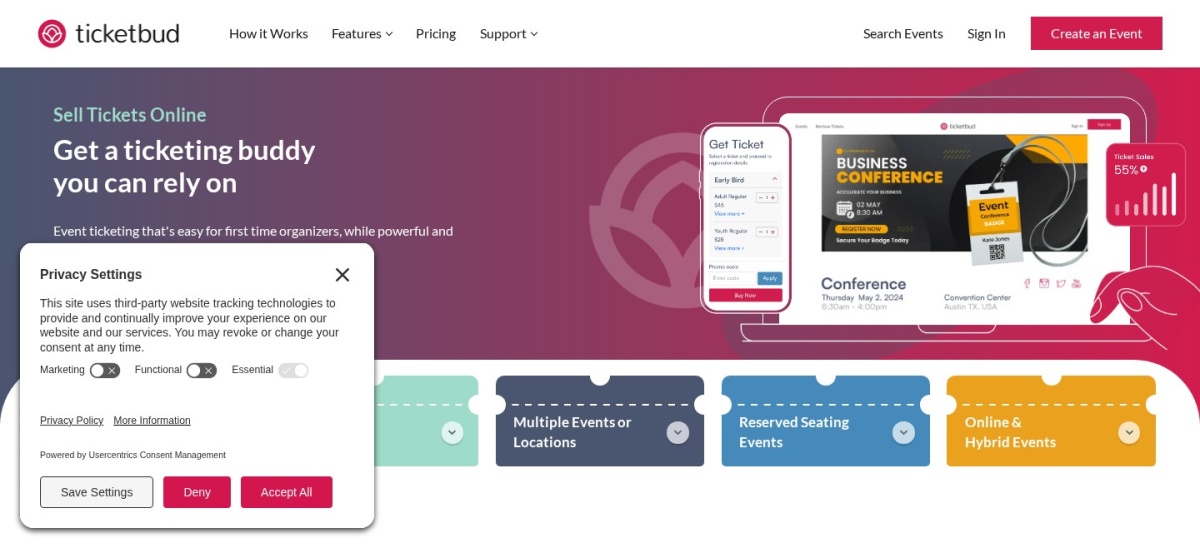
Ticketbud is an event ticketing platform with one rate and no tiers, contracts or subscriptions: 2 percent plus 99 cents per ticket, with nonprofits and schools paying 1.75 percent plus 99 cents. Free events are completely free, and fees can be passed to buyers. It holds a 4.3 out of 5 G2 rating from 23 reviews.
The trade off is evidence. With only 23 G2 reviews, its 4.3 rating rests on a thin base, and the percentage fee grows with ticket price, so expensive tickets cost more than on flat-fee tools. It suits nonprofits and schools that want one simple rate.
What we like
One rate with no tiers, contracts or subscriptions
Nonprofits and schools pay 1.75 percent plus 99 cents
4.5/5on Trustpilot (475 reviews, checked Nov 2026)
Pricing2.1% + $0.99/ticket
Best for charity and community events
Free planYes, free events
Cheapest paid2.1% + $0.99/ticket
Monthly billingNo monthly fee
Built forCharities and community events
humanitix.com
Humanitix homepage, captured Nov 2026.
Humanitix is a not-for-profit ticketing platform that gives all of its booking-fee profits to charity. Paid tickets cost 2.1 percent plus 99 cents on its Standard plan, while charities and schools pay 1 percent plus 99 cents, and free events cost nothing. It holds a 4.5 out of 5 Trustpilot rating from 475 reviews.
The trade off is the fee. At 2.1 percent plus 99 cents it costs more per ticket than TicketSpice or Ticket Tailor, and its G2 review base is thin at 21 reviews. It suits charities, schools and community events that value the donation model and affiliate-code tracking.
What we like
Trackable affiliate codes for per-seller reporting
A consignment deal starts with a block of tickets and a seller. The organizer hands over a set number of tickets, the seller sells what they can, and unsold tickets come back for general sale or the next seller.
The tool tags each seller so sales can be traced back. Promo codes and access codes are the common method, while affiliate codes and seller accounts give cleaner per-seller reports for larger promoter teams.
Payouts close the loop. Weekly payouts, as TicketSpice and RegFox offer, settle sellers soon after sales close, while tools that pay after the event leave promoters waiting.
How we chose
We started from the ticketing tools most often named for consignment sales, then kept those that sell tickets online, track sales by ticket type, code or seller, and publish a price or fee. Tools with no aggregator rating were left out.
Fees come from each vendor's pricing page, checked on 30 November 2026, except Humanitix, whose fee comes from secondary reads of its pricing page, and Ticket Tailor's pay-as-you-go rate, which also rests on secondary reads. Ratings and review counts come from G2, Capterra and Trustpilot on the same day.
We left out TicketLeap for its thin review base of 16 G2 reviews, and tools with no published fee. No vendor paid for a place, and we do not claim hands-on testing for this list.
How to choose ticket consignment tracking software
Start with your ticket price and seller count, then check the full fee per ticket.
Work out the fee on your ticket price. A flat fee wins on expensive tickets, while a percentage fee wins on cheap ones. Price 500 tickets at your real face value on each tool before you shortlist.
Check per-seller reporting first. Ask the tool to show sales by promo code, access code or seller account. If it cannot tag a seller's sales, consignment reconciliation falls back to a spreadsheet.
Ask who pays the fee. Most of these tools let you pass the fee to buyers or absorb it yourself. Check the default, because it changes what your sellers actually earn.
Test the payout timing. Weekly payouts settle sellers fast, while post-event payouts leave promoters waiting. See the best event check-in app list for the door side of the same events.
FAQ
What is the best software for ticket consignment tracking in 2026?
TicketSpice is the best software for ticket consignment tracking for most organizers. It charges a flat 99 cents per ticket on its Standard plan, pays out weekly, and offers promo codes plus affiliate tracking for per-seller reporting.
What is ticket consignment tracking?
Ticket consignment tracking means giving a seller a block of tickets and recording how many they sold, how many remain unsold, and what they are owed. The tool tags each seller with a promo code, an access code, a distinct ticket type or a seller account, then reports sales per tag.
Which ticket consignment software is the cheapest?
Ticket Tailor is the cheapest option here, with prepaid credits from 30 cents per ticket and pay as you go at 85 cents per ticket. TicketSpice is the cheapest flat-rate option without credits, at 99 cents per ticket on its Standard plan.
Is there a free ticket consignment tracking tool?
Yes, for free events. Purplepass, Ticket Tailor, Eventbrite, SimpleTix, Ticketbud and Humanitix all charge nothing for free events. Paid tickets always carry a per-ticket fee on every tool here, so free means free events only.
How do promoters get paid for consigned tickets?
TicketSpice and RegFox pay out weekly, while Purplepass pays the Thursday after the event. Check the payout timing before you hand out ticket blocks, because promoters expect settlement soon after sales close.
Why is Eventbrite so expensive for consignment sales?
Eventbrite charges 3.7 percent plus $1.79 per ticket plus 2.9 percent processing, with no fee cap, so its cost grows with ticket price and volume. It only wins when its discovery marketplace brings buyers you would not reach on your own.
SaaS SEO and WordPress specialist with about 8 years of experience. Rakib compares WordPress plugins, themes, hosting and software using public pricing, documentation and user reviews. See how we rank.