PLAXIS 2D is the best software for geotechnical engineering for most teams, with two-dimensional finite element analysis for excavations, embankments and tunnels from four thousand four hundred fifty dollars a year, while Rocscience covers slope stability and settlement from one thousand three hundred forty-nine dollars a year. Leapfrog Geo leads on three-dimensional geological modelling.
How we make this list: we compare pricing pages, product documentation and public user reviews, then re-check every price before each update. No product paid for a place. Disclosure.
PLAXIS 2D is the best all-round pick, with two-dimensional finite element analysis from $4,450 a year.
Rocscience covers the most ground per dollar, with slope, finite element and settlement programs from $1,349 a year.
Leapfrog Geo is the modelling pick, with ninety-two G2 reviews, but its price is quote only.
RockWorks is the cheapest paid plan at $860 a year, though it visualises data rather than analysing it.
Ratings are thin across this niche, with review counts from one to ninety-two, so treat small differences as noise.
How do you choose software for geotechnical engineering?
Start from the failure mode, not the brand. A slope stability job needs limit equilibrium and pore-pressure handling, while a deep excavation needs staged construction and deformation tracking, and the two point at different tools even when one vendor sells both.
Price is a lease, not a purchase, for most of this market. PLAXIS and Rocscience both sell twelve-month subscriptions, so the real question is the renewal bill and what happens to your models if you stop paying, not the first-year figure alone.
Ratings are thin in this niche, so read them with care. The best-rated tools here carry between one and ninety-two reviews on G2 and Capterra, which means a single review can move the average, and a tool with no listing at all may still be the standard in its corner of the industry.
Match the tool to the ground you actually model. Three-dimensional geology tools earn their keep on complex sites with boreholes and faults, while a focused slope or pile program is faster and cheaper when the geometry is simple and the design code is fixed.
The 7 best software for geotechnical engineering tools
01
PLAXIS 2D
4.5/5on G2 (12 reviews, checked Nov 2026)
Starts at$4,450/yr
Best geotechnical software overall
Analysis2D finite element, deformation and stability
Material modelsHardening soil, Mohr-Coulomb, Hoek-Brown
GroundwaterSteady-state and transient flow
Cheapest planPLAXIS 2D, $4,450/yr
seequent.com
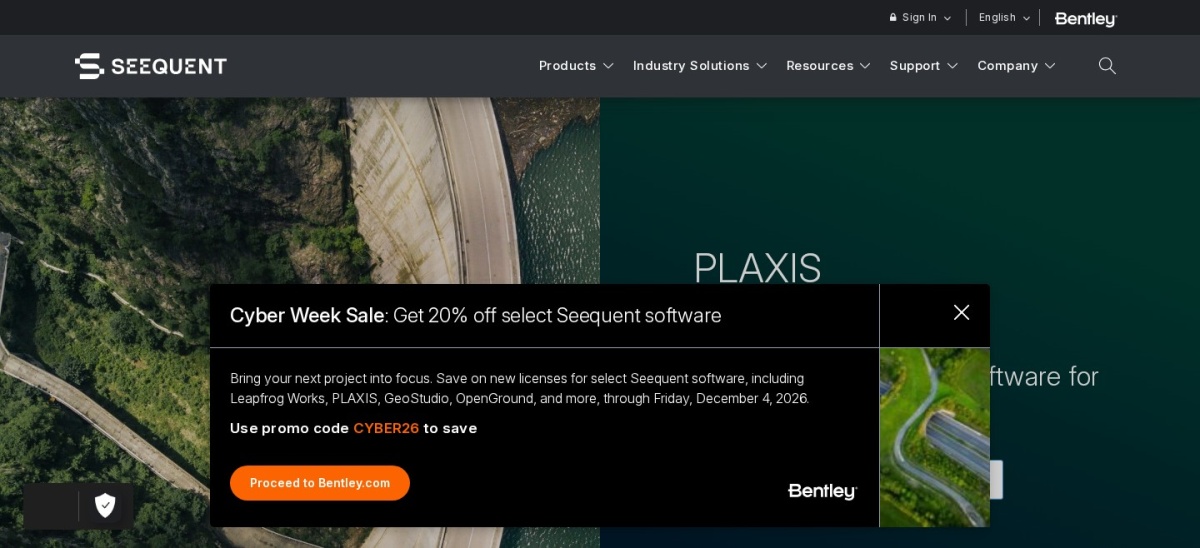
PLAXIS 2D homepage, captured Nov 2026.
PLAXIS 2D is a two-dimensional finite element program for deformation, stability and flow in geotechnical projects. The base plan costs $4,450 a year for a twelve-month Virtuoso subscription and covers excavations, embankments, foundations and tunnels, with staged construction, consolidation and groundwater flow.
The trade off is the ceiling on dimensionality. A two-dimensional cross-section cannot capture three-dimensional ground movement around a tunnel portal or a complex excavation corner, so those jobs need PLAXIS 3D at more than twice the price, and the Advanced and Ultimate plans add further cost.
What we like
Industry-standard 2D finite element analysis
Staged construction and consolidation built in
Free academic option for students and teachers
Watch out for
No three-dimensional modelling in the base plan
Advanced and Ultimate plans cost considerably more
Windows only
Advanced and Ultimate plans add dynamics and thermal analysisVisit seequent.com
02
Rocscience
4.4/5on G2 (47 reviews, checked Nov 2026)
Starts at$1,349/yr
Best slope stability suite
ProgramsSlide2, RS2, Settle3 and more
LicensingOne-year cloud lease, Personal or Flexible+
Trial15 days
Cheapest planSettle3, $1,349/yr
rocscience.com
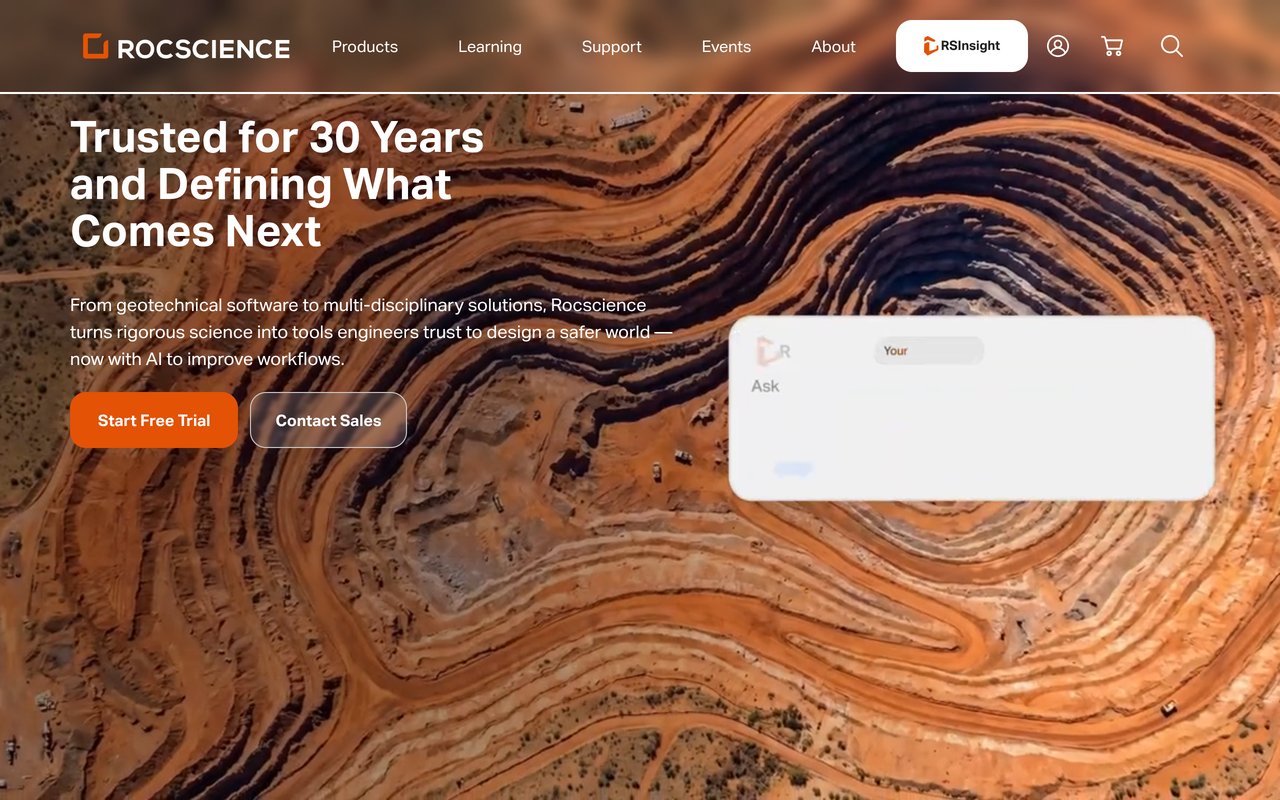
Rocscience homepage, captured Nov 2026.
Rocscience is a suite of geotechnical programs sold as one-year leases, covering limit equilibrium slope stability, finite element analysis and settlement. The cheapest program is Settle3 at $1,349 a year, while Slide2 costs $2,599 and RS2 costs $4,649, all on a Personal Cloud Lease with a fifteen-day trial.
The trade off is that the suite is sold program by program. Covering slopes, finite elements and settlement together means several leases, and the Flexible+ lease for sharing across machines costs roughly twice the Personal price, so a small team should price the full set before buying.
What we like
Deepest slope stability bench in this list
One materials library shared across programs
Published price list, no quote needed
Watch out for
Each program is a separate lease
Flexible+ sharing costs about twice as much
No single bundle price published
RS3, the three-dimensional finite element program, leases for $8,899 a yearVisit rocscience.com
03
PLAXIS 3D
4.8/5on G2 (9 reviews, checked Nov 2026)
Starts at$11,675/yr
Highest rated in this list
Analysis3D finite element, deformation and safety
Material modelsHardening soil, creep, user-defined models
ImportCAD, boreholes, tunnel designer
Cheapest planPLAXIS 3D, $11,675/yr
seequent.com
PLAXIS 3D homepage, captured Nov 2026.
PLAXIS 3D is a three-dimensional finite element program for deformation and safety analysis of soil, rock and structures. The base plan costs $11,675 a year for a twelve-month Virtuoso subscription and handles tunnels, deep excavations and seismic loading with CAD imports and a tunnel designer.
The trade off is price and weight. At more than twice the cost of PLAXIS 2D, it only earns its keep on genuinely three-dimensional problems, and the Advanced and Ultimate plans climb to $15,625 and $19,155 a year for creep, dynamics and user-defined soil models.
Leapfrog Geo is Seequent's software for three-dimensional geological modelling, built around an implicit modelling engine that updates models as new borehole and survey data arrives. Teams use it to build and share subsurface models that feed directly into PLAXIS and GeoStudio analysis.
The trade off is that pricing is not published. Leapfrog Geo is sold by quote through Seequent, so there is no list price to compare against the tools here, and the licensing setup with connectors and central seats has drawn complaints from new users.
What we like
Most reviewed tool in this list at 92 G2 reviews
Models update as new data arrives
Shares models across the team through Seequent Central
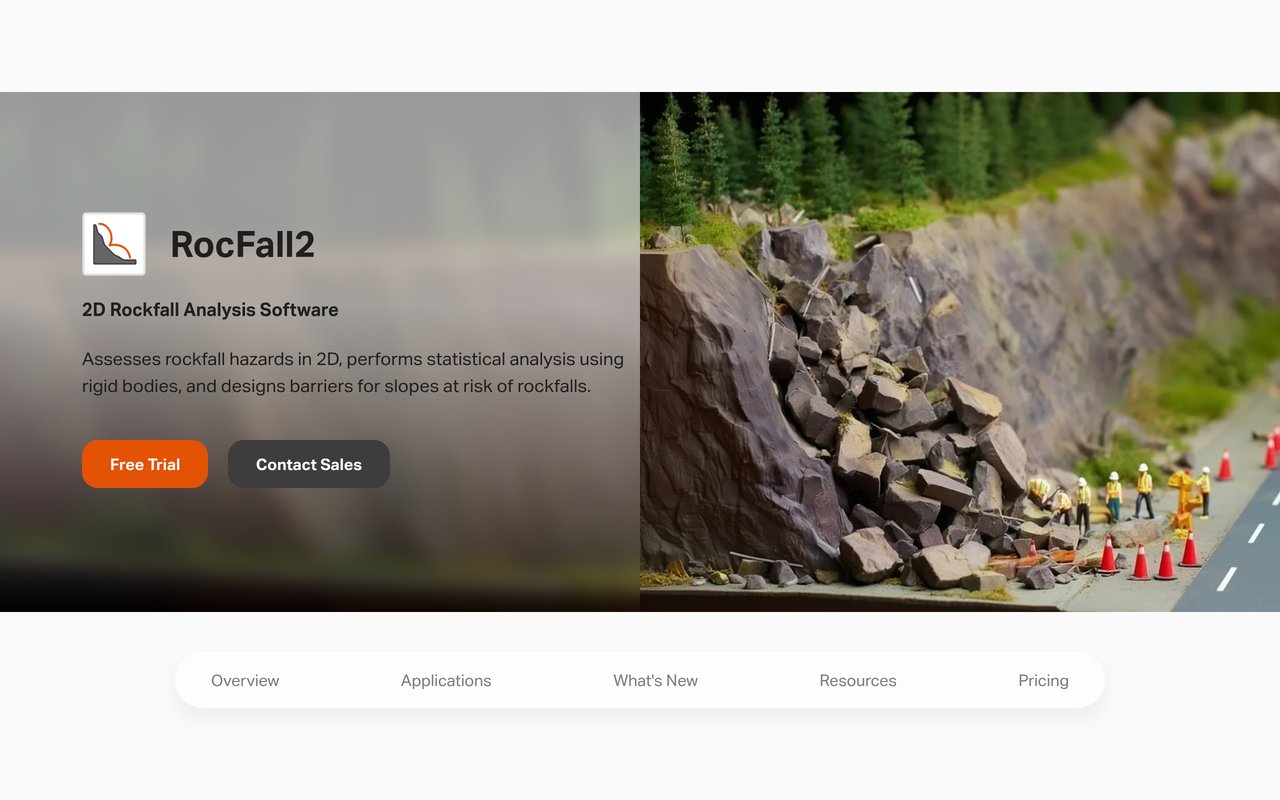
RocFall2 is a two-dimensional rockfall analysis program from Rocscience. It assesses rockfall hazards, runs statistical analysis with rigid bodies, and designs barriers for slopes at risk of rockfalls, with a Personal Cloud Lease at $1,149 a year.
The trade off is narrow scope. RocFall2 does one job, rockfall on slopes, so it sits beside a slope stability program rather than replacing one, and the Flexible+ lease for shared machines costs $2,999 a year.
What we like
Focused rockfall tool, not a generalist
Statistical analysis built in
Fifteen-day trial before buying
Watch out for
Single-purpose, needs a slope tool beside it
Only six G2 reviews
Shared-machine lease costs far more
The three-dimensional version, RocFall3, leases for $3,799 a yearVisit rocscience.com
06
RockWorks
4.7/5on Capterra (6 reviews, checked Nov 2026)
Starts at$860/yr
Cheapest paid plan in this list
OutputMaps, logs, cross sections, solid models
DataBorehole, stratigraphy, geochemistry
LicensingAnnual or perpetual, Basic to Advanced
Cheapest planAnnual Basic, $860/yr
rockware.com
RockWorks homepage, captured Nov 2026.
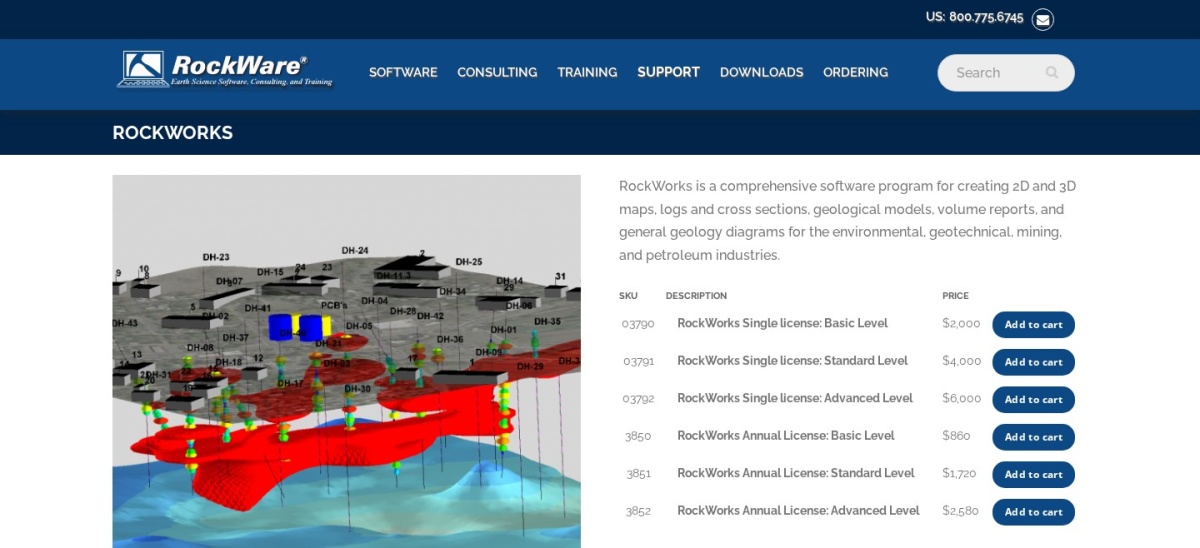
RockWorks is a RockWare program for creating two-dimensional and three-dimensional maps, logs, cross sections and geological models from borehole and subsurface data. The annual Basic licence costs $860 a year, while a perpetual Single licence starts at $2,000.
The trade off is that it visualises rather than analyses. RockWorks turns borehole data into maps, logs and solid models, but slope stability, settlement and deformation checks need one of the analysis tools in this list alongside it.
What we like
Cheapest paid plan in this list
Strongest Capterra rating here at 4.7
Perpetual licence option avoids renewals
Watch out for
Visualisation, not analysis
Learning curve is steep for new users
Advanced annual licence costs $2,580 a year
Standard and Advanced annual licences cost $1,720 and $2,580Visit rockware.com
07
RSPile
4/5on G2 (1 reviews, checked Nov 2026)
Starts at$1,099/yr
Best pile analysis
Analysis3D piles, axial and lateral loading
Pile typesGrouped, bored and capacity piles
Trial15 days
Cheapest planPersonal lease, $1,099/yr
rocscience.com
RSPile homepage, captured Nov 2026.
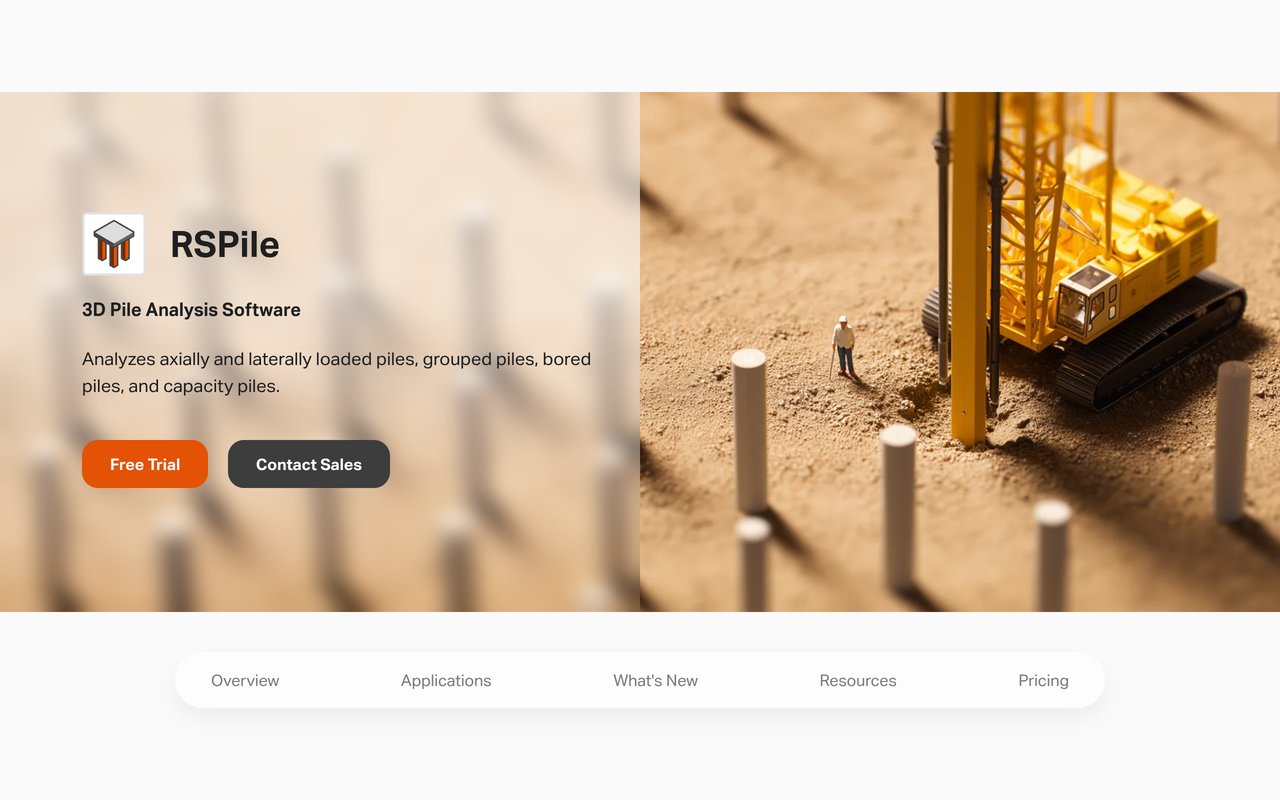
RSPile is a three-dimensional pile analysis program from Rocscience. It analyses axially and laterally loaded piles, grouped piles, bored piles and capacity piles, with a Personal Cloud Lease at $1,099 a year.
The trade off is the thin review record. RSPile carries a single G2 review, so its four-star rating says little about how it holds up in daily use, and pile groups with a capping beam need the program's more advanced workflows.
Geotechnical software barely exists on review sites, so this list leans on the few listings that do: PLAXIS 2D and 3D, Leapfrog Geo and the Rocscience programs on G2, plus RockWorks on Capterra. The biggest names in the field, GeoStudio and FLAC3D, have no usable G2 or Capterra rating, which is why they are absent here rather than ranked low.
That absence is a gap, not a verdict. If your team already runs GeoStudio for seepage and slope work, or FLAC3D for advanced constitutive modelling, neither is displaced by anything in this list. Use the ratings here to compare the listed tools with each other, not to judge the whole market.
How we chose
We started from the geotechnical programs most often shortlisted for slope, excavation, foundation and tunnel work, then kept the seven with a numeric rating on G2 or Capterra. That rule left out well-known tools such as GeoStudio and FLAC3D, which have no usable rating on either site.
Prices come from each vendor's own pricing page, checked on 30 November 2026: Seequent's product plans pages for PLAXIS 2D and PLAXIS 3D, Rocscience's published price list, and RockWare's store for RockWorks. Leapfrog Geo publishes no price, so it is listed as quote only, and every price here is the regular list price, not a sale price.
Ratings and review counts come from G2 and Capterra on the same day. The Rocscience rating is the vendor-level G2 score across its programs, and RSPile's rating rests on a single G2 review. No vendor paid for a place, and we do not claim hands-on testing for this list.
How to choose software for geotechnical engineering
Start from the failure mode, then check the licence bill.
Name the analysis you actually run. Slope stability, settlement, deep excavation and three-dimensional geology each point at different tools, so list your last five jobs before shortlisting.
Check whether the licence is a lease. PLAXIS and Rocscience sell twelve-month subscriptions, so ask what happens to your models and files if you do not renew.
Price the full set, not one program. A slope tool plus a pile tool plus a settlement tool can cost more together than one bigger platform, so add the leases up before deciding.
Ask for a trial on your own data. A fifteen-day Rocscience trial or a vendor demo on a real project file tells you more than a feature table, so run one before signing.
FAQ
What is the best software for geotechnical engineering in 2026?
PLAXIS 2D is the best overall pick for most teams. It covers two-dimensional finite element analysis for excavations, embankments, foundations and tunnels, with staged construction and groundwater flow, from four thousand four hundred fifty dollars a year.
How much does geotechnical engineering software cost?
Entry prices in this list run from eight hundred sixty dollars a year for RockWorks to eleven thousand six hundred seventy-five dollars a year for PLAXIS 3D. Most Rocscience programs lease for one to five thousand dollars a year, and Leapfrog Geo is quote only, so budget for a sales conversation.
Which geotechnical software is best for slope stability?
Rocscience is the strongest slope stability pick, with Slide2 for two-dimensional limit equilibrium work and RS2 for finite element checks using the same soil properties. PLAXIS 2D also handles slopes well when deformation matters as much as the factor of safety.
Is there free geotechnical engineering software?
There is no free plan in this list. Rocscience offers a fifteen-day trial on its programs, Seequent offers free academic access to PLAXIS and GeoStudio for students and teachers, and open-source solvers exist for research, though they need far more setup than the commercial tools here.
What is the difference between PLAXIS 2D and PLAXIS 3D?
PLAXIS 2D models deformation and stability in a two-dimensional cross-section, which suits most excavations, embankments and foundations. PLAXIS 3D adds full three-dimensional geometry for tunnels, complex ground and staged works, at more than twice the starting price.
Do I need GeoStudio as well as PLAXIS?
Not necessarily. GeoStudio suits teams that need coupled seepage, thermal and slope stability workflows in one suite, while PLAXIS covers deformation-led analysis on its own. Many firms run both, and Seequent sells combined WorkSuite bundles for that reason.
SaaS SEO and WordPress specialist with about 8 years of experience. Rakib compares WordPress plugins, themes, hosting and software using public pricing, documentation and user reviews. See how we rank.