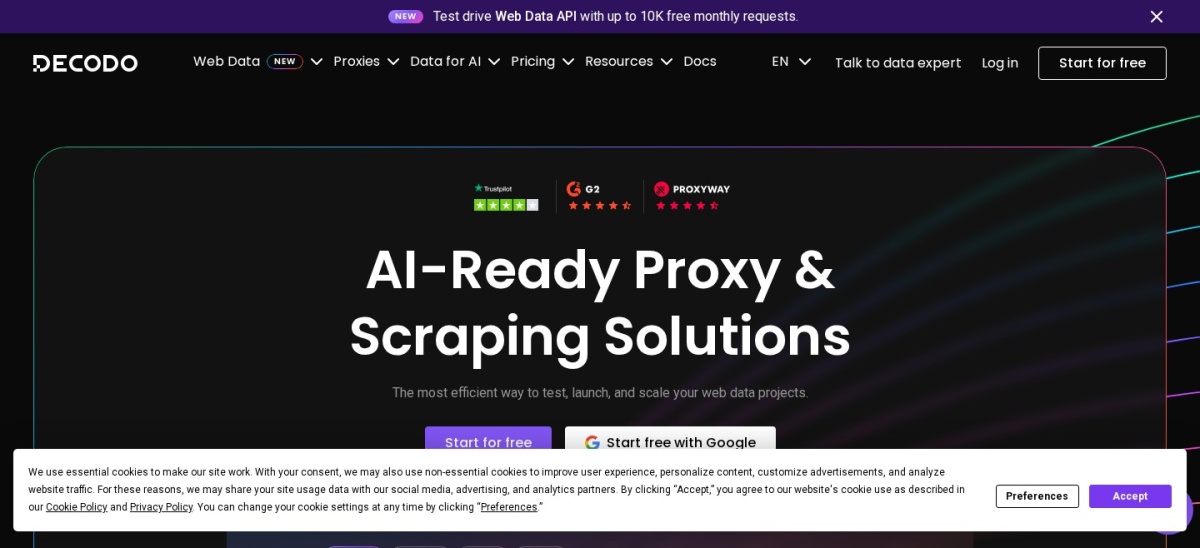
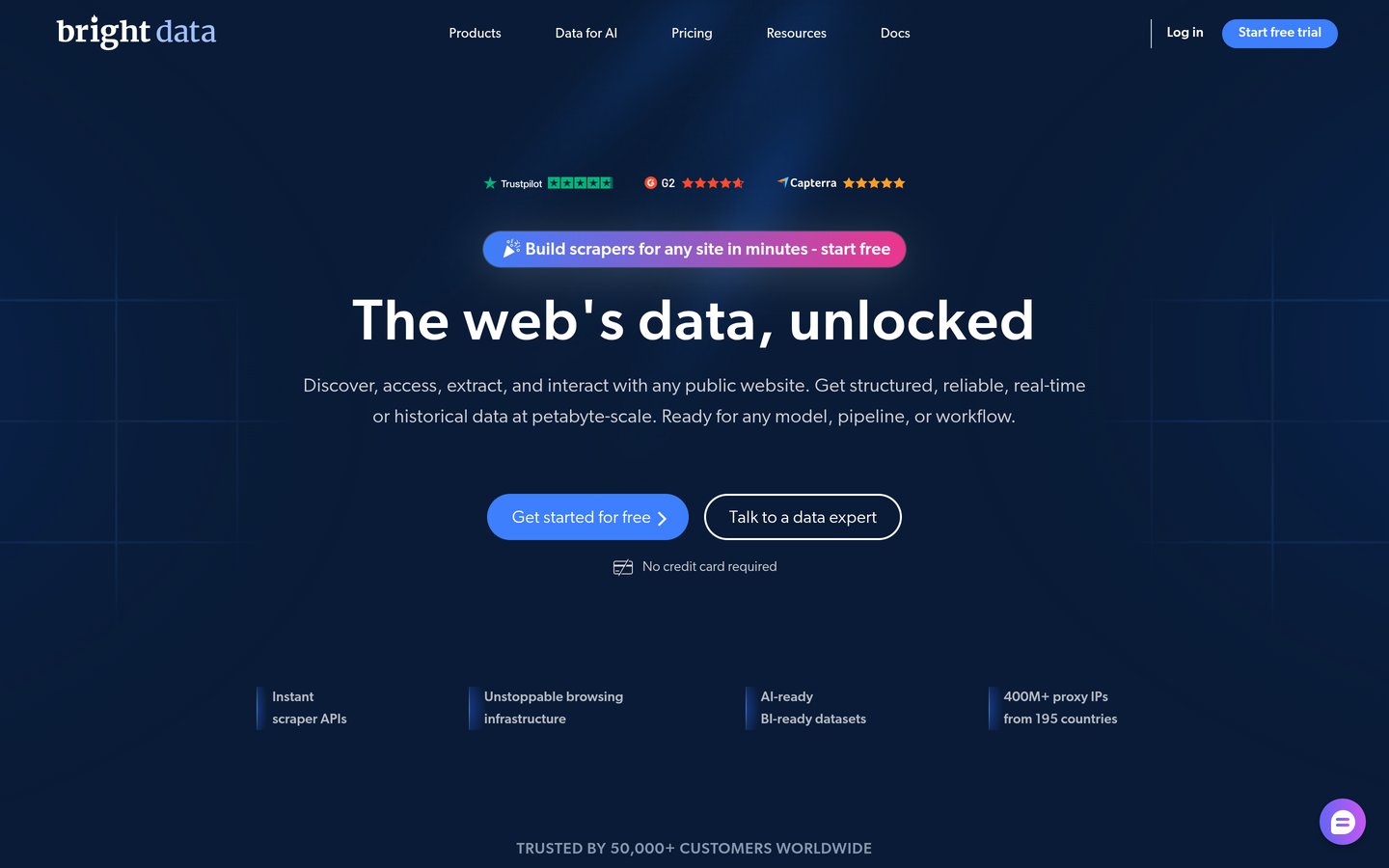
Decodo is the best SOAX alternative for most teams: its residential proxies start at $11.25 a month for 3 GB, it runs a 115M+ IP pool across 195+ locations, and it holds 4.6/5 on G2. Bright Data suits enterprise data teams, while DataImpulse is the cheapest way to buy residential traffic at $1 per GB.
How we make this list: we compare pricing pages, product documentation and public user reviews, then re-check every price before each update. No product paid for a place. Disclosure.
Decodo is the best all-round switch: 115M+ IPs, $11.25 a month for 3 GB, and 4.6/5 on G2.
Bright Data has the biggest pool at 400M+ IPs, but entry costs $499 a month and new residential zones need company verification.
DataImpulse is the cheapest residential traffic at $1 per GB, though its Trustpilot score was removed over fake reviews.
Webshare is the only option with a free plan: 10 proxies and 1 GB a month, no card required.
IPRoyal, DataImpulse and Rayobyte all sell traffic that never expires, which suits irregular workloads.
SOAX itself starts at $200 a month, so every tool here undercuts it except Bright Data.
How do you choose the best SOAX alternative?
SOAX charges $200 a month to start, with residential traffic from $3.60 per GB, so most buyers switch to cut the entry cost rather than to gain features.
Price per gigabyte is the number that matters most at low volume. Decodo starts at $3.75 per GB on its smallest plan, DataImpulse charges $1 per GB with no subscription, and Bright Data lists $8 per GB pay as you go.
Pool size matters when a target blocks repeated requests from the same ranges. Bright Data lists 400M+ residential IPs, Oxylabs 175M+, and Decodo 115M+, while the budget tools run 30M+ to 90M+ pools.
Free trials and rollover terms decide the real cost for irregular work. Residential IPs get blocked less often because they look like ordinary users, which is why our guide on blocking bad bots in WordPress covers the same cat-and-mouse problem from the other side.
Compliance checks can rule a provider out before price does. Oxylabs and Bright Data publish ISO 27001 certification, Decodo has no public SOC 2 report, and every provider here now screens customers before opening residential zones.
Decodo is the proxy provider formerly known as Smartproxy, rebranded in April 2025 with the same network and team. Its residential pool covers 115M+ IPs across 195+ locations, with country, state, city, ZIP and ASN targeting included, and independent Proxyway testing in 2026 measured a 99.92% success rate at 0.53 seconds.
The trade off is that traffic expires at the end of each monthly billing cycle, so unused gigabytes do not roll over, and there is no public SOC 2 report for strict procurement teams. It suits small and mid-size teams that want enterprise-grade residential proxies without enterprise minimums.
Bright Data is the largest proxy network in this list, with more than 400 million residential IPs across 195 countries. It sells residential, datacenter and ISP proxies plus a Web Unlocker, scraping APIs and ready-made datasets, so one account can cover most data-collection jobs.
The trade off is price and paperwork. Residential traffic lists at $8 per GB pay as you go, monthly plans start at $499, and since July 2026 new residential zones open only after company verification. It suits large teams that need the widest toolset and can pass a business check.
What we like
Largest residential pool at 400M+ IPs
Scraping APIs, Web Unlocker and datasets in one account
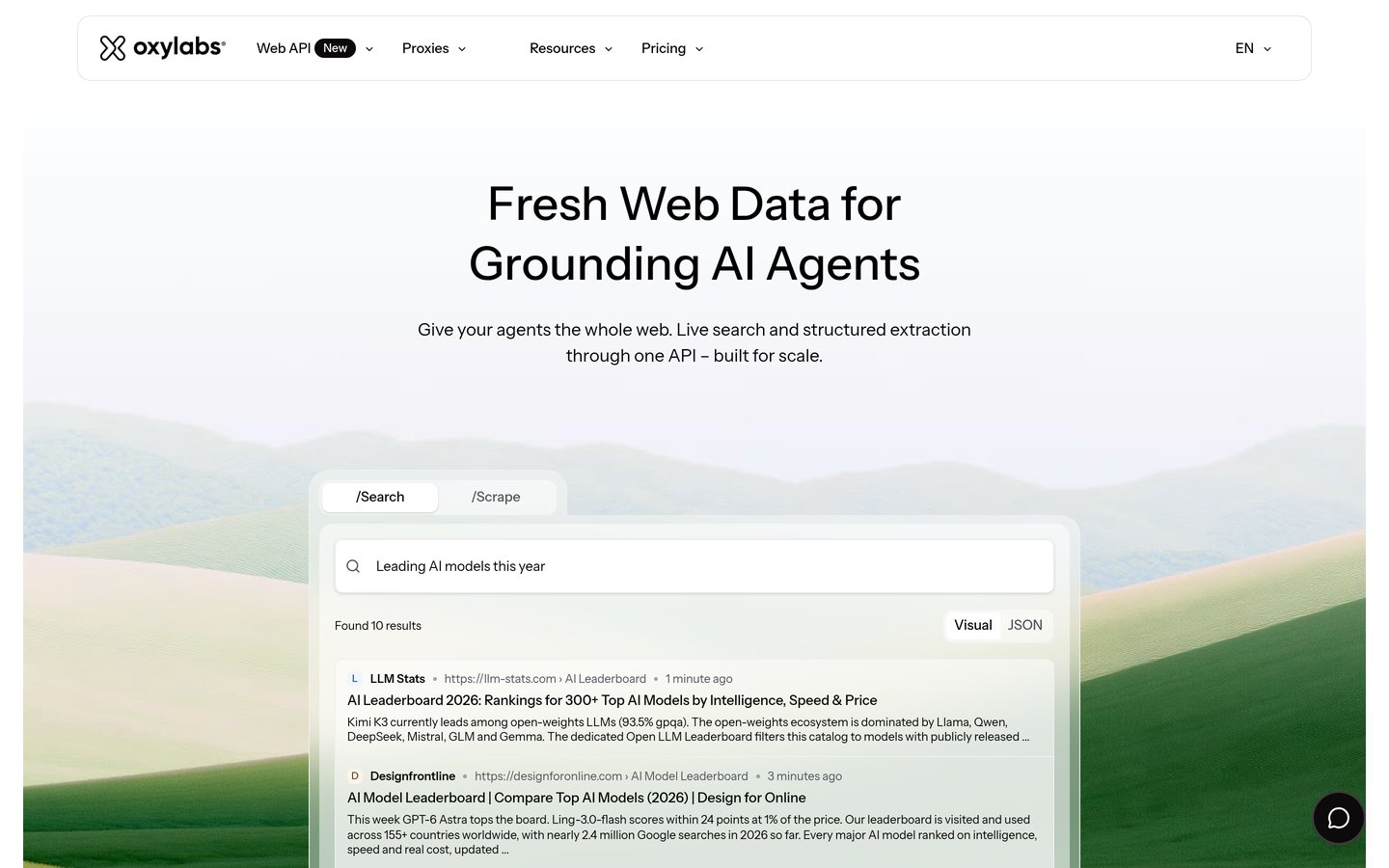
Oxylabs is the enterprise peer to Bright Data, with a 175M+ residential pool across 195 countries and ISO 27001 and SOC 2 certification. It sells residential, ISP, datacenter and mobile proxies alongside a web unblocker, a scraper API and a headless browser.
The trade off is the entry cost at low volume. The Starter plan is $30 a month for 5 GB, and there is no residential pay-as-you-go option, so light users pay for traffic they may not use. It suits compliance-led teams that need audited sourcing and account support.
What we like
175M+ residential IPs with free geo-targeting
ISO 27001 and SOC 2 certified
99.93% residential success rate in 2026 testing
Web Unblocker and scraper API included
Watch out for
$30 monthly minimum with no pay-as-you-go residential
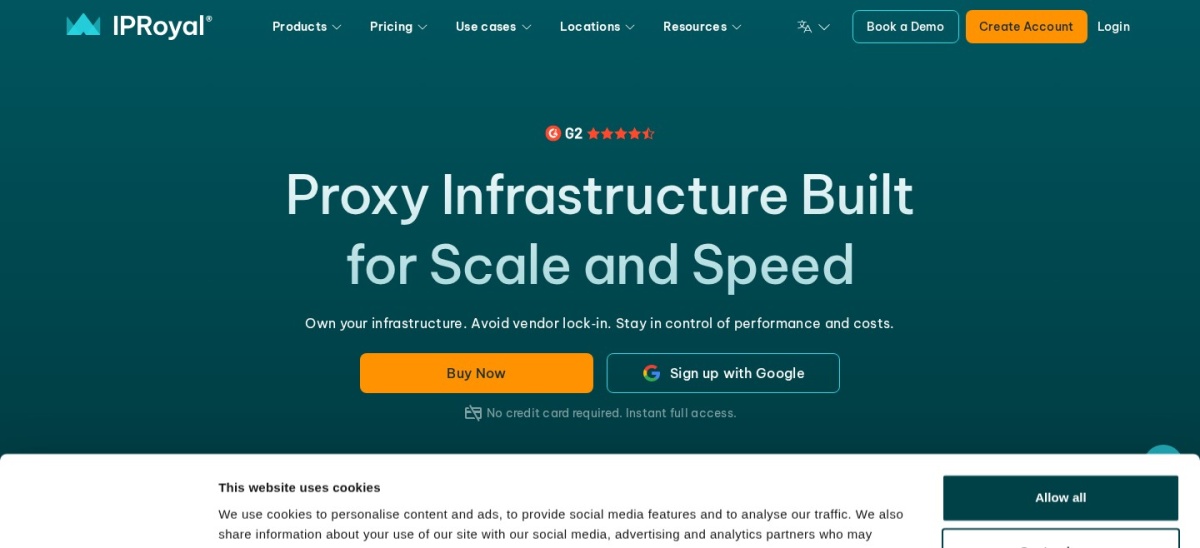
IPRoyal is a Lithuania-based proxy provider built for small teams and solo buyers who want flexible billing. Its residential traffic never expires, so a single gigabyte bought today still works months later, and the pool covers 195 countries with city-level targeting.
The trade off is the headline rate. The $1.75 per GB figure needs a large purchase, while a single gigabyte costs about $7, and there is no free plan. It suits irregular workloads where traffic must not expire between projects.
4.1/5on Trustpilot (1,457 reviews, checked Nov 2026)
Paid from$2.99/mo
Best free way to start with proxies
Residential pool80M+ IPs
Countries195
Residential price$3.50/GB
Entry planProxy Server, $2.99/mo
webshare.io
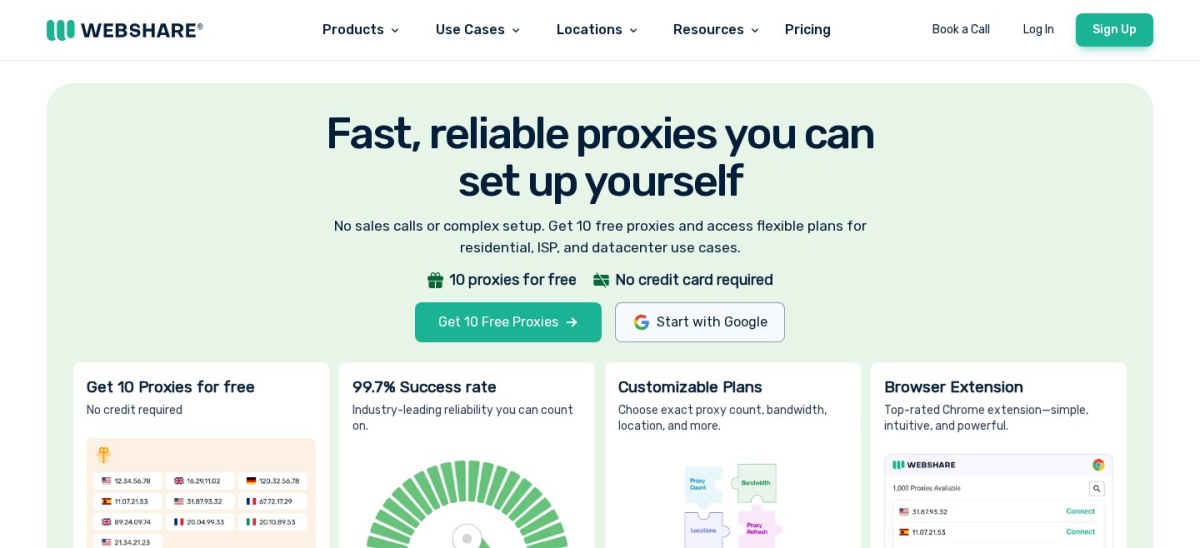
Webshare homepage, captured Nov 2026.
Webshare is the only tool here with a permanent free plan: 10 shared proxies and 1 GB a month with no card required. Its rotating residential pool covers 80M+ IPs across 195 countries, and paid plans start at $2.99 a month for 100 shared datacenter proxies.
The trade off is that residential traffic is the weaker buy. Rotating residential starts at $3.50 per GB, the $7 list rate is struck through as a promotion, and there is no mobile proxy product. It suits developers learning proxies or testing a scraper before spending.
What we like
Only free plan in this list, no card needed
Cheapest paid plan at $2.99 a month
80M+ residential IPs across 195 countries
Owned by Oxylabs, with a clean dashboard
Watch out for
Residential is pricey next to the budget specialists
No mobile proxies
Trustpilot reviews split between praise and complaints
Paid plans add more proxies and cheaper residential ratesVisit webshare.io
06
Proxy-Seller
4.8/5on G2 (170 reviews, checked Nov 2026)
Starts at$3.50/mo
Best for project-based proxy buying
Residential pool47M+ IPs
Countries220+ locations
Residential price$3.50/GB, $1.45 at volume
Entry planResidential, $3.50/mo
proxy-seller.com
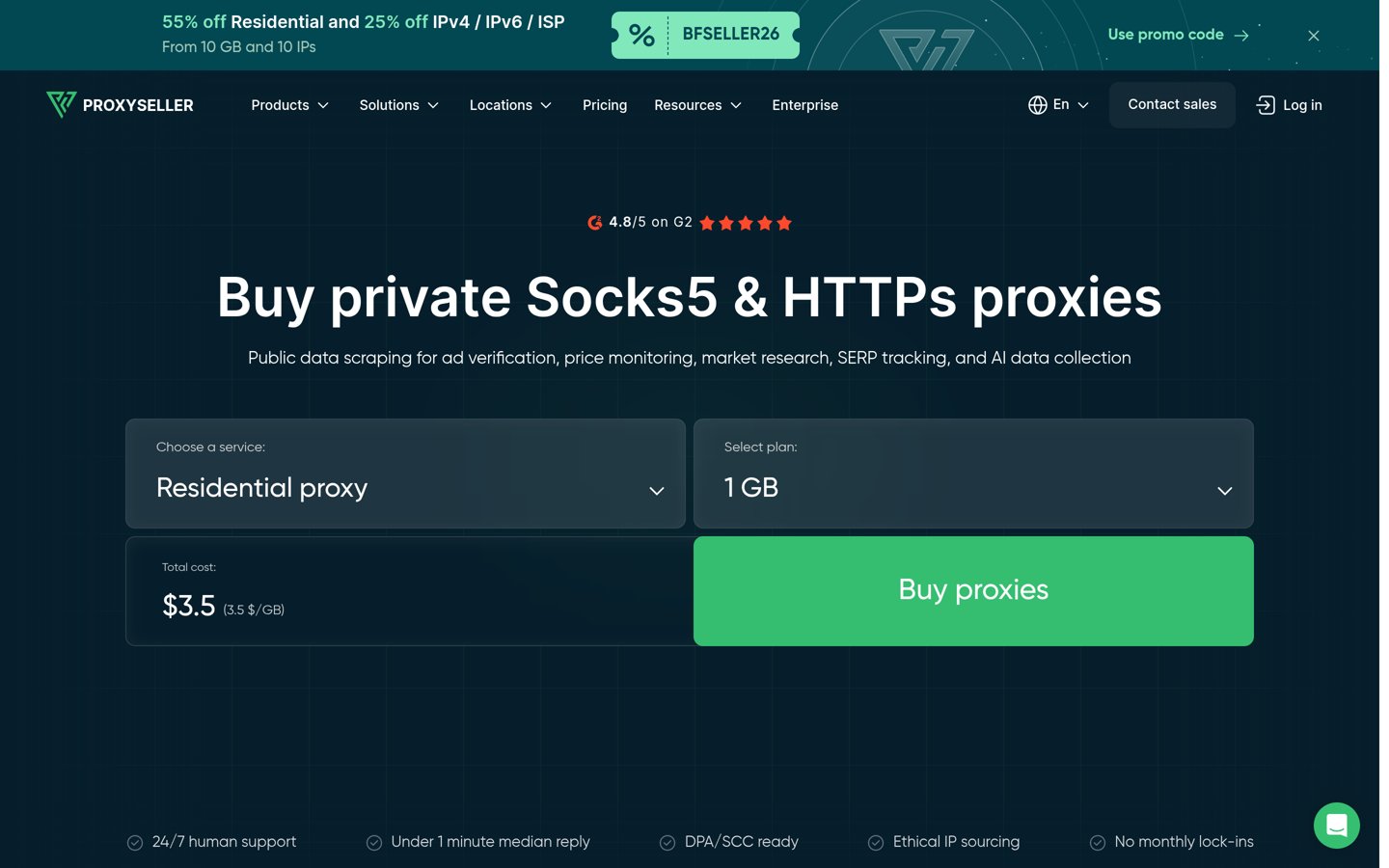
Proxy-Seller homepage, captured Nov 2026.
Proxy-Seller is a proxy infrastructure provider running since 2014, with 185,000+ customers behind it. Its residential network covers 47M+ IPs a month in 220+ locations, with rotation per request, on a timer, or sticky for up to 24 hours, and no monthly lock-in on pay-as-you-go traffic.
The trade off is the one-month window. Residential plans bought monthly last one month only, and G2 reviewers note the per-GB price can feel high before volume discounts apply. It suits teams that buy proxies per project and want support that answers fast.
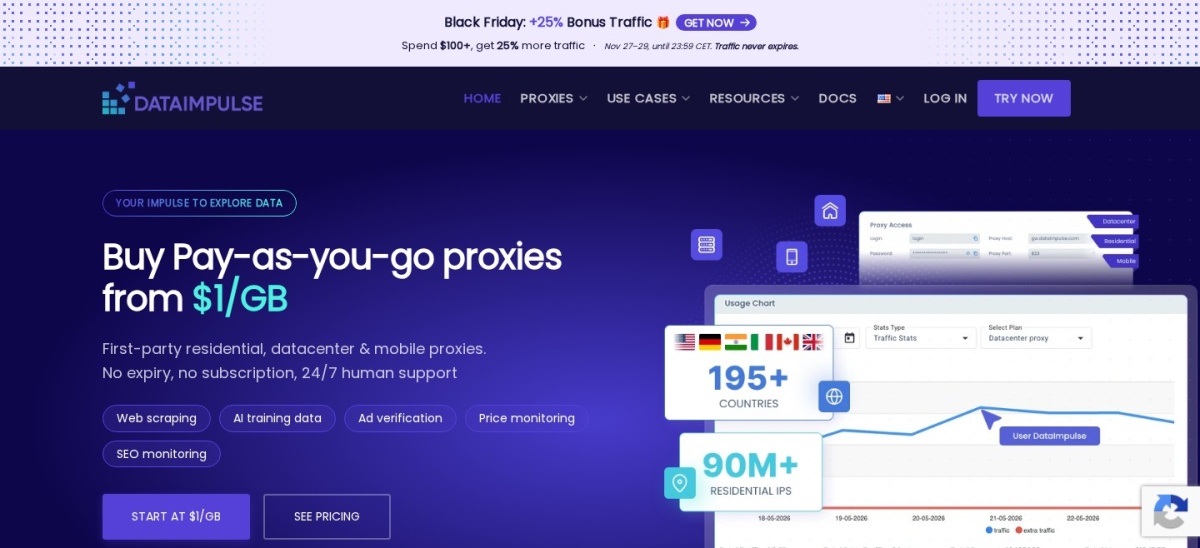
DataImpulse is the cheapest way to buy residential proxies that work: $1 per GB pay as you go from a $5 first top-up, with traffic that never expires. Its pool covers 90M+ residential IPs across 195 countries, and independent Proxyway testing in 2026 measured a 99.74% success rate.
The trade off is trust. Trustpilot removed the company's score after finding fake reviews, so the 4.7/5 G2 rating rests on only 28 reviews, and independent testing found about 15% non-residential IPs in the standard US pool. It suits small, irregular scraping jobs where price matters most.
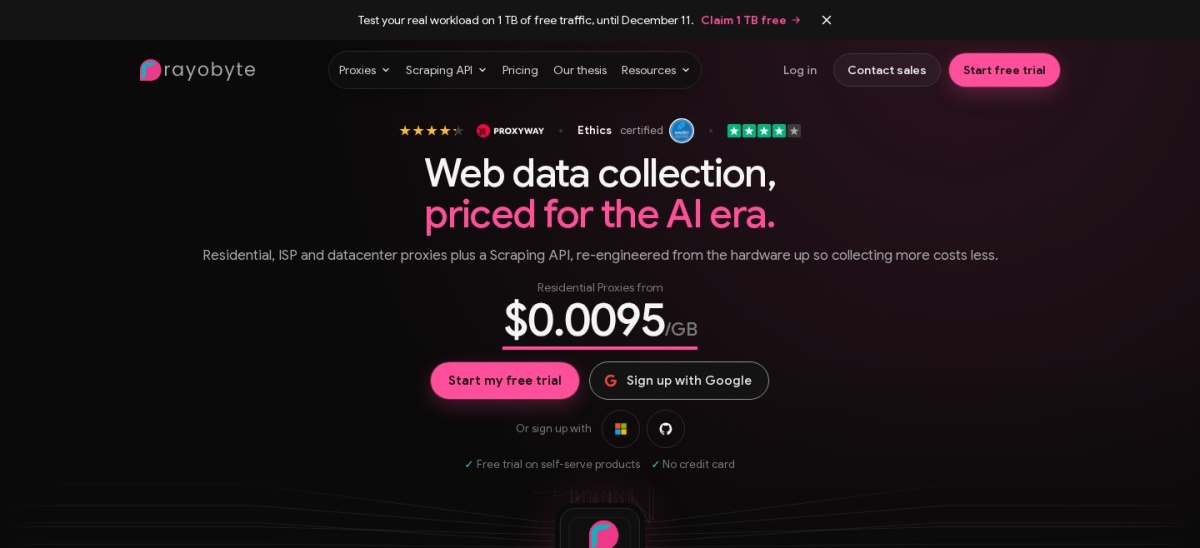
Rayobyte is a US provider that runs its own datacenter infrastructure instead of renting cloud ranges, which keeps its datacenter proxies fast and cheap. Residential traffic costs $3.50 per GB pay as you go from a 40M+ pool, and bought traffic never expires.
The trade off is residential quality. Independent testing scored its residential IP quality below the specialists here, with slow response times and a 0% success rate against Google in one test. It suits buyers who mainly need cheap datacenter proxies with some residential traffic beside them.
4.4/5on Trustpilot (105 reviews, checked Nov 2026)
Starts at$20/mo
Best for rollover bandwidth on small plans
Residential pool30M+ IPs
Countries170+
Residential price$3.50/GB pay as you go
Entry planStarter 7 GB, $20/mo
proxyempire.io
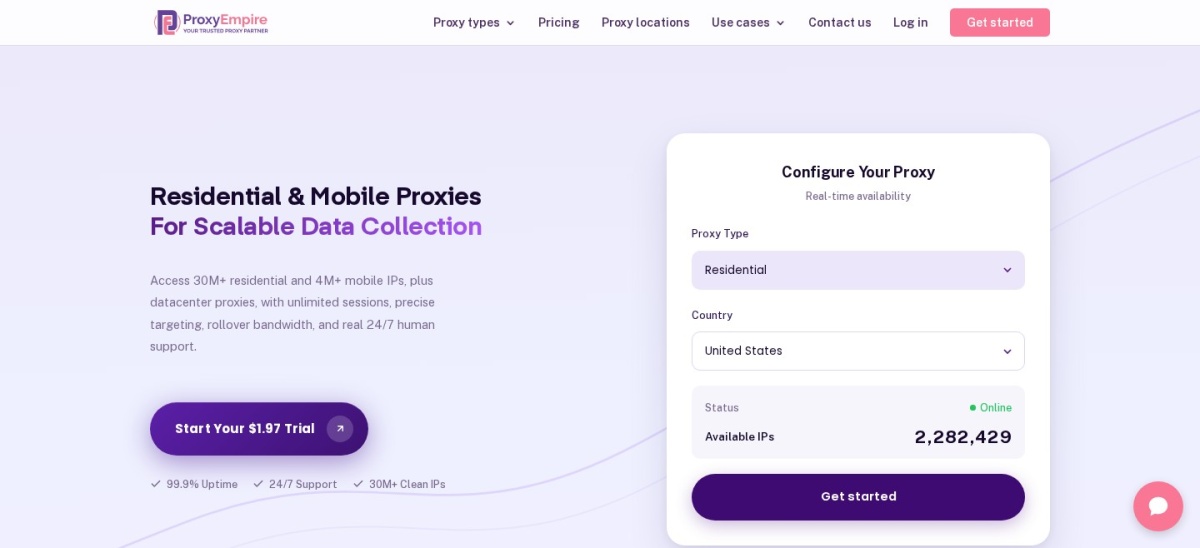
ProxyEmpire homepage, captured Nov 2026.
ProxyEmpire sells rotating residential proxies from a 30M+ pool across 170+ countries, with targeting down to state, ZIP, ASN and carrier. Unused bandwidth rolls over on every plan, and a $1.97 trial buys 150 MB of residential or mobile traffic without converting into a subscription.
The trade off is the thin review record. Its 4.4/5 Trustpilot score rests on about 105 reviews, and the vendor's own pages quote 4.5 and 4.6 in different places. It suits small teams that buy traffic in bursts and want leftovers to carry over.
Pay as you go wins when usage is irregular. DataImpulse, Rayobyte and IPRoyal sell traffic that never expires, so a gigabyte bought today still works next quarter.
Monthly plans win when usage is steady. Decodo drops to $2 per GB at 1 TB, Oxylabs to $2.50 per GB, and Bright Data to $5 per GB, all far below their entry rates.
Watch the expiry rules before you commit. Decodo traffic expires each billing cycle, ProxyEmpire rolls unused bandwidth over, and Oxylabs credit expires too, so the cheapest headline rate is not always the cheapest bill.
How we chose
We started from every residential proxy provider with a public G2 or Trustpilot rating and a published price, then kept the nine that cover the range from $1 per GB to enterprise plans.
Prices come from each vendor's pricing page and G2 pricing listings, checked on 29 November 2026. Ratings and review counts come from G2 or Trustpilot on the same day. Where a vendor shows a sale, the list shows the regular price.
We left out NetNut, whose domains were seized in July 2026, and providers with no public rating at all. No vendor paid for a place, and we do not claim hands-on testing for this list.
How to choose a SOAX alternative
Start with your monthly volume, then match the billing model to it.
Work out how much traffic you actually use. A 3 GB month costs $11.25 at Decodo and $3 at DataImpulse, so the cheapest plan depends on volume, not the headline rate.
Pick pay as you go for irregular work. DataImpulse, Rayobyte and IPRoyal sell traffic that never expires, so nothing is wasted between projects.
Pick a monthly plan for steady scraping. Decodo, Oxylabs and Bright Data cut the per-GB rate sharply at volume, and monthly plans include support and tooling.
Check the compliance box before you pay. Enterprise buyers need ISO 27001 or SOC 2 paperwork, and new residential zones at Bright Data and Oxylabs need company verification.
FAQ
What are the best SOAX alternatives?
Decodo is the best SOAX alternative for most teams, with a 115M+ IP pool, residential from $3.75 per GB, and 4.6/5 on G2. Bright Data suits enterprise data teams with its 400M+ pool, while DataImpulse is the cheapest option at $1 per GB.
How much do SOAX alternatives cost?
Residential traffic runs from $1 per GB at DataImpulse to $8 per GB pay as you go at Bright Data. Monthly plans start at $2.99 at Webshare, $11.25 at Decodo, $30 at Oxylabs and $499 at Bright Data, while SOAX itself starts at $200 a month.
Is there a free alternative to SOAX?
Webshare is the only free alternative here, with 10 shared proxies and 1 GB a month on a permanent free plan that needs no card. Decodo offers a 3-day trial with 100 MB, Rayobyte offers a free trial with no card, and ProxyEmpire sells a $1.97 trial.
Which SOAX alternative is best for beginners?
Decodo is the easiest starting point for beginners, with self-serve signup, a clear dashboard, and a 3-day trial. Webshare is the cheapest way to learn, with a free plan and $2.99-a-month paid plans, though its residential traffic costs more per GB.
Decodo vs Bright Data: which SOAX alternative is better?
Decodo is better for most teams: it costs $11.25 a month against $499 at Bright Data, with a 115M+ pool that covers ordinary scraping well. Bright Data is better for enterprise teams that need a 400M+ pool, scraping APIs, datasets and compliance paperwork.
Do SOAX alternatives offer pay-as-you-go pricing?
Yes. DataImpulse charges $1 per GB, Rayobyte and ProxyEmpire charge $3.50 per GB, IPRoyal sells single gigabytes from about $7, and Decodo offers pay as you go at $4 per GB. Bright Data also offers pay as you go at $8 per GB, while Oxylabs has no pay-as-you-go residential option.
SaaS SEO and WordPress specialist with about 8 years of experience. Rakib compares WordPress plugins, themes, hosting and software using public pricing, documentation and user reviews. See how we rank.