Jobber is the best sales software for contractors who want to manage customer inquiries, estimates, approved jobs and invoices in one platform, starting at $29 per month with annual billing. Choose JobTread for construction estimating and project handoffs or Contractor Foreman for affordable construction management with integrated sales workflows.
How we make this list: we compare pricing pages, product documentation and public user reviews, then re-check every price before each update. No product paid for a place. Disclosure.
Jobber Core renews at $29 per month with annual billing, totaling $348 annually for an individual contractor.
JobTread earns 4.9/5 from 120 G2 reviews and offers a 20% discount on annual subscriptions.
Contractor Foreman starts at $588 annually and has a 4.5/5 G2 rating from 387 reviews.
Pipedrive Lite costs $168 per seat annually and earns 4.3/5 from 5,134 G2 reviews.
Bigin is the cheapest paid CRM in this comparison at $84 per user annually, with a 4.6/5 G2 rating.
HubSpot Sales Hub has 14,417 G2 reviews and a regular Starter list price of $20 per seat monthly.
What should sales software for contractors help businesses manage?
Contractor sales software should connect inquiries with signed jobs. It needs to help businesses capture leads, record customer requirements, prepare estimates, follow up on outstanding proposals and transfer accepted work into an operational schedule.
Field service contractors benefit from integrated sales and job management. Businesses handling electrical work, plumbing, landscaping or maintenance can reduce duplicate administration when customer records, quotes, appointments and invoices belong to the same system.
Construction sales require more detailed estimating and project preparation. Builders and remodeling contractors often need cost catalogs, proposal documents, specifications, allowances and customer approvals before a project can move into production.
General CRM software remains useful for contractors with dedicated sales representatives. Visual pipelines, communication histories, sales forecasts and automated reminders help teams manage opportunities without necessarily replacing their existing estimating or construction applications.
The cheapest subscription is not always the cheapest complete workflow. Some applications reserve automated quote follow-ups, proposal management, advanced reporting or construction estimating for higher plans. Compare the features your sales process requires rather than selecting software by its entry price alone.
For contractors needing customizable sales workflows
$14/mo
Free plan
4.1/5
Price ladder: cheapest paid plan per year
List prices, USD, checked Nov 2026
BiginFREE$84
Pipedrive$168
Zoho CRMFREE$168
HubSpotFREE$240
Jobber$348
Foreman$588
JobTread$1,910
The 7 best sales software tools for contractors
01
Jobber
4.5/5on G2 (535 reviews, checked Nov 2026)
Starts at$29/mo
Best for service contractors managing sales through job completion
Entry paid planCore
Included users1
Regular annual subscription$348
Monthly no-commitment price$49
getjobber.com
Jobber homepage, captured Nov 2026.
Jobber is field service management software that connects customer inquiries, quotes, scheduling, job records and invoicing. Its Core subscription includes one user and provides the essential administrative tools an independent contractor needs to move customers from initial inquiries to completed work.
The trade off is that advanced sales automation and team management require higher subscriptions or additional features. Core renews at $29 monthly with annual billing, following a temporary $21 introductory offer. It suits residential service contractors who want sales and daily operations connected.
What we like
Connects customer quotes with scheduled jobs
Customer records and communication history
Professional quoting and invoicing workflows
Mobile access for contractors working in the field
Less suitable for detailed construction estimating
Dedicated sales pipeline functionality can cost extra
Core provides customer management, quoting, scheduling and invoicing.Visit getjobber.com
02
JobTread
4.9/5on G2 (120 reviews, checked Nov 2026)
Starts at$159.20/mo
Best for construction estimates, proposals and project handoffs
Regular monthly subscription$199
Annual billing discount20%
Additional internal users$20/month at monthly rates
Feature accessAll features included
jobtread.com
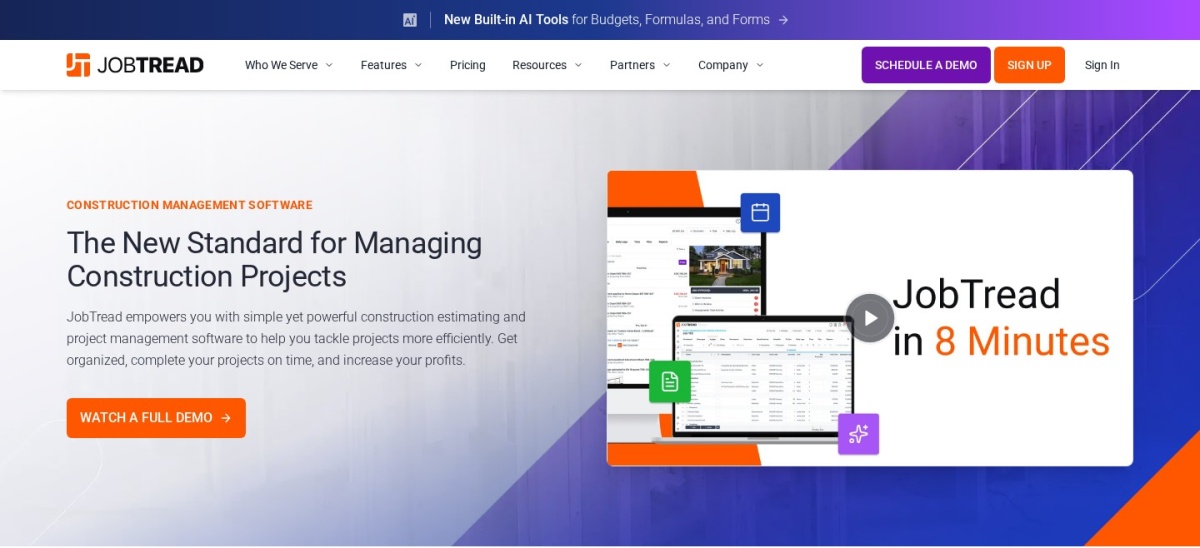
JobTread homepage, captured Nov 2026.
JobTread is construction management software that combines customer relationship management, detailed estimating, proposals, budgets and project delivery. Its standard subscription costs $199 monthly before the regular 20% annual billing discount and includes access to all platform features.
The trade off is its higher base subscription expense compared with general-purpose CRM applications. Annual billing reduces the base cost to $1,910.40, while additional internal users increase expenses. It suits builders, remodelers and specialty contractors who need accurate estimating connected to project execution.
What we like
Highest G2 rating in this comparison
Construction-specific estimating and budgeting
Sales records connect directly to project management
All platform features included in the base subscription
Implementation, training and support included
Watch out for
Higher base subscription cost than standalone CRMs
Additional internal users increase costs
May provide unnecessary features for small service businesses
The subscription includes construction CRM, estimating, proposals, budgeting and project management.Visit jobtread.com
03
Contractor Foreman
4.5/5on G2 (387 reviews, checked Nov 2026)
Starts at$49/mo
Best for affordable construction sales and project administration
Entry paid planBasic
Basic users1
Standard annual-billing rate$105/month
Free trial30 days
contractorforeman.com
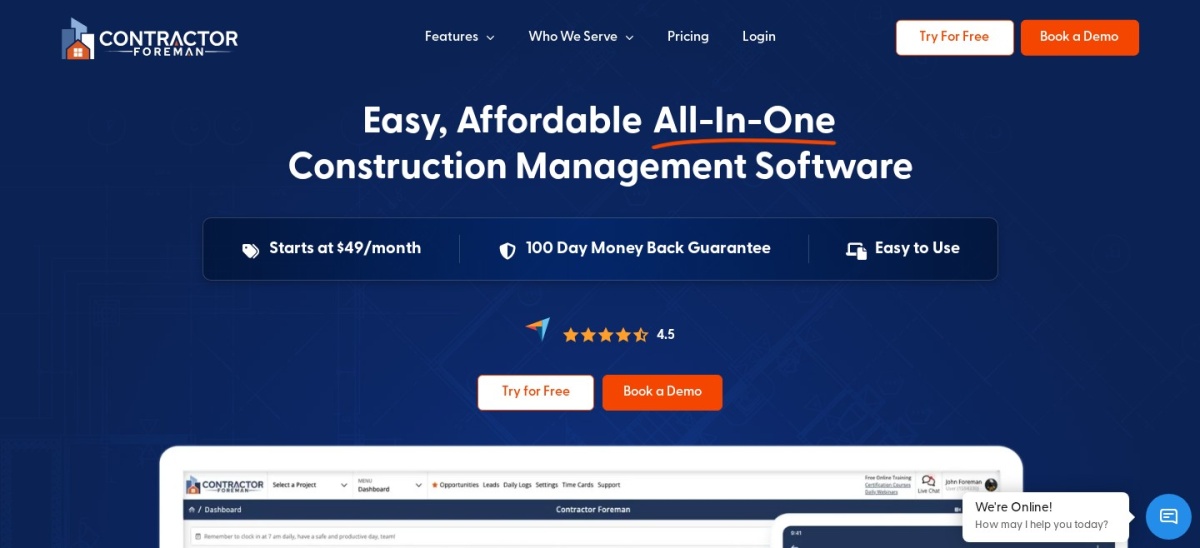
Contractor Foreman homepage, captured Nov 2026.
Contractor Foreman is construction management software covering sales opportunities, estimates, project administration and financial workflows. Its Basic subscription costs $588 annually for one user, offering a relatively affordable entry point into a broader contractor management platform.
The trade off is that feature availability and user allowances vary across subscriptions. Basic costs $49 monthly with annual billing, while Standard costs $105 monthly and accommodates more users. It suits smaller construction businesses seeking sales and operational tools without purchasing separate applications for every department.
What we like
Construction-specific sales and project workflows
Affordable individual contractor subscription
Opportunities and project records within one platform
Broader construction financial management capabilities
Multiple subscription tiers for growing teams
Watch out for
Basic subscription includes only one user
Some sales and estimating capabilities require upgrades
Broader feature set creates a learning curve
Annual commitment required for the lowest entry price
Higher subscriptions expand user allowances and construction management functionality.Visit contractorforeman.com
04
Pipedrive
4.3/5on G2 (5,134 reviews, checked Nov 2026)
Starts at$14/mo
Best for contractors managing dedicated sales representatives
Entry paid planLite
Pricing modelPer seat
Annual entry subscription$168 per seat
Free trial14 days
pipedrive.com
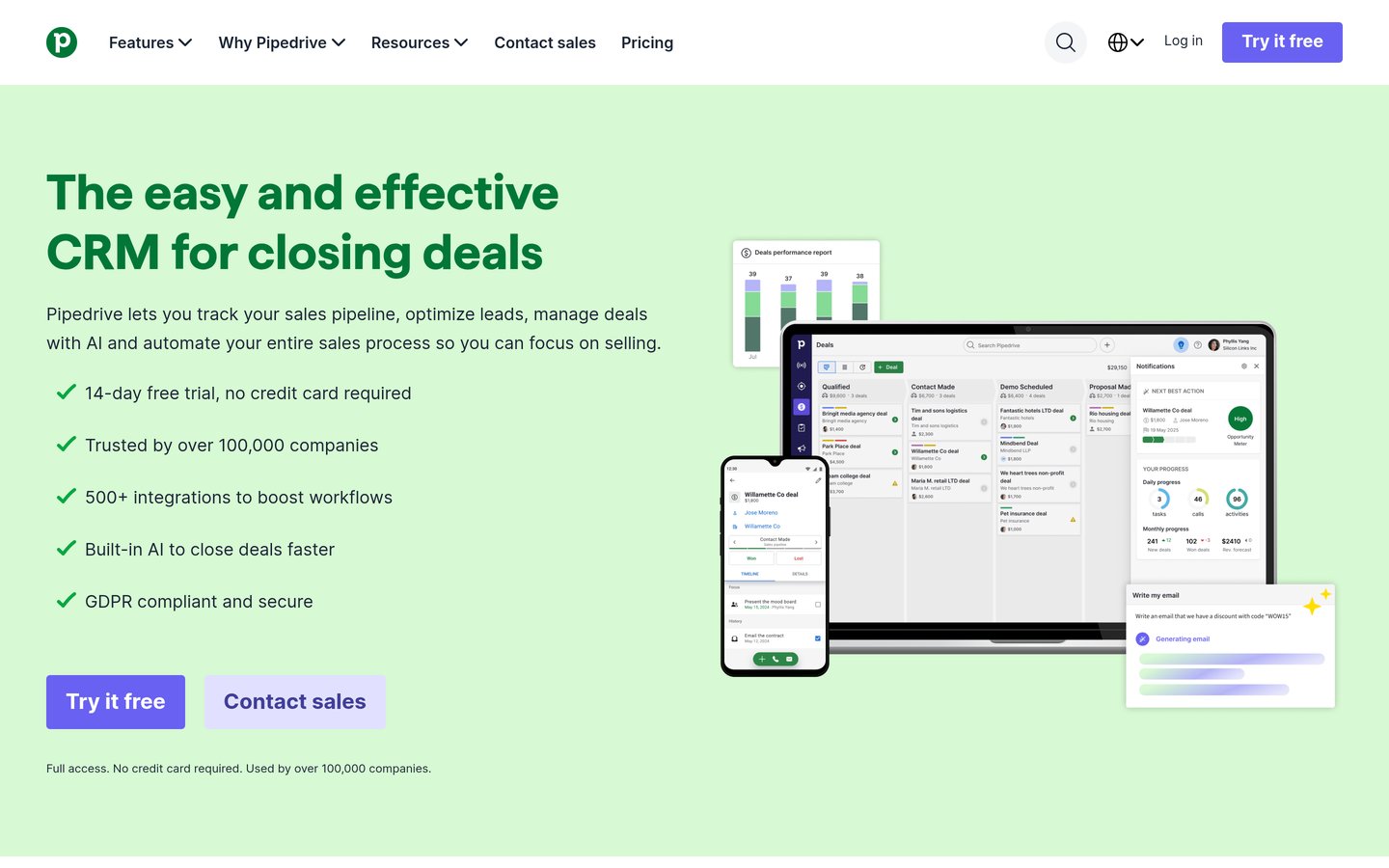
Pipedrive homepage, captured Nov 2026.
Pipedrive is sales CRM software built around visual deal pipelines, contact management, sales activities and performance reporting. Its Lite subscription costs $14 per seat monthly with annual billing and provides the essential tools for tracking contractor leads and outstanding opportunities.
The trade off is that Pipedrive does not replace construction estimating, job costing or crew scheduling applications. Advanced email synchronization and automated sales workflows require higher subscriptions. It suits contractors with dedicated sales representatives who already use separate software for preparing estimates and delivering projects.
What we like
Clear visual representation of sales opportunities
Customizable pipeline stages
Affordable individual sales licenses
Activity reminders and contact management
Extensive public review history
Watch out for
No native construction job costing
No permanent free plan
Advanced automation requires higher subscriptions
Contractor-specific integrations may create additional expenses
Lite includes lead management, deal tracking, calendar activities and sales reporting.Visit pipedrive.com
05
Bigin
4.6/5on G2 (877 reviews, checked Nov 2026)
Paid from$7/mo
Best for independent contractors and small sales teams
Entry paid planExpress
Free users1
Free record allowance500
Free pipeline allowance1
bigin.com
Bigin homepage, captured Nov 2026.
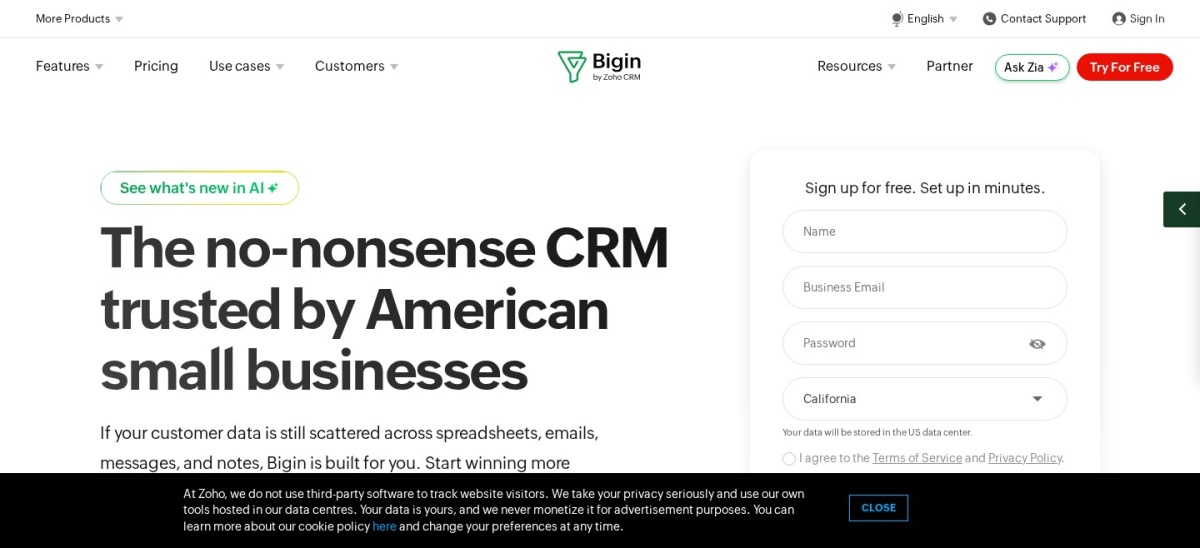
Bigin is a lightweight CRM from Zoho designed for small businesses managing customers, opportunities and repeatable sales processes. Its free plan supports one user, one customizable pipeline, 500 records and 3 automations, making it suitable for independent contractors starting to organize their leads.
The trade off is that Bigin does not provide dedicated construction estimating, field service scheduling or job costing. Express starts at $7 per user monthly with annual billing and expands CRM capacity. It suits small contractor businesses moving away from spreadsheets without adopting a complex sales platform.
What we like
Lowest paid entry price in this comparison
Permanent free plan for an individual contractor
Customizable customer and sales pipelines
Built-in workflow automation
Integrations with the wider Zoho ecosystem
Watch out for
Free plan has limited record capacity
No construction-specific estimating
Less extensive customization than Zoho CRM
Additional software may be needed for job scheduling
Express expands CRM records, pipelines, integrations and automation capabilities.Visit bigin.com
06
HubSpot Sales Hub
4.4/5on G2 (14,417 reviews, checked Nov 2026)
Paid from$20/mo
Best for contractors combining marketing and sales management
Entry paid offeringStarter
Regular list price$20 per seat/month
Free CRMAvailable
Sales featuresContacts, deals and engagement
hubspot.com
HubSpot Sales Hub homepage, captured Nov 2026.
HubSpot Sales Hub is a sales management platform connecting customer records, lead capture, deal pipelines, email engagement and reporting. Its Starter offering has a regular list price of $20 per seat monthly, while free CRM functionality provides a lower-risk starting point for contractors.
The trade off is that advanced sales automation and reporting can require substantially more expensive subscriptions. A new-customer promotion advertises Starter at $7 per seat monthly, but the comparison uses its $20 regular list price. It suits contractors generating inquiries through websites, advertising and marketing campaigns.
What we like
Largest G2 review sample in this comparison
Free CRM entry option
Connects marketing inquiries with sales opportunities
Contact records and sales engagement tools
Extensive integration ecosystem
Watch out for
Higher subscriptions can become expensive
No dedicated construction estimating system
Advanced sales automation is restricted by plan
Multiple HubSpot products can complicate pricing
Starter expands sales engagement, CRM limits and access to commercial platform features.Visit hubspot.com
07
Zoho CRM
4.1/5on G2 (2,964 reviews, checked Nov 2026)
Paid from$14/mo
Best for contractors needing customizable sales workflows
Entry paid planStandard
Free users3
Professional annual-billing rate$23/user/month
Regular monthly Standard rate$20/user
zoho.com
Zoho CRM homepage, captured Nov 2026.
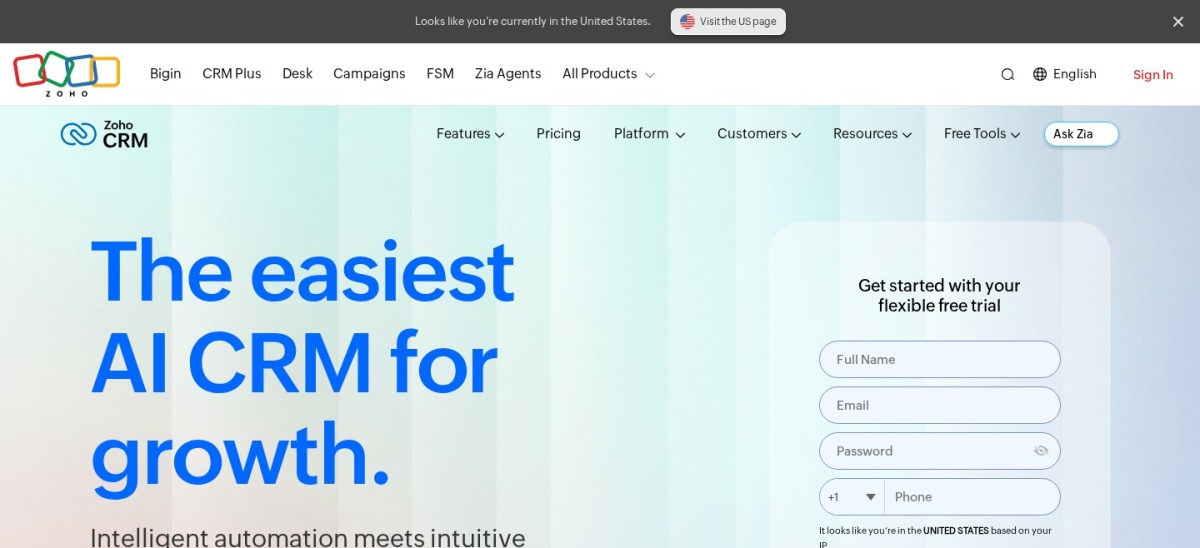
Zoho CRM is a configurable customer relationship management platform supporting leads, contacts, accounts, deals and sales activities. Its free edition accommodates up to 3 users, while Standard costs $14 per user monthly with annual billing and adds expanded sales management and forecasting features.
The trade off is that building contractor-specific workflows requires configuration, and more advanced commercial features belong to higher subscriptions. Standard totals $168 per user annually, while Professional costs $23 per user monthly with annual billing. It suits growing contracting businesses that need greater control over sales processes.
What we like
Free CRM for up to 3 users
Flexible sales record customization
Multiple sales pipelines on paid plans
Sales forecasting and communication integrations
Connections with other Zoho business applications
Watch out for
More configuration required than Bigin
No dedicated construction project management system
Advanced commercial features require higher tiers
Lowest G2 rating among the selected products
Standard adds expanded sales automation, forecasting and customization capabilities.Visit zoho.com
Should contractors choose industry-specific sales software or a general CRM?
Industry-specific software is preferable when the same employee manages customer inquiries, estimates, scheduling and job delivery. Jobber connects these activities within a field service workflow, reducing the need to transfer customer information between applications.
Construction management platforms are preferable for projects requiring detailed estimates, budgets and coordinated production. JobTread and Contractor Foreman connect customer opportunities with broader construction workflows, although their entry subscriptions and feature allowances differ.
General CRM software is preferable when sales management is separate from project operations. Pipedrive, Bigin, HubSpot and Zoho CRM provide tools for tracking opportunities, customer communications and sales activities without requiring contractors to replace their existing project management systems.
A combined approach can work for larger contracting businesses. A dedicated CRM can handle marketing leads and sales representatives, while construction software manages approved projects. Confirm integration availability and data synchronization before committing to separate subscriptions.
What does an effective contractor sales workflow look like?
Lead capture should bring website inquiries, calls, referrals and other prospective customer information into a shared system. Assign responsibility for contacting each prospect and record the requested work before preparing an estimate.
Opportunity qualification should establish the customer's requirements, budget, expected timeline and project suitability. A customizable sales pipeline helps contractors distinguish early inquiries from qualified opportunities and proposals awaiting approval.
Proposal management should make outstanding estimates easy to identify. Record the proposed scope, estimated value, date sent and follow-up activity. Where available, use automated reminders and customer approval tools to reduce manual administration.
The operational handoff should preserve the information collected during sales. Once the customer accepts an estimate, transfer the agreed scope, contact details, pricing and relevant documents into the job scheduling or project management system.
Sales reporting should identify where opportunities are lost. Monitor lead response, outstanding estimates, accepted proposals and reasons for unsuccessful bids. Use those findings to improve follow-up processes rather than simply increasing the number of incoming leads.
How we chose
We selected established field service platforms, construction management applications and general-purpose sales CRMs that address contractor lead management, quoting, customer follow-ups and project handoffs. Rankings prioritize contractor-specific relevance, sales capabilities, pricing accessibility and public review history.
Official pricing pages and G2 review profiles were opened on 30 Nov 2026. Annual prices use regular subscription rates rather than temporary new-customer promotions. JobTread's annual figure is calculated using its published 20% annual discount. Per-seat prices exclude additional users, optional modules and implementation expenses.
We excluded quote-only products and applications without confirmable public entry prices. Jobber's review count was available through its G2 seller profile, but its aggregate rating requires additional confirmation before publication. The remaining products have identifiable aggregate ratings and review counts. No vendor paid for a place, and we do not claim testing for this list.
How to choose sales software for your contracting business
Map your existing sales workflow, identify where customer opportunities are being lost and compare platforms based on the administrative tasks you need to automate.
Decide whether sales and job management need to be connected. Choose Jobber for service-oriented businesses that move quickly from estimates to scheduled jobs. Consider JobTread or Contractor Foreman when construction estimating, budgets and project administration need to remain connected.
Identify your lead capture and follow-up requirements. Check whether the application supports website inquiries, contact records, sales pipelines, appointment reminders and automated follow-ups. Confirm that these capabilities are available on the subscription you intend to purchase.
Evaluate estimating and proposal management. Determine whether your business needs simple service quotes or detailed construction estimates with materials, labor and allowances. Review available proposal formats, customer approvals and integration with your existing estimating software.
Calculate total costs for your sales team. Include required user licenses, sales automation upgrades, additional modules and integrations. Compare regular renewal prices rather than temporary introductory discounts, and consider whether a general CRM could work alongside your current operational software.
FAQ
What is the best sales software for contractors in 2026?
Jobber is the best overall sales software for service contractors who need customer inquiries, quotes, scheduling and invoices connected within one platform. Core costs $29 monthly with annual billing. JobTread is preferable for detailed construction estimating, while Contractor Foreman offers affordable construction-oriented management.
What is the best free sales CRM for contractors?
Bigin is a strong free sales CRM for independent contractors because it supports one user, one pipeline, 500 records and basic automation. Zoho CRM is another option for teams requiring up to 3 free user accounts, while HubSpot provides free CRM functionality for marketing-oriented businesses.
How much does contractor sales software cost?
Contractor sales software starts at $7 per user monthly for Bigin Express, while Jobber Core costs $29 monthly with annual billing. Construction-focused Contractor Foreman starts at $49 monthly, and JobTread has a $199 regular monthly base subscription before its annual billing discount.
Is Jobber better than JobTread for contractors?
Jobber is better for field service contractors managing customer requests, straightforward quotes, appointments and invoices. JobTread is better for builders and remodeling contractors who require detailed estimates, project budgets and connected construction management. Their suitability depends on the complexity and duration of your projects.
What sales software is best for independent contractors?
Bigin is suitable for independent contractors who mainly need affordable lead tracking and customer follow-ups, starting at $84 annually. Jobber Core is preferable when the same contractor also manages estimates, appointments and invoices. Both provide affordable individual entry subscriptions compared with larger construction management platforms.
Can contractors use Pipedrive instead of construction CRM software?
Yes, Pipedrive can manage contractor leads, customer relationships, sales representatives and outstanding opportunities. Its Lite subscription costs $168 per seat annually. However, businesses still need separate applications for detailed construction estimating, job costing, field service scheduling and other operational tasks.
Is HubSpot suitable for construction contractors?
Yes, HubSpot is suitable for construction contractors generating inquiries through websites, advertising and marketing campaigns. Its CRM connects customer records with sales pipelines and engagement tools. However, detailed construction estimates, production schedules and job costs generally require separate construction management software.
Does contractor sales software help follow up on estimates?
Yes, contractor sales software can organize outstanding estimates, assign follow-up responsibilities and provide reminders for customer communications. Some applications also offer automated follow-up messages, although these capabilities may require higher subscriptions. Confirm whether your intended plan supports the automation you need.
What features should a contractor CRM include?
A contractor CRM should include customer records, lead tracking, configurable sales stages, communication history, activity reminders and sales reporting. Businesses that want an integrated operational workflow should also prioritize estimating, customer approvals, scheduling, invoicing and reliable connections to their existing construction or accounting software.
SaaS SEO and WordPress specialist with about 8 years of experience. Rakib compares WordPress plugins, themes, hosting and software using public pricing, documentation and user reviews. See how we rank.