Float is the best project capacity planning software for product teams, with a live capacity view at $7 per scheduled person a month. Pick Runn for forecasting hiring needs months ahead, or monday.com when capacity planning must sit beside roadmaps and boards.
How we make this list: we compare pricing pages, product documentation and public user reviews, then re-check every price before each update. No product paid for a place. Disclosure.
Float leads at $7 per scheduled person a month, with live capacity, time off and margin views in one schedule.
Runn plans months ahead with tentative projects and role placeholders, but paid plans start at 20 seats.
monday.com and ClickUp add workload views to tools product teams already use for roadmaps and tasks.
Resource Guru is the cheapest entry at $4.16 a person a month billed yearly, with clash alerts that stop double-bookings.
Smartsheet needs its Resource Management add-on for full capacity planning, on top of $19 a month.
How do you pick project capacity planning software for a product team?
Capacity planning for a product team is about protecting sprint dates. It compares the hours your designers, engineers and product managers have with the hours your roadmap needs, week by week.
A good planner shows overload before it happens. When bookings pass a person's capacity line, the tool should flag it so you can move work, add a contractor or push a deadline.
Teams that run many projects at once feel the difference first. Keeping that work in one shared schedule matters as much as keeping client sites in one place, as our guide on managing many WordPress sites from one dashboard shows from the site side.
Time off and part-time hours cut real capacity. A planner that ignores holidays and leave will promise dates the team cannot hit.
Tentative work needs a tentative flag. Pipeline projects should show as placeholders, not as confirmed bookings, or the plan will look full when it is not.
The 9 best project capacity planning software tools for product teams
01
Float
4.2/5on G2 (2,249 reviews, checked Nov 2026)
Starts at$7/mo
Best project capacity planning software overall
Capacity viewBy person, role and team
Time trackingPro plan only
Free trial30 days
Paid planStarter, $7/mo
float.com
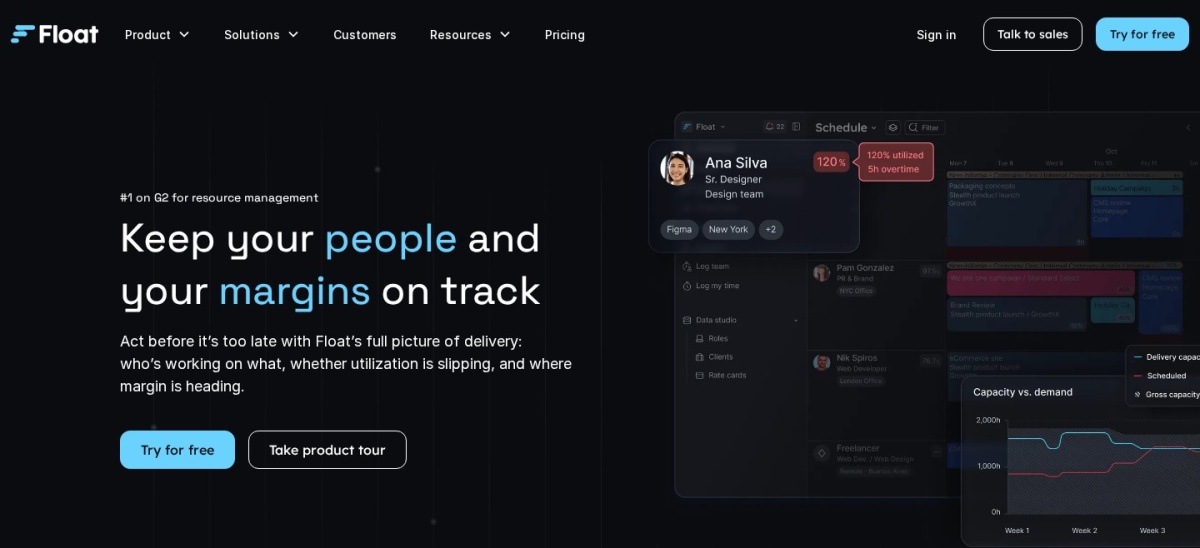
Float homepage, captured Nov 2026.
Float is a purpose-built resource and capacity planning tool for product teams that plan by the week. The Starter plan at $7 per scheduled person a month includes visual scheduling, capacity and time-off management, unlimited projects and project margin tracking, and only scheduled people are billed.
The trade off is that time tracking, single sign-on and advanced reporting need the Pro plan at $12 a month. It suits product teams of about 30 to 1,000 people who want one live view of who is free and what work will cost.
What we like
Only scheduled people are billed
Live capacity and margin views on every plan
Time off and holidays built into the schedule
Rated 4.2 out of 5 on G2 from 2,249 reviews
Watch out for
No free plan, only a 30-day trial
Time tracking needs the $12 Pro plan
No task management, so most teams pair it with a project tool
Pro adds time tracking, single sign-on and advanced reportingVisit float.com
02
Runn
4.8/5on Capterra (33 reviews, checked Nov 2026)
Starts at$7/mo
Best for capacity forecasting
Tentative projectsYes
Saved scenariosStandard plan
Free trial30 days
Paid planLite, $7/seat/mo
runn.io
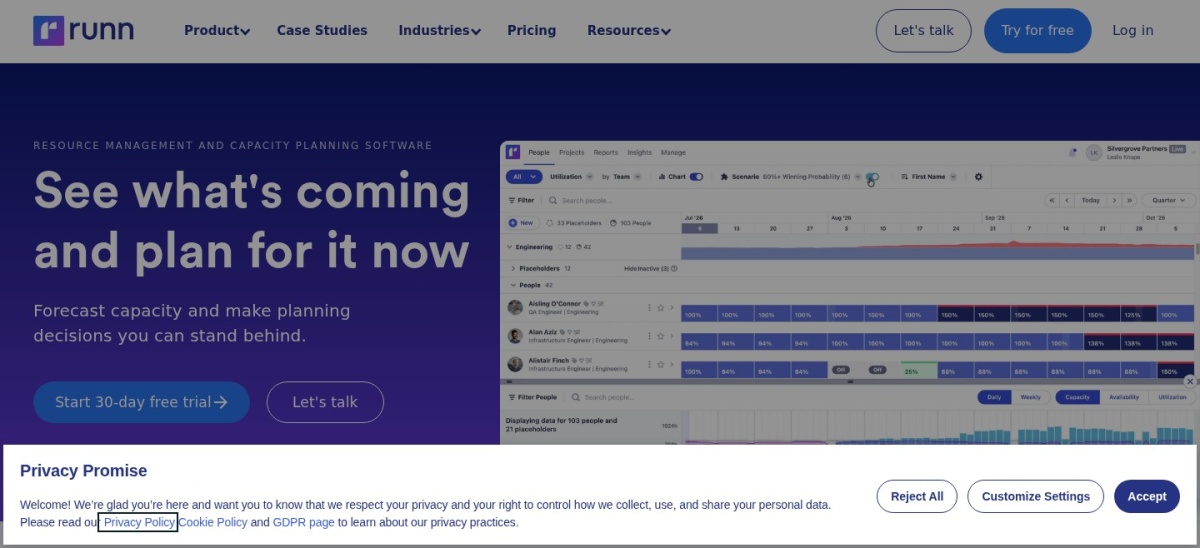
Runn homepage, captured Nov 2026.
Runn is a resource planning and forecasting platform built for teams that plan capacity months ahead. The Lite plan at $7 per resource seat a month includes capacity and utilization charts, tentative projects, placeholders for roles you have not hired yet, and project financials.
The trade off is the 20-seat minimum on paid plans, which sets the lowest bill at $140 a month. It suits product teams of 20 or more that plan hiring against the roadmap and want forecasts tied to project margins.
What we like
Strong forecasting with tentative projects
Placeholders plan roles before hiring
Rated 4.8 out of 5 on Capterra from 33 reviews
Watch out for
20-seat minimum on paid plans
Saved scenarios need Standard at $11 a seat
No task management, so teams pair it with a project tool
Standard at $11 adds saved scenarios; Advanced is quotedVisit runn.io
03
monday.com
4.7/5on G2 (17,144 reviews, checked Nov 2026)
Paid from$9/mo
Best capacity views beside roadmaps
Roadmap viewsTimeline and Gantt
Workload viewPro plan
Free planYes, up to 2 seats
Paid planBasic, $9/seat/mo
monday.com
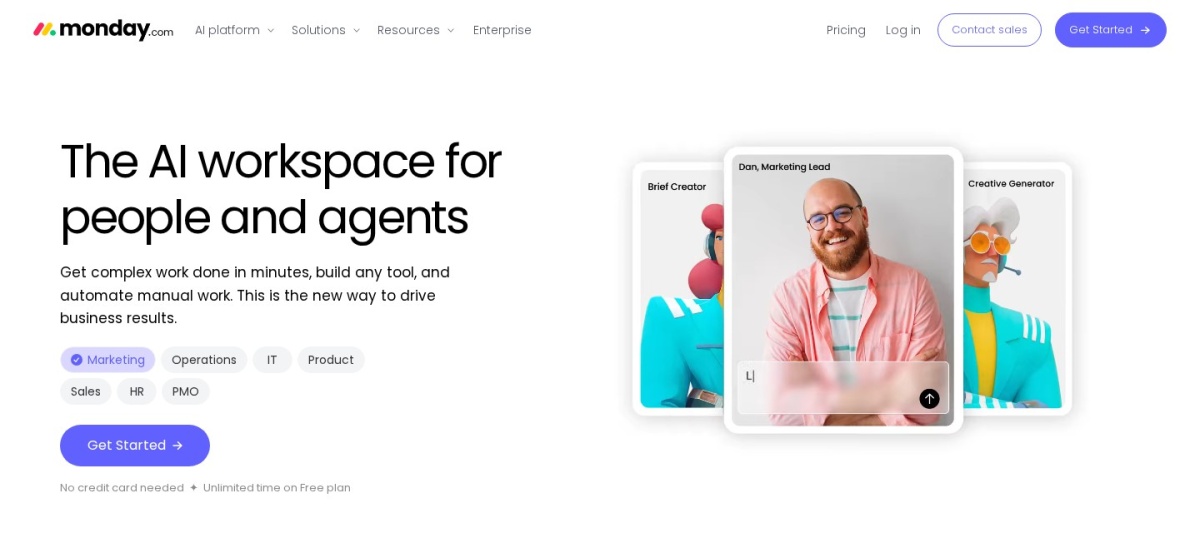
monday.com homepage, captured Nov 2026.
monday.com is a visual work platform built on boards, with timeline, Gantt and dashboard views across projects. The free plan covers up to 2 seats and 3 boards, and paid plans start at $9 a seat a month billed annually on Basic.
The trade off is capacity depth. Basic has no workload view, so teams that need it must move to Pro at $19 a seat a month, and paid plans need at least three seats. It suits product teams that already run roadmaps on monday.com and want basic capacity views without a second tool.
What we like
Rated 4.7 out of 5 on G2 from 17,144 reviews
Timeline and Gantt views for roadmaps
Free plan for up to 2 seats
Watch out for
Workload view needs the Pro plan
Basic has no automations
Three-seat minimum on paid plans
Pro adds the workload view, time tracking and private boardsVisit monday.com
04
ClickUp
4.7/5on G2 (9,000+ reviews, checked Nov 2026)
Paid from$12/mo
Best for teams already using ClickUp
Workload viewYes
Free planYes, unlimited members
Time trackingYes, native
Paid planBusiness, $12/mo
clickup.com
ClickUp homepage, captured Nov 2026.
ClickUp is an all-in-one workspace for tasks, docs and dashboards with workload views for capacity. The free plan covers unlimited members and tasks, and the Business plan at $12 per user a month adds more automation, dashboards and admin controls.
The trade off is depth. Its workload views are lighter than a purpose-built planner, with no margin forecasting or scenario planning. It suits product teams that already run their work in ClickUp and want basic capacity views without a second tool.
What we like
Free plan with unlimited members and tasks
Rated 4.7 out of 5 on G2 from 9,000+ reviews
Tasks, docs and chat in one workspace
Watch out for
Capacity views are lighter than dedicated planners
No margin forecasting or scenarios
Setup takes time in such a broad tool
Business adds more automation, dashboards and admin controlsVisit clickup.com
05
Productive
4.6/5on G2 (71 reviews, checked Nov 2026)
Starts at$10/mo
Best for planning tied to budgets
Resource planningYes, with placeholders
Time trackingYes
Profitability reportsYes
Paid planEssential, from $10/mo
productive.io
Productive homepage, captured Nov 2026.
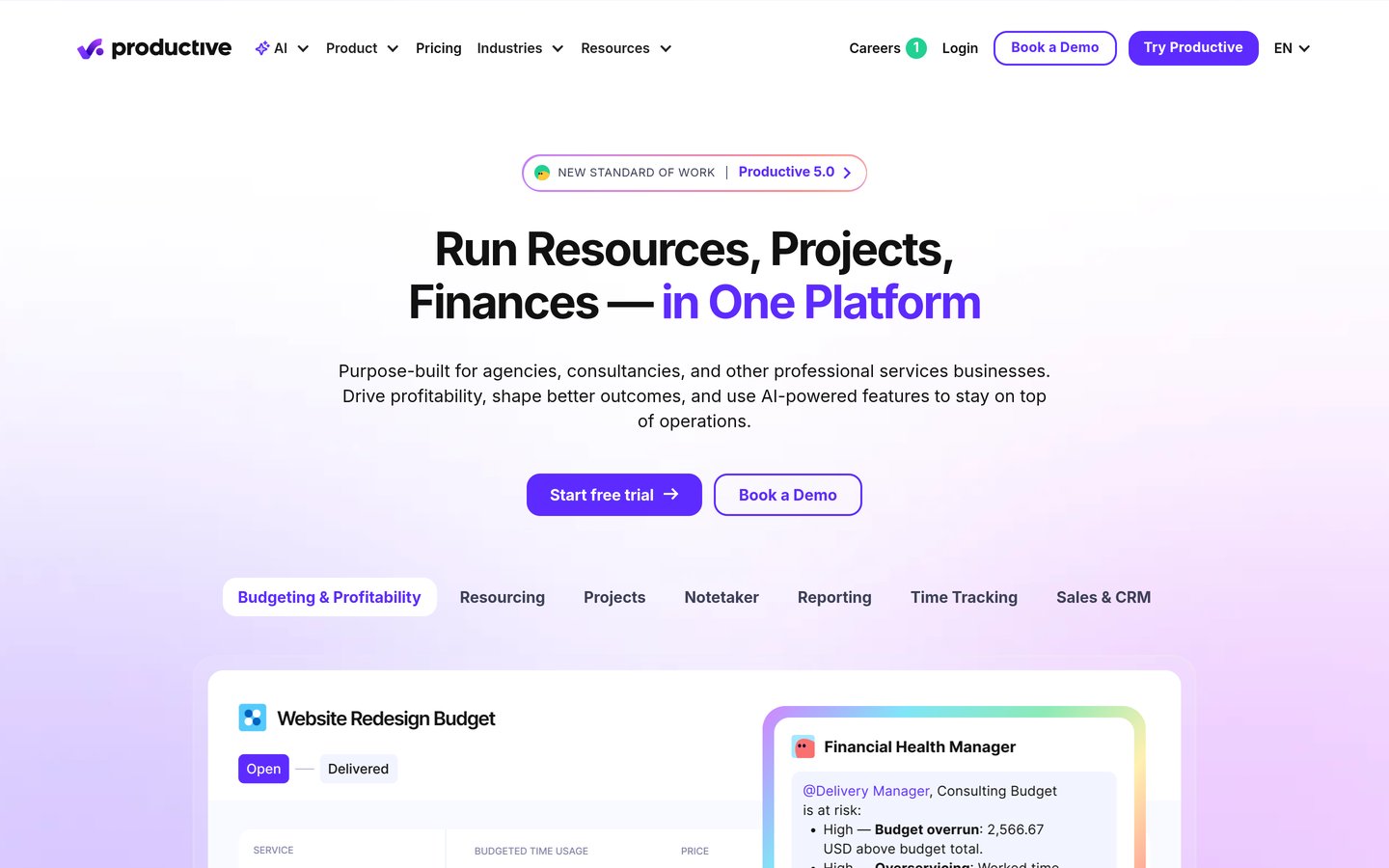
Productive is an all-in-one operations platform for agencies and consultancies. The Essential plan from $10 per user a month combines resource planning, placeholders, budgets, time tracking and profitability reports in one place.
The trade off is that it is a broad platform, so teams that only need scheduling pay for features they will not use. It suits product teams that also run client work and want planning, budgets and invoicing in one system instead of three tools.
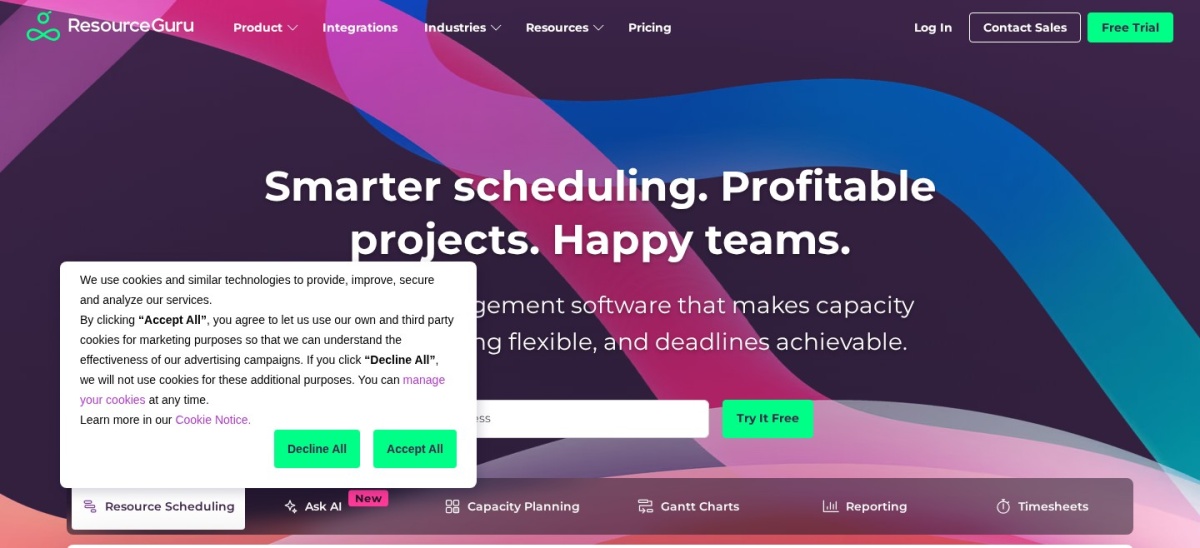
Resource Guru is a simple visual scheduler built around one job: stopping double-bookings. The Grasshopper plan at $4.16 a person a month billed annually, or $5 monthly, covers drag-and-drop scheduling, clash management, leave management and unlimited projects and clients.
The trade off is reporting. Downloadable reports start on the Blackbelt plan at $8 a month, and in-app reporting insights need the Master plan at $12. It suits small product teams that want a clear schedule without a full project suite.
What we like
Cheapest entry in this list
Clash alerts stop double-bookings
Rated 4.6 out of 5 on G2 from 506 reviews
Watch out for
Reports need the $8 or $12 plan
No live time tracking, only timesheets
Every person added is billed, even view-only users
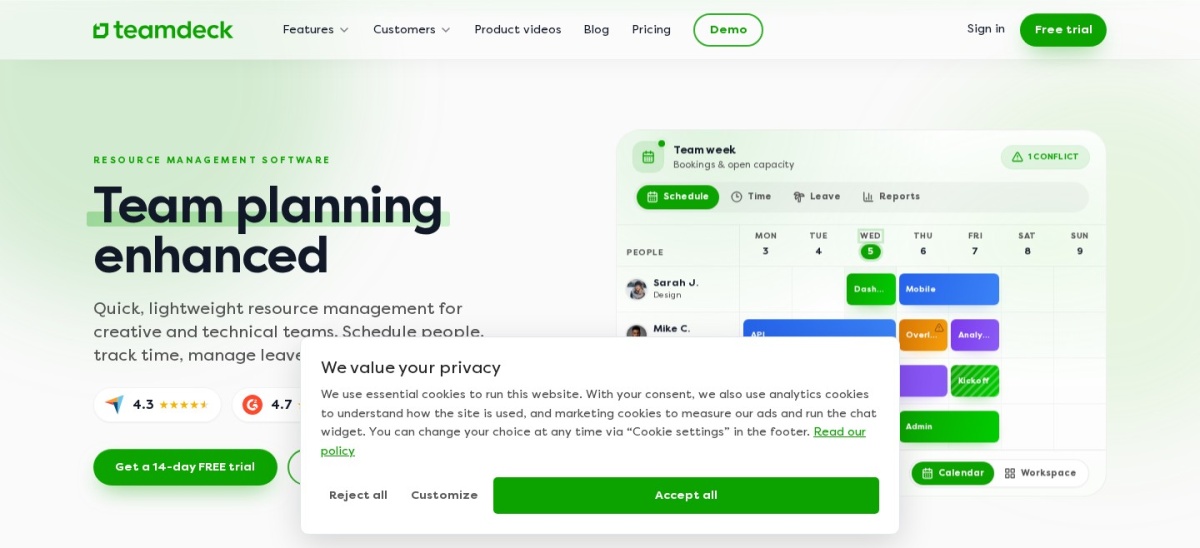
Teamdeck is a lightweight resource manager for creative and technical teams. The Full Member plan at $6 per user a month covers scheduling, time tracking, leave management and reports, while Light Member seats at $2 are view-only.
The trade off is scale and proof. It has only 15 G2 reviews, and it lacks the forecasting depth of Float or Runn. It suits small product teams that want scheduling, time and leave in one low-cost tool.
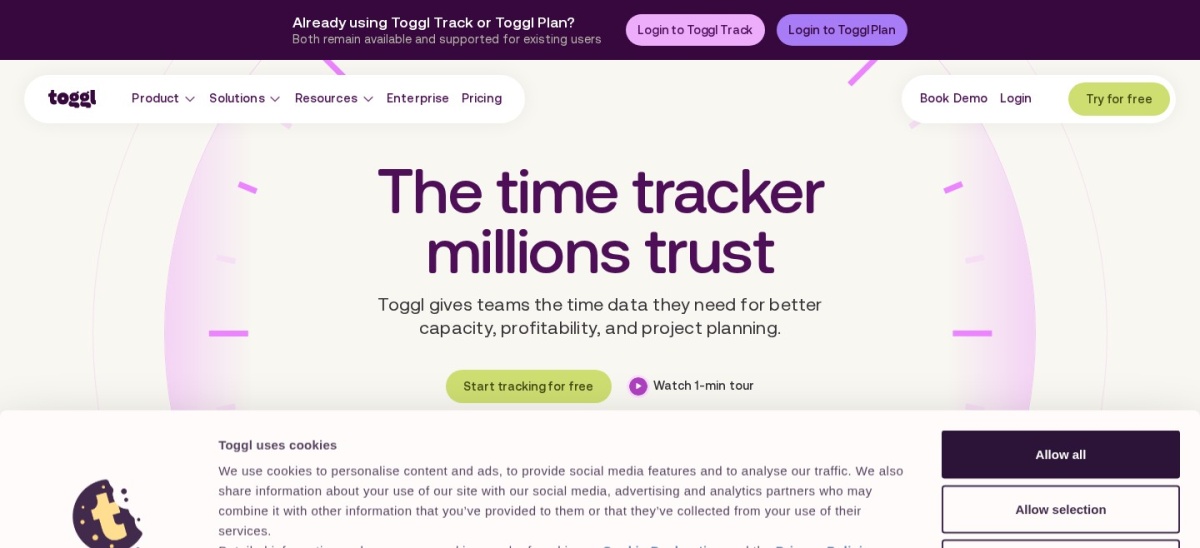
Toggl Plan is a simple timeline planner for small teams that schedule people across projects. The free Solo plan covers one user, and the Team plan at $9 per user a month adds shared timelines, time-off tracking and team reports.
The trade off is depth. It has no forecasting, scenario planning or margin reports, so larger teams outgrow it fast. It suits small product teams that want a clear timeline without a heavy setup.
Smartsheet is a spreadsheet-style work platform with workload tracking and dashboards. The Business plan at $19 per member a month covers sheets, reports and dashboards, and Resource Management is sold as a separate premium add-on for capacity planning.
The trade off is price and packaging. The add-on has no public price, so the true cost of capacity planning is higher than $19 a month. It suits large product teams that already run their work in Smartsheet and need portfolio-level views.
What we like
Rated 4.4 out of 5 on G2 from 23,028 reviews
Familiar spreadsheet-style interface
Strong dashboards and portfolio views
Watch out for
Capacity planning needs a separately priced add-on
Free plans cover basic scheduling well. Toggl Plan gives one user a timeline, ClickUp gives unlimited members and tasks, and monday.com is free for up to two seats.
Paid plans mostly add forecasting, reports and controls. Scenario planning, margin reports and single sign-on usually sit on the second or third tier, not the cheapest plan.
Check the seat rules before you compare prices. Runn bills a 20-seat minimum, Float bills only scheduled people, and monday.com needs at least three seats on paid plans.
How we chose
We started from the capacity planning tools that appear most often in product-team shortlists, then kept nine with public pricing and a numeric rating from G2 or Capterra.
Prices come from each vendor's pricing page, checked on 30 November 2026. Ratings and review counts come from G2 on the same day, except Runn, which uses Capterra because G2 holds only one Runn review. Where a vendor shows a sale, the list shows the regular price.
We left out tools with no public price, such as Kantata, and tools without a usable rating. No vendor paid for a place, and we do not claim to have used these tools ourselves.
How to choose project capacity planning software for a product team
Start with your planning horizon, then check the seat rules before you compare prices.
Work out how far ahead you plan. Four weeks of staffing is a scheduling job. Two quarters of demand against supply needs forecasting and tentative projects.
Count who gets billed. Float bills only scheduled people and Runn has a 20-seat minimum, so the same per-seat price can mean very different monthly bills.
Check what the entry plan leaves out. Workload views, reports and scenarios often sit on higher tiers, so read the plan comparison before you buy.
Run a trial on one live project. Plan one real sprint for a month and compare planned hours with actual hours. The tool with the smallest gap is the right one.
FAQ
What is the best project capacity planning software for product teams?
Float is the best pick for most product teams. Its Starter plan costs $7 per scheduled person a month and shows live capacity, time off and project margins in one schedule, and it is rated 4.2 out of 5 on G2 from 2,249 reviews.
How much does project capacity planning software cost?
Entry prices in this list run from $4.16 to $19 per person a month. Resource Guru starts at $4.16, Float and Runn at $7, and Smartsheet at $19, with its Resource Management add-on priced separately.
Is there free project capacity planning software for product teams?
Yes, with limits. ClickUp has a free plan with unlimited members and tasks, Toggl Plan is free for one user, and monday.com is free for up to two seats. The other tools in this list offer free trials instead of free plans.
Which project capacity planning software is best for beginners or small teams?
Resource Guru is the easiest starting point for a small team. Its booking grid is simple to learn, clash alerts stop double-bookings, and the entry plan costs $4.16 a person a month billed annually.
Float vs Runn: which is better for product teams?
Float fits teams that plan week by week on a visual timeline and want margin views with the schedule. Runn fits teams that plan months ahead, with tentative projects, role placeholders and saved scenarios for hiring decisions.
Do I need a separate tool, or will monday.com or ClickUp do?
A separate planner fits teams that live in capacity data every day, with forecasting, scenarios and margin views. monday.com or ClickUp fit product teams that already run their work there and only need basic workload views beside their roadmaps.
SaaS SEO and WordPress specialist with about 8 years of experience. Rakib compares WordPress plugins, themes, hosting and software using public pricing, documentation and user reviews. See how we rank.