Merge is the best of the Kombo alternatives for most teams. Its unified API covers HRIS, payroll, ATS, accounting and CRM, is rated 4.7/5 on G2 from 253 reviews, and starts at $650 a month with the first three linked accounts free. Pick Apideck for real-time reads, or Finch if payroll and benefits data is the whole job.
How we make this list: we compare pricing pages, product documentation and public user reviews, then re-check every price before each update. No product paid for a place. Disclosure.
Merge is the broadest direct swap, with one API for HRIS, payroll, ATS, accounting, CRM and ticketing from $650 a month.
Apideck holds a 4.9 G2 rating and reads data in real time instead of storing a copy, from $599 a month.
Finch is the payroll specialist, with US payroll and benefits data from $65 per connection a month.
Unified.to holds a 5.0 G2 rating from 31 reviews and charges by API calls, with unlimited connections, from $750 a month.
Nango is the cheapest entry: a free tier, pay-as-you-go from $50 a month, and a self-hosted option.
How do you pick the right Kombo alternative?
The first split is coverage. Kombo is an HR-first unified API, so a true replacement must cover HRIS and ATS at least as deeply, and the wider the net, the fewer vendors you need.
The second split is how the data reaches you. Some vendors store a synced copy of your customers' HR data, while Apideck and Unified.to read it live from the source system, which changes both freshness and your security review.
Price is the hardest part to compare, because vendors charge for different things. Merge bills per linked account, Finch per connection, Apideck per consumer, Unified.to per API call, and Codat and Rutter do not publish a price at all, so model your real volumes before you shortlist.
Coverage claims hide the gaps that matter. Every vendor counts integrations differently, so bring a list of the exact HR and payroll systems your customers use and check each one, including whether the connection is live or assisted. Our guide on creating a custom REST API endpoint in WordPress shows how much of the plumbing a unified API is meant to remove.
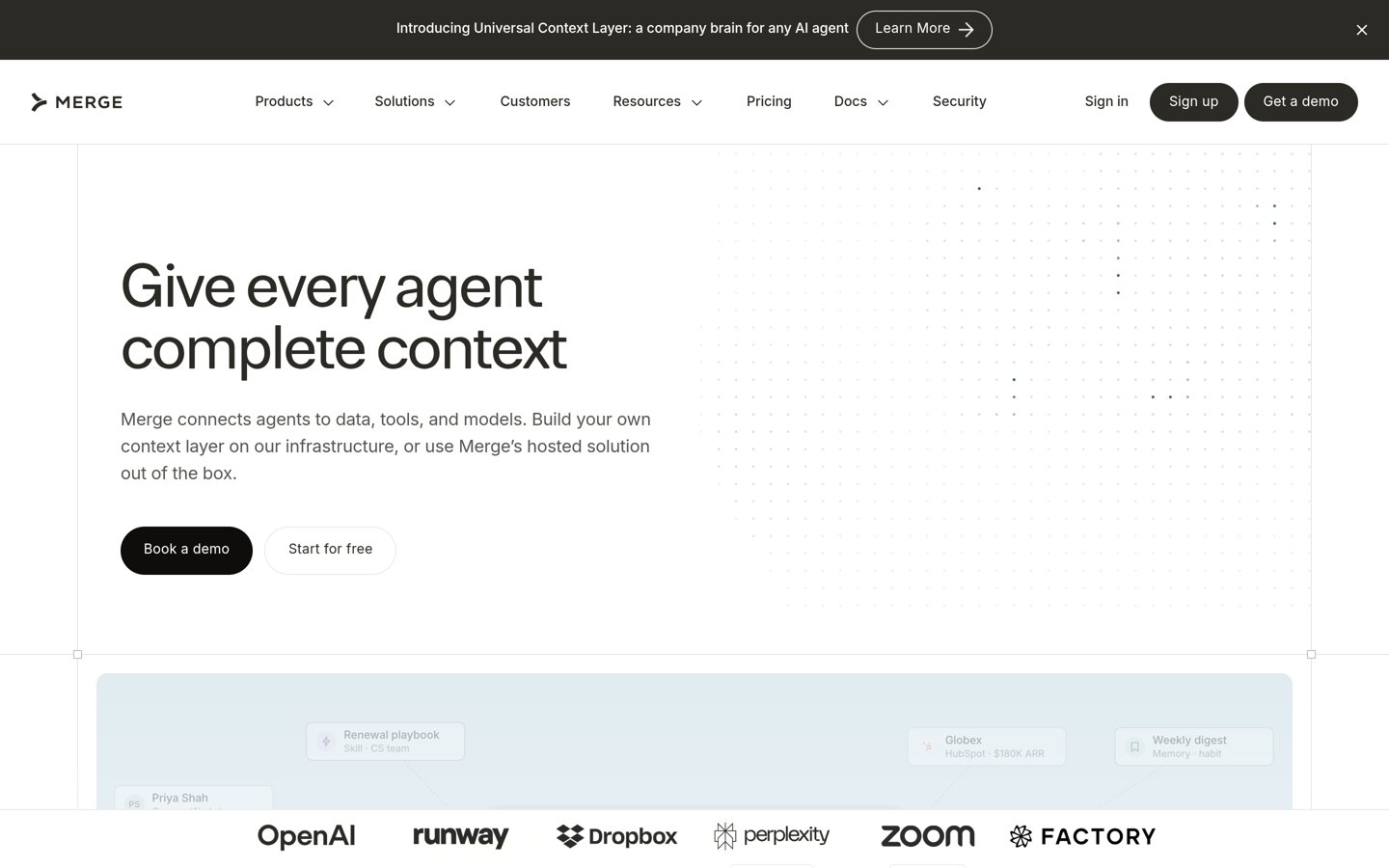
Merge is a unified API platform that gives your product one API for HRIS, payroll, ATS, accounting, CRM and ticketing, instead of one integration per app. Launch is free for the first three production linked accounts, then $650 a month for up to ten, and it holds a 4.7 rating on G2 from 253 reviews.
The trade off is the per-account meter. Each linked account past the first ten costs $65 a month, so the bill climbs fast once hundreds of employers connect. It suits B2B products that need several categories through one vendor.
What we like
One API across HR, payroll, ATS and more
Free for the first 3 production linked accounts
Mature logs and issue detection
Largest review base here, 253 G2 reviews
Watch out for
$65 a month per extra linked account
Key features gated to Professional and Enterprise
59 of its HRIS and ATS integrations are labelled beta
Professional and Enterprise add custom mappings and faster syncsVisit merge.dev
02
Apideck
4.9/5on G2 (61 reviews, checked Nov 2026)
Paid from$599/mo
Best for real-time, pass-through reads
ModelReal-time pass-through
Free tier2,500 API requests
Unified APIs on Launch2
Paid planLaunch, $599/mo
apideck.com
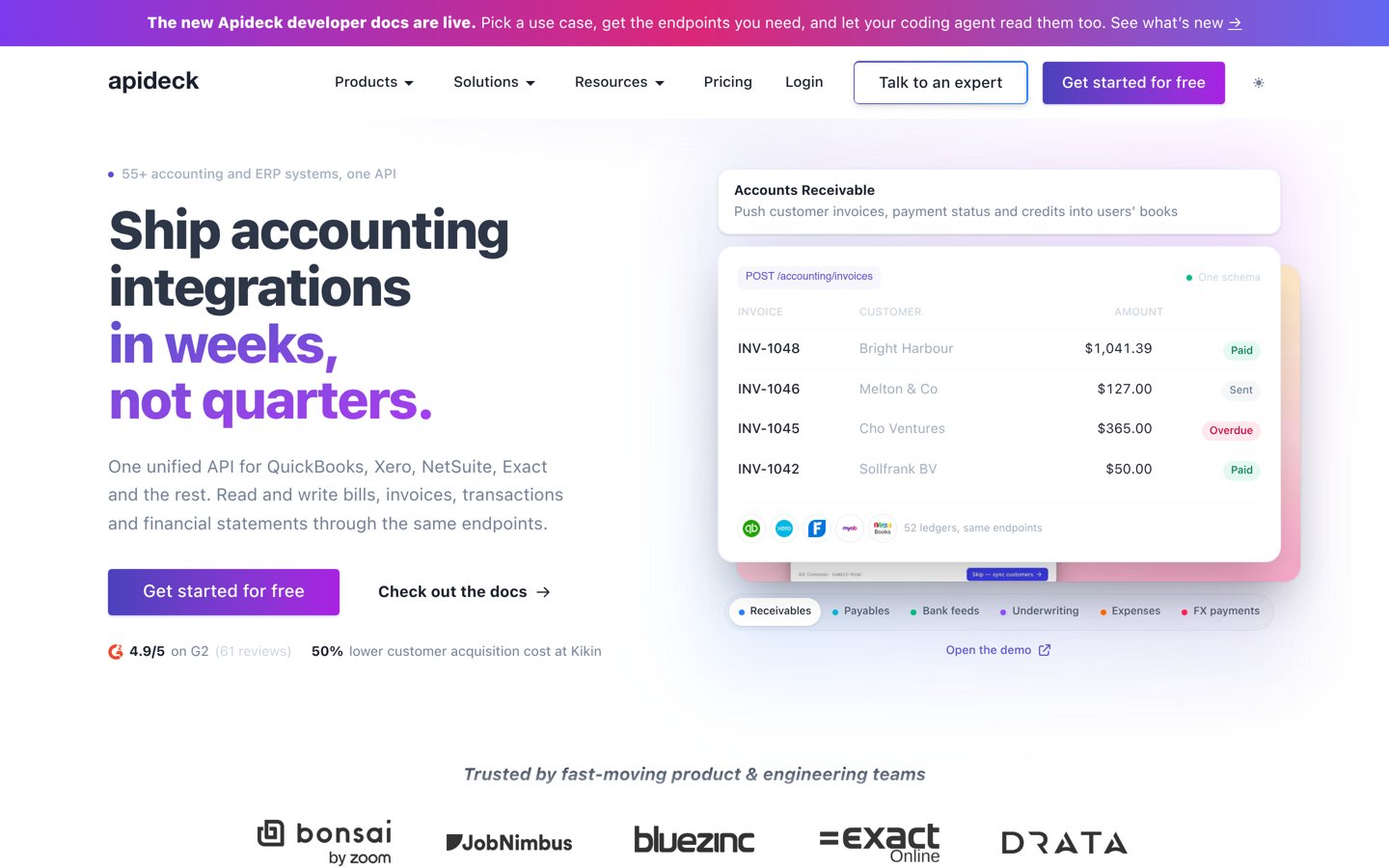
Apideck homepage, captured Nov 2026.
Apideck is a unified API that passes requests through to the source system in real time instead of storing a synced copy of your customers' data. Launch costs $599 a month, covers 2 unified APIs and 25 consumers, and it holds a 4.9 rating on G2 from 61 reviews.
The trade off is the price and the category ceiling. HRIS plus ATS needs the $1,299 Scale plan, and G2 lists the same Launch plan as €599 a month while the vendor site shows $599, so confirm the currency before you budget. It suits teams uneasy about a vendor warehousing payroll data.
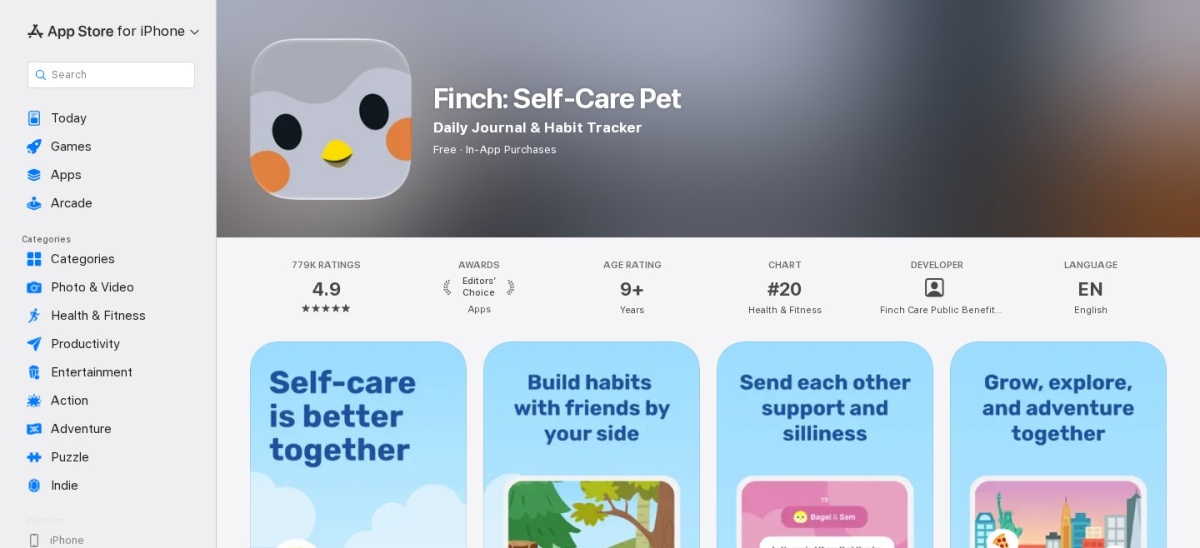
Finch is a unified API for HRIS and payroll that standardises directory, employment, payroll and benefits data from more than 250 providers. Starter costs $65 per connection a month and covers 24 providers with read-only data, and it holds a 4.7 rating on G2 from 67 reviews.
The trade off is scope and the meter. Finch covers HR and payroll only, with no ATS, and the per-connection price compounds fast at volume, while writes and most providers need the Pro plan. It suits US payroll, benefits and lending products.
What we like
Deepest US payroll and benefits coverage here
Deduction and 401(k) write-back on Pro
Free Sandbox for development
Lowest published entry price for a hosted API
Watch out for
No ATS coverage
$65 a month per connection adds up fast
Most providers are assisted connections, not live APIs
Unified.to is a unified API across 37 categories, including HRIS, ATS, CRM and accounting, with real-time pass-through reads and unlimited customers and connections. Grow costs $750 a month for 750,000 API calls, and it holds a 5.0 rating on G2 from 31 reviews.
The trade off is the entry price and the review base. A homepage banner offered 25% off Grow and Pro for three months, so the list shows the regular $750, and 31 reviews is a thin base for a perfect score. It suits teams with high call volume across many categories.
What we like
Unlimited connections and customers
Real-time reads with virtual webhooks
Perfect 5.0 G2 rating
30-day trial with no card
Watch out for
$750 a month is the highest published entry price here
Nango is an open-source integration platform you can run hosted or self-host, with syncs defined in code and access to raw provider APIs when the unified model runs out. The free tier covers 10 connections, paid plans start at $50 a month, and it holds a 4.5 rating on G2 from 67 reviews.
The trade off is the work you keep. Your engineers build and maintain the sync logic per provider, which is the labour Merge and Kombo charge to remove. It suits technical teams that want control of the integration layer and a low starting price.
What we like
Free tier and pay-as-you-go from $50 a month
Self-hosting for strict security reviews
Open source with a large contributor base
Raw API access when the model runs out
Watch out for
Your team builds each provider sync
HR and payroll catalogue is smaller than the specialists
Knit is a managed, HR-first unified API with 66 API-based HRIS integrations and 40 ATS integrations, and strong coverage of APAC systems such as Keka and greytHR. Start Up costs $499 a month with a 30-day free trial, and it holds a 4.8 rating on G2 from 91 reviews.
The trade off is youth. Knit is a newer vendor, so a fair share of its HRIS and ATS integrations have not been as widely adopted as Merge's or Kombo's, and write capabilities are still developing. It suits early-stage teams selling into APAC employers.
What we like
Lowest published entry price of the hosted unified APIs
StackOne is an agent integration platform that gives AI agents governed actions across 640+ business apps, including HRIS, ATS and LMS systems, through MCP, SDKs and a REST API. Gateway Team costs $600 a month, Starter is free with 1,000 credits per seat a month, and it holds a 4.8 rating on G2 from 67 reviews.
The trade off is the shape of the product. StackOne is built for agents that act on systems, not for syncing HR records into your database, and the $600 figure is the Gateway Team plan while OEM pricing for embedding is separate. It suits teams whose agents need to read and write HR tools.
What we like
640+ connectors with 46,000+ actions
MCP gateway for AI agents
Free Starter plan with no card
Prompt-injection defence on every plan
Watch out for
Not a record-sync unified API like Kombo
Gateway and OEM pricing are separate
One review flags limited test credentials below high spend
Codat is a unified API that standardises accounting, commerce and banking data behind one model, with white-label connection flows for lenders and fintechs. It holds a 4.6 rating on G2 from 28 reviews, and pricing is by quote.
The trade off is the fit. Codat is accounting-led, so HRIS and payroll depth is not its focus, and it only earns a place here for products that need financial data beside employment data. It suits lenders and spend platforms that read ledgers first.
What we like
Strong accounting and commerce coverage
White-label connection flow
4.6 G2 rating from 28 reviews
Real-time access to client records
Watch out for
HRIS and payroll are not its focus
No published prices, quote only
Uniformity varies by source system
Paid plans are custom; talk to sales for volumesVisit codat.io
09
Rutter
4.7/5on G2 (16 reviews, checked Nov 2026)
PricingCustom/yr
Best unified API for commerce-led fintech
Main categoriesCommerce, accounting, payments
Platforms covered60+ B2B platforms
Free startYes, no card
Paid planCustom quote
rutter.com
Rutter homepage, captured Nov 2026.
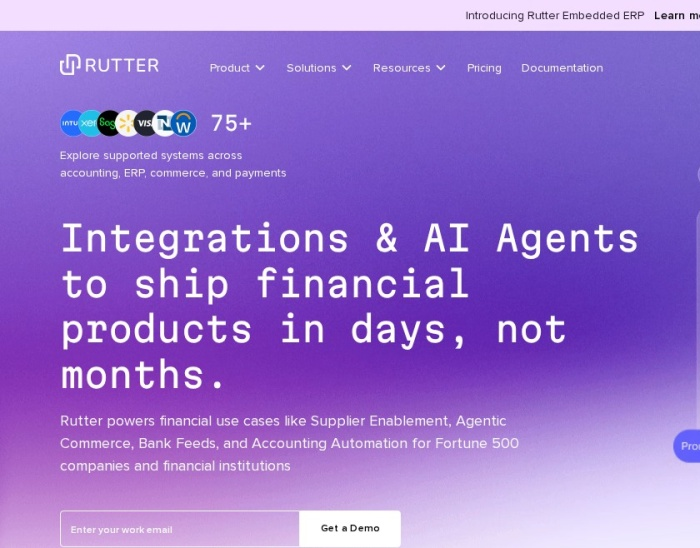
Rutter is a unified API for commerce, accounting, payments and ads data, built for fintechs that read ledgers beside storefront and payment platforms. It holds a 4.7 rating on G2 from 16 reviews, and it is free to start without a card.
The trade off is the same as Codat: HRIS and payroll are not what Rutter is built for, so it only fits teams whose employment-data need sits beside commerce data. It suits fintech products that already live in Rutter's categories.
What we like
Free to start with no card required
One model across 60+ platforms
White-label OAuth flow
4.7 G2 rating
Watch out for
Only 16 G2 reviews
HRIS and payroll are not its focus
Paid pricing is by quote
Paid plans are connection-based subscriptions by quoteVisit rutter.com
Unified APIs vs agent gateways: which job are you hiring for?
A unified API replaces Kombo directly. It reads employer systems with employer permission and returns structured HR and payroll data your product can build features on, day after day.
An agent gateway answers a different question: what can an AI agent do inside those systems right now. StackOne and Knit both sell MCP access, but only Knit is a unified API first, while StackOne is a gateway first.
Many products end up needing one of each. A recruiting product, for example, may run Merge for candidate and employee records and StackOne so its agent can act inside the ATS.
Decide the data job first, then compare coverage and price inside that group. Comparing Merge with StackOne on price alone misses the point, because they do not do the same job.
How we chose
We started from every unified API shortlisted against Kombo in 2026 comparisons, then kept those with a verifiable rating on G2 and a live product.
Prices come from each vendor's pricing page or its vendor-provided G2 listing, checked on 29 November 2026. Ratings and review counts come from G2 on the same day. Where a vendor shows a sale, the list shows the regular price.
We left out worker-permissioned verification tools such as Pinwheel, Truework and Plaid, because they answer income questions for lenders rather than replacing an employer-side HR API, and tools with no verifiable public rating. No vendor paid for a place, and we do not claim to have used these tools ourselves.
How to choose a Kombo alternative
Start with whose data your product runs on, then match coverage and price inside that group.
Decide HR-first or multi-category first. If HR depth is the job, shortlist Merge, Finch, Knit and Apideck. If you also need accounting or commerce, add Codat or Rutter.
Check your exact provider list. Bring your top fifty HR and payroll systems to the evaluation and confirm each one is covered natively, with live or assisted connections.
Compare the meter, not the headline price. Per-account, per-connection, per-consumer and per-call meters cross over quickly as customers grow, so model the bill at real volumes, not launch volumes.
Price at your year-two connection count. Free tiers and first-three-free offers end fast, so model the bill at the connection count you expect in year two before you commit.
FAQ
What is the best Kombo alternative in 2026?
Merge is the best Kombo alternative for most teams. Its unified HRIS and payroll API covers hundreds of systems, is rated 4.7 out of 5 on G2 from 253 reviews, and starts at $650 a month with the first three linked accounts free.
How much do Kombo alternatives cost?
Published starting prices run from $50 a month at Nango, to $65 per connection a month at Finch, $499 at Knit, $599 at Apideck, $600 at StackOne, $650 at Merge and $750 at Unified.to. Codat and Rutter price by quote.
Is there a free Kombo alternative?
Yes, in part. Nango has a free tier covering 10 connections, Merge is free for your first three production linked accounts, StackOne has a free Starter plan, and Apideck offers a free tier of 2,500 API requests. None of the nine is free at production scale.
Which Kombo alternative is best for small teams?
Nango is the best pick for small technical teams, with a free tier and pay-as-you-go pricing from $50 a month. Knit is the best hosted pick for small teams at $499 a month, with a 30-day trial.
Merge vs Apideck: which is better as a Kombo alternative?
Merge is better for breadth, covering HR, payroll, ATS, accounting and CRM through one API from $650 a month. Apideck is better for real-time reads with no stored copy of your customers' data, from $599 a month.
What is the best Kombo alternative for European HR systems?
Merge covers many European systems inside its HR category, and Knit covers APAC and European HR tools at a lower entry price. Kombo itself remains the deepest European HR pick, so check your exact provider list during evaluation.
Which Kombo alternative is best for AI agents?
StackOne is the best pick for AI agents, with a governed MCP gateway across 640+ connectors from $600 a month for Gateway Team. Knit is the better pick if you want a unified API first with MCP access beside it.
SaaS SEO and WordPress specialist with about 8 years of experience. Rakib compares WordPress plugins, themes, hosting and software using public pricing, documentation and user reviews. See how we rank.