Cast AI is the best Kubecost alternative for teams that want automation, with a 4.5 out of 5 G2 rating from 284 reviews and a free cost-monitoring tier. Pick Vantage for the cheapest paid plan at $30 a month, or PerfectScale for free rightsizing up to 300 vCPU a month.
How we make this list: we compare pricing pages, product documentation and public user reviews, then re-check every price before each update. No product paid for a place. Disclosure.
Cast AI automates rightsizing, autoscaling and spot, with a free monitoring tier; Growth starts at $1,000 a month plus about $5 per managed CPU.
Vantage has the cheapest paid plan in this list at $30 a month, with a free tier to $2,500 of tracked cloud spend.
CloudZero, Finout, nOps, Harness and Cloudability publish no entry price; all five sell by quote.
PerfectScale is the only free rightsizer in this list, free up to 300 vCPU a month.
Datadog Pro starts at $5 a month per $1,000 of monitored spend, the only usage-based price in this list.
How do you choose the best Kubecost alternatives?
Start with the job Kubecost did for you. If you only need allocation and chargeback, a reporting tool is enough; if requests are inflated, you need a rightsizer that changes them.
Automation is the biggest split in this list. Cast AI and PerfectScale can change requests and nodes, while Vantage, CloudZero and Finout report and recommend, so your team applies the fixes.
Watch the billing unit before you compare prices. Some tools charge per managed CPU, some take a share of savings, and some charge a flat fee by tracked spend. Our guide on how to read a hosting plan's CPU and RAM limits explains the CPU numbers those per-CPU prices are based on.
Free tiers go a long way here. Cast AI monitors clusters free, PerfectScale is free to 300 vCPU a month, and Vantage is free to $2,500 of tracked spend, so most small teams can start without paying.
Check the rating sample, not just the score. Cast AI's 4.5 rests on 284 G2 reviews, while PerfectScale's 4.6 rests on 21, so the first score carries far more weight.
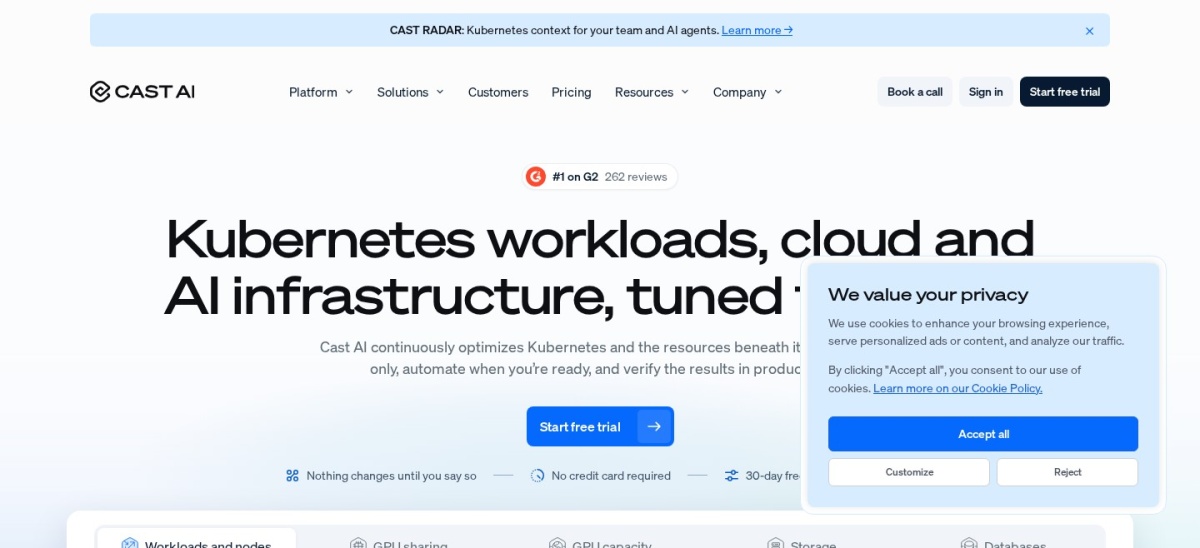
Cast AI is a Kubernetes automation platform that rightsizes CPU and memory requests, replaces the cluster autoscaler, packs pods onto fewer nodes and moves work to spot capacity. Its free tier covers cost monitoring and savings insights for any number of clusters, with no credit card needed.
The trade off is price. Growth starts at $1,000 a month on the AWS Marketplace listing, plus about $5 per managed CPU per month, while the official pricing page asks for a custom quote. It suits teams that want the tool to apply the savings, not just report them.
What we like
Automates rightsizing, autoscaling and spot
Free monitoring tier with no credit card
Works on EKS, AKS, GKE and on-prem clusters
Rated 4.5 out of 5 from 284 G2 reviews
Watch out for
Paid plans start at $1,000 a month before CPU charges
No published rate card on its own pricing page
Automation needs write access to your clusters
Growth adds automation; Enterprise removes the cluster and CPU limitsVisit cast.ai
02
Vantage
4.7/5on G2 (72 reviews, checked Nov 2026)
Paid from$30/mo
Best value Kubecost alternative
Free tierStarter, to $2,500 spend/mo
Providers40+ cloud, AI and SaaS
KubernetesCost reporting included
Paid planPro, $30/mo
vantage.sh
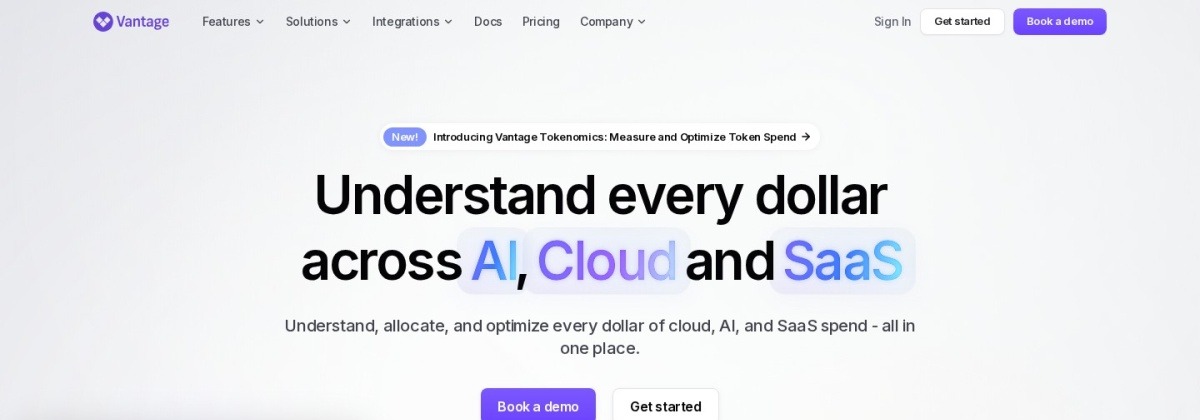
Vantage homepage, captured Nov 2026.
Vantage is a self-serve cloud cost platform that tracks spend across AWS, Azure, Google Cloud and more than 40 providers, including AI and SaaS costs. Its free Starter tier covers up to $2,500 of tracked cloud spend a month for 3 users, and Pro costs $30 a month for up to $7,500 of spend.
The trade off is depth. Vantage reports Kubernetes costs and recommends savings, but it does not rightsize pods or move workloads, so engineers still apply the fixes. It suits small teams that want clear, fixed-price cost tracking across clouds.
What we like
Cheapest paid plan in this list at $30 a month
Fixed prices, not a share of your bill
Free tier covers up to $2,500 of spend a month
Rated 4.7 out of 5 from 72 G2 reviews
Watch out for
No automated rightsizing or node changes
Kubernetes reporting is one feature among many
Price jumps when tracked spend passes a tier
Pro adds Autopilot for AWS Savings Plans and virtual taggingVisit vantage.sh
03
CloudZero
4.6/5on G2 (64 reviews, checked Nov 2026)
PricingCustom/yr
Best for unit economics
Free tierNo
AllocationCustomer, feature, team
Unit economicsCost per customer
Paid planSingle subscription, by quote
cloudzero.com
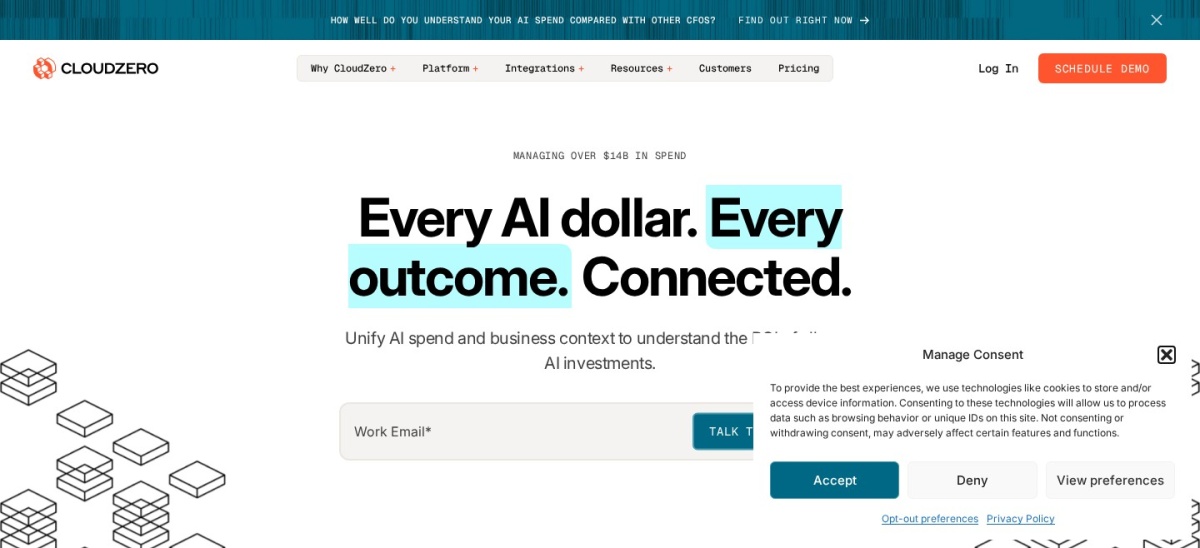
CloudZero homepage, captured Nov 2026.
CloudZero is a cost intelligence platform that maps cloud spend to customers, features, teams and products, even when tagging is incomplete. One subscription covers unlimited users, hourly cost data, anomaly detection, forecasts and optimisation recommendations.
The trade off is that it reports rather than acts. There is no execution layer, so savings depend on your team applying the findings, and the pricing page publishes no rate. It suits SaaS teams that need unit economics, such as cost per customer.
Finout is an enterprise FinOps platform that pulls cloud, SaaS, AI and Kubernetes spend into one set of reports. It covers AWS, Azure, Google Cloud and Oracle Cloud, and its virtual tagging lets finance teams allocate shared costs without re-tagging every resource.
The trade off is price and setup. Finout charges a flat annual fee set by quote, so buyers get no list price to compare, and complex environments need configuration first. It suits larger organisations that need one consolidated bill across clouds.
What we like
Consolidates spending across different environments
Supports AI infrastructure cost allocation
Annual subscription model
Rated 4.5 out of 5 from 87 G2 reviews
Watch out for
Requires a personalised pricing quote
Complex environments require configuration
Kubernetes needs may affect the fee
Annual contracts cover consolidated reporting and financial managementVisit finout.io
05
PerfectScale
4.6/5on G2 (21 reviews, checked Nov 2026)
PriceFree
Best free rightsizing alternative
Free tierCommunity, to 300 vCPU/mo
RightsizingPod and node recommendations
AutomationExpert plan only
Paid planAdvanced, Expert, per vCPU
perfectscale.io
PerfectScale homepage, captured Nov 2026.
PerfectScale is a Kubernetes optimisation platform from DoiT that finds wasted CPU and memory, flags performance and resilience issues, and recommends right-sized requests and nodes. The free Community tier covers unlimited clusters, nodes and pods up to 300 vCPU a month.
The trade off is automation. Unlimited automation, node recommendations and API access sit in the Expert plan, and both paid plans are priced per vCPU per month by quote. It suits mid-size teams that want free rightsizing advice and can apply the changes themselves.
nOps is a cloud cost platform built around AWS that ties Kubernetes cost allocation to commitment savings. It shows costs by team and workload, automates Reserved Instance and Savings Plan buying without long-term commitment risk, and flags anomalies and waste.
The trade off is focus and pricing. It is strongest on AWS, and its pricing page lists no rates: visibility is a flat fee based on cloud spend, while rate optimisation takes a share of savings. It suits AWS-heavy teams that want commitment savings handled for them.
What we like
Automated commitment management with no lock-in
Cost allocation down to team and workload
Sets up in minutes with a 14-day trial
Rated 4.7 out of 5 from 159 G2 reviews
Watch out for
No published price on its pricing page
AWS-first, so other clouds get less depth
Savings-share fees grow with the savings
Visibility is a flat fee; rate optimisation takes a share of savingsVisit nops.io
07
Datadog
4.4/5on G2 (746 reviews, checked Nov 2026)
Paid from$5/mo
Best for cost beside engineering metrics
Free coverageDatadog expenses only
Pro pricing unit$1,000 monitored spending
Cost allocationCloud and Kubernetes
Paid billingAnnual or on-demand
datadoghq.com
Datadog homepage, captured Nov 2026.
Datadog is an observability platform whose Cloud Cost Management module puts cloud and Kubernetes spend beside the metrics engineers already watch. Its free Cost Visibility tier covers Datadog's own charges, while Pro starts at $5 a month per $1,000 of monitored cloud and SaaS spend with annual billing.
The trade off is that the bill grows with monitored spend, and on-demand pricing is $7.20 per $1,000 instead of $5. It suits teams already running Datadog that want cost and performance data in one place.
What we like
Connects financial and operational information
Kubernetes cost allocation
Spending anomaly investigation
Rated 4.4 out of 5 from 746 G2 reviews
Watch out for
Free coverage excludes external cloud spending
Costs increase with monitored expenses
Other Datadog modules may cost extra
Pro adds external cloud cost tracking from $60 yearly per $1,000 of monthly monitored spendingVisit datadoghq.com
08
Harness
4.6/5on G2 (Harness Platform) (336 reviews, checked Nov 2026)
PricingCustom/yr
Best for Harness CI/CD teams
Free tierYes, platform free plan
Cost moduleCloud Cost Management
CloudsAWS, Azure, GCP, on-prem
Paid planEssentials, Enterprise, by quote
harness.io
Harness homepage, captured Nov 2026.
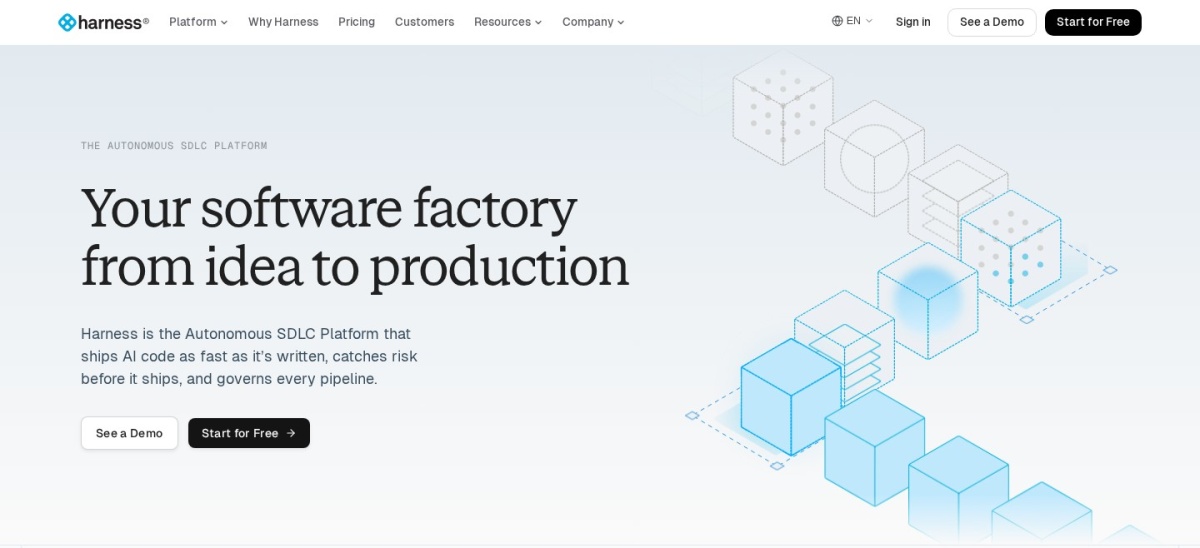
Harness is a software delivery platform, and its Cloud Cost Management module puts cost data beside build and deploy data. Teams can track Kubernetes spend, catch anomalies and auto-stop idle resources, all inside the platform they already use for CI and CD.
The trade off is that cost management is a module, not a standalone purchase, and the pricing page lists no rates for it. It suits teams that already run Harness for delivery and want cost insight without adding another vendor.
What we like
Cost data sits beside CI and CD data
Auto-stopping cuts idle resource spend
Free plan covers individual developers
Rated 4.6 out of 5 from 336 G2 reviews
Watch out for
Not a standalone Kubernetes cost tool
No published price for the cost module
Rating covers the whole platform, not CCM alone
Cost management is a Harness module; Essentials and Enterprise are quotedVisit harness.io
09
IBM Cloudability
4.2/5on G2 (211 reviews, checked Nov 2026)
PricingCustom/yr
Best for enterprise FinOps governance
Free tierNo
Cost allocationDepartmental chargeback
ForecastingDriver-based forecasting
Paid planCustom quote only
ibm.com
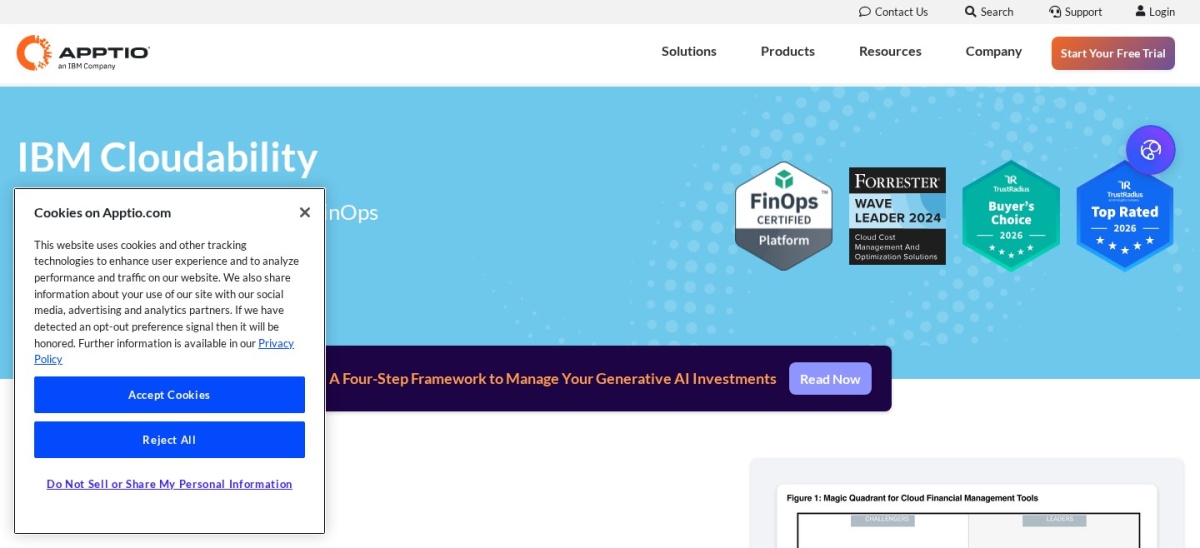
IBM Cloudability homepage, captured Nov 2026.
IBM Cloudability is an enterprise cloud financial management platform that covers spend allocation, forecasting, rightsizing recommendations and departmental chargeback across public clouds. It adds driver-based forecasting and budget variance tracking on top of basic allocation.
The trade off is custom pricing and the effort of setting up enterprise financial processes. It suits large organisations that need structured reporting and accountability between engineering and finance.
What we like
Enterprise financial reporting
Department-level cost attribution
Supports shared expense allocation
Budget variance and forecasting capabilities
Watch out for
No published entry subscription price
Requires structured implementation
May be excessive for small cloud environments
Paid subscriptions support enterprise cost allocation, forecasting and optimisationVisit ibm.com
Visibility vs automation: pick the job first
These tools split into two groups. Cast AI and PerfectScale also change requests, nodes or commitments, while Vantage, CloudZero, Finout and Cloudability mostly show where the money goes.
Start with visibility if you cannot yet say which team or workload drives the bill. Vantage is free to $2,500 of tracked spend a month, and Cast AI monitors clusters free.
Add automation once the waste is mapped. Automated changes need write access to your clusters, so run them in recommendation mode first, then turn on automation for one workload at a time.
How we chose
We started from the tools named most often as Kubecost replacements in FinOps comparisons, then kept nine with a public G2 rating and a live homepage and pricing page.
Prices come from each vendor's pricing page, checked on 29 November 2026, with Marketplace listings used where the vendor page publishes no rate. Ratings come from G2 on the same day. Where a vendor shows a sale, the list shows the regular price.
We left out OpenCost, the closest free match, because it has no public rating on G2, Capterra or Trustpilot, and the checker requires one for every tool. No vendor paid for a place, and we do not claim to have used these tools ourselves.
How to choose a Kubecost alternative
Match the tool to the cost problem you can already name, then check the billing unit before you sign.
Name the missing job. If you cannot say who spends what, start with visibility. If requests are inflated, pick a rightsizer. If nodes sit idle, pick automation or spot handling.
Start free where you can. Cast AI monitors clusters free, PerfectScale is free to 300 vCPU a month, and Vantage is free to $2,500 of tracked spend. Use the free tier to confirm the savings before paying.
Check the billing unit. Some tools charge per managed CPU, some take a share of savings, and some charge a flat fee by tracked spend. Work out the yearly cost at your cluster size before comparing headline prices.
Turn on automation one workload at a time. Automated rightsizing changes live pods, so start in recommendation mode, watch one workload for a week, then allow changes.
FAQ
What is the best free alternative to Kubecost?
PerfectScale is the best free Kubecost alternative for rightsizing. Its Community tier is free up to 300 vCPU a month across unlimited clusters, with cost and waste visibility included. Cast AI is the better free pick if you only need cost monitoring, since its free tier covers any number of clusters.
How much do Kubecost alternatives cost?
Prices run from free to $1,000 a month or more. Vantage Pro costs $30 a month, Datadog Pro starts at $5 a month per $1,000 of monitored spend, and Cast AI Growth starts at $1,000 a month plus about $5 per managed CPU. Five tools in this list publish no price and sell by quote.
Which Kubecost alternative is best for small teams?
Vantage is the best pick for small teams. Its free tier covers up to $2,500 of tracked cloud spend a month, Pro costs $30 a month with published prices, and setup is self-serve with no sales call. PerfectScale is the free pick if the team only runs Kubernetes.
What is the difference between Kubecost and Cast AI?
Kubecost shows where the money goes, while Cast AI also changes the setup. Kubecost allocates spend by namespace, pod and label and recommends savings, and it is free to 250 cores. Cast AI rightsizes requests, replaces the autoscaler and moves work to spot capacity, starting at $1,000 a month.
Which is better, Cast AI or Vantage?
Cast AI is better if you want automation, and Vantage is better if you want cheap, clear pricing. Cast AI rightsizes pods and moves work to spot capacity, but Growth starts at $1,000 a month. Vantage costs $30 a month and reports spend well, but it never changes a pod.
Do Kubecost alternatives change my workloads automatically?
Some do and some do not. Cast AI and PerfectScale can apply rightsizing and node changes in production, usually after a read-only period. Vantage, CloudZero, Finout and Cloudability report and recommend only, so your team applies the fixes. Check what each plan automates before you buy.
SaaS SEO and WordPress specialist with about 8 years of experience. Rakib compares WordPress plugins, themes, hosting and software using public pricing, documentation and user reviews. See how we rank.