Fivetran is the best Debezium alternative for most teams, with 700+ managed connectors, log-based CDC and a free plan to 500,000 monthly active rows. Pick Estuary Flow for real-time CDC into a warehouse, or Airbyte if you want a free open-source core you can self-host.
How we make this list: we compare pricing pages, product documentation and public user reviews, then re-check every price before each update. No product paid for a place. Disclosure.
Fivetran leads with 700+ managed connectors, log-based CDC and a free plan to 500,000 monthly active rows.
Estuary Flow is the fastest CDC here, landing changes in under 100 milliseconds from $0.50 per GB plus $100 per connector.
Airbyte Core is free to self-host, and Airbyte Cloud Standard starts at $20 a month with 5 credits included.
Confluent Cloud is the pick for teams already built around Kafka, with Standard clusters starting at about $385 a month.
Qlik Replicate and Striim publish no list price, so budget them only after a sales quote.
How do you choose the best Debezium alternative for your stack?
Debezium only captures changes. It reads the database log and publishes events, usually to Kafka, and leaves delivery, recovery and schema handling to you.
A managed alternative takes over the rest of the pipeline. Fivetran, Airbyte, Hevo and Estuary capture changes, move them and load them into a warehouse without you running brokers.
Latency is the first real dividing line. Estuary lands changes in under 100 milliseconds, Fivetran syncs every 15 minutes on Standard, and Airbyte Cloud Standard syncs hourly.
Pricing is the second dividing line, because every vendor meters something different. Fivetran bills monthly active rows, Airbyte sells credits, Hevo counts events and Estuary charges per gigabyte plus per connector, so price the same workload on each before choosing.
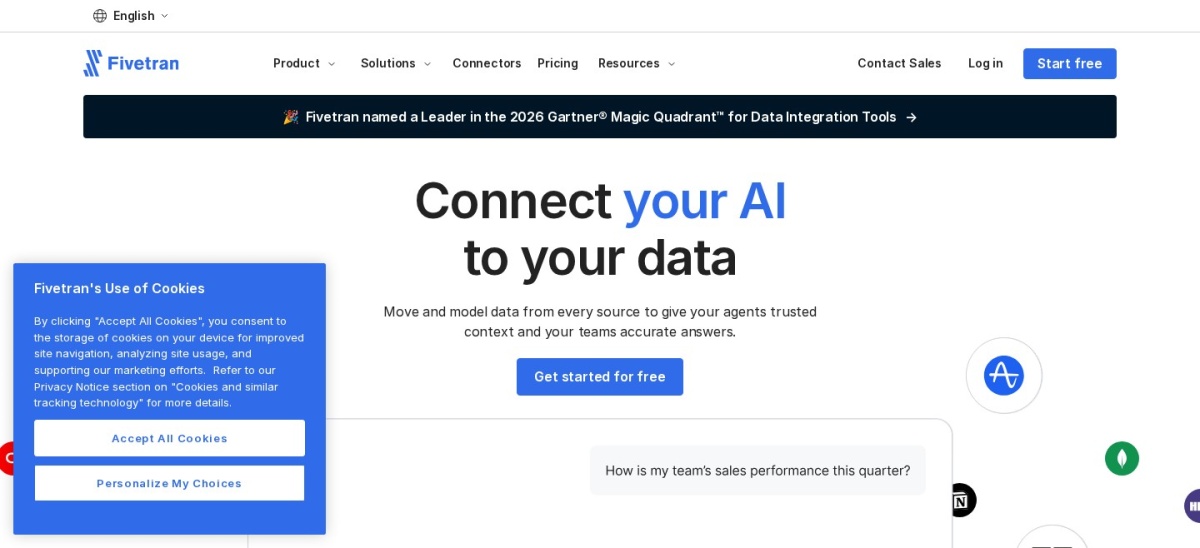
Fivetran is a fully managed ELT platform that moves data from more than 700 sources into a warehouse with automatic schema drift handling. Its database connectors use log-based CDC, and the free plan covers up to 500,000 monthly active rows a month.
The trade off is usage-based billing. Each Standard connection carries a $5 monthly base charge plus $495 per million monthly active rows, and annual contracts start at $12,000. It suits teams that want managed pipelines with almost no maintenance.
What we like
700+ managed connectors with automatic schema handling
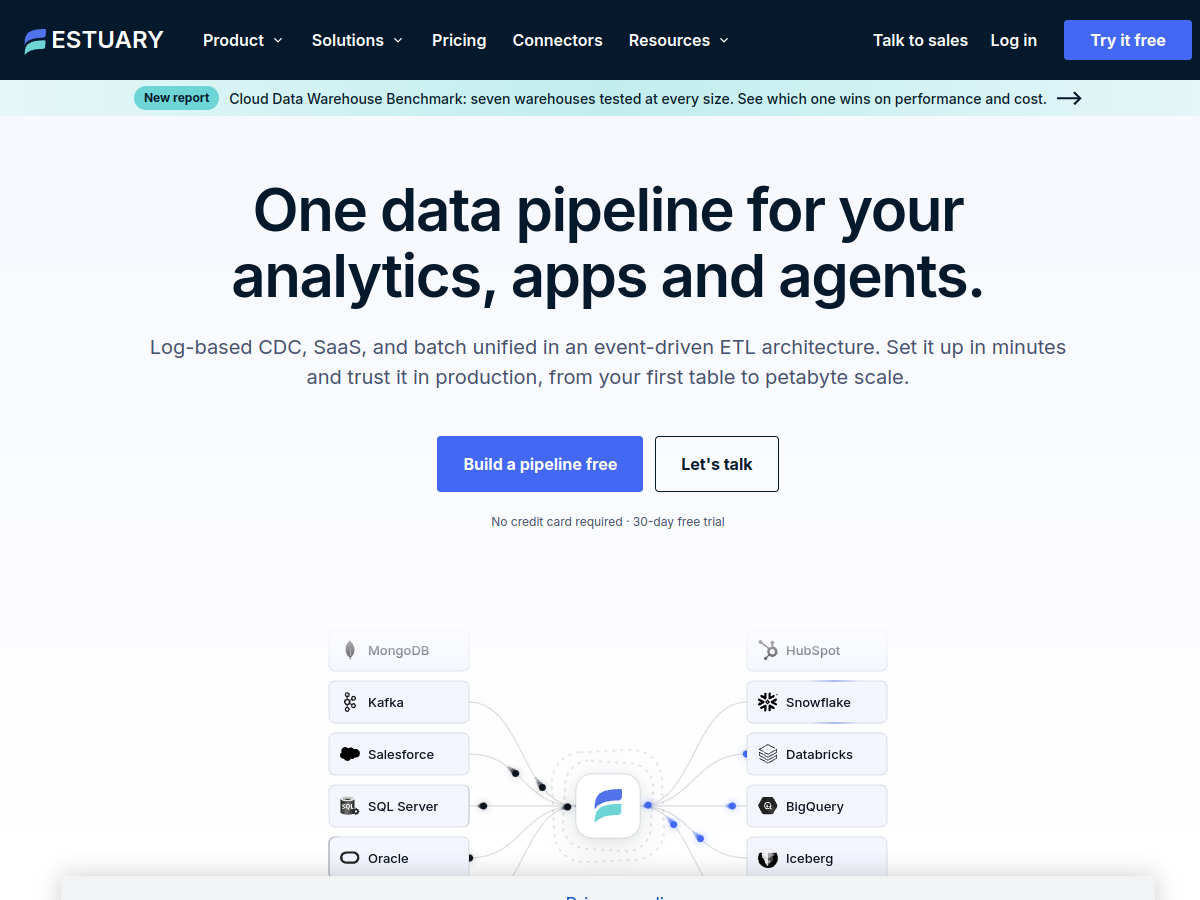
Estuary Flow is a managed streaming platform that unifies CDC, streaming and batch ELT in one place. It captures changes from Postgres, MySQL, SQL Server and MongoDB and lands them in warehouses in under 100 milliseconds, with more than 200 connectors.
The trade off is the meter. Cloud costs $0.50 per GB plus $100 per connector instance a month, and the GB rate applies at capture and again at each destination. It suits teams whose main job is CDC into a warehouse.
What we like
Sub-100ms CDC latency with exactly-once delivery
Free tier covers 10 GB a month and 2 connectors
Open-source core with 200+ connectors
Predictable per-GB billing
Watch out for
GB meter runs at capture and again per destination
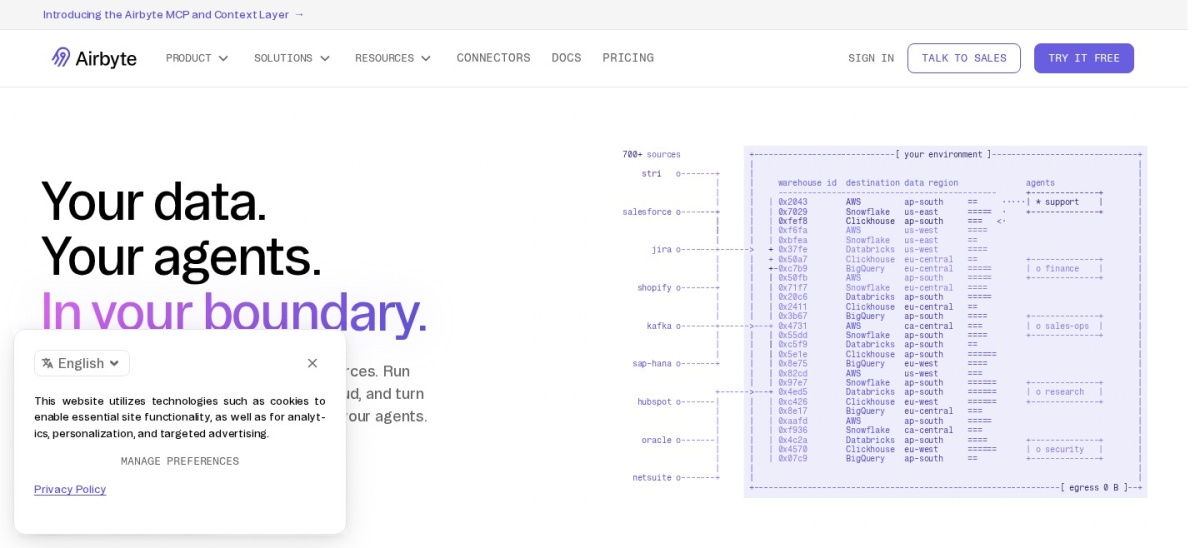
Airbyte is an open-source data integration platform with more than 700 connectors, and its Postgres, MySQL, SQL Server and MongoDB sources support log-based CDC. Teams can self-host Airbyte Core for free or start Airbyte Cloud Standard at $20 a month.
The trade off is sync speed on the cheapest cloud plan. Standard syncs run hourly, and 15-minute syncs need the $189-a-month Plus plan. It suits engineering teams that want open-source flexibility at a low managed price.
Confluent Cloud is the managed Kafka platform from the company founded by the creators of Apache Kafka. It adds Flink for SQL stream processing, a schema registry and more than 80 fully managed connectors, including Debezium-based CDC connectors.
The trade off is the bill. Pricing is usage-based across compute, data in and out, storage and connectors, and the Standard tier starts at about $385 a month. It suits enterprises standardizing on Kafka.
Hevo Data is a no-code ELT platform with real-time change data capture, so source changes stream to the warehouse quickly without engineering work. It covers more than 150 sources with dbt integration and 24-hour live chat support on paid plans.
The trade off is the new price. Starter now starts at $265 a month, up from $239 earlier in 2026, and Professional costs $750 a month. It suits mid-market data teams that want managed ETL with stronger transforms than Stitch.
Stitch is a lightweight ELT loader, now part of Qlik, for simple SaaS-to-warehouse replication, with more than 140 connectors and published pricing from $100 a month for 5 million rows and one destination. It moves data on a schedule and stays out of the way.
The trade off is depth. Stitch has no free plan, no real-time sync and lighter transformation than Hevo or Matillion, so complex pipelines outgrow it. It suits small teams with 10 or fewer standard sources and one warehouse.
Qlik Replicate is an enterprise database replication tool built around log-based CDC, with automatic DDL handling and parallel processing. It covers legacy and mainframe systems as well as Oracle, SQL Server and other common databases.
The trade off is price transparency. There is no free plan or published price, and licensing is quoted by sales, so smaller teams may find it hard to evaluate. It suits enterprises replicating large, high-volume estates.
Striim is a real-time data integration platform that combines log-based CDC with an in-memory stream processing engine. Teams can filter, mask, enrich and join data in motion with SQL before it lands anywhere.
The trade off is enterprise pricing. The Developer tier is free to 25 million events a month, but Striim Cloud and Platform pricing is by quote, so costs are hard to compare before a sales call. It suits enterprises that need transforms inside the stream.
Skyvia is a no-code data integration platform for CRM and database sync, with more than 200 connectors across SaaS apps, databases and warehouses. Its free plan covers 10,000 records a month, and the Basic plan costs $79 a month billed annually.
The trade off is scale. Skyvia is built for straightforward pipelines, and high-volume or complex transformation work fits Fivetran or Matillion better. It suits data-driven teams that want no-code pipelines without a dedicated data engineer.
Managed tools own the pipeline. They run the capture, the transport, the retries and the monitoring, and you pay for that with usage-based billing.
Staying on Debezium plus Kafka keeps the software free and the control total. The cost moves to your team instead: brokers, connectors, offsets, monitoring and on-call cover.
Small teams usually save money going managed, even at Fivetran or Estuary usage rates. Large teams with steady, high-volume streams and Kafka skills already in house can run Debezium cheaper.
A middle path is Confluent Cloud or Airbyte Cloud. You keep the open-source engine and move only the operations to a vendor.
How we chose
We started from the CDC tools most often named as Debezium replacements in 2026 comparisons, then kept the nine with a public G2 rating and published pricing or a clear free tier.
Prices come from each vendor's pricing page, checked on 29 November 2026. Ratings and review counts come from G2 on the same day. Where a vendor shows a sale, the list shows the regular price.
We left out tools with no public rating and no published price. No vendor paid for a place, and we do not claim to have used these tools ourselves.
How to choose a Debezium alternative
Start with where the data needs to land, then match latency and price to that job.
Decide the destination first. If changes must land in a warehouse, pick Fivetran, Estuary, Airbyte or Hevo. If services must consume events, pick Confluent or Striim instead.
Set the latency you actually need. Sub-second freshness needs Estuary or Striim. Fifteen-minute or hourly syncs are fine for reporting, and cost far less.
Price the same workload on two tools. Run one source with the same change volume through both pricing pages, because row, credit, event and gigabyte meters give very different bills.
Check the connector for your database. Log-based CDC is not offered for every source on every tool, so confirm your exact database version is supported before you commit.
FAQ
What is the best alternative to Debezium in 2026?
Fivetran is the best Debezium alternative for most teams. It offers 700+ managed connectors, log-based CDC and a free plan to 500,000 monthly active rows, and it is rated 4.3 out of 5 on G2 from 857 reviews.
How much do Debezium alternatives cost?
Prices start at $5 a month per connection for Fivetran, $20 a month for Airbyte Cloud and $79 a month for Skyvia. Estuary charges $0.50 per GB plus $100 per connector, while Qlik Replicate and Striim are priced by quote.
Is there a free Debezium alternative?
Yes. Airbyte Core is free to self-host with no volume limit, Fivetran is free to 500,000 monthly active rows, and Estuary is free to 10 GB a month with 2 connectors. Striim Developer is also free to 25 million events a month.
Which Debezium alternative is best for beginners or small teams?
Skyvia is the easiest start for a small team, with no-code setup and a free plan for 10,000 records a month. Fivetran is the simplest managed option overall, and Hevo adds real-time CDC without code.
Fivetran vs Estuary Flow: which is better for CDC?
Estuary Flow is better for pure CDC, with sub-100ms latency and $0.50 per GB pricing. Fivetran is better for general ELT, with 700+ connectors, 15-minute syncs and automatic schema handling across SaaS and database sources.
Which Debezium alternative is open source?
Airbyte is the strongest open-source option, with a free self-hosted Core edition and 700+ connectors. Estuary also has an open-source core, while Debezium itself remains free under Apache 2.0 for teams that keep running it.
Which Debezium alternative is best on AWS?
Fivetran and Estuary both run well on AWS and load into Redshift, S3 and other AWS targets. AWS Database Migration Service is the native AWS option, with pay-as-you-go CDC, but it was left out here because it has no public G2 rating to compare.
SaaS SEO and WordPress specialist with about 8 years of experience. Rakib compares WordPress plugins, themes, hosting and software using public pricing, documentation and user reviews. See how we rank.