Argo CD is the best cloud native software update system for most teams. It is free and open source, rated 4.6 out of 5 on G2, and reconciles Kubernetes clusters from Git with automatic rollback on drift. Pick GitLab for Git, CI and updates in one place, or Mender for over-the-air updates to Linux device fleets.
How we make this list: we compare pricing pages, product documentation and public user reviews, then re-check every price before each update. No product paid for a place. Disclosure.
Argo CD is the standard for Kubernetes updates: free, open source, rated 4.6 out of 5 on G2, with a web UI that shows sync and drift.
GitLab Premium costs $29 per user a month billed annually, against $4 a month for GitHub Team, but GitLab bundles Git, CI and security scanning in one place.
LaunchDarkly lets teams roll a release out to 1% of users and switch it off in seconds, with a free Developer tier and a 4.5 out of 5 G2 rating from 914 reviews.
Mender is the only device-fleet updater here: open source, with A/B updates and automatic rollback, from $34 a month for 50 devices.
Three tools in this list are free with no paid licence at all: Argo CD, Jenkins and Spinnaker.
How do you choose a cloud native software update system?
A cloud native update system moves new software to clusters and fleets without manual steps on each machine. The controller or pipeline takes a new version from Git or a registry, rolls it out in stages, and rolls it back when health checks fail.
Rollback is the feature that matters most. A system that can return to the last good version in minutes is worth more than one with a longer feature list, because a bad update reaches every target at once.
Pricing splits into two shapes. Open-source controllers such as Argo CD, Jenkins and Spinnaker cost nothing to licence, while hosted platforms charge per seat, per device or by usage, so compare the meter that grows with your fleet.
Pick the tool that matches where the software runs. Kubernetes workloads need a reconciler, device fleets need an OTA platform, and user-facing releases need progressive rollout controls. Our guide on deploying WordPress with GitHub Actions shows the Git-driven pattern in a simpler form.
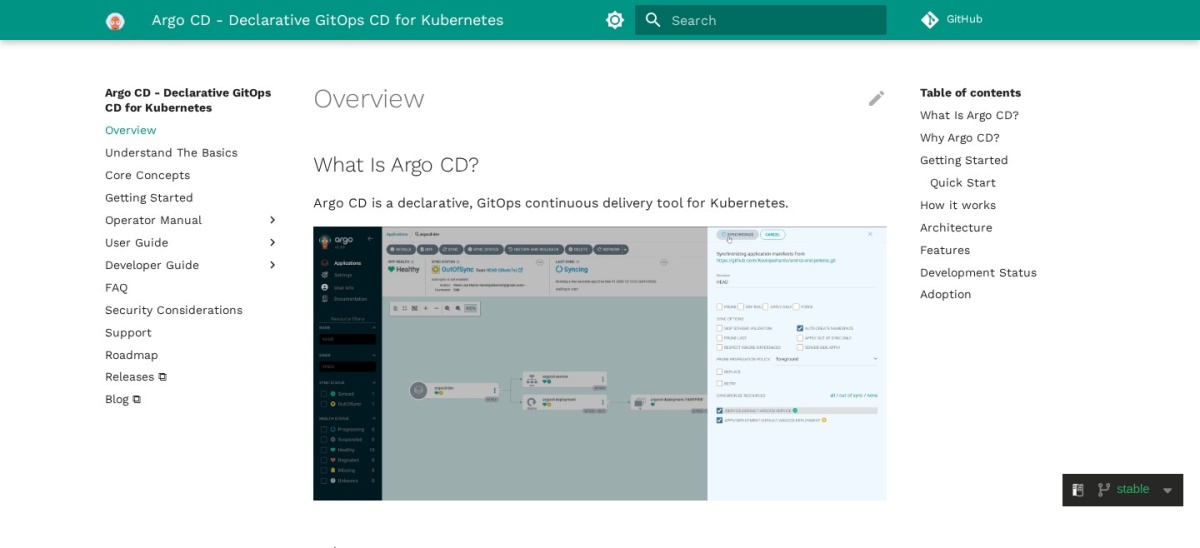
Argo CD is a declarative GitOps continuous delivery tool for Kubernetes, and a CNCF Graduated project. It syncs applications from Git, Helm or Kustomize, shows a live resource tree with diffs in a web UI, and can manage many clusters from one control plane.
The trade off is that you run it yourself. There is no paid Argo CD licence, so support and a managed control plane come from Akuity, whose Pro plan starts at $495 a month. It suits Kubernetes teams that want the standard update controller and are happy to operate it.
What we like
Free and open source, with no licence cost
Clear web UI for sync status, diffs and rollbacks
Multi-cluster support and ApplicationSets for fleets
Largest GitOps community, so answers are easy to find
Watch out for
You operate, upgrade and secure the controller yourself
RBAC and project setup get complex as fleets grow
No built-in image automation; that needs Argo Image Updater
Update modelGit as source of truth, CI plus agents
Free planYes, 400 compute minutes a month
Premium minutes10,000 compute minutes a month
Paid planPremium, $29 per user a month
about.gitlab.com
GitLab homepage, captured Nov 2026.
GitLab is a DevSecOps platform that combines source control, CI and deployment in one application, and its update workflows use Git as the source of truth for cluster state. The free plan includes 400 compute minutes a month, while Premium raises that to 10,000 minutes a month.
The trade off is the seat price. Premium costs $29 per user a month billed annually, which adds up fast for a large team, and the top tier is quote-only. It suits teams that want one platform for code, pipelines, security scans and updates, instead of several tools.
What we like
Git, CI, registry and security scanning in one product
Strongest review base in this list, with 902 G2 reviews
Free plan is usable for small teams and side projects
Self-managed option for teams that must host their own Git
Watch out for
Premium at $29 per user a month is dear for large teams
Wide feature set takes time to learn and configure
Advanced security and compliance need the quote-only tier
Update modelActions update Git; controller applies it
Free planYes, 2,000 CI/CD minutes a month
Team minutes3,000 CI/CD minutes a month
Paid planTeam, $4 per user a month
github.com
GitHub homepage, captured Nov 2026.
GitHub is the most widely used code host in this list, and GitHub Actions is the usual way its users drive updates: a workflow builds, tests and writes the new image or config back to Git, and a controller such as Argo CD applies it. The free plan includes 2,000 CI/CD minutes a month.
The trade off is that GitHub is not a reconciler itself. It holds the desired state and runs the automation, but you still need Argo CD or a similar controller to watch Git and fix drift. It suits teams whose code, reviews and pipelines already live on GitHub.
What we like
Highest G2 rating in this list, 4.7 out of 5
Cheapest paid plan here, at $4 per user a month
Largest Actions marketplace and integration set
Free for public repositories with unlimited collaborators
Watch out for
No built-in cluster reconciliation or drift detection
Per-minute Actions billing can climb on heavy matrices
LaunchDarkly is a feature management platform that separates deploying code from releasing it, with percentage rollouts, targeting rules and kill switches across more than 30 SDKs. The free Developer tier includes unlimited seats and unlimited flags, with 1 project and 3 environments.
The trade off is price. Foundation is pay-as-you-go from $10 a month, with service connections and client-side monthly active users metered on top, so the bill moves with traffic. It suits teams that want to switch a release off in seconds without redeploying.
What we like
Unlimited seats and flags on the free Developer tier
Professional Cloud$4,330 a year, up to 100 projects
Paid planProfessional Server, $2,080 a year
octopus.com
Octopus Deploy homepage, captured Nov 2026.
Octopus Deploy is a continuous delivery platform for release orchestration, deployment automation and runbook operations, with GitOps deployments through Argo CD. The free plan covers 10 projects, 10 tenants, 10 machines and 10 users, and Professional self-hosted starts at $2,080 a year.
The trade off is that the cloud price is higher. Professional in Octopus Cloud costs $4,330 a year, and machines and tenants beyond the free allowance are add-ons. It suits teams with complex, multi-environment releases that need approvals, tenants and runbooks as well as updates.
What we like
Strong release orchestration and environment promotion
Tenants and runbooks for multi-customer delivery
Free plan for up to 10 projects and 10 users
GitOps deployments with Argo CD built in
Watch out for
Cloud Professional costs more than double the Server price
Licensing by projects, tenants and machines gets costly at scale
Heavier setup than a plain Argo CD install
Professional adds unlimited projects and guided onboardingVisit octopus.com
06
Pulumi
4.8/5on G2 (25 reviews, checked Nov 2026)
Paid from$40/mo
Best for infrastructure updates in real languages
LanguagesTypeScript, Python, Go, C#, Java, YAML
Free planYes, 1 user, 500 workflow minutes
Managed stateYes, with secrets
Paid planEssentials, $40 a month
pulumi.com
Pulumi homepage, captured Nov 2026.
Pulumi is infrastructure as code in general-purpose programming languages such as TypeScript, Python and Go, instead of a config language. Pulumi Cloud adds managed state, secrets and Git-driven runs through Pulumi Deployments, and the free edition covers one user with 500 workflow minutes a month.
The trade off is usage-based cost. Essentials starts at $40 a month with unlimited users, but managed resources, deployments and secrets draw on credits beyond the included amounts. It suits developer-led teams that want loops, functions and unit tests in their infrastructure code.
What we like
Highest G2 rating in this list, 4.8 out of 5
Real programming languages with tests and reuse
Managed state, secrets and Git-driven deployments
Free edition for one user with unlimited stacks
Watch out for
Only 25 G2 reviews, so the rating rests on a small base
Mender is an over-the-air update and device lifecycle platform built around embedded Linux and real-time operating systems. It offers a free open-source core alongside a Basic hosted plan starting at $34 a month for up to 50 devices, with A/B updates and automatic rollback.
The trade off is that delta updates, scheduled deployments and automatic retries sit on higher tiers starting at $291 a month for Professional. It suits engineering teams shipping Linux or RTOS hardware that need atomic updates and rollback controls.
What we like
Free open-source core with self-hosted and cloud options
Full disk image and application updates with rollback safety
A/B updates that roll back automatically on failure
REST API access and a 12-month hosted trial
Watch out for
Delta updates and scheduled rollouts need the $291/mo Professional tier
Only 10 G2 reviews, so the rating rests on a small sample
Focused on updates, not dashboards or analytics
Professional adds delta updates, scheduled rollouts and retriesVisit mender.io
08
Jenkins
4.4/5on G2 (573 reviews, checked Nov 2026)
PriceFree
Best free CI engine for update pipelines
Update modelPipelines update Git; controller applies it
LicenceFree, open source, MIT
PluginsLarge plugin library
Paid planNone; you pay for hosting only
jenkins.io
Jenkins homepage, captured Nov 2026.
Jenkins is a free, open source automation server that builds, tests and deploys software, and it is the oldest CI tool in this list. In an update setup it usually runs the pipeline that commits the new image or config to Git, while a controller such as Argo CD applies the change to the cluster.
The trade off is maintenance. Jenkins itself costs nothing, but you run the server, patch plugins and manage credentials, and plugin updates can break working pipelines. It suits teams that want full control and a huge plugin library, and already have the skills to run it.
What we like
Free with no licence fees or user caps
Huge plugin library for almost any integration
Runs on premises, air-gapped or in any cloud
573 G2 reviews, the second largest base in this list
Watch out for
Self-hosting means constant plugin and JVM upkeep
Interface feels dated next to newer platforms
No built-in GitOps reconciliation or drift view
No paid plan; costs are hosting and operations time onlyVisit jenkins.io
09
Spinnaker
4/5on G2 (23 reviews, checked Nov 2026)
PriceFree
Best for multi-cloud delivery pipelines
Update modelPipelines deploy from Git, not reconcile
CloudsMulti-cloud, including Kubernetes
StrategiesCanary and blue-green releases
Paid planNone; free and open source
spinnaker.io
Spinnaker homepage, captured Nov 2026.
Spinnaker is a free, open source continuous delivery platform for multi-cloud pipelines, with canary and blue-green release strategies built in. It deploys from Git across clouds and container platforms, and it handles large-scale releases that a single-cluster controller is not built for.
The trade off is that it is not a pull-based reconciler. It runs pipelines rather than watching Git and fixing drift, and reviewers note slow recent development and a heavy, resource-hungry install. It suits large teams with multi-cloud releases who can operate a big platform.
What we like
Free and open source, with no licence cost
Canary and blue-green strategies built in
Multi-cloud pipelines across many targets
Handles large-scale releases well once set up
Watch out for
Lowest G2 rating in this list, 4.0 out of 5
Resource-hungry install with a dated UI
Not a Git reconciler, so drift needs another tool
No paid plan; costs are infrastructure and operations timeVisit spinnaker.io
Free vs paid: what you give up
Free tools cover the core update job well. Argo CD, Jenkins and Spinnaker cost nothing to licence, and GitLab, GitHub, LaunchDarkly and Mender all have free plans.
Paid plans mostly add management and governance. You get a hosted control plane, more minutes, support, SSO and audit logs, instead of a different update engine.
The expensive step is managed Argo CD. Akuity Pro starts at $495 a month, and Octopus Deploy Professional in the cloud costs $4,330 a year, so compare those against the cost of running the tools yourself.
For a small team, start free and pay only when the free limits bind. The first paid tier that usually matters is minutes or seats: GitHub Team at $4 a month, or GitLab Premium at $29 a month.
How we chose
We started from the tools named most often in 2026 comparisons of cloud-native delivery and update systems, then kept those with a usable public rating on G2 and a clear update role, whether reconciler, Git platform, delivery platform, progressive rollout tool or device OTA platform.
Prices come from each vendor's pricing page, checked on 30 November 2026. Ratings and review counts come from G2 on the same day. Where a vendor shows a sale, the list shows the regular price.
We left out Flux CD, the other leading reconciler, because its G2 listing covers a different product and no usable public rating exists for Flux CD itself. We also left out Harness, whose paid prices are quote-only, and Codefresh, which is a managed Argo CD control plane rather than a separate update engine. No vendor paid for a place, and we do not claim to have used these tools ourselves.
How to choose a cloud native software update system
Start with where your software runs, then pick the tool that fills the gap.
Pick a reconciler first if you run Kubernetes. Argo CD is the default choice, with a UI and multi-cluster support. Add a second tool only for a job Argo CD does not do.
Check what your Git platform already covers. If your code is on GitHub, GitHub Actions can drive the Git updates. If it is on GitLab, GitLab CI can do the same job in one place.
Decide how a release reaches users. LaunchDarkly rolls a feature out to a percentage of users and switches it off without a redeploy, while Mender does the same staged job for device fleets.
Count the real cost before you commit. Per-user seats, per-device tiers and per-minute billing all grow with the team. See our guide on rolling back a plugin update for how a rollback plan looks in practice.
FAQ
What is the best cloud native software update system in 2026?
Argo CD is the best cloud native software update system for most teams. It is free and open source, rated 4.6 out of 5 on G2, and it reconciles Kubernetes clusters from Git with a clear web view of sync and drift.
How much does a cloud native software update system cost?
It ranges from free to thousands a year. Argo CD, Jenkins and Spinnaker cost nothing to licence, GitHub Team costs $4 per user a month, and Octopus Deploy Professional starts at $2,080 a year for self-hosted use.
Is there a free cloud native software update system?
Yes. Argo CD, Jenkins and Spinnaker are free and open source, and GitLab, GitHub, LaunchDarkly and Mender all have free plans that cover small teams or small fleets.
Which cloud native software update system is best for beginners?
GitHub is the easiest starting point for small teams. Its free plan includes 2,000 CI/CD minutes a month, and GitHub Actions can drive updates to Git while Argo CD applies them to the cluster.
Argo CD vs GitLab: which is better for updates?
Argo CD is better for Kubernetes updates alone, because it reconciles clusters from Git and shows drift in a web UI. GitLab is better when you want Git, CI, security scanning and updates in one platform, at $29 per user a month for Premium.
How do I update software on a fleet of Linux devices?
Use an OTA platform such as Mender. It pushes full disk image or application updates over the air, uses A/B partitions, and rolls back automatically if a device fails to boot after an update.
What is the difference between GitOps and progressive delivery?
GitOps is pull-based: a controller watches Git and brings the live system in line with it, so drift is detected and corrected automatically. Progressive delivery adds staged rollouts, so a release reaches a small share of users first and can be switched off without a redeploy.
SaaS SEO and WordPress specialist with about 8 years of experience. Rakib compares WordPress plugins, themes, hosting and software using public pricing, documentation and user reviews. See how we rank.