Snowflake is the best ClickHouse alternative for most teams, a managed cloud warehouse rated 4.6/5 on G2 from 789 reviews with usage-based pricing from $2 per credit. Pick Databricks for unified data and AI work, or Apache Druid when sub-second queries on streaming data matter most.
How we make this list: we compare pricing pages, product documentation and public user reviews, then re-check every price before each update. No product paid for a place. Disclosure.
Snowflake tops the list at 4.6/5 from 789 G2 reviews, with compute from $2 per credit and storage billed separately.
Databricks matches Snowflake at 4.6/5 with the largest review base here, 1,434 reviews, and Jobs compute from $0.15 per DBU.
BigQuery is the cheapest way to start, with a free tier and on-demand queries at $6.25 per TB scanned.
Apache Druid is the only open-source pick in this list, built for sub-second queries on streaming data, and free to run yourself.
Microsoft Fabric has the highest starting price at $262.80 a month for F2 capacity, but it bundles warehousing, pipelines and Power BI in one bill.
Redshift is the natural pick for AWS-heavy teams, rated 4.3/5 from 427 reviews, with its smallest node from $0.25 an hour.
What should you look for in ClickHouse alternatives?
ClickHouse wins on raw speed for analytical queries, so any replacement has to match it on scan speed first. Columnar storage and parallel execution are the baseline, and every tool in this list offers both in some form.
The biggest difference between these tools is how you pay. Most bill by usage, such as credits, DBUs or terabytes scanned, so a quiet month costs little and a heavy month costs much more. Only Fabric charges a flat monthly capacity fee, which suits steady workloads.
Real-time ingestion splits the list in two. Druid and SingleStore ingest streaming events as they arrive, while the cloud warehouses are stronger for scheduled batch loads and large reporting queries.
Open source changes the deal. Druid costs nothing to run yourself, but you pay in operations time instead. Managed services remove that work and charge for it, so the cheapest licence is not always the cheapest total.
Snowflake is a managed cloud data warehouse that runs on AWS, Azure and Google Cloud, with storage and compute billed separately. It handles standard SQL, semi-structured data such as JSON, and data sharing between accounts, and reviewers praise its ease of use. A free trial is available to try it before paying.
The trade off is cost control. Compute starts at $2 per credit on the Standard edition, and bills can climb fast when queries run often or warehouses stay on. It suits teams that want a fully managed warehouse and can watch usage. It fits best when easy scaling matters more than the lowest bill.
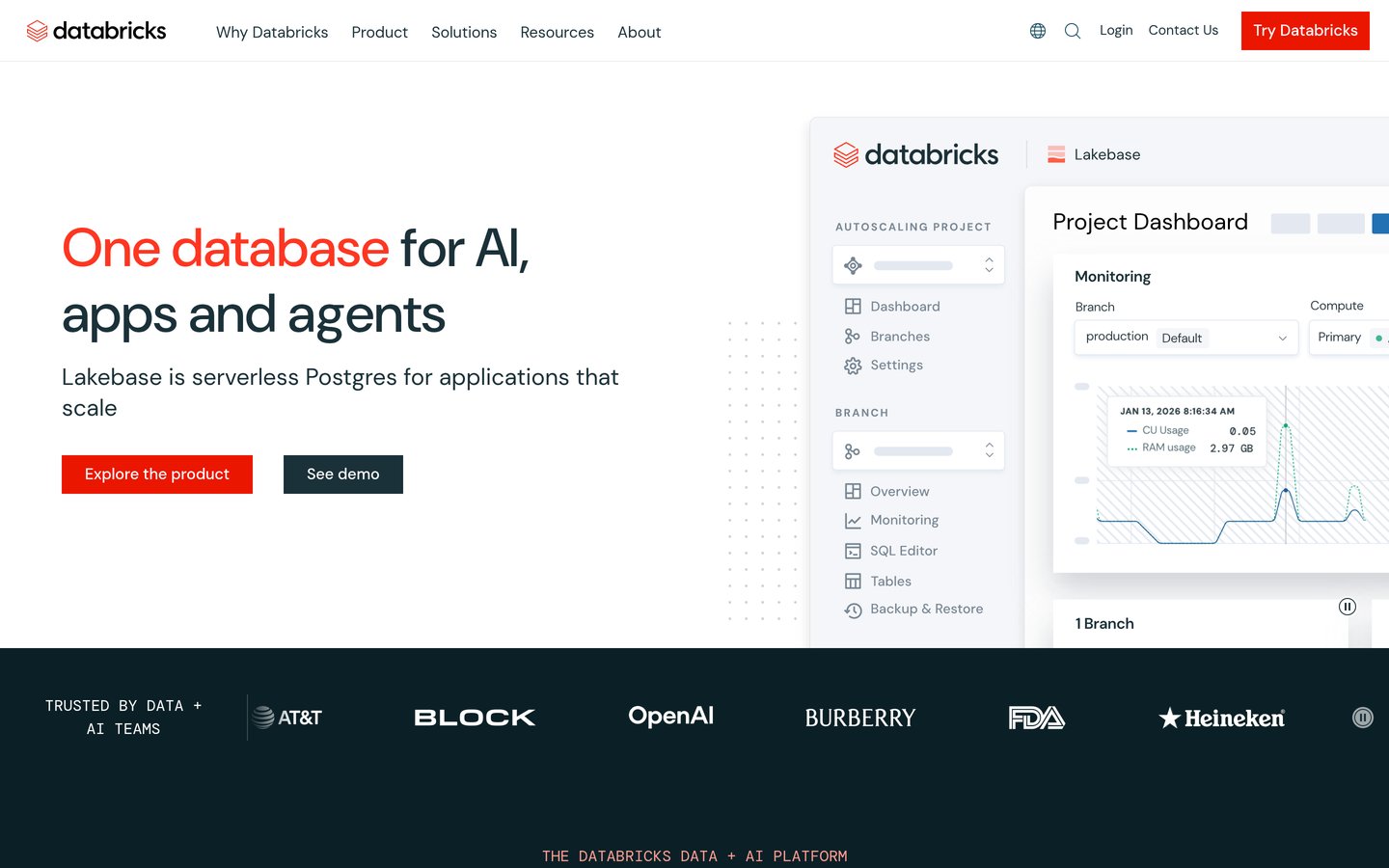
Databricks is a unified platform for data engineering, analytics and machine learning, built on Apache Spark. It combines notebooks, SQL, Delta Lake storage and governance through Unity Catalog in one workspace. Jobs compute starts at $0.15 per DBU, with cloud infrastructure billed on top, and a free trial is available.
The trade off is complexity and cost. Pricing is hard to predict because DBU charges sit on top of cloud bills, and new users face a learning curve around Spark. It suits teams that already work in Spark or want engineering, SQL and AI in one place.
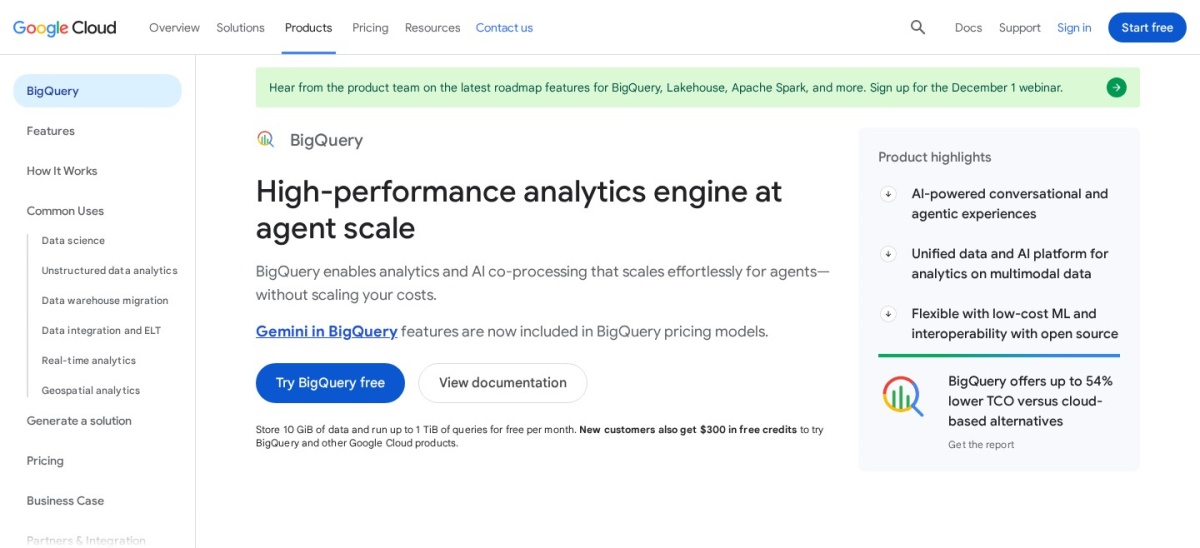
Google BigQuery is a serverless data warehouse on Google Cloud that runs SQL over large datasets with no servers to manage. It includes a free tier, built-in machine learning with BigQuery ML, and tight links to Looker and Google Analytics. On-demand queries cost $6.25 per TB scanned.
The trade off is unpredictable bills. A single unfiltered query over a large table can cost more than expected, so cost controls and partitioned tables matter. It suits teams already on Google Cloud that want fast setup and pay-as-you-go queries.
Amazon Redshift is a managed cloud data warehouse from AWS that stores data in columns and runs queries across many nodes at once. It speaks PostgreSQL-style SQL, queries data in S3 through Redshift Spectrum, and fits teams that already store data in AWS. Its smallest node costs $0.25 an hour on demand.
The trade off is upkeep. Sort keys, distribution styles and regular VACUUM and ANALYZE runs need attention, and heavy concurrent use can queue queries. It suits AWS-heavy teams that want a familiar warehouse and can tune it. It fits reporting and BI workloads best.
Apache Druid is an open-source, distributed database built for sub-second queries on streaming and time-series data. It ingests events from Kafka and other sources as they arrive, pre-aggregates them, and answers dashboard queries in milliseconds. It is free to run yourself under the Apache 2.0 licence.
The trade off is operations. A Druid cluster has several services to run and tune, so most teams either hire for it or pay for a managed service such as Imply Polaris. It suits product analytics, clickstream data and live dashboards where low latency matters most.
SingleStore is a distributed SQL database that handles transactions and analytics in one engine, so the same tables serve apps and reports. Its managed Helios cloud starts with an S-00 deployment at $0.99 an hour before storage, and a free tier is available. It supports MySQL-compatible SQL.
The trade off is that the headline rate is only part of the bill. Storage, edition and multi-zone options add charges, and the smallest deployment still bills while it runs. It suits teams that need fast reads and writes together, such as live apps with built-in reporting.
Dremio is a lakehouse platform that runs SQL directly on data in open formats such as Apache Iceberg, without copying it into a warehouse first. Its semantic layer gives analysts one governed view of metrics, and a 30-day trial includes $400 in credits. Cloud use costs $0.20 per DCU.
The trade off is maturity at scale. Reviewers praise query speed and cost savings, but note bugs, uneven integrations and a roadmap now shaped by its SAP acquisition. It suits teams with data already in a lake who want warehouse speed without moving it.
Starburst is a data lakehouse platform built on Trino that queries data where it lives, across more than 50 sources, with one SQL statement. Its managed Galaxy service runs on AWS, GCP and Azure, and teams can start free without a credit card. Galaxy bills from $0.50 per credit.
The trade off is setup and cost tracking. Permissions and query tuning take technical care, and usage-based billing is hard to forecast without budgets in place. It suits teams with data spread across warehouses, lakes and databases who want one query layer.
Microsoft Fabric is an all-in-one analytics platform from Microsoft that combines data engineering, warehousing, real-time analytics and Power BI on shared OneLake storage. Its smallest F2 capacity costs $262.80 a month, and a free trial is available. It fits teams already invested in Microsoft 365 and Azure.
The trade off is price and lock-in. F2 is the dearest starting point in this list, and the platform works best inside Microsoft's own ecosystem. It suits large Microsoft shops that want one bill and one governance model for data and reporting.
What we like
Warehousing, pipelines and Power BI in one bill
OneLake storage shared across engines
Free trial available
Watch out for
Highest starting price in this list
Best inside Microsoft's ecosystem
Larger capacities add more compute and free mirroring storageVisit microsoft.com
Open source vs managed: what changes
Open-source tools shift the cost from licences to labour. Druid is free to download, but someone has to run, tune and patch the cluster, and that time has a price.
Managed services bundle that work into the bill. Snowflake, BigQuery and the rest handle upgrades, scaling and backups, which is why their per-unit prices look high next to $0.
Back up everything before you move it, and test the migration on a copy first. Our database backup guide covers the basics of keeping a safe copy.
How we chose
We started from the tools most often named as ClickHouse replacements in G2 comparisons and data-team write-ups, then kept the nine with a public rating and a published price.
Prices come from each vendor's pricing page or G2 pricing data, checked on 29 November 2026. Ratings and review counts come from G2 on the same day. Where a vendor bills by usage, the list shows the smallest published unit rate.
We left out tools with no public rating, including DuckDB, which has no G2 reviews, and ClickHouse itself, since this list covers alternatives to it. No vendor paid for a place, and we do not claim to have used these tools ourselves.
How to choose a ClickHouse alternative
Start with your query pattern, then match the billing model to it.
Work out whether you need real-time queries. If dashboards must update in seconds as events arrive, shortlist Druid or SingleStore. If nightly reports are enough, any cloud warehouse will do.
Check where your data already lives. Pick the warehouse that sits in your cloud. BigQuery fits Google Cloud, Redshift fits AWS, and Fabric fits Microsoft shops, because moving data between clouds costs time and money.
Price a typical week, not a single query. Run your heaviest queries through the vendor's calculator. Usage billing rewards quiet weeks and punishes unfiltered scans, so set budget alerts before you go live.
Try the free tier or trial first. Load a sample of your real data and run the queries you run every day. A trial shows the true speed and cost of a tool better than any price page.
FAQ
What is the best ClickHouse alternative in 2026?
Snowflake is the best ClickHouse alternative for most teams. It is a fully managed cloud warehouse rated 4.6/5 on G2 from 789 reviews, with compute from $2 per credit and no servers to run. Databricks is the stronger pick for teams that also need data engineering and AI.
How much does a ClickHouse alternative cost?
It depends on how you are billed. Usage-based tools start from $0.15 per DBU for Databricks, $0.20 per DCU for Dremio and $6.25 per TB scanned for BigQuery. Microsoft Fabric is the only flat-rate pick here, from $262.80 a month for F2 capacity.
Is there a free alternative to ClickHouse?
Yes. Apache Druid is open source and free to run yourself, and BigQuery, Dremio and Starburst all offer free tiers or trials. Druid is the closest free match for real-time analytics, but you take on the work of running the cluster.
Which ClickHouse alternative is best for small teams?
BigQuery is the best pick for small teams. Its free tier covers light use, setup takes minutes with no servers to manage, and on-demand queries cost $6.25 per TB scanned. Dremio is a good second choice when your data already sits in a lake.
What is the best ClickHouse alternative for real-time analytics?
Apache Druid is the best pick for real-time analytics. It is built for sub-second queries on streaming data, ingests events as they arrive, and is rated 4.3/5 on G2. SingleStore is the managed option when you also need transactions in the same database.
Snowflake vs Databricks: which is the better ClickHouse alternative?
Snowflake is better for most analytics teams, with simpler setup, separate storage and compute billing, and a 4.6/5 rating from 789 reviews. Databricks wins for teams that need Spark-based engineering and AI in the same workspace, and it has the larger review base at 1,434 reviews.
SaaS SEO and WordPress specialist with about 8 years of experience. Rakib compares WordPress plugins, themes, hosting and software using public pricing, documentation and user reviews. See how we rank.