ScyllaDB is the best of the Cassandra alternatives for most teams leaving self-hosted Cassandra, because it runs the same CQL and data model with a 4.5 out of 5 G2 rating from 438 reviews. DataStax Astra DB is the closest managed Cassandra, while DynamoDB suits teams already on AWS.
How we make this list: we compare pricing pages, product documentation and public user reviews, then re-check every price before each update. No product paid for a place. Disclosure.
ScyllaDB is the closest drop-in: same CQL and wide-column model, rated 4.5 out of 5 by 438 G2 reviewers.
DataStax Astra DB is managed Cassandra with vector search, rated 4.6 out of 5 by 46 G2 reviewers, the highest rating here.
DynamoDB and Cosmos DB charge per request, so small workloads start near $0, but heavy workloads need careful modelling.
MongoDB Atlas Flex is the cheapest fixed paid start here at $8 a month, capped at $30 a month.
Bigtable is the priciest fixed start at $468 a month for one node, and ScyllaDB Cloud and Aerospike publish no list price at all.
How do you choose the right Cassandra alternatives for your workload?
Compatibility decides the migration cost. Tools that speak CQL, such as ScyllaDB, Astra DB and YugabyteDB, let existing queries and data models move with far less rewriting than a document or key-value store.
Managed hosting decides the running cost. A managed service removes node repairs, upgrades and backups, but usage-based billing means the bill follows traffic, so a quiet table costs little and a busy one costs much more.
Query patterns decide the fit. Cassandra suits wide rows keyed by partition, with reads by key and time range, so a tool built for ad-hoc joins or complex transactions will fight the workload instead of serving it.
Free tiers decide the trial cost. Most tools here have a free plan or free tier, so build a small copy of one real workload first and measure latency and cost before moving production data.
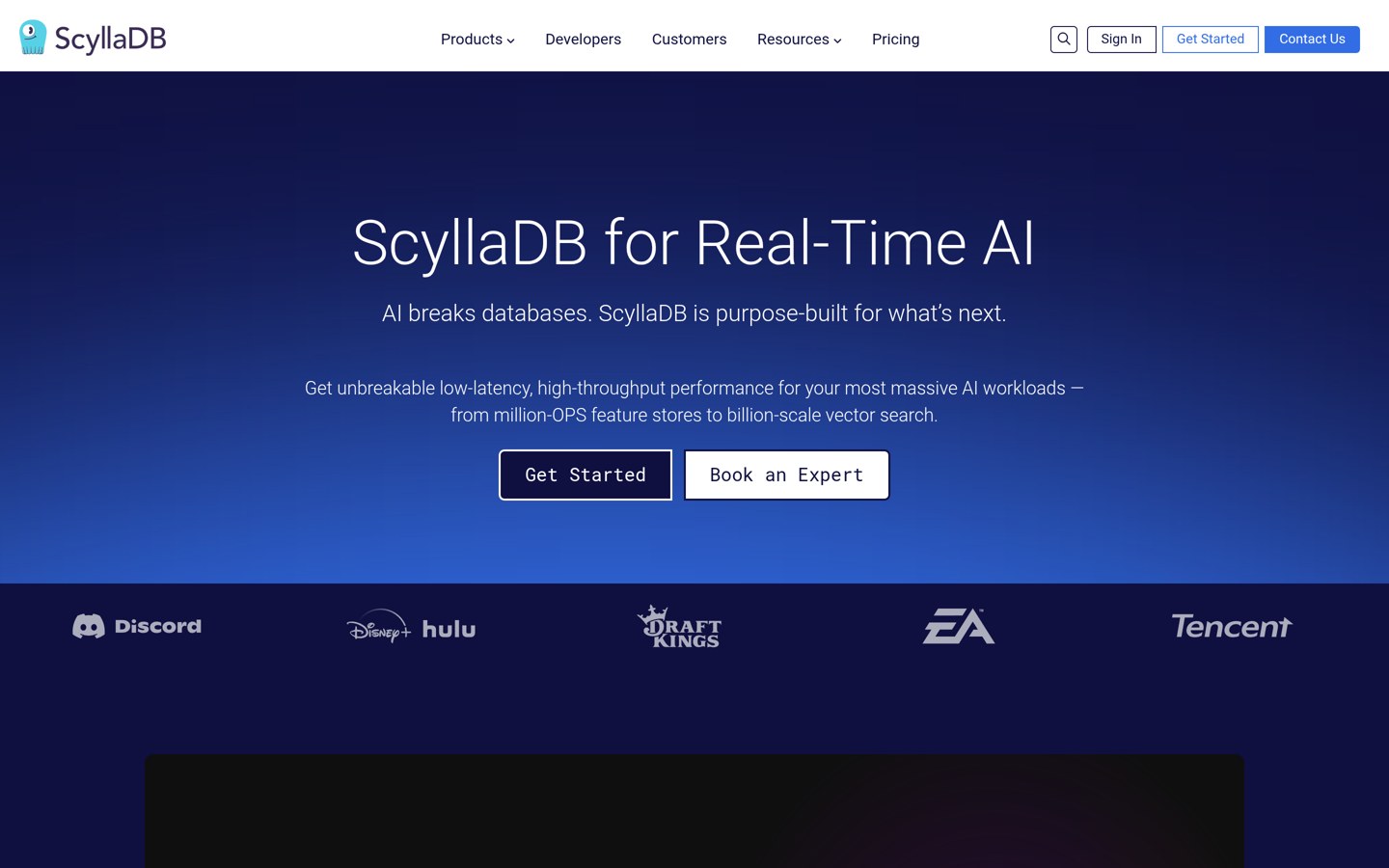
ScyllaDB is a C++ rewrite of the Cassandra engine that runs the same CQL, data model and drivers, so most Cassandra applications connect with little or no code change. The open-source edition is free to run, and ScyllaDB Cloud adds managed clusters with backups, repairs and 24x7 support.
The trade off is price transparency. ScyllaDB Cloud publishes no list price and bills by vCPU, RAM and NVMe storage through a calculator or quote, so the ladder shows $0 because there is no fixed monthly minimum to quote. It suits teams that want Cassandra compatibility with higher throughput per node.
What we like
Same CQL and data model as Cassandra
High throughput per node, so fewer nodes
Open-source edition is free to run
Also offers a DynamoDB-compatible API
Watch out for
Cloud price is by quote, with no published list
Steep learning curve for data modelling
Enterprise features need a commercial licence
Cloud adds managed backups, repairs and support, priced by quoteVisit scylladb.com
02
DataStax Astra DB
4.6/5on G2 (46 reviews, checked Nov 2026)
Paid from$83.30/mo
Best managed Cassandra
CQL supportYes, built on Cassandra
DeploymentManaged, multi-cloud
Free optionFree plan, monthly credits
Paid planStandard, $83.30/mo subscription
datastax.com
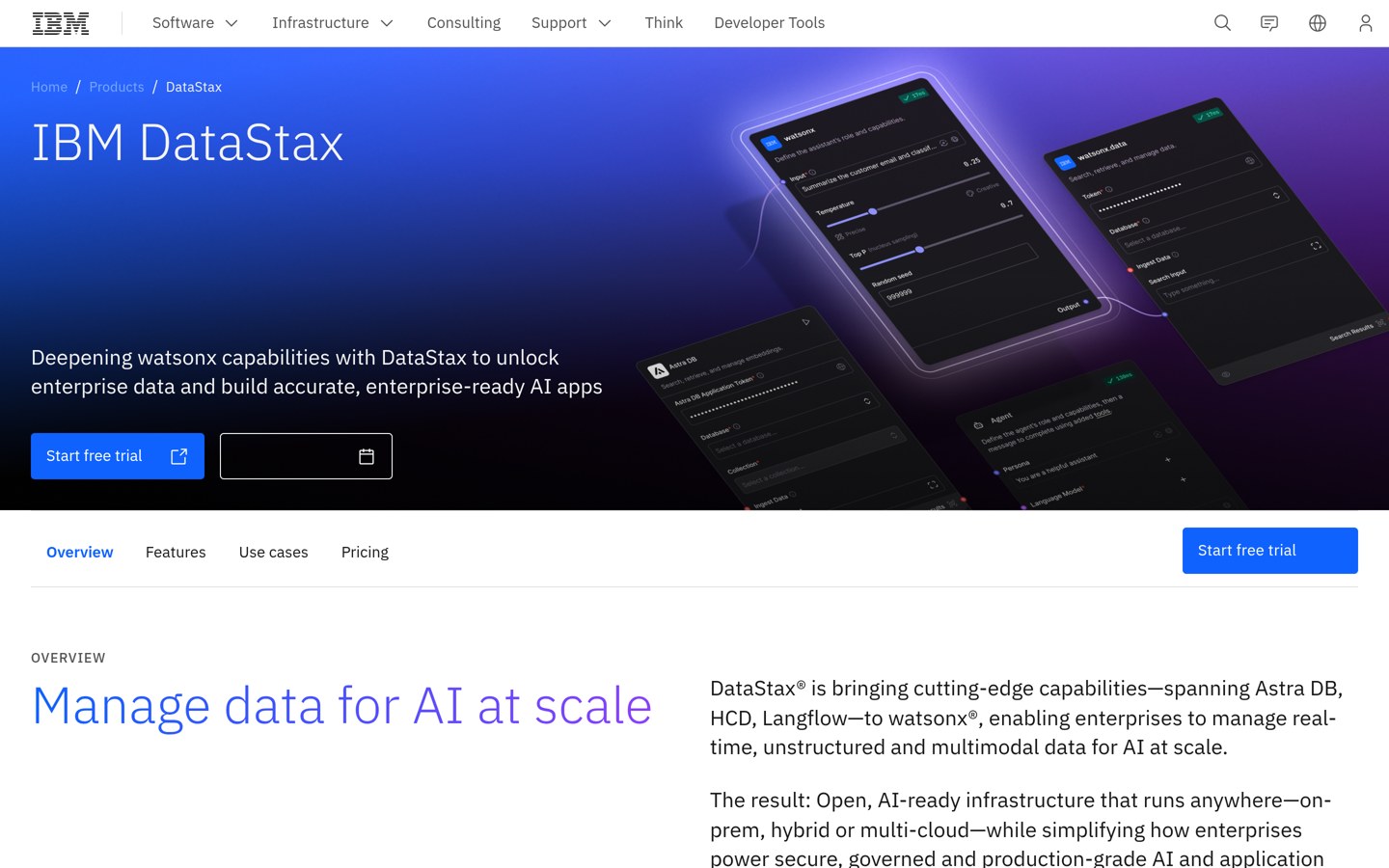
DataStax Astra DB homepage, captured Nov 2026.
DataStax Astra DB is a fully managed database-as-a-service built on Apache Cassandra, now part of IBM watsonx.data, with a Data API, vector search and multi-region deployment. The free plan gives monthly credits for up to five databases, and the Standard plan bills by consumption in Resource Units at $1 per unit.
The trade off is the move to IBM billing. Astra DB pricing now sits inside IBM watsonx.data, with a prepaid Standard subscription from $83.30 a month, and the per-unit bill can be hard to forecast for chatty workloads. It suits teams that want Cassandra without running clusters, plus vector search for AI features.
What we like
Real managed Cassandra, no cluster ops
Vector search built in for AI workloads
Highest G2 rating in this list at 4.6
Multi-region and multi-cloud deployment
Watch out for
Smallest review base here at 46 reviews
Pricing moved under IBM watsonx.data
Usage-based bills are hard to forecast
Standard adds private endpoints and enterprise organisation controlsVisit datastax.com
03
Amazon DynamoDB
4.4/5on G2 (529 reviews, checked Nov 2026)
PriceFree
Best Cassandra alternative on AWS
CQL supportNo, key-value and document
DeploymentManaged, serverless
Free option25 GB and 25 RCU/WCU free
Paid planOn-demand, $1.25 per 1M writes
aws.amazon.com
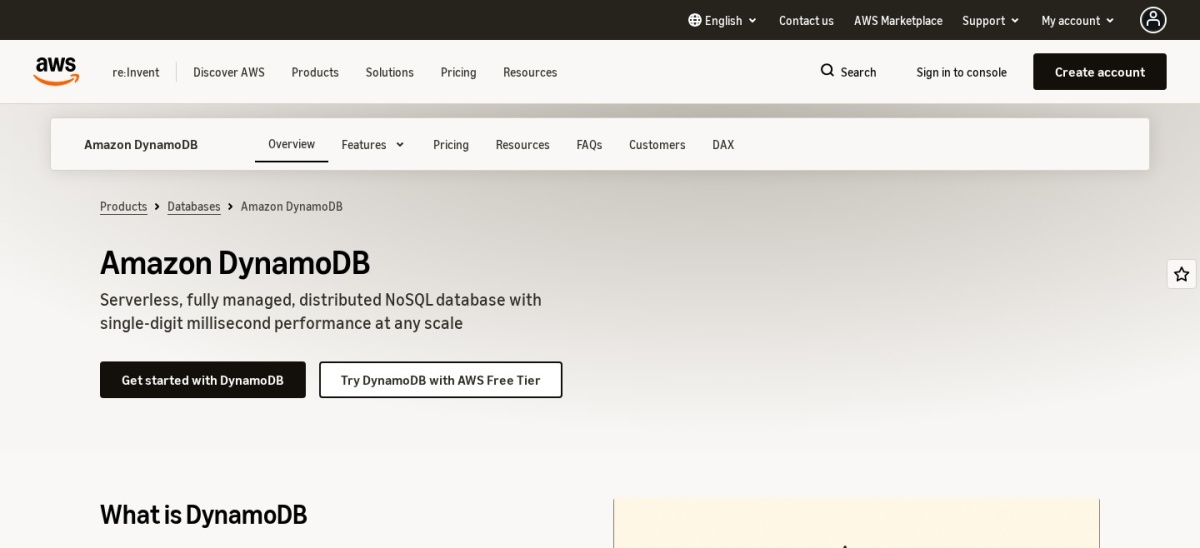
Amazon DynamoDB homepage, captured Nov 2026.
Amazon DynamoDB is a fully managed key-value and document database with single-digit millisecond latency, automatic scaling and global tables. The free tier covers 25 GB of storage and 25 read and write capacity units, and on-demand mode charges $1.25 per million writes and $0.25 per million reads, with no idle compute cost.
The trade off is the data model. DynamoDB has no CQL and no joins, so Cassandra queries must be redesigned around partition keys and access patterns, and costs can climb fast on unoptimised workloads. It suits teams already on AWS that want zero database administration.
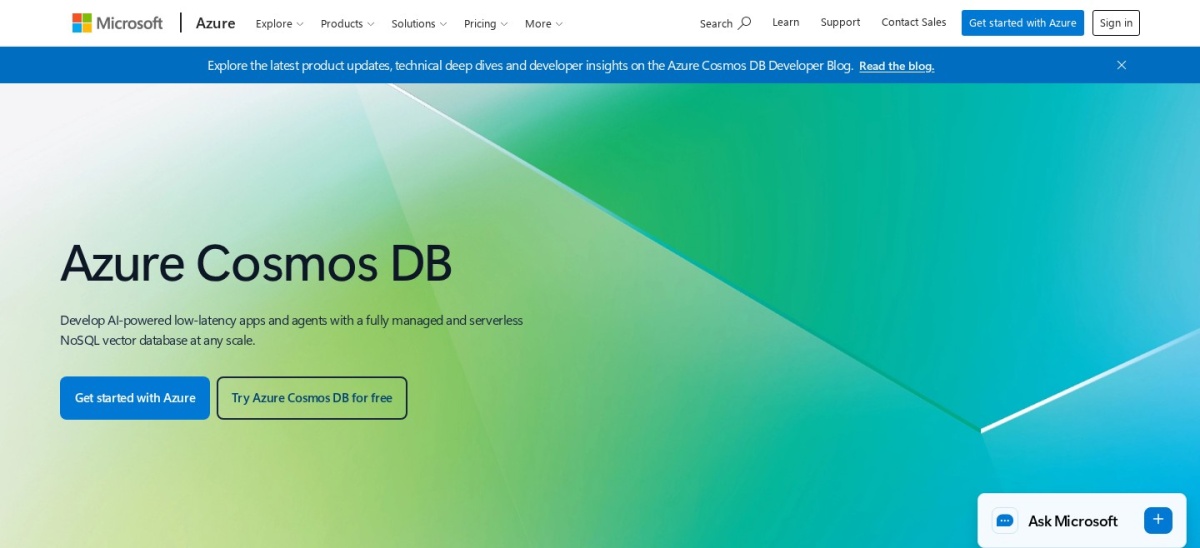
Azure Cosmos DB is a globally distributed, multi-model database with APIs for NoSQL, MongoDB, Gremlin, Table and Cassandra, so a Cassandra API account accepts CQL-style access patterns. Serverless mode bills $0.25 per million request units, while standard provisioned throughput starts at $0.008 per 100 RU/s per hour, with a 400 RU/s minimum of about $23 a month.
The trade off is Request Unit billing. Every operation costs RUs, and a poor partition design or heavy indexing can push the bill up fast, so teams need to model and monitor usage. It suits teams already on Azure that need global distribution and several APIs in one service.
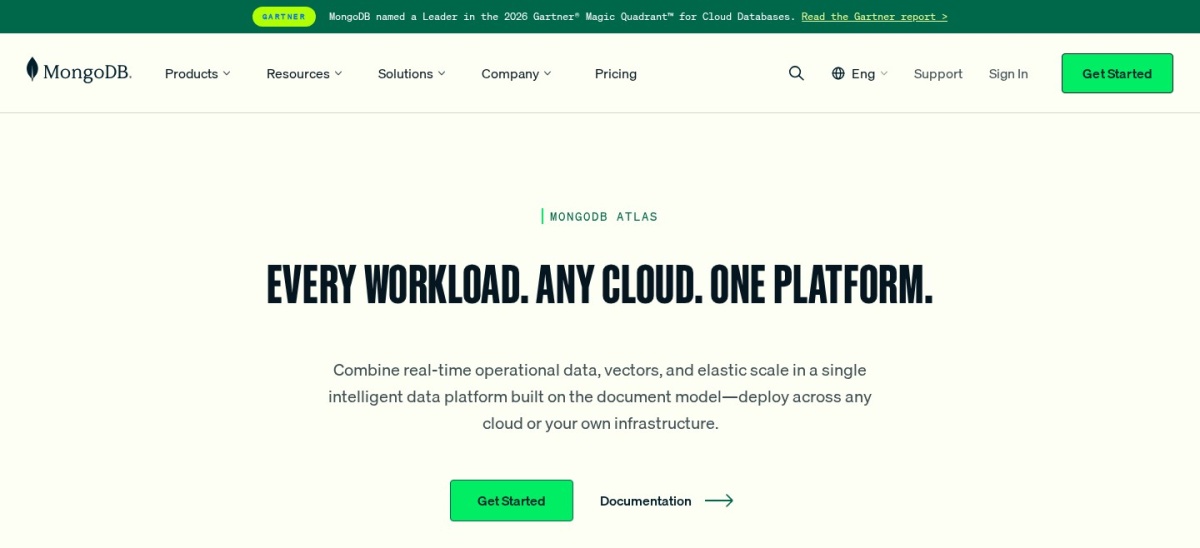
MongoDB Atlas is a managed document database that stores data as flexible JSON-like records, with search, vector search, aggregations and Atlas Stream Processing. The free M0 tier covers 512 MB, and Flex clusters cost $8 to $30 a month for up to 5 GB and 500 operations a second, capped so the bill cannot run away.
The trade off is a different data model. Wide-column Cassandra tables must be remodelled as documents, and production work needs a Dedicated cluster from about $57 a month, a jump from the $30 Flex cap. It suits teams whose data changes shape often and who value flexible queries over CQL.
What we like
Largest review base here at 910 G2 reviews
Flex tier caps the bill at $30 a month
Rich queries, search and vector search built in
Free M0 tier for learning and prototypes
Watch out for
No CQL, so Cassandra data must be remodelled
Dedicated clusters jump to about $57 a month
Loose schemas can lead to messy data
Dedicated adds backups, VPC peering and point-in-time restoreVisit mongodb.com
06
Google Cloud Bigtable
4.4/5on G2 (41 reviews, checked Nov 2026)
Starts at$468/mo
Best for very large wide-column tables on Google Cloud
CQL supportNo, wide-column key-value
DeploymentManaged, Google Cloud
Free optionTrial credits only
Paid planEnterprise, $0.65/node/hr
cloud.google.com
Google Cloud Bigtable homepage, captured Nov 2026.
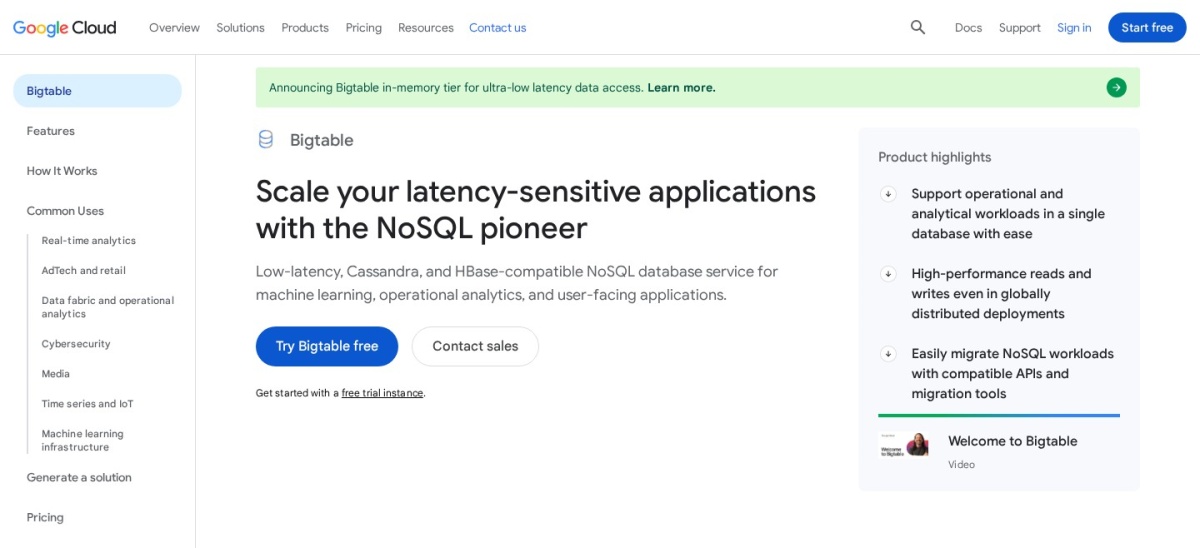
Google Cloud Bigtable is a fully managed wide-column NoSQL service that shares Cassandra's roots in the Bigtable paper, so its row-key and time-range model will feel familiar to Cassandra teams. The Enterprise edition costs $0.65 per node per hour in us-central1, which is about $468 a month for a single node before storage.
The trade off is cost and fit. Nodes are billed for every hour they are provisioned, even when idle, so Bigtable is the priciest fixed start in this list, and it has no permanent free tier. It suits Google Cloud teams ingesting very large time-series or event streams with key-based access.
What we like
Closest wide-column model to Cassandra
Scales to billions of rows and thousands of columns
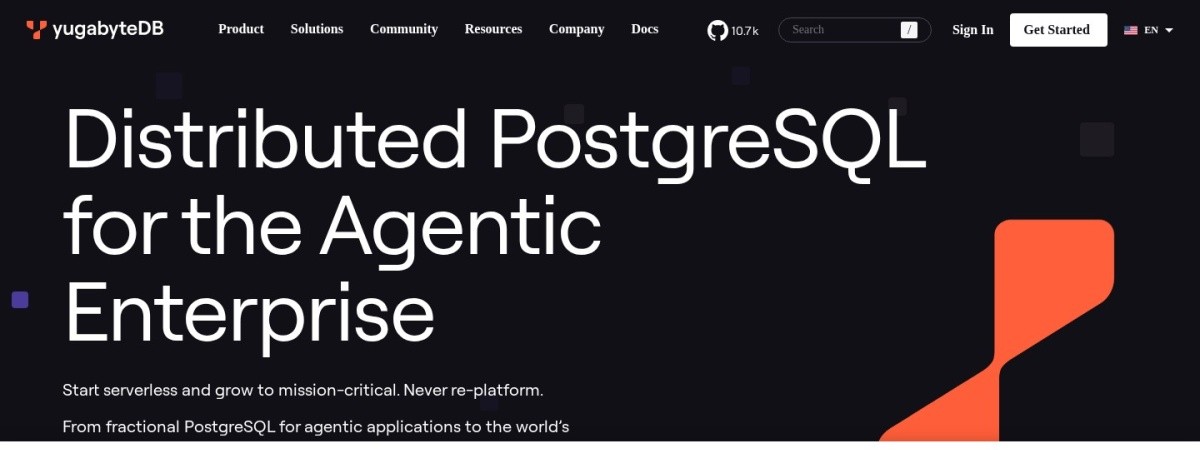
YugabyteDB is a distributed database that pairs PostgreSQL-compatible SQL with a Cassandra-compatible YCQL API, so teams can keep wide-column access patterns and add transactions and joins. The open-source core is free under Apache 2.0, and the managed Aeon service starts at $125 per vCPU per month for Standard, with disk at $0.10 per GB a month.
The trade off is operational weight. Reviewers praise scalability and reliability but note complex setup, upgrades and tuning, and the per-vCPU bill grows with every node in the cluster. It suits teams that want Cassandra-style scale plus strong consistency and SQL in one database.
What we like
YCQL keeps Cassandra-style access patterns
PostgreSQL-compatible SQL and transactions
Open-source core is free to self-host
Multi-region replication built in
Watch out for
Aeon bills per vCPU, so clusters get pricey
Complex setup and tuning for new teams
Smaller review base at 65 G2 reviews
Aeon Professional adds multi-region replication at $167 per vCPU a monthVisit yugabyte.com
08
Aerospike
4.4/5on G2 (83 reviews, checked Nov 2026)
PricingCustom/mo
Best for sub-millisecond key-value reads
CQL supportNo, key-value and document
DeploymentSelf-hosted or Cloud
Free optionCommunity, up to 8 nodes
Paid planEnterprise, by quote
aerospike.com
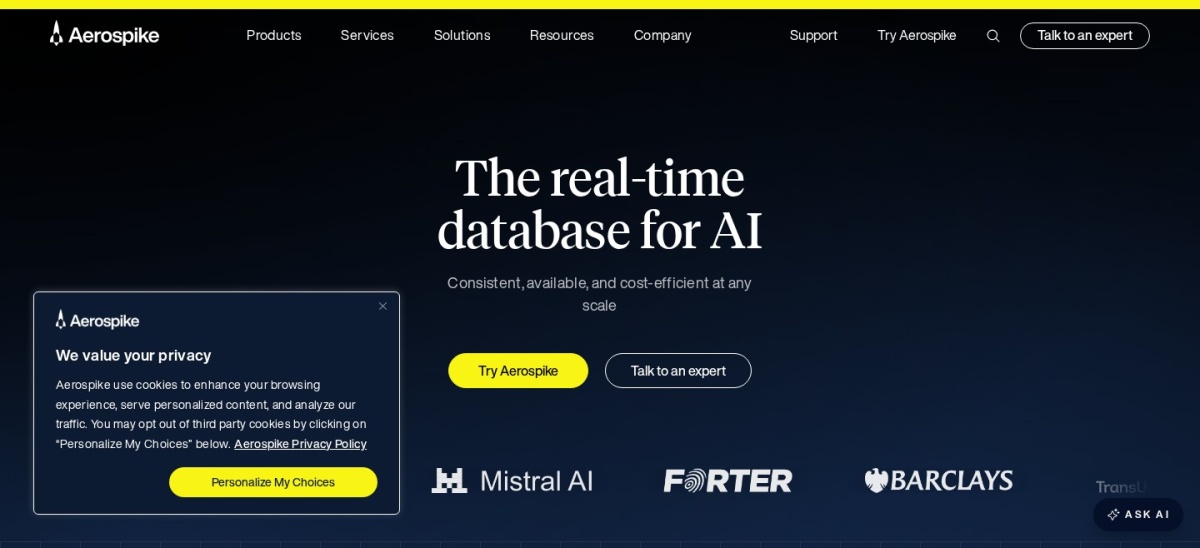
Aerospike homepage, captured Nov 2026.
Aerospike is a real-time key-value and document database built for sub-millisecond reads at very high throughput, with a hybrid memory architecture that keeps the primary index in memory and data on SSD. The free Community Edition covers up to 8 nodes and 2.5 TB per cluster, while Aerospike Cloud runs the Enterprise Edition as a managed service.
The trade off is price transparency. Enterprise and Cloud pricing are by quote, based on unique production data volume and active clusters, so the ladder shows $0 because there is no published list price. It suits ad tech, fraud detection and personalisation workloads that need predictable low-latency key access.
What we like
Sub-millisecond latency at high throughput
No charge per operation on Enterprise
Free Community Edition for production use
Strong consistency and transactions in Database 8
Watch out for
Enterprise price is by quote only
No CQL, so Cassandra queries must be rewritten
Community lacks cross-datacenter replication
Enterprise adds strong consistency, multi-site clustering and 24x7 supportVisit aerospike.com
09
Couchbase
4.3/5on G2 (151 reviews, checked Nov 2026)
Paid from$110/mo
Best for document and key-value in one store
CQL supportNo, SQL++ queries
DeploymentSelf-hosted or Capella
Free optionCapella free, 1 node
Paid planCapella Basic, from $0.15/hr/node
couchbase.com
Couchbase homepage, captured Nov 2026.
Couchbase is a distributed NoSQL database that combines document, key-value, search and analytics in one store, queried with SQL++. The managed Capella service has a free 1-node cluster, and Basic starts at $0.15 per node per hour, about $110 a month for one node, with Developer Pro from $0.35 and Enterprise from $0.49.
The trade off is a new query language. Cassandra teams must remodel wide-column tables as JSON documents and learn SQL++, and the per-node-hour bill rises with node size, count and region. It suits operational apps such as user profiles, catalogues and session stores that need flexible documents and fast key access.
What we like
Document, key-value, search and analytics in one store
SQL++ queries feel familiar to SQL users
Free Capella cluster for prototyping
Mobile sync for offline-first apps
Watch out for
No CQL, so data must be remodelled as documents
Per-node-hour billing scales fast in production
Setup scores lower than most tools here
Capella Developer Pro adds a 99.99% uptime SLA at $0.35 per node per hourVisit couchbase.com
Managed or self-hosted: which Cassandra alternative costs less?
Managed services cost more per unit but remove the on-call work. Repairs, upgrades, backups and node failures become the vendor's job, which matters most for small teams with no database specialist.
Self-hosting costs less in licence fees but more in time. ScyllaDB, YugabyteDB, Aerospike and Couchbase all have free open-source or Community editions, yet the team still pays for servers, storage and the hours spent running them.
Usage-based billing changes the comparison. DynamoDB, Cosmos DB and Astra DB charge for what you use, so a quiet workload can cost almost nothing, while a busy one can cost more than a fixed cluster of the same size.
How we chose
We started from the databases most often named as Cassandra replacements, then kept nine with a public G2 rating, a free plan or trial, and a published pricing page or a clearly stated quote-only model.
Prices come from each vendor's pricing page, checked on 29 November 2026. Ratings and review counts come from G2 on the same day. Where a vendor shows a sale, the list shows the regular price. ScyllaDB Cloud and Aerospike publish no list price, and DynamoDB charges per request with no fixed monthly minimum, so their ladder figures are $0 and the per-unit rates are given in the text instead.
We left out tools with no public rating and tools aimed only at one cloud's internal use. No vendor paid for a place, and we do not claim hands-on testing for this list.
How to choose a Cassandra alternative
Start with one real workload, not with a feature list, then measure it on the free tier.
List your access patterns first. Write down how you read and write: partition key, sort key, time ranges and secondary lookups. A tool that cannot serve those patterns cheaply is the wrong pick, however good its rating.
Check CQL compatibility before anything else. If you want to keep existing queries, shortlist ScyllaDB, Astra DB, Cosmos DB and YugabyteDB. If you are willing to remodel, DynamoDB, MongoDB, Bigtable, Aerospike and Couchbase open up.
Try the free tier with real data. Load a copy of one real table and run your heaviest queries. Measure latency and the bill for a week before deciding, and back up your data first using our guide on how to back up the WordPress database.
Model the bill at your real volume. Per-request and per-node-hour prices look small until traffic grows, so price the workload at peak, not at idle, and compare the fixed-node options beside the usage-based ones.
FAQ
What are the best Cassandra alternatives in 2026?
ScyllaDB is the best Cassandra alternative for most teams, because it runs the same CQL and data model and is rated 4.5 out of 5 by 438 G2 reviewers. DataStax Astra DB is the closest managed Cassandra, and DynamoDB is the best pick for teams already on AWS.
What is the closest drop-in replacement for Cassandra?
ScyllaDB is the closest drop-in, because it is wire-compatible with CQL and uses the same wide-column data model, so most Cassandra applications connect with little or no code change. DataStax Astra DB is the closest fully managed option, since it is built on Cassandra itself.
Is there a free Cassandra alternative?
Yes. ScyllaDB, YugabyteDB, Aerospike and Couchbase all have free open-source or Community editions, and DynamoDB, Cosmos DB, Astra DB and MongoDB Atlas all have free tiers. Bigtable is the only tool here with no permanent free tier, offering trial credits instead.
How much do Cassandra alternatives cost?
Costs vary widely because most charge by use. MongoDB Atlas Flex starts at $8 a month, Cosmos DB provisioned starts at about $23 a month, and Bigtable starts at $468 a month for one node. ScyllaDB Cloud and Aerospike publish no list price, so ask for a quote before budgeting.
Is ScyllaDB or DataStax Astra DB better?
ScyllaDB is better for teams that want the closest Cassandra compatibility with high throughput per node, while Astra DB is better for teams that want Cassandra fully managed with vector search built in. Astra DB is rated slightly higher at 4.6 against 4.5, but from only 46 reviews against 438.
Is DynamoDB or Cosmos DB better than Cassandra?
DynamoDB is better for serverless AWS workloads with unpredictable traffic, and Cosmos DB is better for Azure teams that need global distribution and a Cassandra API. Neither runs CQL natively, so both need queries redesigned, while ScyllaDB keeps the Cassandra model.
Can I migrate from Cassandra without downtime?
Yes, in most cases, by running the new database beside Cassandra, replicating data, and switching reads over gradually. Tools with CQL support make this easier, but every migration needs a tested rollback plan and a full backup before the switch.
SaaS SEO and WordPress specialist with about 8 years of experience. Rakib compares WordPress plugins, themes, hosting and software using public pricing, documentation and user reviews. See how we rank.