Material UI is the best of these Bootstrap alternatives, with a free MIT-licensed React core rated 4.5 out of 5 on G2 and paid data tools from $15 a month per developer. Ant Design is the free pick for admin dashboards, while Semantic UI suits plain HTML sites with no build step.
How we make this list: we compare pricing pages, product documentation and public user reviews, then re-check every price before each update. No product paid for a place. Disclosure.
Material UI leads: free MIT core, MUI X Pro from $15 a month per developer, rated 4.5 out of 5 on G2.
Ant Design, Ionic and Semantic UI are free, with no paid tier at all.
Syncfusion covers 1,600+ components but costs $1,199 a year per developer.
Kendo UI and DevExtreme are paid-only suites, starting at $799 and $899.99 a year per developer.
Five of the 7 tools have a free option; only Kendo UI and DevExtreme have no free tier.
What should you look for in Bootstrap alternatives?
Bootstrap alternatives split into two camps: plain CSS frameworks and React component libraries. Most tools in this list are React component libraries, not drop-in CSS files, and only Semantic UI works like Bootstrap, with classes you add to plain HTML and no build step.
Price is the sharpest divide in this list. Four tools cost nothing at all, Material UI charges only for advanced data components, and the two commercial suites start near $800 a year per developer. Our guide on adding custom CSS in WordPress shows how much styling you can change without a framework at all.
Ratings are thin for free frameworks. Syncfusion has 801 G2 reviews, while Ant Design has only 13, so a high score on a small base means less than the same score on hundreds of reviews.
The framework you already use decides most of it. React teams get the widest choice here, while teams on plain HTML, jQuery or Vue should check the framework row for each tool before committing.
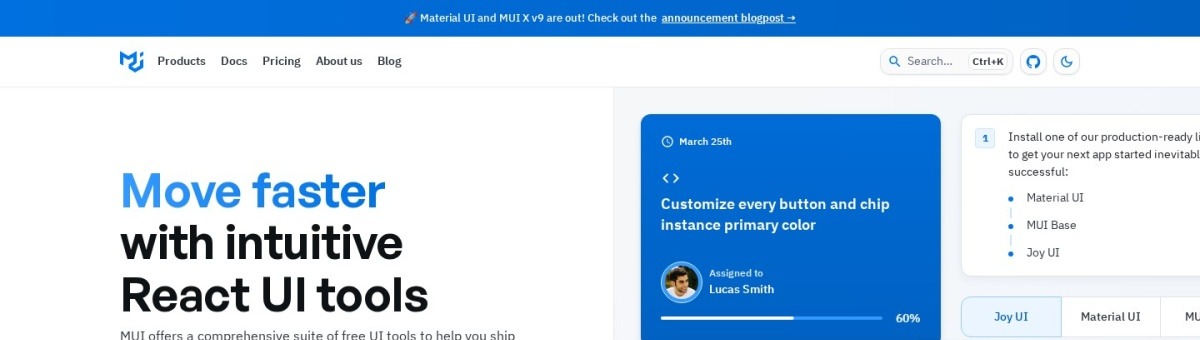
Material UI is a free React component library that follows Google Material Design, with buttons, forms, tables and navigation ready to use. Material UI v9 is out, and the core library is free under the MIT licence.
The trade off is that the advanced pieces cost money. The Data Grid Pro, charts and date pickers need MUI X Pro at $15 a month per developer, billed yearly at $180. It suits React teams building data-rich apps.
What we like
Free core library for React
Large, well-documented component set
Theming system for a custom look
Rated 4.5 out of 5 from 30 G2 reviews
Watch out for
React only, not for plain HTML sites
Advanced data components need a paid plan
MUI X Pro adds the Data Grid, charts and pickersVisit mui.com
02
Ant Design
4.5/5on G2 (13 reviews, checked Nov 2026)
PriceFree
Best free kit for admin dashboards
LicenceMIT, free
FrameworkReact
Version6.0
Paid planNone, free
ant.design
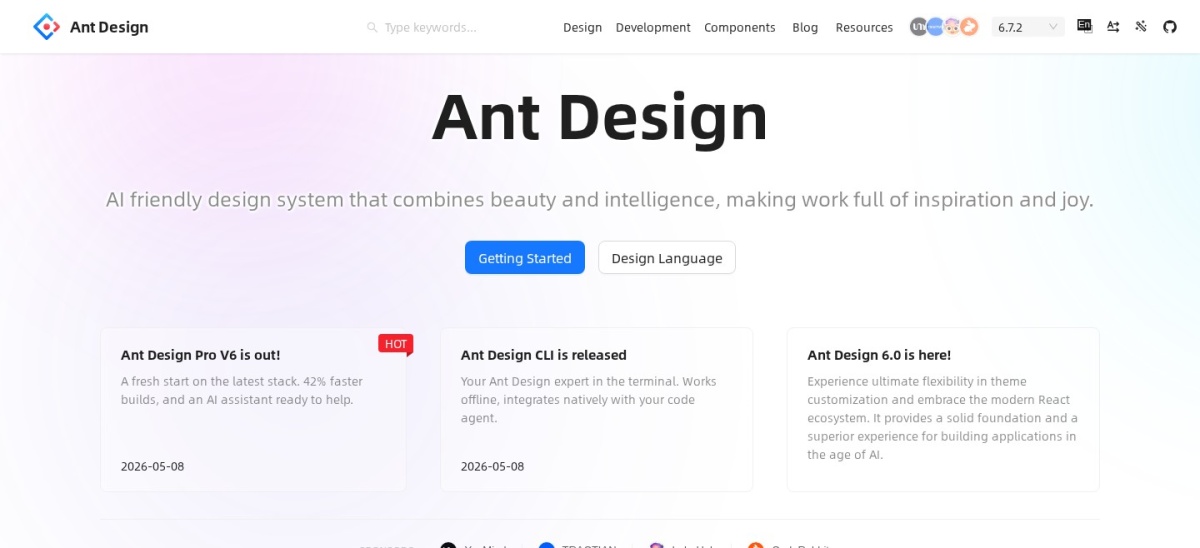
Ant Design homepage, captured Nov 2026.
Ant Design is a free React design system with a large set of components for tables, forms, layouts and data display. Version 6.0 is out, and the library is aimed at enterprise admin panels and dashboards.
The trade off is the look. Ant Design has a strong default style, and changing it takes theme work, so marketing sites often need more effort than dashboards. It suits teams building internal tools and admin panels.
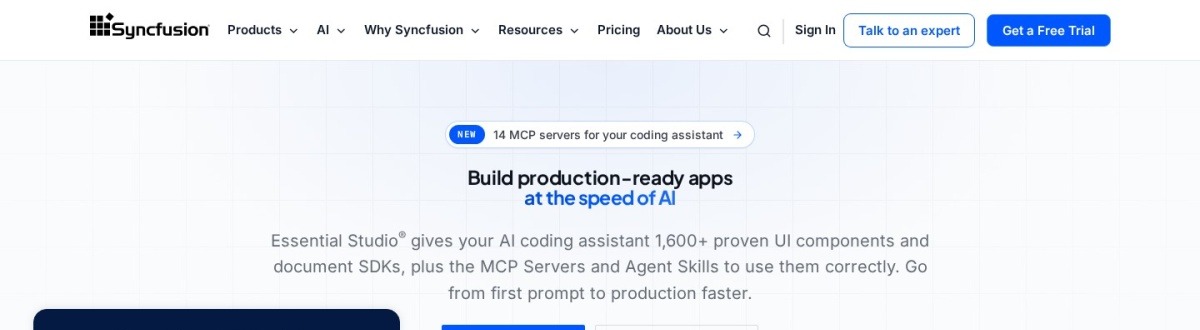
Syncfusion Essential Studio homepage, captured Nov 2026.
Syncfusion Essential Studio is a commercial component suite with 1,600+ components across React, Angular, Vue, Blazor and JavaScript. The UI Component Suite costs $1,199 a year per developer and includes business support.
The trade off is price and scope. A free Community License covers only small companies, and the full suite is far more than a small site needs. It suits large teams that need grids, charts, schedulers and document tools in one licence.
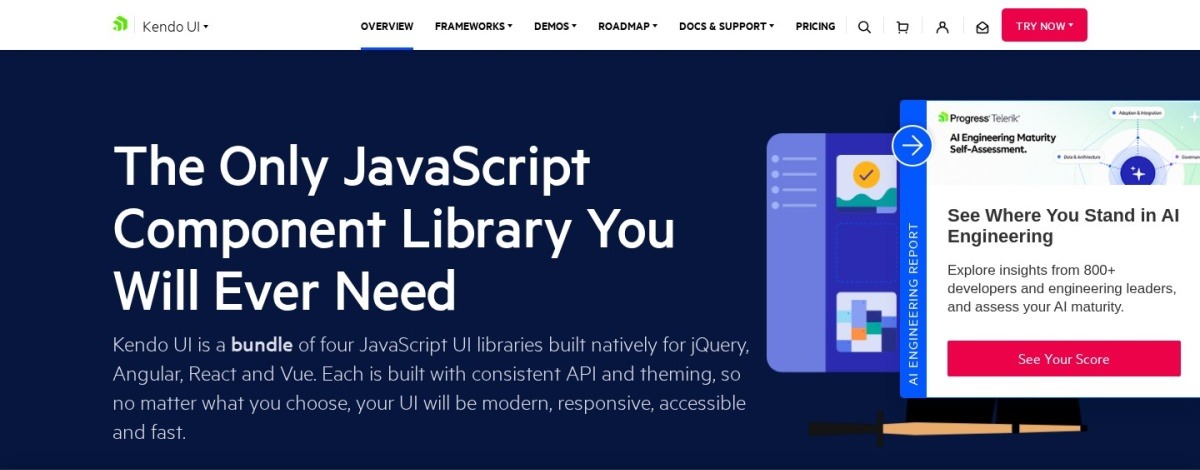
Progress Kendo UI is a paid bundle of four JavaScript UI libraries built for jQuery, Angular, React and Vue. The Lite Support plan starts at $799 a year per developer, and Priority Support costs $899 a year.
The trade off is cost. There is no free tier for the full bundle, only a 30-day trial, so small teams pay from the start. It suits teams that run more than one JavaScript framework and want one vendor for all of them.
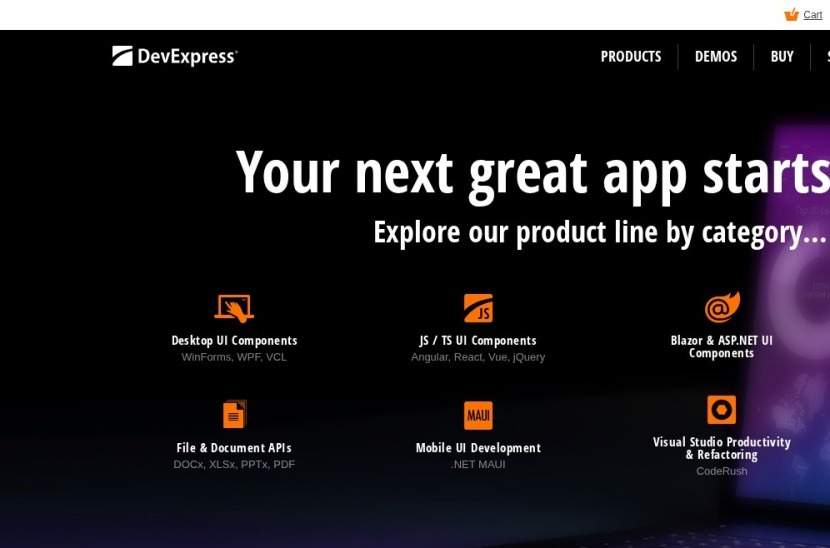
DevExpress DevExtreme homepage, captured Nov 2026.
DevExpress DevExtreme is a commercial JavaScript suite with 80+ components for Angular, React, Vue and jQuery, led by its DataGrid. DevExtreme Complete costs $899.99 a year per developer, with renewal at $449.99.
The trade off is that nothing is free. There is a 30-day trial but no free tier, and the suite is built for business apps rather than marketing sites. It suits teams that need grids, pivot tables, schedulers and charts with support.
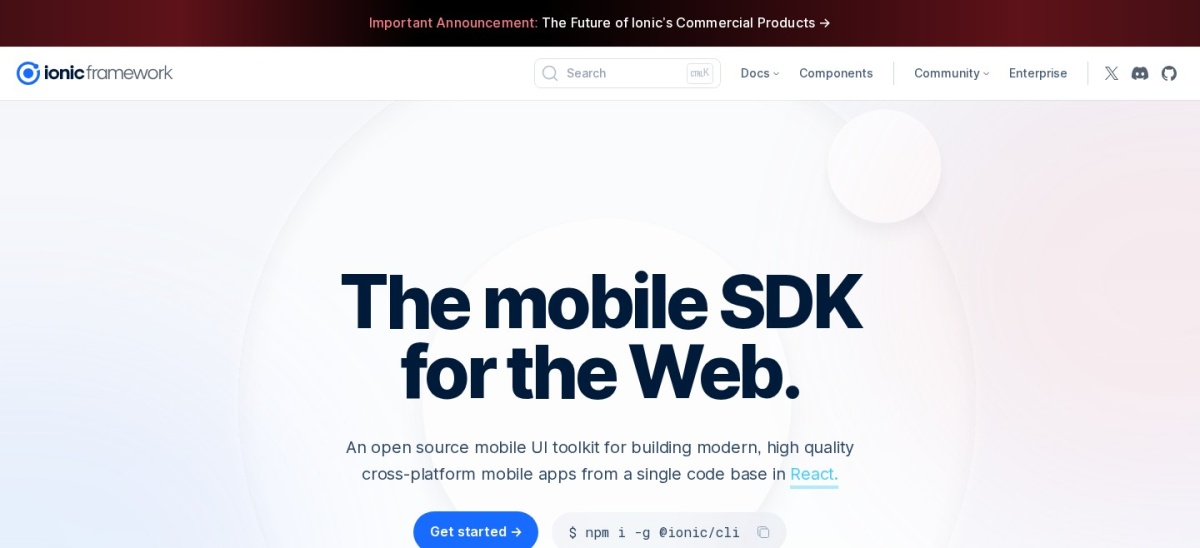
Ionic is a free, open-source mobile UI toolkit that builds apps for iOS, Android, desktop and the web from one codebase. It works with Angular, React or Vue and uses Capacitor to reach native device features.
The trade off is the paid cloud layer. Ionic stopped selling Appflow to new customers in February 2025, so teams must arrange their own builds and live updates. It suits web teams shipping mobile apps from code they already know.
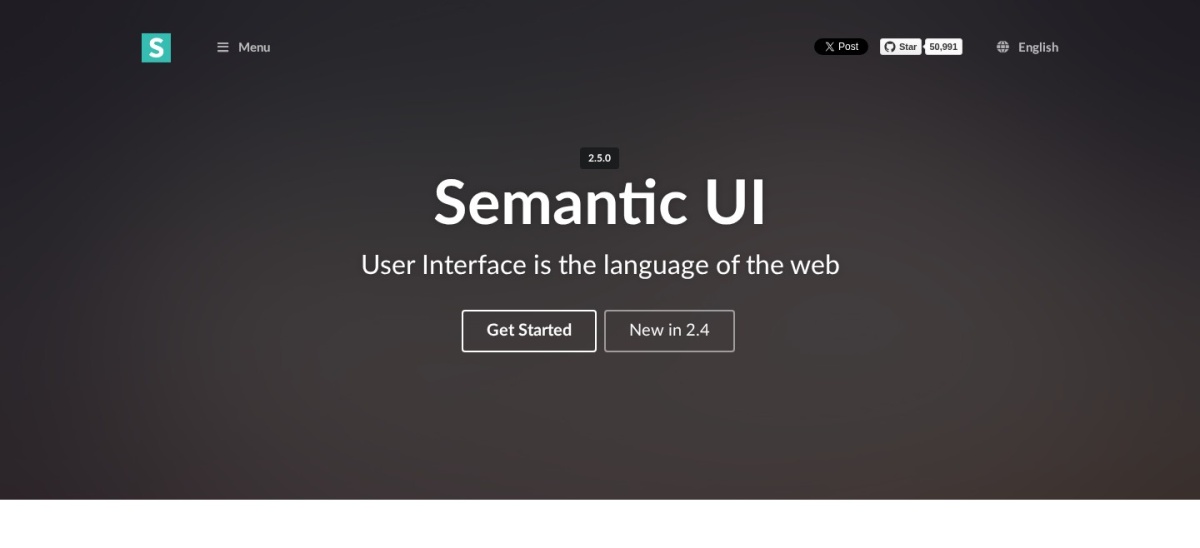
Semantic UI is a free CSS framework with components named in plain English, such as button, card and menu. Version 2.5.0 is the current release, and the project has 50,991 stars on GitHub.
The trade off is pace. Updates are infrequent, and reviewers note that customisation can be tricky, so it fits stable sites better than fast-moving projects. It suits developers who want readable class names and no build step.
Free plans cover the basics well. Material UI, Ant Design, Ionic and Semantic UI cost nothing, and they include the buttons, forms, tables and layouts most sites need.
Paid plans mostly add data tools and support. Syncfusion, Kendo UI and DevExtreme charge per developer, and their grids, pivot tables and schedulers are built for business apps rather than simple sites.
If you only need buttons, grids and forms, a free library is enough. Our child theme guide shows how to change a site's styling safely before you add any framework.
For a data-heavy app, the first year of a paid suite often costs less than building a grid, a scheduler and a chart library from scratch.
How we chose
We started from the established Bootstrap alternatives with a public G2 rating, then kept the seven with a numeric rating and review count we could verify on 29 November 2026.
Prices come from each vendor's pricing page, checked on 29 November 2026. Ratings and review counts come from G2 on the same day. Where a vendor shows a sale, the list shows the regular price.
We left out frameworks with no public G2, Capterra or Trustpilot rating, including Bulma, Chakra UI, Mantine, Foundation and Vuetify. No vendor paid for a place, and we do not claim to have used these tools ourselves.
How to choose a Bootstrap alternative
Start with the stack you already run, then match the framework to it.
Check whether you need React. Bootstrap works with plain HTML, while Material UI and Ant Design need React. Pick Semantic UI if you want classes in plain HTML with no build step.
List the components you actually use. Grids, tables, forms and navigation cover most sites. Only pay for a suite if you also need data grids, schedulers or pivot tables.
Compare the free core first. Material UI, Ant Design, Ionic and Semantic UI cost nothing to start. Try the free core before paying for a data grid or a support plan.
Price the paid tier per developer. Syncfusion, Kendo UI and DevExtreme charge per developer per year, so multiply the headline price by your team size before you compare totals.
FAQ
What is the best alternative to Bootstrap in 2026?
Material UI is the best alternative to Bootstrap for most teams. Its React core is free under the MIT licence, it is rated 4.5 out of 5 from 30 G2 reviews, and paid data tools start at $15 a month per developer.
What is the best free alternative to Bootstrap?
Semantic UI is the best free alternative for plain HTML sites, because it works like Bootstrap with classes and no build step. Ant Design is the best free pick for React admin dashboards, and Ionic is the best free pick for mobile apps.
How much do Bootstrap alternatives cost?
Four of the seven tools in this list are free, and Material UI charges only for advanced data components from $15 a month per developer. The paid suites start at $799 a year per developer for Kendo UI and reach $1,199 for Syncfusion.
Which Bootstrap alternative is best for beginners or small teams?
Semantic UI is the easiest pick for beginners, because its class names read like plain English and it needs no build step. Small React teams should start with Material UI, whose free core covers most components.
Material UI vs Ant Design: which is better?
Material UI is the better pick for most React teams, with a larger component set, a theming system and paid data tools. Ant Design is the better pick for admin dashboards, with stronger tables and forms and no paid tier at all.
Can I use a Bootstrap alternative without React?
Yes. Semantic UI is the plain-HTML pick in this list, and it needs no JavaScript framework. Ionic also works without React, and Kendo UI and DevExtreme both support jQuery, Angular and Vue as well as React.
SaaS SEO and WordPress specialist with about 8 years of experience. Rakib compares WordPress plugins, themes, hosting and software using public pricing, documentation and user reviews. See how we rank.