Snowflake is the best BigQuery alternative for most teams, rated 4.6 out of 5 on G2 from 783 reviews, with storage and compute that scale separately. Databricks suits teams that also need Spark and machine learning, while MotherDuck is the lightest pick for small DuckDB teams.
How we make this list: we compare pricing pages, product documentation and public user reviews, then re-check every price before each update. No product paid for a place. Disclosure.
Snowflake leads on reviewer satisfaction: 4.6 out of 5 from 783 G2 reviews, the largest base among the warehouse-first picks.
Databricks is the only pick that covers pipelines, SQL and machine learning on one platform, but its DBU billing is the hardest to forecast.
Dremio, Starburst and ClickHouse keep data in open formats, so leaving costs less than leaving a proprietary warehouse.
MotherDuck and Firebolt are the cheapest ways in: free tiers cover small workloads before any paid meter starts.
Every pick here bills by usage, so the cheapest headline rate rarely means the cheapest month. Price one real workload on each.
What should you look for in BigQuery alternatives?
Start with where your data already lives. BigQuery charges $6.25 per TiB scanned with the first 1 TiB free each month, so teams already on Google Cloud need a strong reason to move. The alternatives below win when your data, your team or your budget sits elsewhere.
Billing is the real difference between these tools. None of them sells a simple per-seat plan. Snowflake bills credits, Databricks bills DBUs, Dremio bills DCUs and Starburst bills credits, so compare the same workload on each instead of comparing headline rates.
Open formats protect your exit. Dremio and Starburst query Iceberg and Trino data in place, and ClickHouse is open source, so your data stays portable. A proprietary warehouse is faster to start and slower to leave.
Small teams should start with a free tier. MotherDuck Lite, Dremio Cloud, Starburst Galaxy and the Databricks Community Edition all cover real small workloads free, so you can prove the fit before any meter starts running.
Snowflake is a cloud data warehouse that separates storage from compute, so queries scale without copying data. It runs on AWS, Azure and GCP, speaks standard SQL, and G2 lists its entry plan at $23 a month.
The trade off is cost control. Credits are metered while warehouses run, so a warehouse left running adds up fast. It suits teams that want a managed warehouse with the widest tool ecosystem.
Best for pipelines, SQL and machine learning in one place
Billing unit$99/mo Basic (G2)
Free editionCommunity Edition
GovernanceUnity Catalog
EngineApache Spark
databricks.com
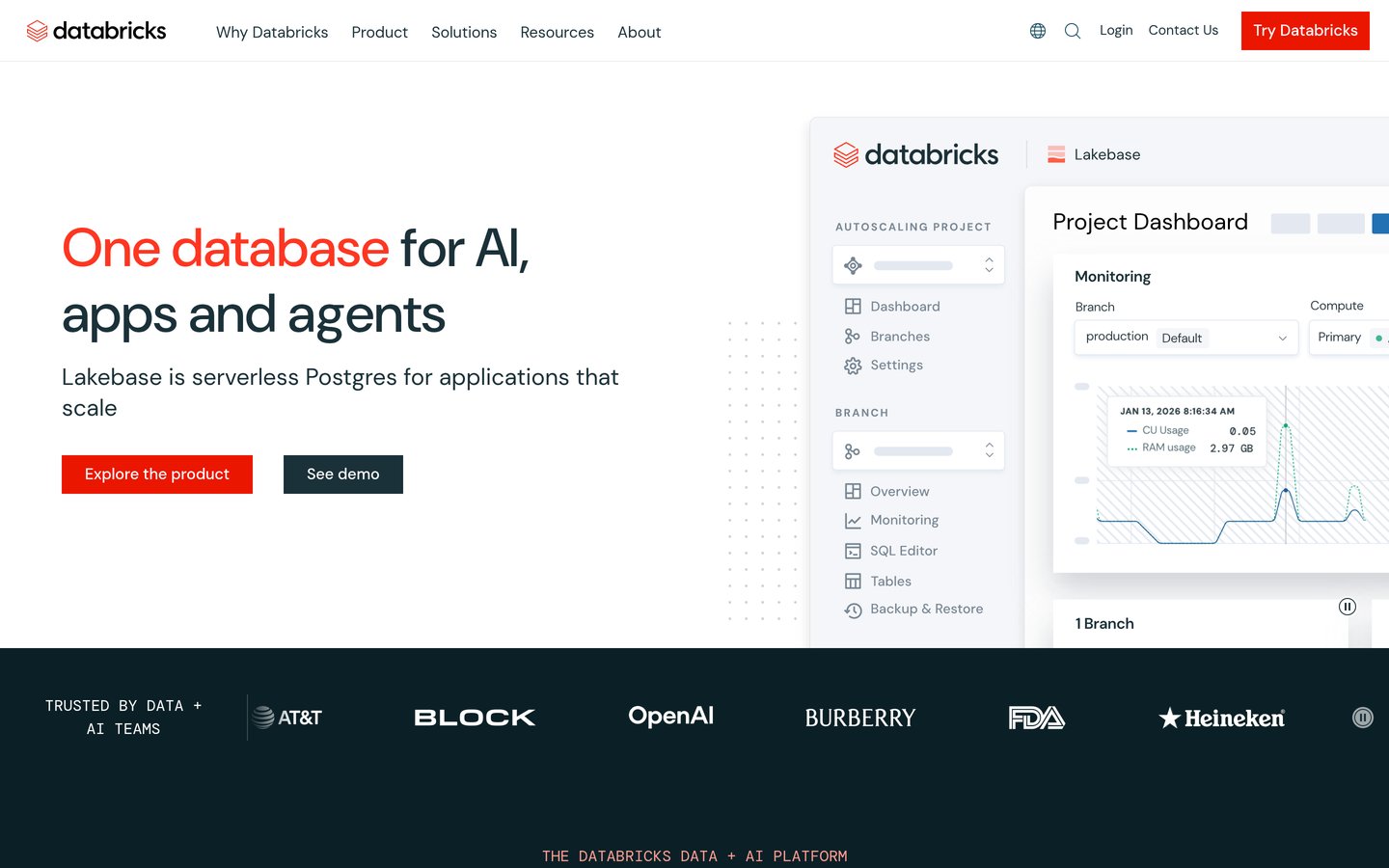
Databricks homepage, captured Nov 2026.
Databricks is a unified Data Intelligence Platform that runs data engineering, SQL analytics and machine learning on one lakehouse. It is built by the original creators of Apache Spark, and G2 lists its Basic plan at $99 a month, with a free Community Edition for learning.
The trade off is billing. DBU rates vary by workload, and cloud infrastructure is billed on top, so the monthly total is harder to forecast than a flat plan. It suits teams that want pipelines, SQL and AI in one place.
What we like
One platform for pipelines, SQL and machine learning
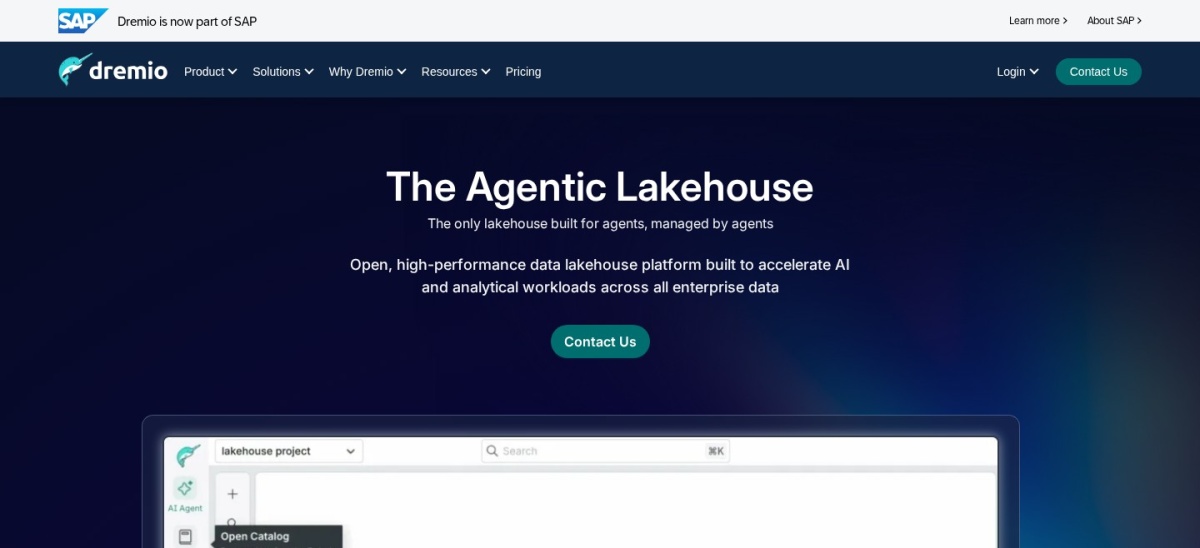
Dremio is an open lakehouse platform that runs SQL directly on Apache Iceberg tables in object storage, so data never moves into proprietary storage. Its Cloud free tier covers small workloads, and paid engines bill at $0.20 per DCU, with a 30-day trial that includes $400 in credits.
The trade off is the 2026 ownership change. SAP acquired Dremio in 2026, so buyers on multi-year deals should ask about roadmap and pricing protection. It suits teams that want fast SQL on Iceberg data they already own.
What we like
Queries Iceberg data without moving it
Permanent free tier on Dremio Cloud
Semantic layer governs metrics in one place
Open formats keep exit costs low
Watch out for
SAP acquisition raises roadmap questions
Smallest engine starts at $6.40 an hour
Needs data already in open formats
Paid engines add scalable DCU compute and query accelerationVisit dremio.com
04
MotherDuck
4.5/5on G2 (14 reviews, checked Nov 2026)
Paid from$250/mo
Best for small DuckDB teams that want it hosted
Billing$250/mo Business
Free tierLite, 10 GB, 10 hrs
EngineDuckDB, serverless
SharingShareable databases
motherduck.com
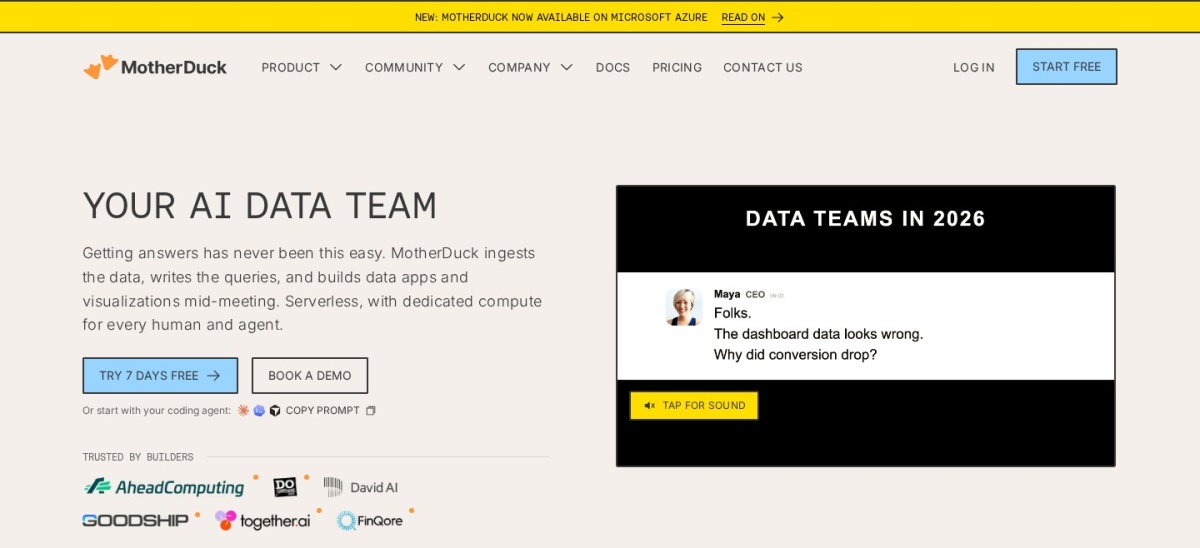
MotherDuck homepage, captured Nov 2026.
MotherDuck is DuckDB in the cloud, adding sharing, collaboration and cloud storage to the fast local analytical engine. The free Lite tier covers 10 GB of storage and 10 compute hours a month, and the Business plan starts at $250 a month plus usage.
The trade off is the small review base. It holds 4.5 out of 5 on G2 but from only 14 reviews, and teams not already on DuckDB face a migration. It suits small data teams that already love DuckDB and want it shared and hosted.
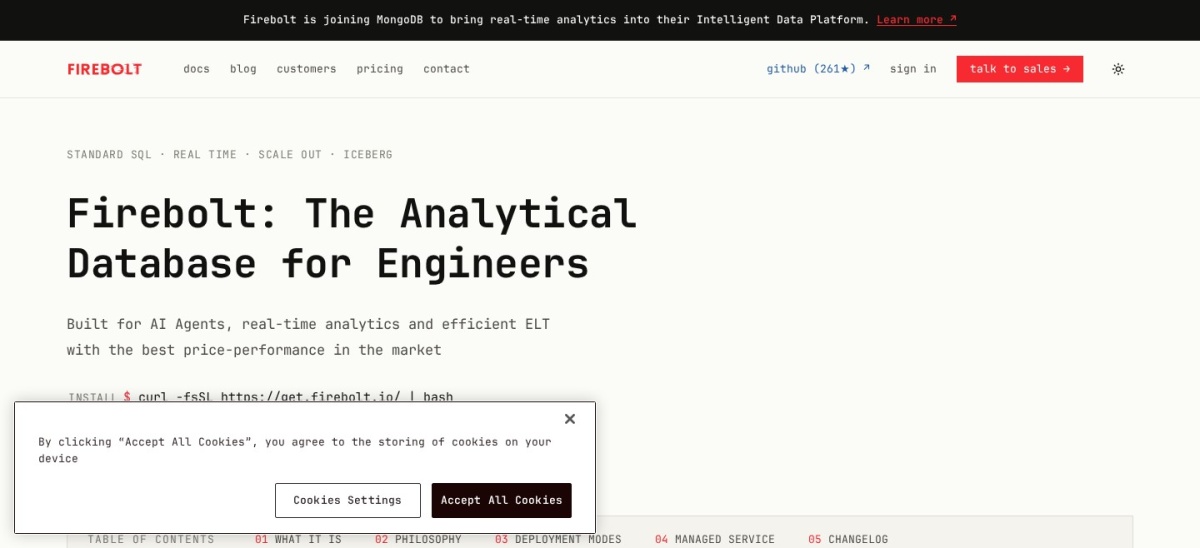
Firebolt is a cloud warehouse built for sub-second SQL at high concurrency, with engines that bill per second and stop after 20 idle minutes. Standard compute costs $0.23 per FBU-hour, and the self-hosted Core edition is free.
The trade off is scope. It runs on AWS only, and concurrency auto-scaling and PrivateLink need the Enterprise tier at $0.35 per FBU-hour. It suits engineering teams serving customer-facing dashboards that need fast queries under load.
What we like
Sub-second queries at high concurrency
Per-second billing with auto-stop
Free self-hosted Core edition
$200 trial credit with no card
Watch out for
AWS only, no other cloud
Speed depends on per-table index design
Only 14 G2 reviews so far
Enterprise adds auto-scaling, PrivateLink and HIPAA supportVisit firebolt.io
06
Azure Synapse Analytics
4.4/5on G2 (38 reviews, checked Nov 2026)
Starts at$5/TB
Best for Azure teams that want SQL and Spark together
Serverless SQL$5 per TB processed
Dedicated SQLFrom $1.51 per DW100c hour
SparkFrom $0.138 per vCore-hour
WorkspaceOne workspace, SQL + Spark
azure.microsoft.com
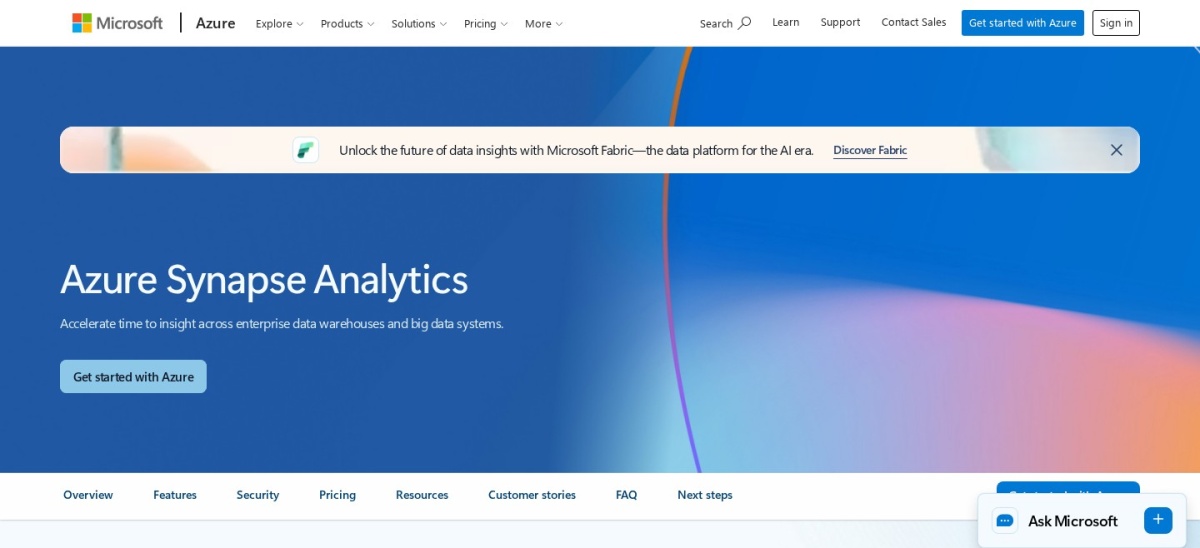
Azure Synapse Analytics homepage, captured Nov 2026.
Azure Synapse Analytics is Microsoft's unified analytics workspace, combining serverless SQL, dedicated SQL pools, Spark and pipelines in one place. Serverless SQL costs $5 per TB of data processed, so an idle workspace costs nothing for queries.
The trade off is complexity. Each engine bills separately, and reviewers say cost estimation is the hardest part. It suits teams already on Azure who want T-SQL, Spark and Power BI in one workspace.
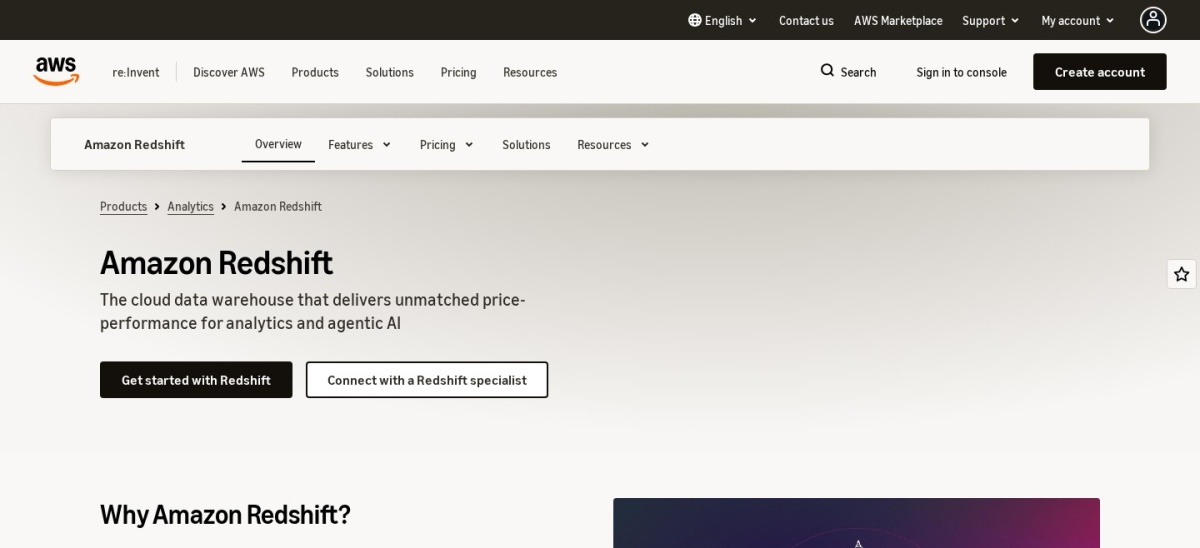
Amazon Redshift is AWS's cloud warehouse, with provisioned clusters and a serverless option that scales with queries. The smallest provisioned node, dc2.large, lists from $0.094 an hour, and Redshift Serverless charges only for the queries you run.
The trade off is AWS lock-in. It is at its best inside AWS, and reviewers warn that costs climb fast without reserved pricing. It suits teams whose data and tools already live on AWS.
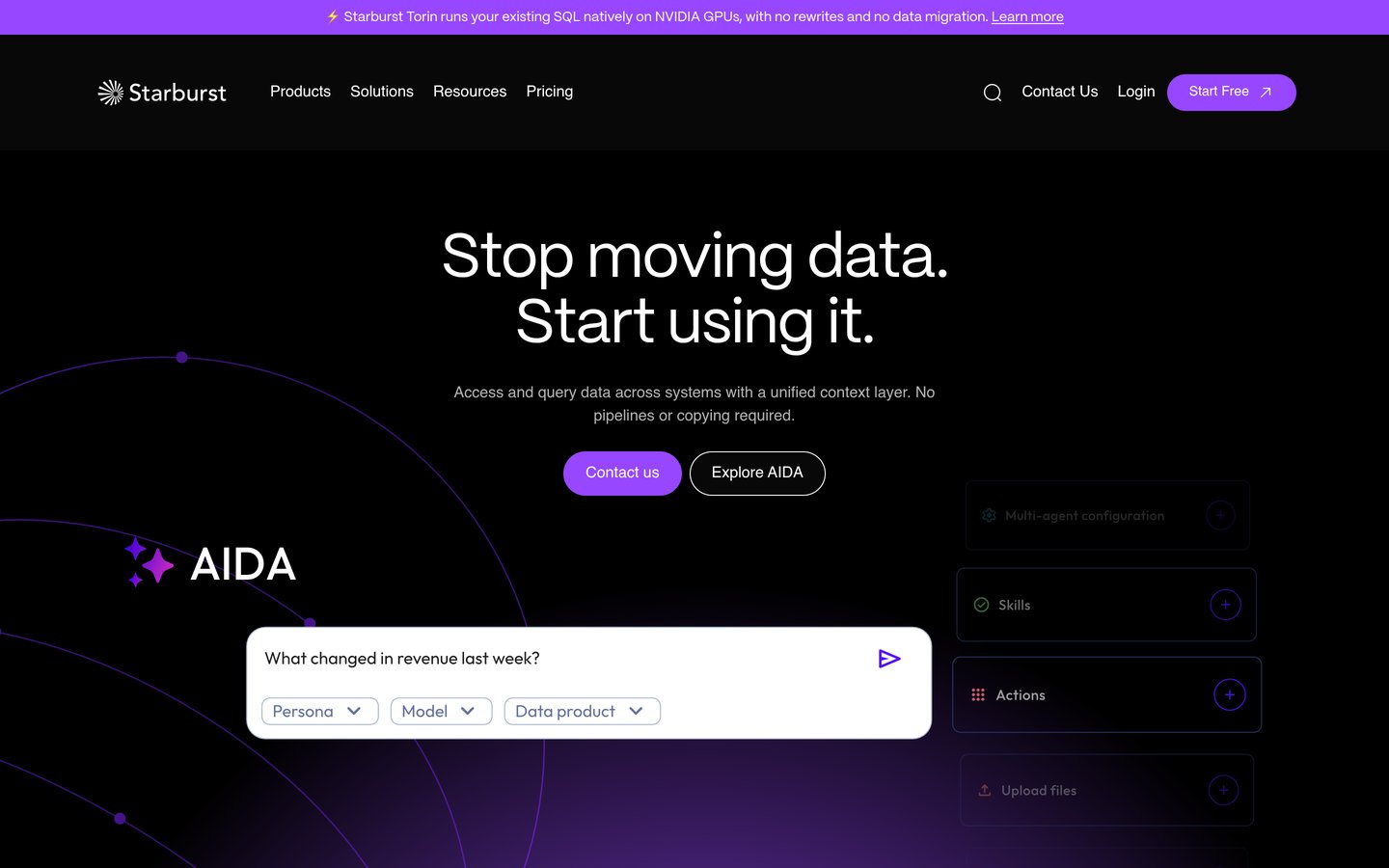
Starburst is an enterprise distribution of open-source Trino that runs federated SQL across lakes, warehouses and databases without moving data. Its managed Galaxy service has a free tier with up to three clusters, and paid Pro plans start at $0.50 per credit.
The trade off is predictability. Usage billing makes monthly costs hard to forecast, and Enterprise features raise the rate to $0.75 per credit. It suits teams that need one SQL layer across many sources.
Best for very fast aggregations on huge event volumes
Billing$53/mo Basic (Cloud)
Free tierOpen source, self-hosted
Compute$0.2181 per unit-hour
Trial$300 credit, 30 days
clickhouse.com
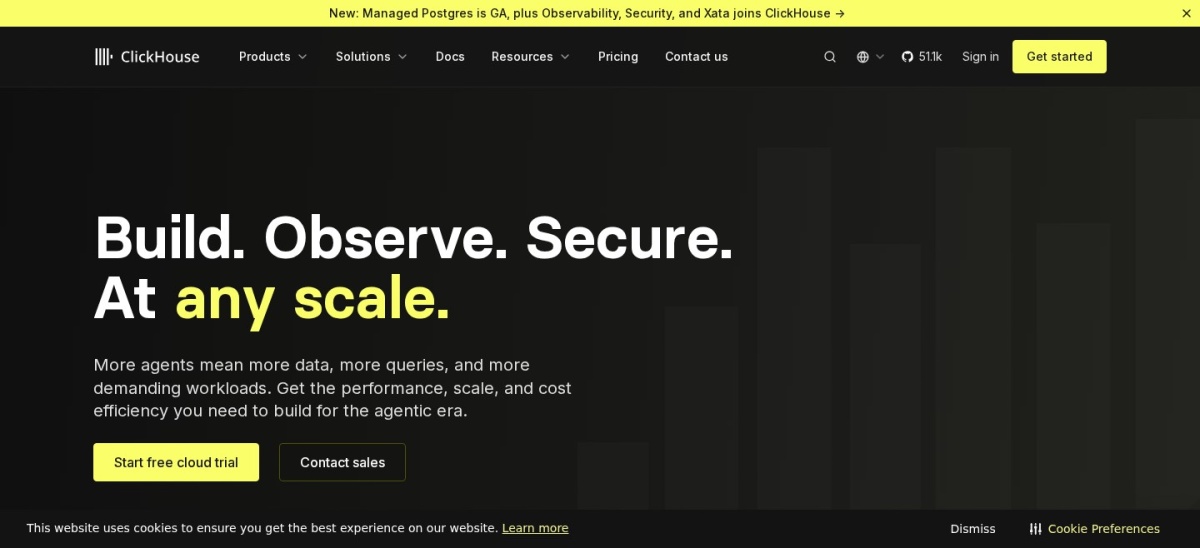
ClickHouse homepage, captured Nov 2026.
ClickHouse is a fast open-source columnar database for real-time analytics, logs and events. The open-source edition is free to self-host, and ClickHouse Cloud Basic starts at $53 a month, with $300 in trial credits for new accounts.
The trade off is operations. A production cluster needs work on replication and sharding, and the G2 review base is only 58 reviews. It suits teams that need very fast aggregations on huge event volumes and can manage the setup.
Free tiers here are real but narrow. MotherDuck Lite gives 10 GB of storage and 10 compute hours a month, Starburst Galaxy keeps up to three clusters free, and Dremio Cloud has a permanent free tier for small Iceberg workloads.
Paid meters start the moment you outgrow those limits. ClickHouse Cloud has no free tier beyond its $300 trial credit, and Redshift and Synapse only offer trials, so budget for usage from day one on those three.
The cheapest move is to run one real workload on two free tiers before paying. The same queries on MotherDuck Lite and Dremio Cloud will tell you more about fit and cost than any pricing page.
How we chose
We started from the platforms buyers compare with BigQuery most often: cloud warehouses, lakehouse platforms and open-source analytical engines with a public rating.
Prices come from each vendor pricing page and G2 listings, checked on 29 November 2026. Ratings and review counts come from G2 on the same day. Where a vendor shows a sale, the list shows the regular price.
We left out tools with no public rating and tools sold only by custom quote. No vendor paid for a place, and we do not claim to have used these tools ourselves.
How to choose a BigQuery alternative
Start with your cloud, your data format and your query pattern, then price one real workload.
Match the tool to your cloud. Redshift fits AWS shops, Synapse fits Azure shops, and Snowflake and Databricks run on all three. Moving clouds to chase a warehouse rarely pays.
Decide how portable your data must be. If you want to leave any time, pick an open-format option such as Dremio, Starburst or ClickHouse. If you want a managed warehouse, accept the lock-in.
Price one real workload, not the headline rate. Run the same queries and the same data volume on two tools. Credits, DBUs, DCUs and TiB scanned are not comparable until you do.
Start on a free tier. MotherDuck Lite, Dremio Cloud, Starburst Galaxy and the Databricks Community Edition all let you prove the fit before the first bill arrives.
FAQ
What is the best BigQuery alternative in 2026?
Snowflake is the best BigQuery alternative for most teams. It is rated 4.6 out of 5 on G2 from 783 reviews, separates storage from compute, and runs on AWS, Azure and GCP, so it fits teams on any cloud.
How much do BigQuery alternatives cost?
Most bill by usage, not by seat. Snowflake entry is listed at $23 a month, Databricks Basic at $99 a month, Dremio at $0.20 per DCU and Starburst Pro at $0.50 per credit. Total cost depends on how much you query, so price one real workload.
Is there a free BigQuery alternative?
Yes. MotherDuck Lite is free with 10 GB of storage and 10 compute hours a month, Dremio Cloud and Starburst Galaxy have permanent free tiers, ClickHouse is free to self-host, and Databricks has a free Community Edition for learning.
What is the best BigQuery alternative for small teams?
MotherDuck is the best pick for small teams that already use DuckDB. Its free Lite tier covers 10 GB and 10 compute hours a month, and the Business plan starts at $250 a month plus usage.
Snowflake vs Databricks: which is the better BigQuery alternative?
Snowflake is better for pure warehouse analytics, with the highest G2 rating in this list and the simplest SQL-first setup. Databricks is better when the same team also builds pipelines and machine learning on Spark.
Can I move my data out of BigQuery easily?
Yes, BigQuery exports tables to Parquet, CSV and JSON in Cloud Storage, and most tools here can query those files in place. Dremio and Starburst are built for exactly that pattern, so you can switch query engines without moving the data first.
SaaS SEO and WordPress specialist with about 8 years of experience. Rakib compares WordPress plugins, themes, hosting and software using public pricing, documentation and user reviews. See how we rank.