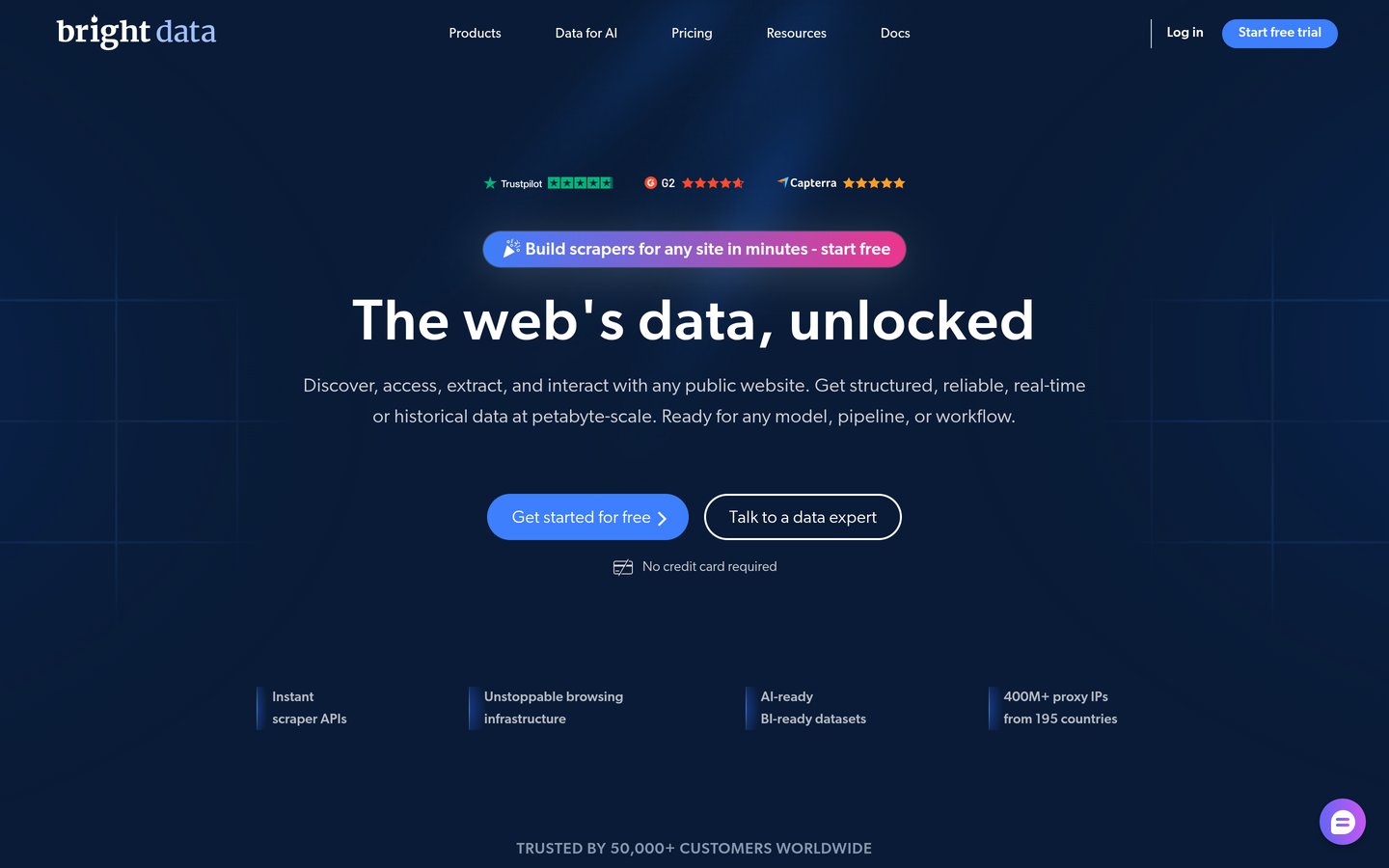
Bright Data is the top web scraping tool for large datasets, pairing 400M+ residential IPs with unlimited concurrency and pre-built scrapers for 1,400+ sites. Apify suits developers who want ready-made marketplace Actors with 32 to 256 concurrent runs, while ScraperAPI fits engineering teams pushing millions of monthly requests through a single endpoint.
How we make this list: we compare pricing pages, product documentation and public user reviews, then re-check every price before each update. No product paid for a place. Disclosure.
Bright Data includes 5,000 free monthly credits and scales to 384,000 records for $499/mo with unlimited concurrency.
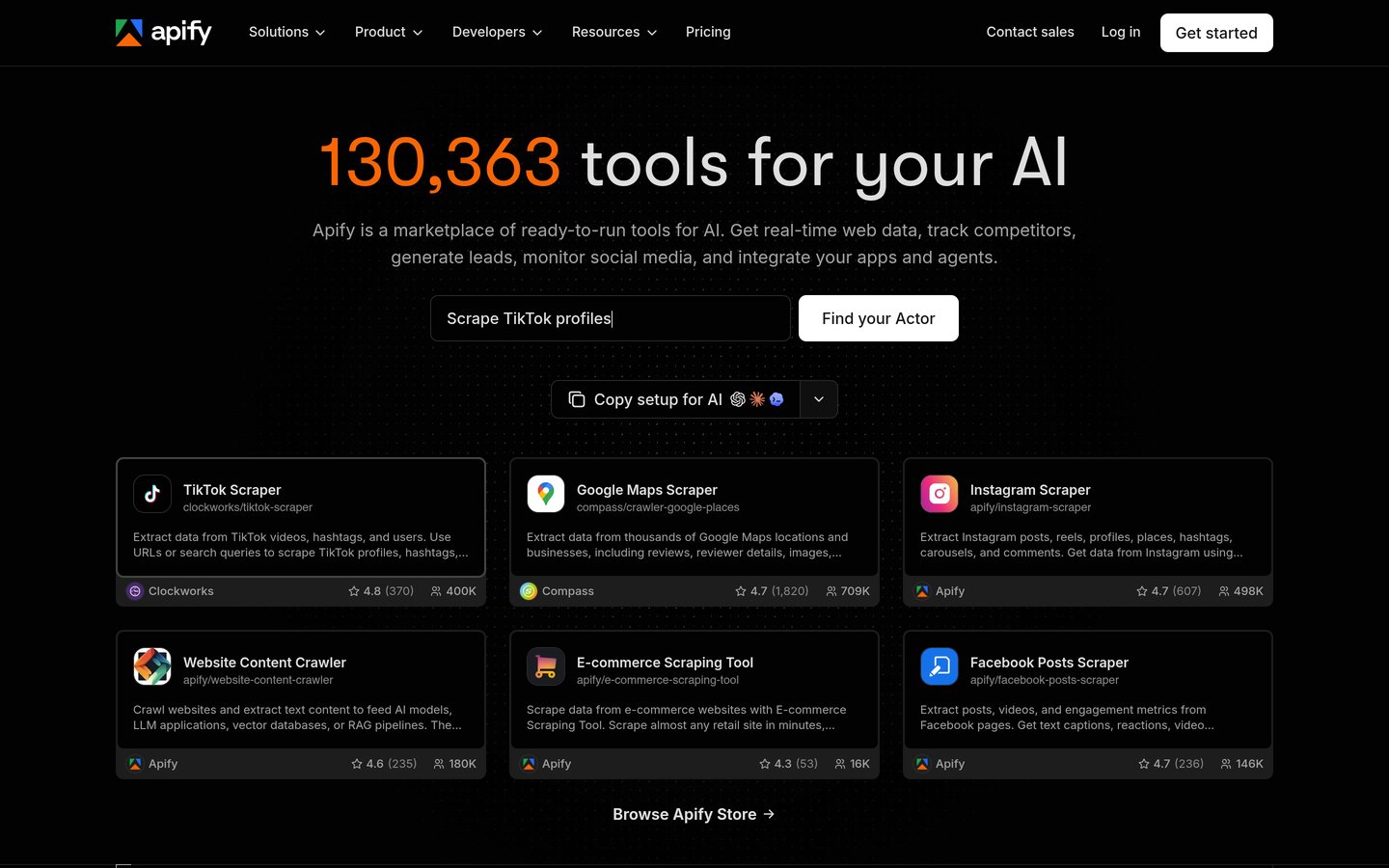
Apify starts at $19/mo plus usage for 32 concurrent runs and 131,500+ store Actors, backed by a 4.8/5 Capterra rating.
ScraperAPI scales from 100,000 credits at $49/mo up to 21.5 million monthly credits and 500 concurrent threads.
Zyte API prices HTTP requests from $0.13 per 1,000 on pay-as-you-go and drops to $0.06 per 1,000 at a $500/mo commitment.
Oxylabs Web Scraper API starts at $15/mo for 10,000 results and scales down to $0.25 per 1,000 results at 10M+ volume.
No-code teams can run scheduled cloud crawls on Octoparse from $83/mo ($69/mo yearly) with unlimited monthly rows.
What to look for in web scraping tools for large datasets
Collecting millions of records breaks standard single-threaded scripts. At high volume, target websites trigger rate limits, CAPTCHAs, and IP bans within minutes. Look for tools that combine automatic proxy rotation across residential or mobile IP pools with built-in JavaScript rendering and anti-bot unblocking so jobs finish without manual babysitting.
Concurrency and throughput limits determine how fast a large crawl completes. A plan with 5 concurrent requests takes days to pull a million-page catalog, whereas platforms offering 50 to 500 concurrent threads or unlimited concurrency finish the same batch in hours. Always check both the monthly credit cap and the maximum simultaneous connections.
Metering models also change your real cost per thousand records. Some vendors charge 1 credit for plain HTML but 5 to 75 credits when browser rendering and residential proxies turn on. Compare the effective cost for protected pages, check whether failed requests are excluded from billing, and verify direct export support to webhooks, S3, or Snowflake.
Bright Data is an enterprise web data platform combining Scraper APIs for 1,400+ websites, an AI scraper builder, and a 400M+ residential IP network. Its free tier includes 5,000 monthly credits with no credit card required, and failed deliveries are never billed. Results stream as JSON, NDJSON, or CSV directly to AWS S3, Google Cloud, Azure, Snowflake, or webhooks.
The trade off is the $499/mo ($5,988/yr) entry commitment for its Growth plan, which covers 384,000 records at $1.30 per 1,000 additional records with unlimited concurrency (new accounts can also use promo code API60 for 60% off for three months). It suits enterprise data engineering teams running continuous, high-volume pipelines.
What we like
Unlimited concurrency and auto-scaling infrastructure for massive batch jobs
All-in per-record pricing bundles residential proxies, CAPTCHA solving, and parsing
Direct cloud delivery to Snowflake, S3, GCS, Azure, and webhooks
Zero charges on failed requests
Watch out for
High $499/mo monthly subscription threshold after the free tier
Strict account verification and compliance onboarding steps
Apify is a cloud web scraping and automation platform built around a marketplace of more than 131,500 ready-made scrapers called Actors. The free plan includes $5 in monthly platform usage, 5 concurrent runs, and 16 GB of Actor RAM. Developers can also deploy custom Python, Playwright, or Scrapy code with built-in storage queues and scheduling.
The trade off is variable usage billing on top of the $19/mo ($228/yr) Starter base fee, since compute units ($0.20/CU), residential proxies ($8/GB), and individual Actor fees stack together. Annual billing takes 10% off the platform tier. It suits teams that want off-the-shelf scrapers for major platforms alongside cloud orchestration.
What we like
Massive library of 131,500+ pre-built Actors avoids writing custom parsers
Scales from 32 concurrent runs on Starter to 256 on Business ($999/mo)
Built-in request queues, dataset storage, and MCP server support
Low $19/mo entry point with spend caps
Watch out for
Total run costs are harder to predict across compute, proxy, and Actor fees
Starter plan limits compute to $0.20/CU compared to $0.16 on Scale ($199/mo)
Starter ($19/mo) raises concurrent runs from 5 to 32 and Actor RAM to 64 GB.Visit apify.com
03
ScraperAPI
4.6/5on Capterra (62 reviews, checked Nov 2026)
Paid from$49/mo
Best for high-concurrency proxy APIs
Entry paid plan$49/mo (100,000 credits)
Free tier1,000 credits/mo (5K 7-day trial)
Concurrency20 to 500+ concurrent threads
High-volume tier21.5M credits at $1,975/mo
scraperapi.com
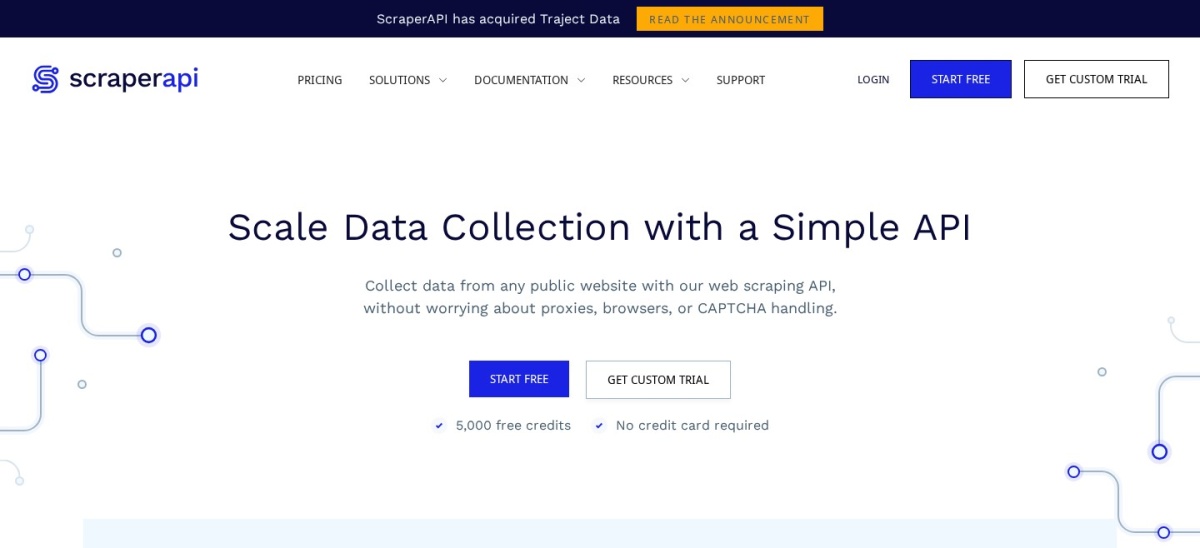
ScraperAPI homepage, captured Nov 2026.
ScraperAPI is a proxy and unblocking API that handles IP rotation, headless browser rendering, and CAPTCHA solving behind a single endpoint. Its permanent free tier provides 1,000 monthly API credits after a 7-day trial with 5,000 credits. Higher tiers include DataPipeline for automated batch scheduling and structured JSON endpoints for major search and e-commerce sites.
The trade off is credit consumption on protected pages and feature gating on lower plans: Hobby at $49/mo ($588/yr, or $44.10/mo billed annually) includes 100,000 credits and 20 threads, but global geotargeting requires Business ($299/mo) and pay-as-you-go overflow requires Scaling ($475/mo). It suits engineering teams scraping millions of pages with their own parsers.
What we like
Scales up to 21.5 million credits and 500 concurrent threads on self-serve plans
Simple single-endpoint integration with automatic proxy and CAPTCHA handling
Includes DataPipeline batch automation and crawler access on paid tiers
10% discount on annual billing across all tiers
Watch out for
Global geotargeting outside US and EU is locked until the $299/mo Business plan
JavaScript rendering plus ultra-premium proxies multiply credit usage per page
Hobby ($49/mo) delivers 100,000 monthly API credits, 20 threads, and JS rendering.Visit scraperapi.com
04
Zyte
4.4/5on Capterra (43 reviews, checked Nov 2026)
Paid from$100/mo
Best for pay-as-you-go volume discounts
Entry paid plan$100/mo commitment (or PAYG)
Free tier$5 initial credit, no card
Rate limitUp to 10,000 RPM
Per-1K HTTP rate$0.06 to $1.27 by site tier
zyte.com
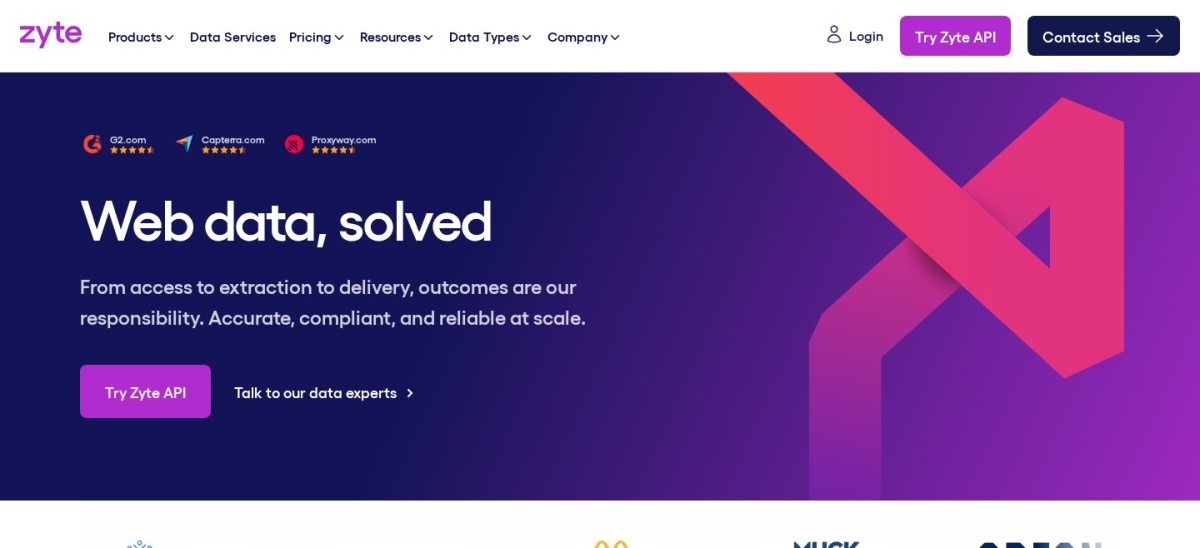
Zyte homepage, captured Nov 2026.
Zyte (from the creators of Scrapy) offers Zyte API, an automated extraction and unblocking API priced across five website difficulty tiers. New accounts start with $5 in free credit and can run pay-as-you-go up to a $100 monthly spend limit, starting at $0.13 per 1,000 simple HTTP responses or $1.01 per 1,000 browser-rendered pages.
The trade off is that per-request pricing varies widely by target difficulty—reaching $16.08 per 1,000 browser-rendered requests on Tier 5 sites without a monthly commitment—and unlocking volume discounts requires a $100/mo ($1,200/yr) to $500/mo commitment. It suits Python and Scrapy teams scaling large crawls with predictable unit economics.
What we like
Drops HTTP costs to $0.06 per 1,000 requests on a $500/mo commitment
Supports up to 10,000 requests per minute and 100 MB file downloads
No overage penalty fees when exceeding a monthly commitment
Native integration with Scrapy and Scrapy Cloud
Watch out for
Five-tier target pricing makes upfront cost estimation complex
Unused monthly commitment balances do not roll over or refund
A $100/mo commitment lowers HTTP rates to $0.10–$0.95 per 1,000 requests.Visit zyte.com
05
Oxylabs
4.6/5on Capterra (27 reviews, checked Nov 2026)
Paid from$15/mo
Best for predictable per-result APIs
Entry paid plan$15/mo (up to 30K results)
Free tier1-week free trial (5,000 results)
Per-1K rate$0.25 to $1.50 per 1,000 results
AI parsing$3.00 per 1,000 parsed pages
oxylabs.io
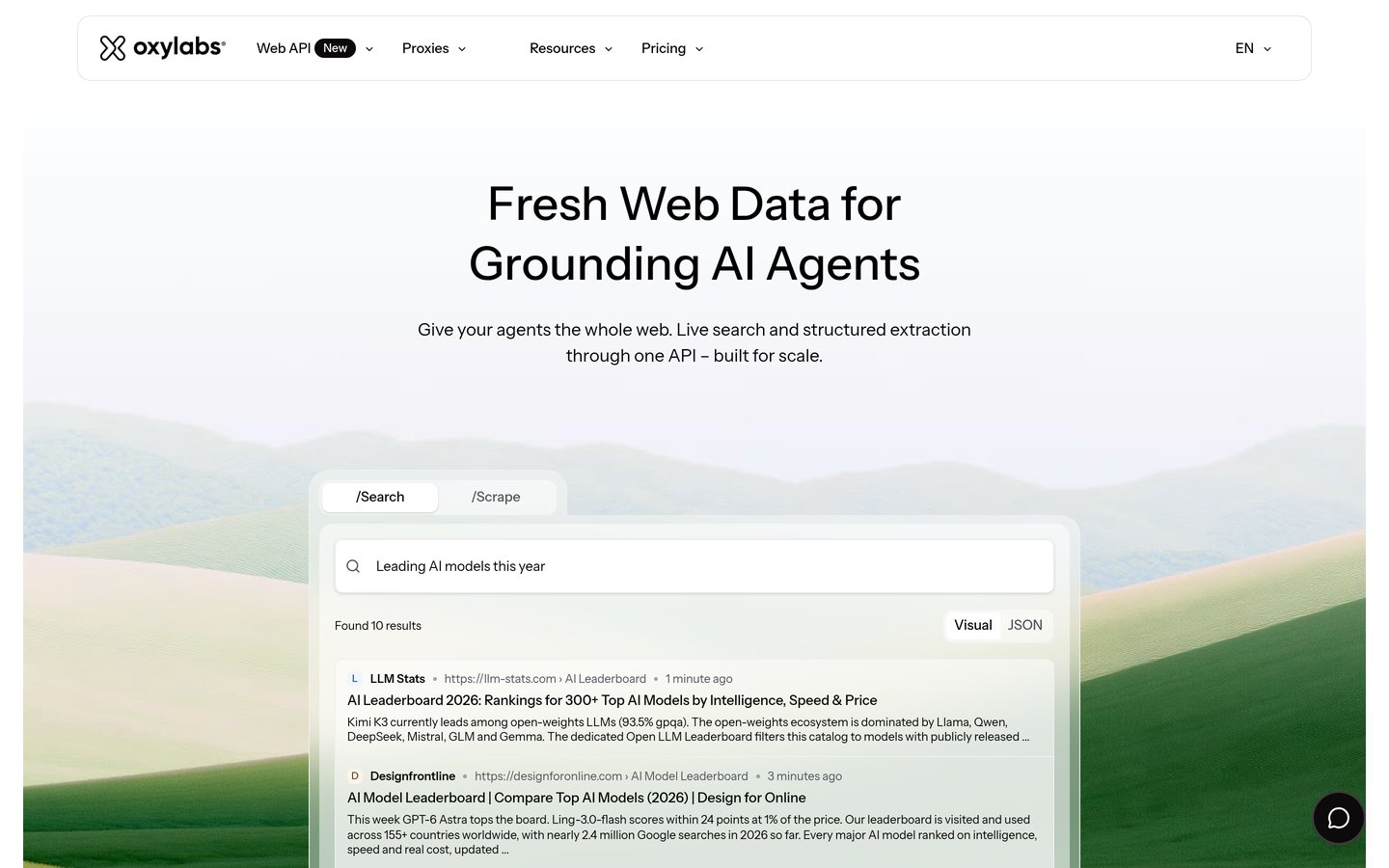
Oxylabs homepage, captured Nov 2026.
Oxylabs provides a Web Scraper API with dedicated endpoints for search engines, e-commerce catalogs, and custom domains. A free 7-day trial covers up to 5,000 results, while the Micro plan starts at $15/mo for up to 30,000 standard results ($0.50 per 1,000) or 10,000 JavaScript-rendered custom domain results ($1.50 per 1,000), with unlimited top-ups.
The trade off is that custom JavaScript rendering and AI schema parsing ($3.00 per 1,000 pages) increase per-record spend, and higher volume discounts require jumping to the $100/mo Starter or $500/mo Flexible plans ($0.25/1K at 10M+ results). It suits teams wanting clear per-result billing from small tests up to millions of records.
What we like
Low $15/mo entry tier with unlimited self-serve top-ups
Dedicated endpoints for Google, Amazon, and major e-commerce targets
Scales down to $0.25 per 1,000 results at 10M+ monthly volume
Includes 24/7 technical support and real-time usage tracking
Watch out for
Custom domain JavaScript scraping costs 3x more than standard endpoints
Advanced API configuration requires technical familiarity
Micro ($15/mo) includes up to 30,000 standard results with unlimited top-ups.Visit oxylabs.io
06
Scrapfly
4.9/5on Capterra (245 reviews, checked Nov 2026)
Paid from$30/mo
Best for anti-bot bypass and debugging
Entry paid plan$30/mo (200,000 credits)
Free tier1,000 credits/mo, no card
Concurrency5 to 100 concurrent requests
ComplianceSOC 2 Type II, ISO 27001, GDPR
scrapfly.io
Scrapfly homepage, captured Nov 2026.
Scrapfly is a web scraping and cloud browser API built to bypass strict anti-bot systems with a single unblocker parameter. Its forever-free tier includes 1,000 monthly credits with access to every API product and zero charges on failed scrapes. Paid plans include visual session debugging logs and proxy coverage across 190+ countries.
The trade off is credit multiplication when anti-bot bypass and browser rendering engage—moving a request from 1 credit for plain HTTP up to 25+ credits—and the $30/mo ($360/yr) Discovery plan caps concurrency at 5 requests without pay-as-you-go overflow. It suits developers scraping heavily protected targets who need visual debugging.
What we like
Highest user satisfaction score on Capterra (4.9/5 across 245 reviews)
Single API key covers scraping, cloud browser, screenshots, and AI extraction
Visual session recordings and logs speed up troubleshooting on blocked sites
Auto pay-as-you-go overflow from Pro ($100/mo) upward
Watch out for
Protected targets with browser rendering burn 25+ credits per page
Discovery plan is limited to 5 concurrent requests
Discovery ($30/mo) provides 200,000 monthly API credits across all five APIs.Visit scrapfly.io
07
Firecrawl
4.7/5on G2 (1,519 reviews, checked Nov 2026)
Paid from$19/mo
Best for AI and LLM training datasets
Entry paid plan$19/mo ($16/mo billed annually)
Free tier1,000 credits/mo, no card
Concurrency5 to 100 concurrent browsers
High-volume tier1M credits at $749/mo ($599 yearly)
firecrawl.dev
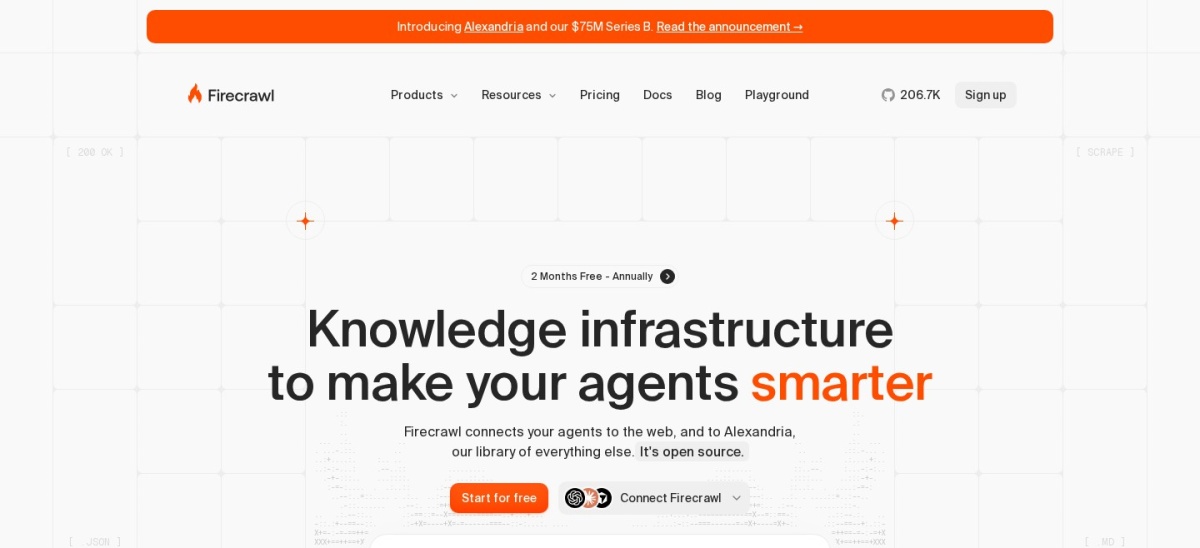
Firecrawl homepage, captured Nov 2026.
Firecrawl is an AI-focused web crawling and scraping API that turns full websites into clean Markdown or structured JSON for LLM training and RAG pipelines. Its free tier provides 1,000 monthly credits across `/scrape`, `/crawl`, `/map`, and `/search` endpoints, stripping navigation boilerplate automatically and handling dynamic JavaScript pages.
The trade off is credit burn on structured JSON extraction (5 credits per page versus 1 credit for Markdown) and lower concurrency on entry tiers: Hobby at $19/mo ($228/yr, or $16/mo billed annually) includes 5,000 credits and 5 concurrent browsers, while 25+ browsers require Standard ($99/mo). It suits AI engineers building clean text corpora.
What we like
Outputs clean, boilerplate-free Markdown ready for LLM ingestion
Combines site mapping, full-domain crawling, search, and browser interaction
Supports up to 100 concurrent browsers and 10,000 requests/min on Scale
Native MCP server and n8n workflow integrations
Watch out for
Credits do not roll over except on the $749/mo Scale plan
Structured JSON extraction uses 5x more credits than plain Markdown
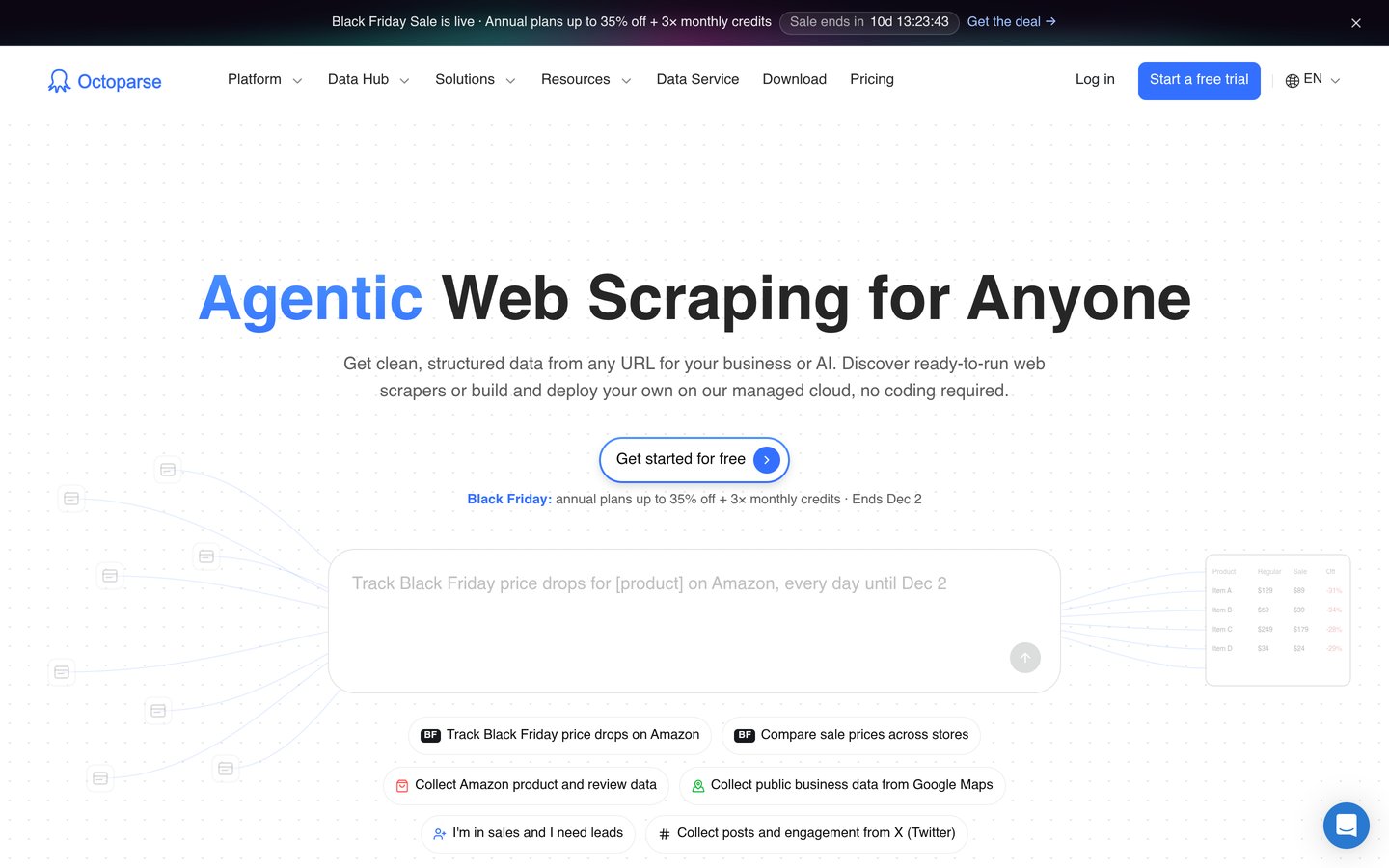
Octoparse is a visual, point-and-click web scraper with an AI assistant that auto-detects page lists and tables without code. Its free plan supports 10 local desktop tasks and exports up to 50,000 rows per month (plus 2,000 template or API rows). Paid plans add hundreds of ready-made site templates and direct database or cloud exports.
The trade off is that Basic at $19/mo ($228/yr, monthly billing only) still runs locally with a 10,000-row template/API cap; scheduled cloud runs, IP rotation, and unlimited monthly rows start on Standard at $83/mo ($69/mo billed annually, with seasonal Black Friday discounts up to 35% off). It suits analysts who want visual scraping without writing scripts.
What we like
Unlimited monthly scraped rows on Standard ($83/mo) and Professional ($299/mo)
Visual point-and-click workflow builder with AI field auto-detection
Generous free desktop plan allowing up to 50,000 exported rows per month
Professional plan exports directly to Google Drive, Dropbox, and Amazon S3
Watch out for
Cloud execution, scheduling, and IP rotation require Standard ($83/mo) or higher
Residential proxies ($3/GB) and CAPTCHA solving draw from add-on credits
Basic ($19/mo) expands local tasks to 20 and includes $1 in monthly add-on credits.Visit octoparse.com
How pricing scales at 1 million pages per month
Entry plans look similar on paper, but unit economics diverge sharply once a pipeline crosses 1 million pages per month. Credit-based APIs like ScraperAPI, Scrapfly, and Firecrawl bill 1 credit for plain HTML requests yet charge 5 to 25 credits when headless browsers and residential proxies engage on protected domains.
At high volume, per-result APIs and volume-committed endpoints offer clearer predictability. Oxylabs drops standard `/scrape` rates to $0.35 per 1,000 results at 1.43M volume ($500/mo tier), Zyte API lowers simple HTTP costs to $0.06 per 1,000 on a $500/mo commitment, and Bright Data bundles proxies, CAPTCHA solving, and parsing into a single per-record rate with zero charges for failed requests.
How we chose
We evaluated web scraping APIs, cloud browser platforms, and no-code extractors built to sustain high-volume data collection. Each candidate had to support automated IP rotation, handle JavaScript-heavy pages, and maintain an established track record with at least 20 verified reviews on Capterra or G2.
All pricing tiers, credit allowances, concurrency limits, ratings, and review counts were verified directly against official vendor pricing pages and public review directories on 22 Nov 2026. Where vendors display discounted annual monthly equivalents alongside regular monthly rates, we recorded the regular monthly rate for yearly cost calculations and noted annual discounts in the text.
We excluded pure open-source libraries like Scrapy and Playwright that lack managed proxy infrastructure, as well as tools that hide all pricing behind custom enterprise sales calls. No vendor paid for a place, and we do not claim testing for this list.
How to choose a web scraping tool for large datasets
Match your target sites, engineering stack, and monthly page volume against four practical criteria before committing to a paid tier:
Test your hardest target URLs on the free tier first. Run 200 to 1,000 sample requests against your actual target domains to see whether plain HTTP succeeds or if JavaScript rendering and residential proxies are required, since anti-bot protection can multiply credit usage by 5x to 25x.
Calculate your effective cost per 1,000 successful records. Divide the monthly plan price by the number of protected pages its credit pool actually covers, and confirm whether failed HTTP 403 or 429 responses are refunded automatically.
Size concurrency to match your refresh window. If you need to refresh 500,000 product prices overnight, prioritize platforms offering 50 to 500 concurrent threads or unlimited concurrency rather than entry plans capped at 5 simultaneous connections.
Verify direct cloud storage and pipeline exports. Downloading multi-gigabyte CSV files manually creates bottlenecks at scale, so check for native webhooks, S3, Google Cloud Storage, or Snowflake delivery on your chosen tier.
FAQ
Which web scraping tool is cheapest for 1 million pages a month?
For unprotected HTML pages, Zyte API drops as low as $0.06 per 1,000 requests ($60) on a $500/mo commitment, and Oxylabs reaches $0.35 per 1,000 ($350) on its $500/mo plan. For heavily protected sites needing residential proxies, Bright Data and ScraperAPI provide predictable high-volume bundles.
Can I scrape large datasets without writing code?
Yes. Octoparse lets you build point-and-click workflows and run unlimited monthly rows in the cloud starting on its Standard plan at $83/mo ($69/mo billed annually). Bright Data and Apify also offer ready-made no-code scrapers for major e-commerce and social sites.
Why do scraping API credits run out faster than advertised?
Most credit-based tools charge 1 credit for a basic datacenter HTML fetch but deduct 5 to 75 credits when headless browser rendering, residential proxies, or AI schema extraction are enabled. Always calculate capacity using the JavaScript plus premium proxy column.
Do these tools charge for blocked or failed requests?
Bright Data, ScraperAPI, ScrapingBee, Scrapfly, and ZenRows do not charge for failed requests or blocked attempts. You only pay when the API returns a valid response, though HTTP 404 pages typically count as valid responses.
What is the best web scraping tool for building LLM training datasets?
Firecrawl is built specifically for AI pipelines, converting crawled websites into clean, boilerplate-free Markdown or JSON with up to 100 concurrent browsers. Bright Data and Apify also provide direct integrations and pre-built Actors for feeding structured web data into AI models.
SaaS SEO and WordPress specialist with about 8 years of experience. Rakib compares WordPress plugins, themes, hosting and software using public pricing, documentation and user reviews. See how we rank.