Best Video Platforms for Enterprises in 2026: 7 Tools Compared
WLWPLegible EditorsLast verified 22 Nov 2026How we rank11 min read
★ Short answer
Vimeo is the best video platform for most enterprises, combining an ad-free player, SAML SSO, and eCDN event delivery starting at $144/yr on self-serve tiers. Choose Wistia ($948/yr) for B2B lead capture and CRM attribution, or SproutVideo ($144/yr) for strict login-protected internal training portals.
How we make this list: we compare pricing pages, product documentation and public user reviews, then re-check every price before each update. No product paid for a place. Disclosure.
Vimeo holds a 4.3/5 rating across 724 G2 reviews and starts at $12/mo ($144/yr) billed annually, scaling up to custom Enterprise plans with SAML SSO, SCIM, and eCDN.
Wistia earns 4.6/5 across 1,196 G2 reviews and includes 25 GB free storage, while its Business tier starts at $79/mo ($948/yr) billed annually with 250 GB storage and 3 seats.
SproutVideo scores 4.6/5 across 188 G2 reviews and starts at $12/mo ($144/yr) billed annually for 150 GB storage and 1,800 GB annual bandwidth, with no permanent free tier.
Vidyard (4.5/5 across 840 G2 reviews) targets revenue teams with a free 5-video plan and paid Starter seats at $59/seat/mo ($708/yr) billed annually.
Developer APIs like Mux (4.4/5 on G2, $20/mo Launch credit) and Cloudflare Stream ($5/mo per 1,000 stored minutes) cut delivery costs at massive view volumes.
What separates an enterprise video platform from consumer hosting
Public video hosts like YouTube optimize for ad impressions and algorithmic discovery, which sends viewers away from your domain and exposes internal training or product demos to external recommendations. Enterprise video platforms give organizations an ad-free player, domain-level embed restrictions, and centralized media libraries with role-based permissions.
At scale, internal broadcasts and town halls strain corporate networks when thousands of employees stream simultaneously. Enterprise-ready platforms solve this with Enterprise Content Delivery Networks (eCDN), single sign-on (SSO via SAML or Okta), audit logs, and compliance certifications such as SOC 2 Type II.
Pricing models split into three camps: flat monthly SaaS tiers (Vimeo, Wistia, SproutVideo), per-seat sales enablement plans (Vidyard), and pure usage-based APIs billed by stored and delivered minutes (Mux, Cloudflare Stream). Checking bandwidth caps and extra-seat fees before signing avoids renewal surprises.
Enterprise securitySAML SSO, SCIM, eCDN on Enterprise
vimeo.com
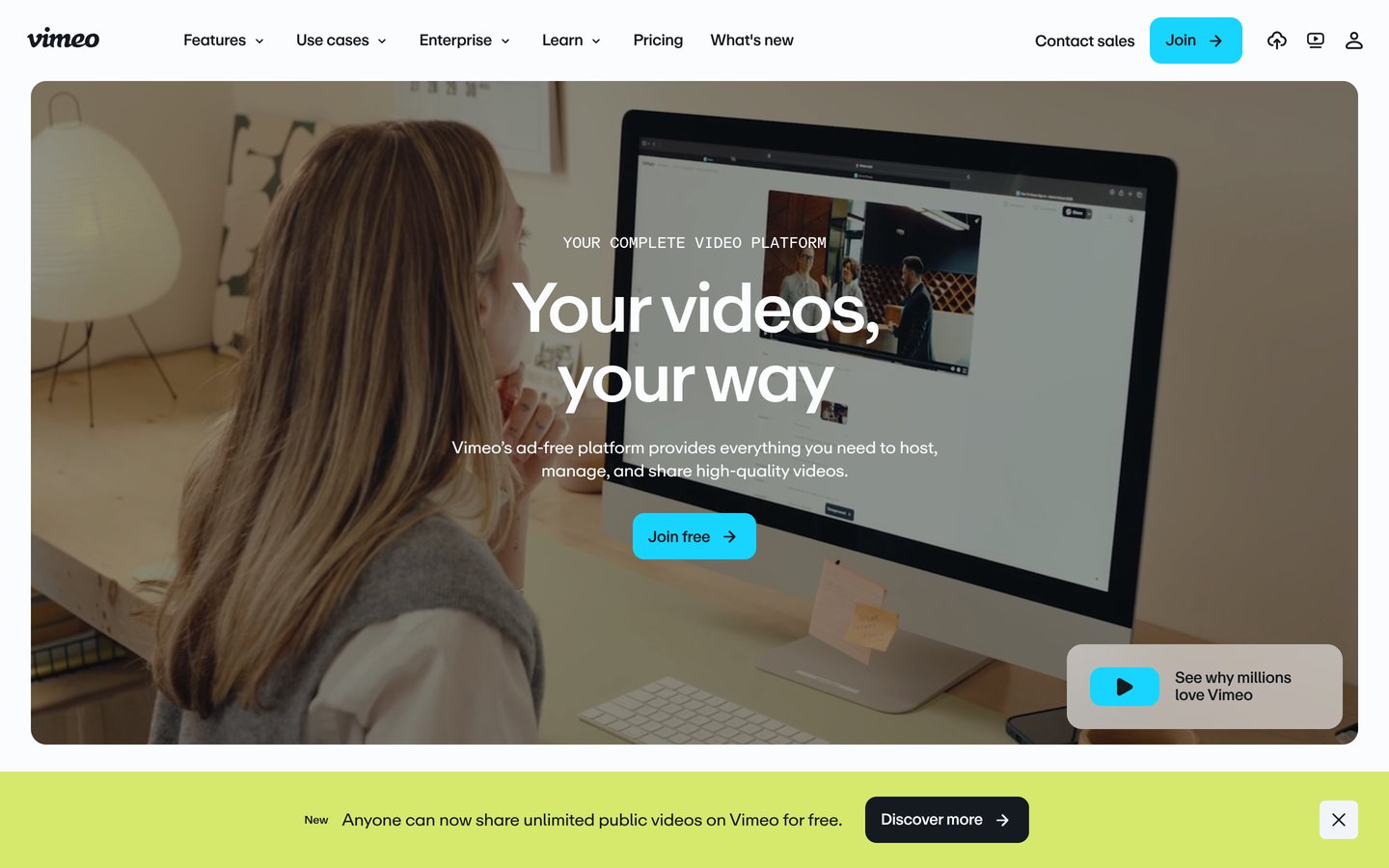
Vimeo homepage, captured Nov 2026.
Vimeo is an all-in-one video hosting, creation, and live event platform used for both external marketing and internal company broadcasts. Its Free plan covers 1 user with 3 GB of managed storage and an ad-free player, while the Starter plan starts at $12/mo ($144/yr) billed annually with 50 GB managed storage, password privacy, and engagement analytics.
The trade off is that true enterprise governance—including SAML SSO, Okta/Azure SCIM provisioning, backup streams, and eCDN delivery—is locked behind custom-quoted Enterprise contracts rather than the $75/mo Advanced tier. It suits organizations that want a single workspace for video editing, webinars, and internal portals.
What we like
Ad-free customizable player even on the permanent free plan
Scales from $12/mo Starter up to custom Enterprise with SAML SSO, SCIM, and eCDN
Built-in browser recorder, text-based editor, and live Q&A/polling on higher tiers
Integrates with Adobe Premiere Pro, Zoom, and major marketing tools
Watch out for
Self-serve plans cap bandwidth at 2 TB/mo before overage or Enterprise upgrades
SSO and eCDN require a custom Enterprise quote
Navigation across large multi-team libraries takes adjustment
Starter ($12/mo annual) unlocks 50 GB storage, player customization, and password privacy.Visit vimeo.com
02
Wistia
4.6/5on G2 (1,196 reviews, checked Nov 2026)
Paid from$79/mo
Best for B2B marketing and lead capture
Entry paid plan$79/mo billed annually
Free tier25 GB storage, 200 GB bandwidth, 1 user
Business limits250 GB storage, 1 TB bandwidth, 3 users
Enterprise securitySSO and playback protection on Enterprise
wistia.com
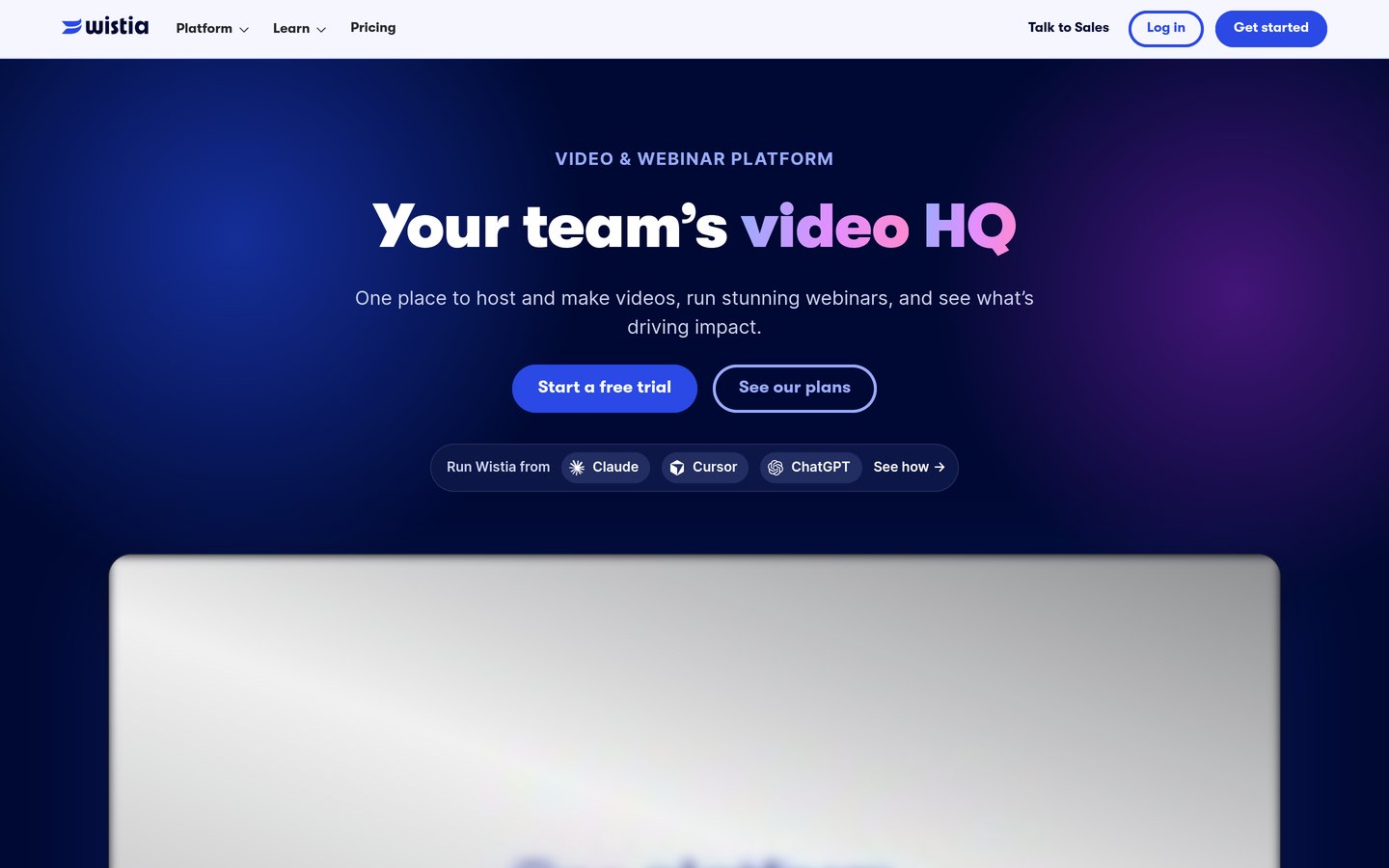
Wistia homepage, captured Nov 2026.
Wistia is a B2B video marketing and webinar platform built to turn embedded site videos into measurable pipeline. Its Free plan gives 1 user 25 GB of storage and 200 GB of bandwidth with Wistia branding, while Business starts at $79/mo ($948/yr) billed annually for 3 users, 250 GB storage, 1 TB bandwidth, heatmaps, and in-player CTAs.
The trade off is a steep jump from the free tier to $79/mo, plus $25/mo per extra user and $329/mo billed annually if you need HubSpot or Marketo contact-level sync via Business + Signals. It suits B2B marketing teams embedding product demos and webinars on landing pages.
What we like
Generous 25 GB permanent free plan with transcript-based editing
Viewer heatmaps, A/B testing, and in-video email capture forms on Business
Deep HubSpot, Marketo, and Pardot lead scoring on Business + Signals
Highest G2 review volume in this comparison (4.6/5 across 1,196 reviews)
Watch out for
No low-cost entry tier between Free ($0) and Business ($79/mo annual)
CRM automation integrations require the $329/mo Business + Signals tier
SSO and dedicated customer success manager require custom Enterprise pricing
Business ($79/mo annual) removes Wistia branding and adds 3 seats, 250 GB storage, and lead forms.Visit wistia.com
Enterprise securitySSO and IP restrictions on Forest ($195/mo)
sproutvideo.com
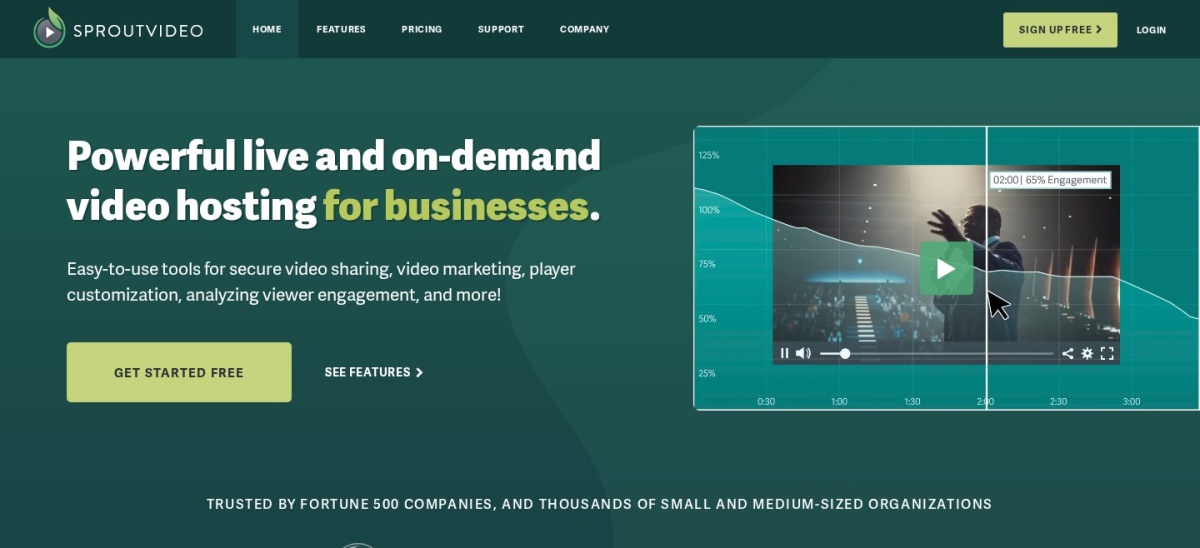
SproutVideo homepage, captured Nov 2026.
SproutVideo is a business video hosting and live streaming platform focused on strict access controls and hosted video portals. There is no permanent free plan beyond a 30-day trial, and the entry Seed plan costs $12/mo ($144/yr) billed annually with 150 GB of storage, 1,800 GB of pooled annual bandwidth, and custom embeds.
The trade off is that restricted viewer login protection requires the $35/mo Sprout tier, while single sign-on, IP address restrictions, and 50 team seats sit on the $195/mo ($2,340/yr) Forest plan. It suits compliance-minded teams running private training hubs or client portals.
What we like
Transparent self-serve pricing all the way up to SSO on the $195/mo Forest plan
Pooled annual bandwidth on yearly plans prevents single-month spike penalties
Built-in themed video website templates with viewer login protection
Pay-as-you-go overages ($0.25/GB on Seed down to $0.06/GB on Forest)
Watch out for
No permanent free plan after the 30-day trial expires
Login-protected viewer accounts start on the $35/mo Sprout plan, not Seed
Fewer native AI video generation tools than Vimeo or Vidyard
Enterprise securitySSO and custom permissions on Enterprise
vidyard.com
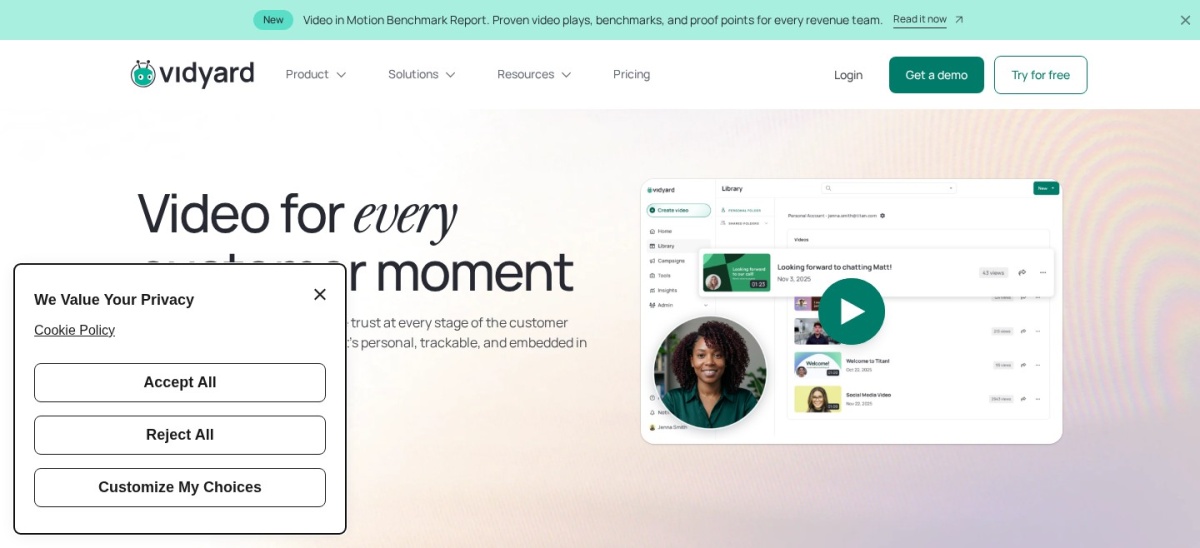
Vidyard homepage, captured Nov 2026.
Vidyard is a video messaging and hosting platform built around outbound sales, onboarding, and revenue team workflows. Its Free plan allows 5 video recordings per month (up to 30 minutes each) plus 15 AI videos, while Starter costs $59/seat/mo ($708/yr) billed annually for unlimited video recordings, folder management, and viewer alerts.
The trade off is per-seat pricing that multiplies rapidly across large departments, plus custom-quoted Teams and Enterprise tiers for Salesforce/HubSpot CRM sync and SSO. It suits enterprise revenue and customer success teams personalizing buyer outreach at scale.
What we like
4K recording and playback supported across all plans including Free
Real-time viewer notifications and in-video CTAs built for sales reps
AI avatar and automated Video Agent workflows for personalized outreach
Integrates with Salesforce, HubSpot, Salesloft, and Marketo on higher tiers
Watch out for
Per-seat billing at $59/seat/mo becomes costly for company-wide hosting
CRM/MAP integrations and SSO are gated behind custom-quoted Teams and Enterprise plans
Free plan caps recording at 5 videos per month
Starter ($59/seat/mo annual) unlocks unlimited video recordings, password protection, and team analytics.Visit vidyard.com
05
Gumlet
4.7/5on G2 (357 reviews, checked Nov 2026)
Paid from$6/mo
Best budget DRM-protected hosting
Entry paid plan$6/mo billed annually (Creator)
Free tier60 storage minutes, 100 GB bandwidth
DRM add-on$99/mo flat fee with $0 per-license cost
ComplianceSOC 2 Type II and ISO 27001 certified
gumlet.com
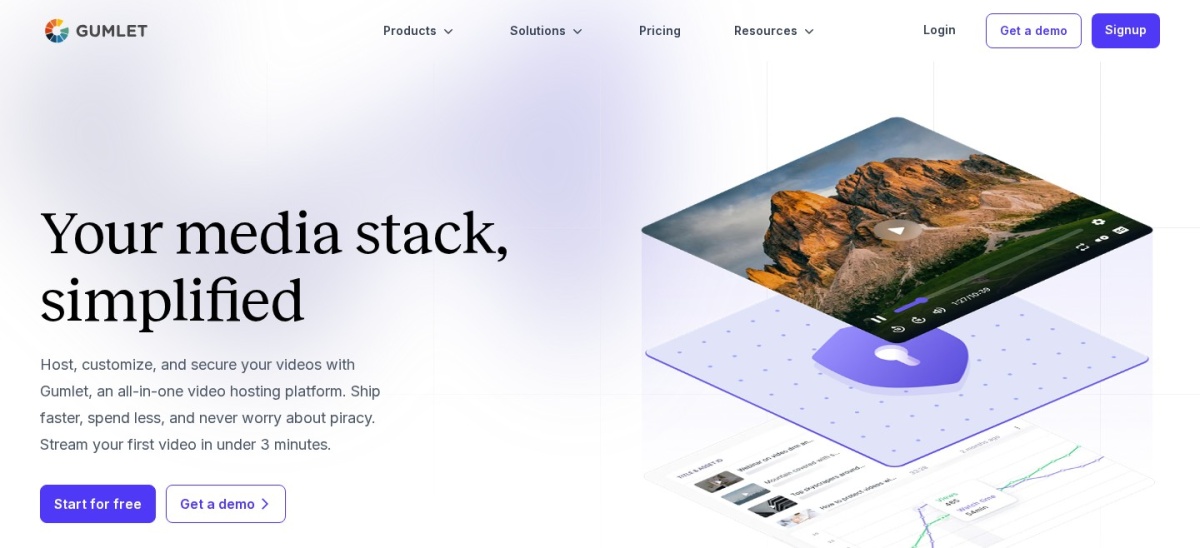
Gumlet homepage, captured Nov 2026.
Gumlet is a video hosting and optimization platform combining adaptive CDN streaming with studio-grade piracy protection. Its Free plan includes 60 storage minutes and 100 GB of bandwidth, while paid plans start at $6/mo ($72/yr) billed annually on Creator and scale to Growth ($19/mo) and Business ($99/mo).
The trade off is that hardware-level Widevine and FairPlay DRM with dynamic watermarking requires a $99/mo DRM add-on on top of your base hosting tier, and G2 reviewers note the dashboard UI can feel dense for non-technical staff. It suits EdTech and media enterprises protecting paid courses or proprietary content.
What we like
Lowest annual entry price ($72/yr) with SOC 2 Type II and ISO 27001 compliance
Flat-rate $99/mo Widevine/FairPlay DRM add-on with zero per-license fees
Includes offline mobile DRM playback and session-specific dynamic watermarking
Highest G2 score on this list at 4.7/5 across 357 reviews
Watch out for
Multi-DRM protection adds $99/mo on top of the base hosting plan
Free plan is limited to 60 minutes of stored video
Less suited for live town-hall Q&A and webinar registration workflows
Creator ($6/mo annual) expands storage and bandwidth limits for commercial embedding.Visit gumlet.com
Advanced tiersEvent ($63/mo) and Scale ($165/mo annual)
dacast.com
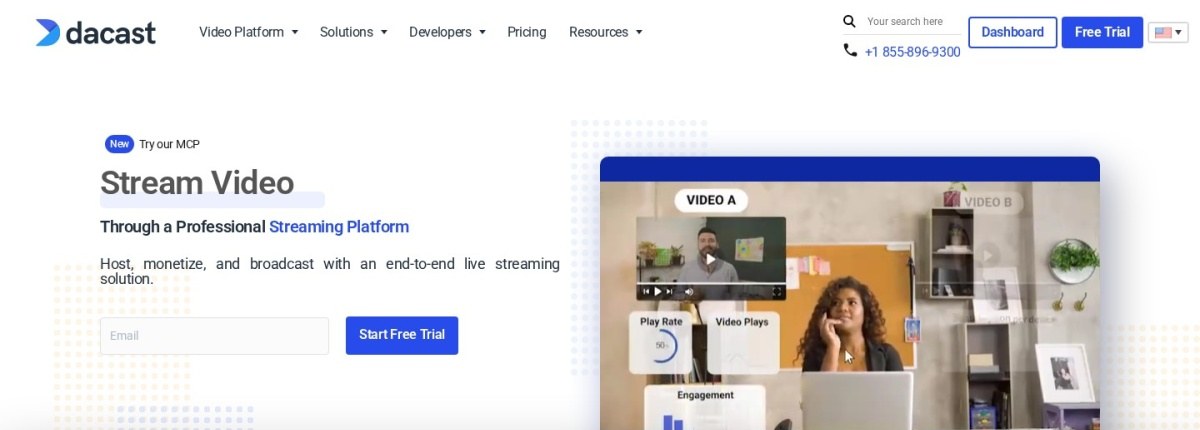
Dacast homepage, captured Nov 2026.
Dacast is a live streaming and video-on-demand platform built around Akamai multi-CDN delivery, integrated paywalls, and global reach including mainland China. It has no permanent free plan, starting with Starter at $39/mo ($468/yr) billed annually for 2.4 TB of annual bandwidth, 500 GB of storage, and 3 live transcoding channels.
The trade off is that paywalls, ad insertion, and mainland China streaming require the $63/mo Event plan, while VOD DRM, AES encryption, and 3 team seats require the $165/mo ($1,980/yr) Scale tier. It suits enterprises broadcasting live global events or monetizing pay-per-view streams.
What we like
Includes 500 GB storage and 2.4 TB annual bandwidth on the $39/mo entry plan
Supports live and VOD delivery inside mainland China on Event ($63/mo) and above
Built-in paywall monetization and multi-CDN failover without third-party plugins
24/7 phone, email, and live chat support across paid plans
Watch out for
No free tier and extra team seats cost $10/user/mo
DRM for VOD and player CNAME branding require the $165/mo Scale plan
Bandwidth overages bill at $0.30/GB if annual allocations are exceeded
Starter ($39/mo annual) includes 500 GB storage, 2.4 TB annual bandwidth, and 3 live channels.Visit dacast.com
07
Mux
4.4/5on G2 (20 reviews, checked Nov 2026)
Paid from$20/mo
Best developer API for custom video apps
Entry paid plan$20/mo Launch plan ($100 monthly credit)
Usage ratesStorage from $0.0024/min; delivery from $0.0008/min
Enterprise optionsVolume discounts above $3k/mo, SLAs, 24/7 support
mux.com
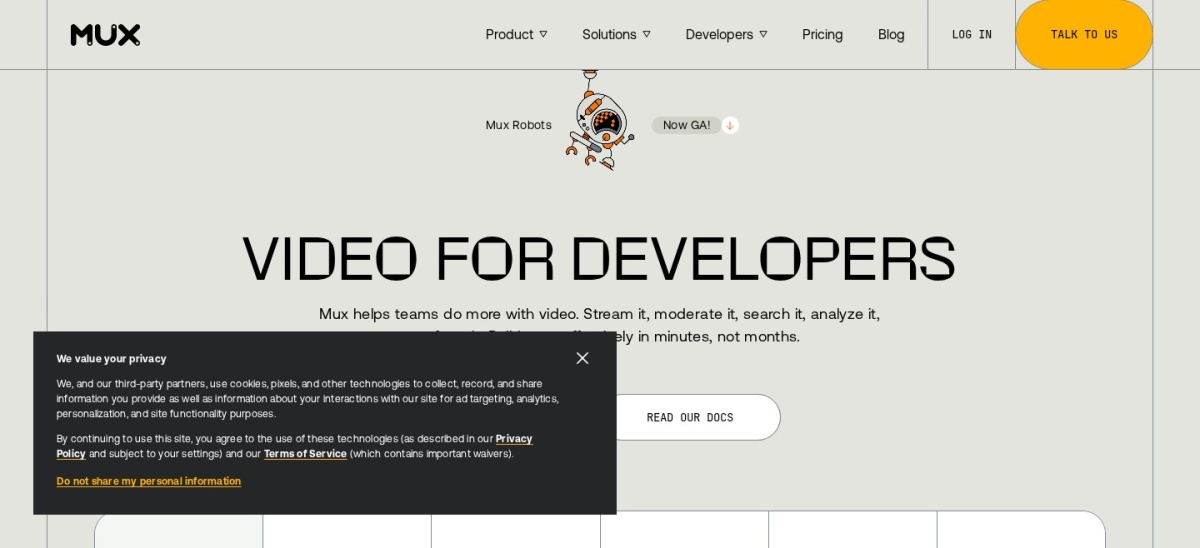
Mux homepage, captured Nov 2026.
Mux is an API-first video infrastructure platform for engineering teams building live and on-demand streaming directly into enterprise apps. Its Free tier includes 100,000 monthly delivery minutes, free Mux Data analytics, and up to 10 stored videos, while the Launch plan starts at $20/mo ($240/yr) and provides $100 in monthly usage credit.
The trade off is that Mux provides APIs and player wrappers rather than a turnkey marketing portal or no-code webinar room, and custom domains or media-grade DRM each add $100/mo. It suits product and engineering teams building custom internal apps or customer-facing streaming platforms.
What we like
100,000 free monthly delivery minutes and free Mux Data QoE analytics on all plans
Launch plan ($20/mo) grants $100/mo in usage credit for predictable scaling
Per-minute pricing starting at $0.0024/min storage and $0.0008/min delivery (720p)
Built-in AI workflows for auto-captions, chaptering, and summarization
Watch out for
Requires developer integration rather than a turnkey marketer dashboard
Custom streaming domains and DRM each carry a $100/mo base add-on fee
Live stream latency is higher than ultra-low-latency WebRTC tools
Launch ($20/mo) removes the 10-video cap, unlocks live streaming, and includes $100 in monthly credit.Visit mux.com
SaaS tiers vs. per-minute video APIs
Traditional SaaS platforms like Vimeo, Wistia, and SproutVideo bundle storage, a branded player, and an admin dashboard into fixed monthly subscriptions. That predictability works well for corporate communications and marketing teams, though exceeding monthly bandwidth caps (such as Vimeo's 2 TB/mo self-serve threshold) forces an upgrade to custom Enterprise contracts.
API-first platforms like Mux and Cloudflare Stream ($5/mo per 1,000 stored minutes plus $1 per 1,000 delivered minutes) eliminate seat limits and bundle markups by billing strictly per minute stored and streamed. If your engineering team already maintains an internal portal or mobile app, per-minute APIs typically cut delivery bills significantly at high viewership.
How we chose
We built this shortlist by evaluating major enterprise video hosting, live streaming, and video infrastructure platforms across published documentation, security specifications, and verified buyer reviews on G2.
Every price, storage quota, bandwidth limit, and G2 rating in this guide was verified on 22 Nov 2026 directly from vendor pricing pages and public G2 product profiles, using regular annual billing rates.
We excluded consumer-only social video sites, desktop-only editors without cloud hosting, and enterprise vendors that hide all pricing tiers behind mandatory sales calls without a self-serve entry point. No vendor paid for a place, and we do not claim testing for this list.
How to choose an enterprise video platform
Audit your primary distribution workflow, security requirements, and peak bandwidth before comparing sticker prices.
Separate internal training from external lead generation. Marketing teams benefit from Wistia's in-player forms and CRM lead scoring, whereas internal HR and learning teams need SproutVideo's login portals or Vimeo's SAML SSO.
Verify whether SSO and eCDN sit behind custom Enterprise tiers. Several platforms advertise single sign-on and peer-assisted eCDN delivery on their homepages but restrict them to custom-quoted Enterprise contracts rather than self-serve plans.
Calculate annual bandwidth against pooled vs. monthly caps. Platforms like SproutVideo and Dacast pool bandwidth across the entire year on annual plans, which protects budgets during quarterly all-hands broadcasts.
Match the interface to the team publishing the videos. Pick a turnkey SaaS dashboard if non-technical marketers or trainers upload content, or choose Mux if developers are embedding video into a custom application.
FAQ
What is an enterprise video platform?
An enterprise video platform is a cloud service for hosting, managing, securing, and streaming live or on-demand video across an organization. Unlike consumer video sites, it provides an ad-free player, role-based permissions, single sign-on (SSO), detailed viewer analytics, and network-friendly delivery.
Why do enterprises need an eCDN for live video?
Standard CDNs deliver video from external edge servers, which can saturate a corporate office's internet connection when thousands of employees watch a live town hall at once. An Enterprise CDN (eCDN) caches or distributes streams locally inside the corporate network to prevent buffering.
Which enterprise video platform is best for B2B lead generation?
Wistia is built specifically for B2B marketing teams, offering customizable calls to action, email capture forms inside the video player, engagement heatmaps, and direct contact-level syncing with HubSpot, Marketo, and Pardot on its Business + Signals plan.
Can you get DRM video protection without a custom enterprise contract?
Yes. Gumlet offers hardware-level Widevine and FairPlay DRM with dynamic watermarking as a flat $99/mo add-on with zero per-license fees on top of its self-serve plans, and Dacast includes VOD DRM on its $165/mo Scale plan.
When should an enterprise use a video API like Mux instead of Vimeo?
Choose an API-first platform like Mux when your software engineers are building video playback or live streaming directly into a proprietary web or mobile app and want per-minute billing rather than per-seat SaaS licenses.