Shopify is the best shopping cart platform for most online stores, combining hosted checkout, 24/7 support, and a 4.4/5 G2 score across 5,158 reviews. WordPress site owners who want full data ownership and zero SaaS lock-in should pick WooCommerce, while existing websites can add Ecwid from $5/mo.
How we make this list: we compare pricing pages, product documentation and public user reviews, then re-check every price before each update. No product paid for a place. Disclosure.
Shopify leads hosted stores at $29/mo billed yearly ($348/yr) with 4.4/5 on G2 across 5,158 reviews, though third-party gateways add 2% on Basic.
WooCommerce powers 7M+ active WordPress installs with a free core plugin, leaving hosting and paid extensions as your main ongoing costs.
BigCommerce matches Shopify's $29/mo annual entry price ($348/yr) while charging 0% extra gateway fees and allowing up to 600 variants per product.
Ecwid offers the lowest paid entry tier at $5/mo ($60/yr) and embeds directly into any existing website without a rebuild.
Square Online lets local shops start at $0/mo on its Free tier (3.3% + 30¢ online card fee) before scaling to $49/mo per location.
What to look for in a shopping cart platform
A shopping cart platform handles product catalogs, tax and shipping calculations, payment processing, and PCI-compliant checkout. The first decision is hosted SaaS versus self-hosted software: hosted platforms like Shopify and BigCommerce manage servers, SSL, and security patches for a monthly fee, while WordPress plugins like WooCommerce and SureCart give you full control over your site and database.
Headline subscription rates rarely tell the full cost story. Payment card rates typically run 2.5% to 3.3% plus 30¢ per order, and several platforms tack on an extra 0.5% to 2% surcharge if you connect an external payment gateway instead of their native processor.
Catalog limits and plan caps also matter before you commit. Some entry plans restrict product counts, staff logins, or annual sales volume and automatically upgrade your tier once you cross a threshold. Checking variant limits, abandoned-cart tools, and multi-channel sync early prevents costly migrations later.
Shopify is a fully hosted ecommerce platform that bundles storefront themes, Level 1 PCI-compliant checkout, shipping labels, and Shopify Payments in one dashboard. The entry Basic plan includes unlimited products, abandoned-checkout recovery emails, discount codes, and 24/7 chat support, with a 3-day free trial followed by a $1/month promo for three months.
The trade off is extra fees once you customize or use outside processors: Basic costs $29/mo billed yearly ($39/mo monthly), includes zero extra staff accounts, and adds a 2% surcharge on third-party payment gateways. It suits solo founders and growing brands that want fast setup without managing servers.
What we like
Hosted infrastructure with Level 1 PCI compliance and SSL included
Unlimited products and abandoned-checkout emails on the entry tier
Built-in POS sync for selling both online and in physical locations
Largest third-party app and theme ecosystem in ecommerce
Watch out for
Adds a 2% fee on Basic when using non-Shopify payment gateways
Basic plan allows no extra staff logins until upgrading to Grow ($89/mo yearly)
Paid apps and themes can quickly raise total monthly spend
Grow ($89/mo yearly) adds 5 staff accounts, 10 inventory locations, and lowers online card fees to 2.7% + 30¢.Visit shopify.com
02
WooCommerce
4.5/5on WordPress.org (4,834 reviews, checked Nov 2026)
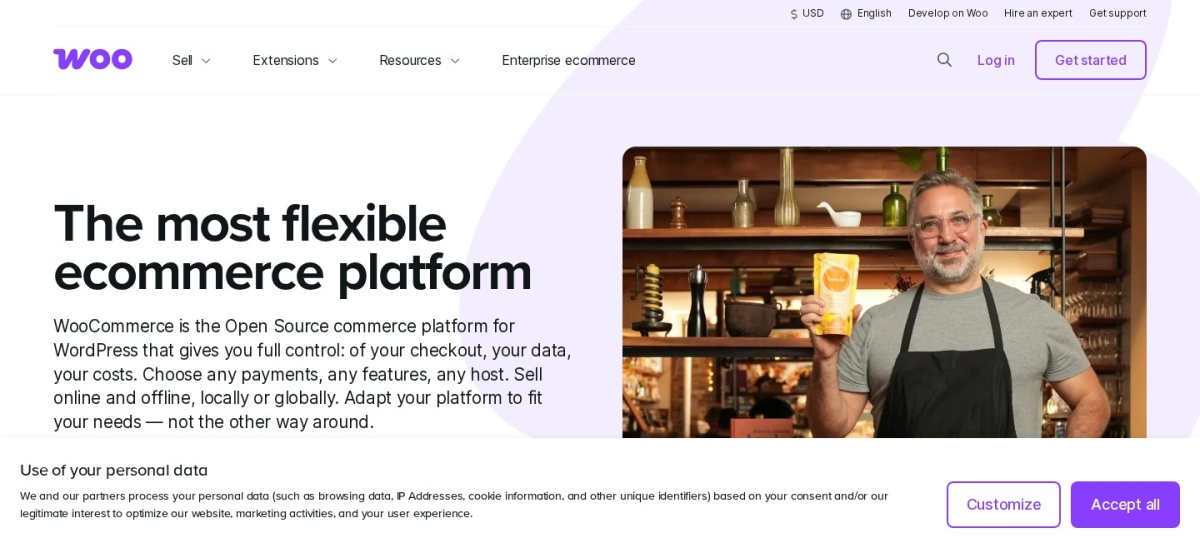
WooCommerce is an open-source WordPress plugin built by Automattic that turns any WordPress site into a full online store with physical, digital, and variable products. The free core plugin includes order management, tax and shipping zones, coupon codes, mobile apps, and 0% platform transaction fees across 100+ gateways.
The trade off is that you must supply and maintain your own WordPress hosting, backups, and security updates, while specialized extensions typically cost $29 to $299 per year each. It suits content-driven brands and developers who want total code and data ownership.
What we like
Completely free core software with no product or revenue caps
Zero platform surcharge on third-party payment gateways
Full ownership of store data, code, and WordPress SEO setup
Huge library of free and commercial extensions
Watch out for
Requires separate WordPress hosting, SSL, and ongoing maintenance
Official extensions for subscriptions or bookings add recurring annual costs
Core plugin is 100% free; paid add-ons on WooCommerce.com start around $29/yr depending on the feature.Visit woocommerce.com
03
BigCommerce
4.2/5on G2 (581 reviews, checked Nov 2026)
Starts at$29/mo
Best for large catalogs and payment freedom
Entry planCore ($29/mo yearly, $39 monthly)
Extra gateway fee0% on all plans
Variants per productUp to 600 variants
Annual sales cap$30,000/yr on Core
bigcommerce.com
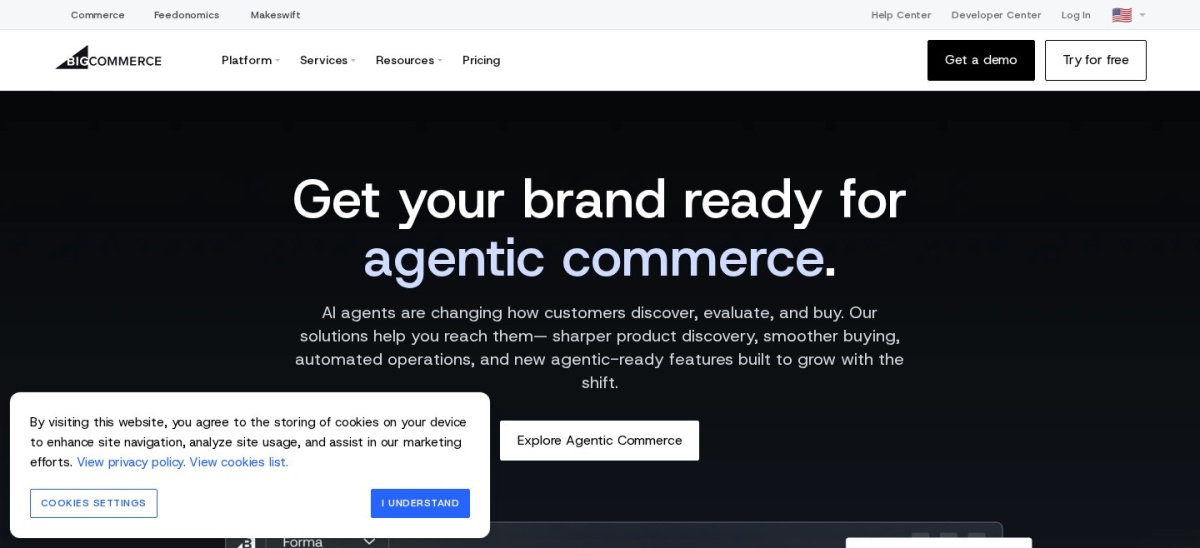
BigCommerce homepage, captured Nov 2026.
BigCommerce is a hosted SaaS ecommerce platform built for merchants with complex catalogs, multi-channel feeds, and B2B requirements. Its entry Core plan includes unlimited products, up to 600 variants per SKU, real-time shipping quotes, and 0% additional transaction fees regardless of which payment gateway you connect.
The trade off is automatic tier upgrades based on trailing 12-month sales—Core ($29/mo billed yearly, $39/mo monthly) caps revenue at $30,000/yr before moving you to Growth at $79/mo yearly, and abandoned-cart recovery is reserved for Growth and above. It suits growing stores with deep SKU matrices that want to pick their own processor.
What we like
Zero platform transaction fees on any supported payment gateway
Supports up to 600 product variants natively out of the box
Strong built-in SEO controls, faceted search, and B2B tooling
15-day free trial with no credit card required
Watch out for
Enforces annual sales caps ($30K on Core, $100K on Growth) that force upgrades
Abandoned-cart recovery is excluded from the entry Core plan
Growth ($79/mo yearly) raises the sales cap to $100,000/yr and unlocks abandoned-cart recovery and customer groups.Visit bigcommerce.com
04
Ecwid
4.7/5on G2 (228 reviews, checked Nov 2026)
Starts at$5/mo
Best for adding a cart to an existing site
Entry planStarter ($5/mo)
Extra gateway fee0% on all plans
Product caps10 on Starter, 100 on Venture
WordPress installs20,000+ active installs
ecwid.com
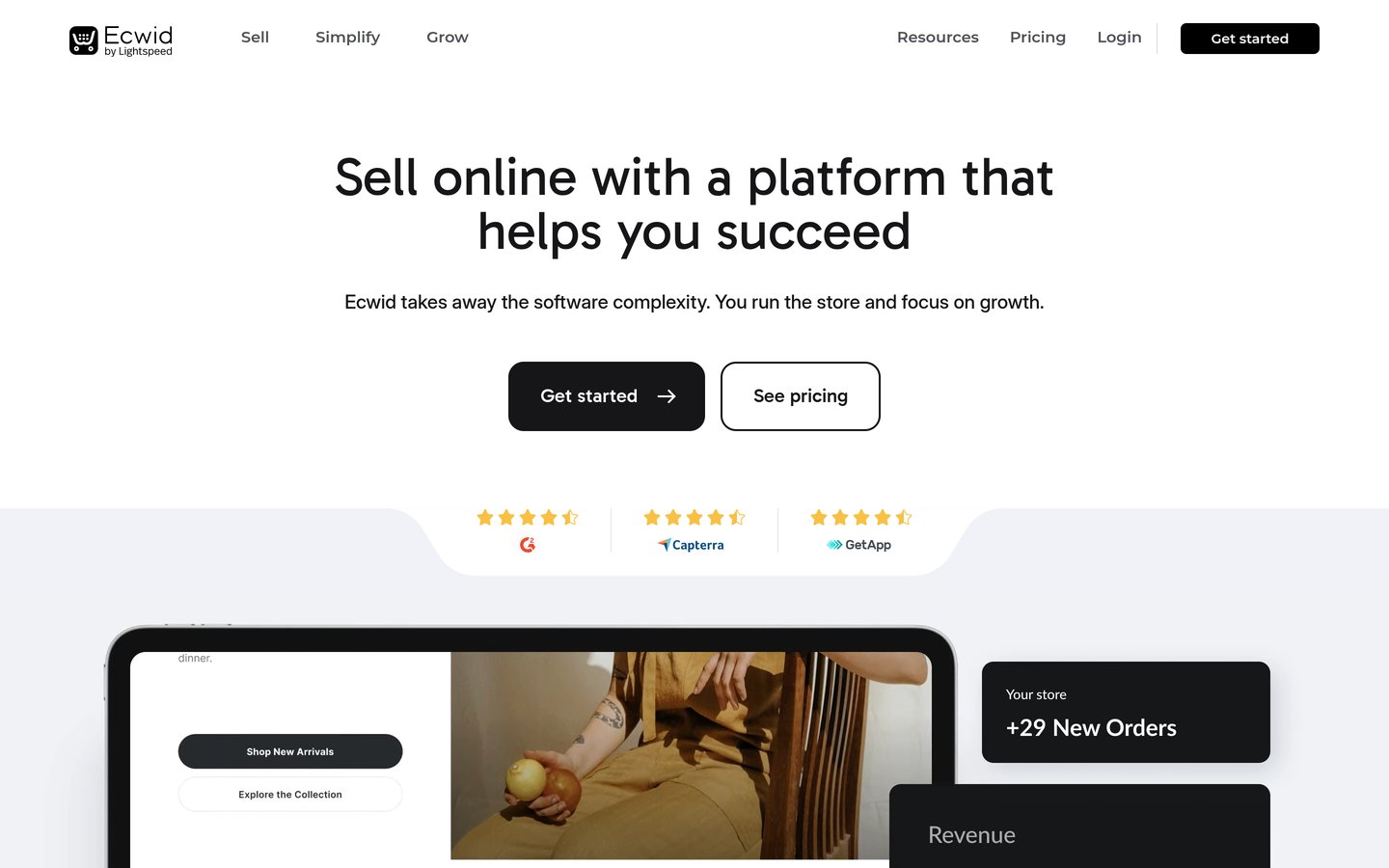
Ecwid homepage, captured Nov 2026.
Ecwid by Lightspeed is a cloud-hosted shopping cart widget that embeds into WordPress, Wix, Squarespace, or any custom HTML site without replacing your existing theme. The entry Starter plan costs $5/mo, charges 0% platform transaction fees, and includes a standalone Instant Site plus mobile store management.
The trade off is strict catalog ceilings on lower plans: Starter caps you at 10 products, Venture ($29/mo billed yearly, $35/mo monthly) caps at 100 products, and Business ($49/mo yearly) caps at 2,500. It suits bloggers, creators, and small businesses adding a compact shop to an established website.
What we like
Cheapest paid entry plan at $5/mo with 0% platform transaction fees
Embeds cleanly into existing WordPress or static sites in minutes
Tight product limits on Starter (10 items) and Venture (100 items)
Large catalogs require Unlimited ($119/mo yearly), costing more than Shopify Basic
Venture ($29/mo yearly) raises the limit to 100 products and adds Instagram/Facebook selling and digital goods.Visit ecwid.com
05
Wix
4.2/5on G2 (1,600+ reviews, checked Nov 2026)
Starts at$29/mo
Best for design-focused small stores
Entry commerce planCore ($29/mo billed yearly)
Catalog limitUp to 50,000 products
Variants per productUp to 1,000 variants
Free builderFree to design, paid plan to sell
wix.com
Wix homepage, captured Nov 2026.
Wix combines a visual drag-and-drop website builder with built-in ecommerce checkout, shipping rules, and multi-channel listings. You can design your storefront on a free account, then upgrade to the Core plan at $29/mo billed yearly to accept online payments, sell up to 50,000 products, and recover abandoned carts.
The trade off is limited template portability once your site is live and a smaller third-party ecommerce app ecosystem than Shopify. It suits small businesses and portfolio brands that prioritize visual page design alongside a mid-sized catalog.
What we like
Flexible visual editor with hundreds of storefront templates
Supports up to 50,000 products and 1,000 variants per item on Core
Includes abandoned-cart recovery on the entry commerce tier
Watch out for
Cannot switch templates without rebuilding pages after publishing
Free tier only lets you build the site and cannot accept payments
Business ($36/mo yearly) adds automated sales tax calculations, multiple currencies, and product reviews.Visit wix.com
06
Squarespace
4.4/5on G2 (1,050+ reviews, checked Nov 2026)
Starts at$25/mo
Best for visual brands and digital creators
Entry planBasic ($25/mo billed yearly)
Store transaction fee2% on Basic, 0% on Core+
Digital content fee7% on Basic, 5% on Core
Free trial14 days, no credit card
squarespace.com
Squarespace homepage, captured Nov 2026.
Squarespace is a hosted website and commerce platform known for editorial templates, built-in appointment scheduling, and digital product delivery. Its entry Basic plan starts at $25/mo billed yearly after a 14-day free trial and lets you sell physical goods, services, and memberships from a unified dashboard.
The trade off is transaction surcharges on the entry tier: Basic takes a 2% platform fee on physical product sales and 7% on digital content until you move up to Core or higher. It suits boutique brands, artists, and service providers prioritizing aesthetics over deep catalog integrations.
What we like
Polished, mobile-ready templates that need minimal layout tweaking
Combines physical products, digital downloads, and bookings in one place
0% platform fee on physical products once you upgrade to Core
Watch out for
Charges a 2% product fee and 7% digital content fee on the Basic plan
Fewer payment gateways and third-party extensions than Shopify or WooCommerce
Core removes the 2% physical store transaction fee and adds shipping, tax tools, and funnel analytics.Visit squarespace.com
07
Square Online
4.2/5on G2 (295 reviews, checked Nov 2026)
Paid from$49/mo
Best free plan for local retail and cafes
Free plan$0/mo (3.3% + 30¢ online card fee)
Cheapest paid planPlus ($49/mo per location)
Paid card rate2.9% + 30¢ online
POS syncReal-time inventory with Square POS
squareup.com
Square Online homepage, captured Nov 2026.
Square Online is a hosted online store builder designed to sync inventory, menus, and local pickup orders directly with Square POS. Its Free plan costs $0/mo with unlimited products and charges only when you make a sale, making it a low-risk way for brick-and-mortar shops and cafes to take online orders.
The trade off is a higher 3.3% + 30¢ online card rate on the Free plan and per-location pricing on paid tiers, starting with Plus at $49/mo per location ($588/yr) for custom domains and 2.9% + 30¢ processing. It suits local retailers and restaurants already using Square hardware.
What we like
True $0/mo free plan that processes live online orders with no monthly fee
Automatic real-time inventory and order sync with Square POS
Built-in curbside pickup, local delivery, and restaurant ordering flows
Watch out for
Higher 3.3% + 30¢ online card processing rate on the Free tier
Paid plans are billed per physical location ($49/mo on Plus, $149/mo on Premium)
Plus ($49/mo per location) unlocks custom domain support, lower 2.9% + 30¢ online card fees, and item badges.Visit squareup.com
How payment fees change the real annual bill
Monthly subscription prices are rarely your biggest shopping cart expense. On a store processing $5,000 per month ($60,000 per year) across 750 orders at an $80 average order value, standard 2.9% + 30¢ card processing costs roughly $1,965 per year—more than five times the $348 annual subscription for Shopify Basic or BigCommerce Core.
Choosing a platform with an extra gateway surcharge multiplies that gap. If you run $60,000 in annual sales through an external payment provider on Shopify Basic, the 2% third-party fee adds $1,200 per year on top of your processor's own card rate, whereas BigCommerce, WooCommerce, and Ecwid charge 0% extra.
How we chose
We selected these seven shopping cart platforms from the most widely deployed hosted ecommerce builders and WordPress store plugins, prioritizing active maintenance, transparent public pricing, and verified user review profiles.
All subscription rates, transaction fee schedules, install figures, and G2 or WordPress.org ratings were verified on 22 Nov 2026 directly from vendor pricing pages and public directories. Where vendors offer both monthly and annual billing, the price ladder reflects the cheapest regular annual rate.
We excluded enterprise-only platforms without public pricing (such as Adobe Commerce), abandoned open-source forks, and niche plugins with fewer than 1,000 active installations. No vendor paid for a place, and we do not claim testing for this list.
How to choose a shopping cart platform in 4 steps
Follow these four steps to narrow the list to the right cart for your catalog and technical setup.
Decide between hosted SaaS and WordPress. Pick WooCommerce if you already run WordPress and want full control over hosting and data, or choose Shopify, BigCommerce, or Wix if you want security, SSL, and servers managed for you.
Check your payment processor before comparing plans. If you must use a specific local or merchant-account gateway rather than Shopify Payments, BigCommerce, WooCommerce, and Ecwid save you 0.6% to 2% per transaction.
Match catalog size and variant limits to entry tiers. Verify that the starter plan covers your SKU count and product options—Ecwid Starter stops at 10 products, while BigCommerce Core supports up to 600 variants per item.
Model your first-year fees at realistic monthly volume. Multiply your projected monthly revenue by the plan's card percentage plus per-order cents, then add any required paid apps or extensions to see true annual cost.
FAQ
What is the best shopping cart platform for beginners?
Shopify is the easiest starting point for most beginners because hosting, SSL, themes, and Shopify Payments work out of the box with 24/7 chat support. If you already have a WordPress website, WooCommerce offers a guided setup wizard with no monthly software fee.
Is there a completely free shopping cart platform?
WooCommerce is free open-source software with no monthly license fee, though you still pay for WordPress hosting and domain registration. For a hosted option with zero monthly subscription, Square Online offers a $0/mo Free plan and charges 3.3% plus 30¢ per online card transaction.
Which shopping cart platform has no extra transaction fees?
BigCommerce, WooCommerce, Ecwid, and Wix Core charge 0% additional platform surcharges on top of your payment processor's standard card rate. By contrast, Shopify Basic adds a 2% fee if you use a gateway other than Shopify Payments.
Can I add a shopping cart to an existing website without rebuilding it?
Yes. Ecwid is built specifically to embed into an existing WordPress, Wix, Squarespace, or custom HTML page using a lightweight script or plugin, letting you keep your current design while adding a PCI-compliant cart and checkout.
Should I choose Shopify or WooCommerce?
Choose Shopify if you want predictable hosted maintenance, built-in POS hardware sync, and fast setup without managing servers. Choose WooCommerce if you already run WordPress, want complete ownership of your database and SEO architecture, and prefer avoiding SaaS platform surcharges.
SaaS SEO and WordPress specialist with about 8 years of experience. Rakib compares WordPress plugins, themes, hosting and software using public pricing, documentation and user reviews. See how we rank.