Best Retail Inventory Management Software in 2026: 7 Tools Compared
WLWPLegible EditorsLast verified 22 Nov 2026How we rank13 min read
★ Short answer
Square is the best retail inventory management software for smaller stores, offering free inventory tracking and a $49-per-location monthly Plus plan with stock intake, purchase orders and cost-of-goods reporting. Zoho Inventory is better for multichannel order management, while Shopify POS suits retailers combining online and in-store sales.
How we make this list: we compare pricing pages, product documentation and public user reviews, then re-check every price before each update. No product paid for a place. Disclosure.
Square for Retail offers a free POS plan, while Plus costs $49/location/month and adds purchase orders, stock intake and inventory reporting. Capterra rates it 4.7/5 from 496 reviews.
Zoho Inventory Standard costs $29/month billed annually, supports 500 orders monthly and includes 3 users. Its Capterra rating is 4.5/5 from 424 reviews.
Shopify Basic costs $29/month billed annually and synchronizes online and in-store inventory through Shopify POS. Capterra rates Shopify POS 4.6/5 from 248 reviews.
Lightspeed Retail Basic costs $89/month with annual billing and includes inventory management, purchase orders and 1 register. Its Capterra rating is 4.0/5 from 976 reviews.
Sortly offers a free plan with 100 unique items. Advanced has a regular monthly price of $49, while its current first-year annual offer is promotional. Capterra rates Sortly 4.5/5 from 958 reviews.
inFlow Inventory Lite costs $1,188/year, while Cin7 Core Standard starts at $349/month with 5 users, 2 integrations and 6,000 annual sales orders.
What to look for in retail inventory management software
Retail inventory management software tracks merchandise as products are purchased, received, stored, sold, returned and transferred. It helps retailers maintain accurate stock counts and understand which products need replenishment.
Start with real-time stock visibility. The software should show available quantities, item variations, stock adjustments and reorder alerts. Retailers selling online and in person also need inventory updates to move reliably between sales channels.
Barcode scanning and stock counting become important as product catalogs grow. Look for barcode labels, mobile scanning, purchase receiving and cycle counting. These features reduce manual entry, although physical counts remain necessary to reconcile stock differences.
Purchasing and supplier management are equally important. Purchase orders, reorder thresholds, incoming inventory and supplier records help teams plan replenishment. Larger retailers may also need inventory transfers between stores and warehouses.
Finally, compare reporting and total cost. Basic stock tracking may be free, but advanced purchasing, integrations, additional locations and warehouse functionality can require paid plans. Choose software that matches your sales channels and inventory complexity.
The 7 best retail inventory management software tools
01
Square
4.7/5on Capterra (496 reviews, checked Nov 2026)
Paid from$49/mo
Best overall for retail inventory and POS
Free plan$0/location/month
Paid planPlus, $49/location/month
PurchasingPurchase orders on Plus
Inventory reportingCOGS reporting on Plus
squareup.com
Square homepage, captured Nov 2026.
Square is a retail POS and inventory management platform connecting checkout, product catalogs, stock counts and sales reporting. Its Free plan costs $0 per location monthly and includes item creation, SKUs and essential inventory tracking. Plus costs $49 per location monthly and adds stock intake, purchase orders, vendor management and cost-of-goods reporting.
The trade off is that advanced inventory capabilities require the $588 annual Plus subscription, while card processing and hardware cost extra. Premium costs $149 per location monthly and adds transfer orders and cross-location fulfillment. It suits independent retailers that want stock control directly connected to daily sales.
What we like
Free inventory and POS entry plan
Inventory updates connected to sales
Purchase orders and vendor management on Plus
Barcode labeling and stock counting
Integrated sales and inventory reports
Watch out for
Advanced inventory requires paid plans
Payment processing fees apply
Transfer orders require Premium
Subscriptions increase with additional locations
Plus adds purchase orders, stock intake and COGS reports; Premium adds transfers and cross-location fulfillment.Visit squareup.com
02
Zoho Inventory
4.5/5on Capterra (424 reviews, checked Nov 2026)
Paid from$29/mo
Best value for retail stock and order management
Free orders50/month
Entry paid planStandard, $29/month annually
Standard orders500/month
Standard users3
zoho.com
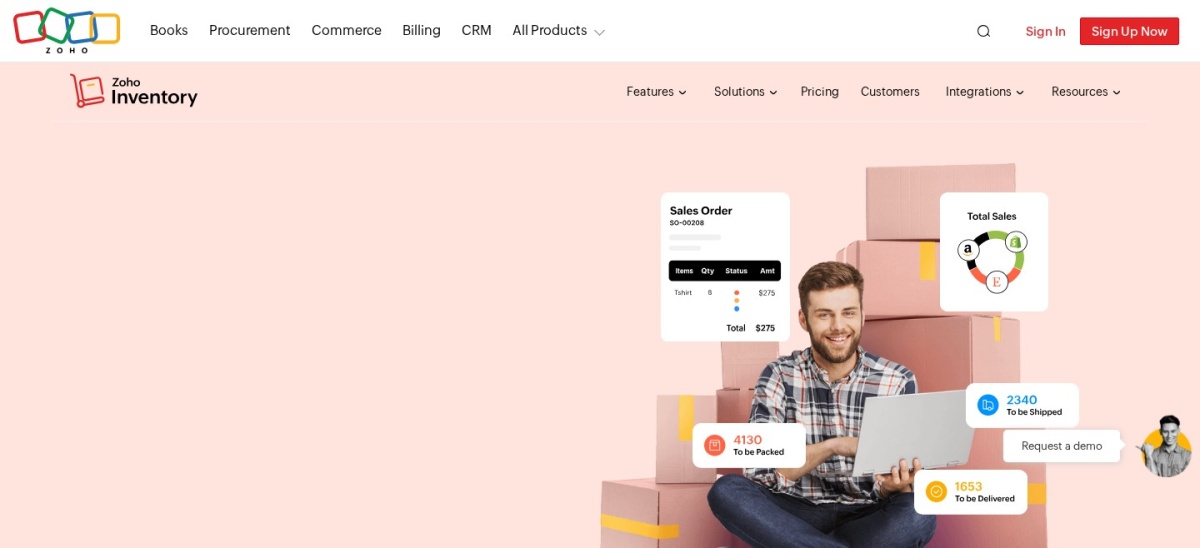
Zoho Inventory homepage, captured Nov 2026.
Zoho Inventory is an inventory and order management platform for retailers selling through multiple channels. Its free plan supports 50 monthly orders, while Standard costs $29 per month billed annually and includes 500 monthly orders, 3 users, purchase orders, sales tracking and inventory tools. It integrates with ecommerce and accounting applications.
The trade off is that monthly order allowances and more advanced warehouse features depend on the subscription tier. Standard costs $348 annually, while Premium costs $79 per month with annual billing and supports greater order volume. It suits small and growing retailers that need purchasing and stock management beyond a basic POS.
What we like
Free inventory plan available
Affordable Standard subscription
Purchase orders and sales order tracking
Ecommerce and accounting integrations
Upgrade path for higher order volumes
Watch out for
Monthly order limits apply
Advanced warehousing requires higher plans
Some integrations need additional setup
Not a complete in-store POS replacement
Higher plans expand monthly orders, locations, user capacity and advanced inventory functionality.Visit zoho.com
03
Shopify POS
4.6/5on Capterra (248 reviews, checked Nov 2026)
Starts at$29/mo
Best for online and in-store inventory synchronization
Entry planShopify Basic
Annual billing rate$29/month
POS softwarePOS Lite included
InventoryOnline and in-store sync
shopify.com
Shopify POS homepage, captured Nov 2026.
Shopify POS is a retail point-of-sale system connecting in-store transactions with Shopify ecommerce inventory. Shopify Basic costs $29 per month billed annually and includes POS Lite, product management, inventory synchronization and online selling tools. Sales update shared product records so retailers can manage merchandise across their storefront and checkout.
The trade off is that advanced retail workflows require POS Pro, which carries a separate subscription charge. Basic costs $348 annually before hardware, processing and additional apps. It suits merchants already using Shopify who want online and physical sales connected to the same product catalog.
What we like
Online and in-store stock synchronization
POS Lite included with Shopify plans
Integrated ecommerce storefront
Unified product and customer records
Large integration ecosystem
Watch out for
Advanced POS features require POS Pro
Hardware and payment processing cost extra
Some inventory workflows require apps
Not designed primarily as warehouse software
POS Pro adds more advanced retail staff, checkout and inventory workflows.Visit shopify.com
04
Lightspeed Retail
4/5on Capterra (976 reviews, checked Nov 2026)
Starts at$89/mo
Best for established stores needing retail purchasing
Entry planBasic
Annual billing rate$89/month
Registers1 included
PurchasingPurchase orders and PO sync
lightspeedhq.com
Lightspeed Retail homepage, captured Nov 2026.
Lightspeed Retail is a POS and inventory platform combining merchandise management, purchasing, payment processing and retail reporting. Basic costs $89 per month with annual billing and includes one register, inventory management, purchase orders, supplier catalog access, stock synchronization and integrated payments.
The trade off is the $1,068 annual software commitment, with additional locations, registers and specialized services potentially increasing the cost. Core costs $149 monthly and adds expanded ecommerce, integrations, landed costs and inventory insights. It suits established retailers managing frequent purchasing and a sizable product catalog.
Best for visual stock counting and barcode tracking
Free plan100 unique items
Paid planAdvanced
Regular monthly price$49
Advanced capacity500 items, 2 users
sortly.com
Sortly homepage, captured Nov 2026.
Sortly is a visual inventory management platform using item photos, mobile scanning, custom folders and QR codes. Its free plan supports 100 unique items and one user. Advanced has a regular monthly price of $49 and includes 500 unique items, 2 users, low-stock alerts and unlimited QR code labels.
The trade off is that Sortly emphasizes stock organization rather than integrated retail checkout and multichannel sales. The vendor currently advertises a first-year annual discount, with a smaller recurring annual discount afterward; $588 is the regular monthly-rate annual equivalent. It suits retailers that need accessible stock counting without a complex POS system.
What we like
Free inventory tracking option
Photo-based item records
Mobile scanning and QR labels
Low-stock alerts on paid plans
Simple visual inventory organization
Watch out for
Not a complete retail POS
Free plan has limited item capacity
Advanced features require higher tiers
Current annual offer is promotional
Advanced adds more items, users, alerts and QR labels; Ultra expands barcode and purchasing functionality.Visit sortly.com
06
inFlow Inventory
4.6/5on Capterra (504 reviews, checked Nov 2026)
Starts at$99/mo
Best for purchasing and warehouse stock operations
Entry planLite
Annual subscription$1,188
Monthly billing$129
API add-on$49/month
inflowinventory.com
inFlow Inventory homepage, captured Nov 2026.
inFlow Inventory is inventory and order management software for retailers, distributors and businesses handling physical stock. Its Lite plan costs $1,188 annually, equivalent to $99 per month, and supports inventory tracking, sales orders, purchasing and stock workflows. The platform also offers barcode, receiving and fulfillment capabilities.
The trade off is that extra team members, serial-number tracking and API access can add recurring charges. Monthly billing costs $129, while Core starts at $3,588 annually and provides a larger operational package. It suits retailers that need structured purchasing and fulfillment beyond the capabilities of basic POS inventory.
What we like
Purchase and sales order workflows
Barcode-oriented stock management
Receiving and fulfillment tools
Cloud inventory visibility
Additional warehouse functionality available
Watch out for
More expensive than basic inventory apps
API access costs extra on Lite
Additional users may require paid add-ons
Implementation takes planning for complex catalogs
Core expands operational capacity; optional add-ons provide API access, additional users and stockroom tools.Visit inflowinventory.com
07
Cin7 Core
4.3/5on Capterra (739 reviews, checked Nov 2026)
Starts at$349/mo
Best for complex multichannel retail inventory
Entry planStandard
Included users5
Annual sales orders6,000
Inventory locationsUnlimited
cin7.com
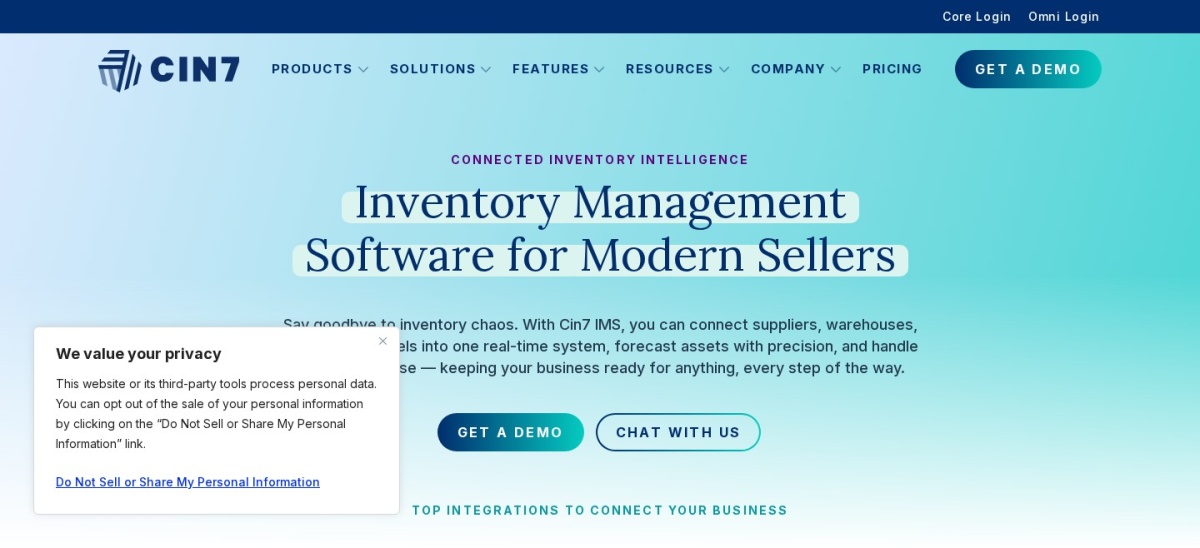
Cin7 Core homepage, captured Nov 2026.
Cin7 Core is an inventory and order management system for retailers coordinating sales, purchasing and fulfillment across multiple channels. Standard costs $349 per month and includes 5 users, 2 ecommerce or application integrations, 6,000 annual sales orders, unlimited inventory locations and standard warehouse management.
The trade off is the $4,188 annualized subscription, with extra integrations and advanced capabilities potentially increasing spending. Pro costs $599 per month and adds more users, integrations, order capacity and planning tools. It suits established retailers whose inventory operations extend beyond individual storefronts.
Pro adds greater order capacity, more integrations and material requirements planning.Visit cin7.com
Retail inventory management software vs. POS inventory tools
A retail POS system records sales and updates product quantities when purchases are completed. Inventory management software provides broader stock administration, including purchasing, receiving, warehouse organization and replenishment.
Square, Shopify POS and Lightspeed Retail connect inventory management directly to retail checkout. These systems are attractive when a store wants one platform for sales and merchandise tracking.
Zoho Inventory, inFlow and Cin7 Core focus more heavily on stock operations, sales orders and purchasing. They may be better suited to businesses selling through several channels or managing separate storage locations.
Sortly concentrates on visual stock records, mobile scanning and inventory counting. It is useful for stock organization but does not replace a complete retail checkout system.
Choose based on where inventory errors originate. A store struggling with checkout synchronization may need an integrated POS, while a business managing complex purchasing may benefit from dedicated inventory software.
What affects the cost of retail inventory software?
Retail inventory software may be priced per store, user, subscription or order volume. Those differences become significant as a business adds staff, sales channels and storage locations.
Square Plus charges $49 monthly per location, while Zoho Inventory Standard costs $29 monthly with annual billing and includes 500 monthly orders. Lightspeed Retail Basic starts at $89 monthly with annual billing.
Specialized inventory systems cost more. inFlow Lite is $1,188 annually, and Cin7 Core Standard costs $349 monthly. These products address purchasing and warehouse workflows that simpler POS systems may not cover.
Watch for additional user licenses, barcode devices, payment processing, integrations and implementation charges. Sortly also illustrates why advertised annual discounts need careful interpretation: its current first-year offer is not the regular recurring price.
Compare software against the inventory problems it solves. A lower-cost system may be adequate for a single store, while complex multichannel operations can justify a more extensive platform.
How we chose
We shortlisted established retail inventory management products with documented stock tracking, purchasing, barcode, ecommerce or POS capabilities. The comparison includes dedicated inventory systems and retail POS platforms because retailers may need one or both. Public Capterra ratings were checked for every product.
Official pricing pages, vendor documentation and Capterra profiles were reviewed on November 23, 2026, using November 22 as the requested editorial reference date. Annual costs reflect published regular entry prices or annual-billing rates where identified. Temporary promotional pricing is excluded, and subscription limitations are noted.
We excluded products without verifiable entry pricing or adequate customer review evidence. We also separated inventory-focused platforms from POS-centered systems, identified usage-based limitations and distinguished advanced features requiring upgrades. No vendor paid for a place, and we do not claim testing for this list.
How to choose retail inventory management software
Identify your sales channels, stock movement and purchasing needs before comparing inventory software subscriptions.
Map your inventory workflow. Determine how products enter inventory, move between locations and leave through sales or fulfillment. Choose a platform that supports your actual stock processes rather than paying for features unrelated to your business.
Check sales channel synchronization. If you sell online and in physical stores, confirm that inventory quantities update across every connected channel. Review how the software handles returns, canceled orders, reserved stock and inventory adjustments.
Evaluate purchasing and barcode tools. Look for reorder alerts, purchase orders, receiving, barcode scanning and stock counting. Businesses with warehouses may also require bin locations, transfer orders and picking workflows.
Calculate recurring and implementation costs. Compare subscriptions, additional stores, users, orders, integrations, scanning devices and setup expenses. Confirm which advanced inventory tools are included in the entry plan and which require upgrades.
FAQ
What is the best retail inventory management software in 2026?
Square is our top choice for smaller retailers that want inventory tracking connected directly to checkout. Zoho Inventory is better for businesses emphasizing order management and purchasing, while Shopify POS suits merchants managing online and in-store sales through Shopify.
Is there free retail inventory management software?
Yes. Square provides free POS software with essential inventory tracking, Zoho Inventory offers a limited free plan, and Sortly supports up to 100 unique items without a subscription. Free plans typically restrict advanced purchasing, reporting, order volume or user capacity.
How much does retail inventory management software cost?
Prices vary by capability. Zoho Inventory Standard costs $29 monthly with annual billing, Square Plus costs $49 per location monthly, and Lightspeed Retail Basic costs $89 monthly with annual billing. Dedicated systems such as Cin7 Core can cost substantially more.
Can retail inventory software sync online and in-store stock?
Yes. Shopify POS synchronizes products and inventory between Shopify ecommerce and physical checkout. Square also supports inventory connected to retail sales, while other systems offer integrations for additional channels. Verify synchronization rules and limitations before migrating your catalog.
What is the difference between inventory management and warehouse management software?
Inventory management tracks products, quantities, purchasing and availability. Warehouse management focuses more heavily on physical storage, bin locations, picking, receiving and stock movement. Some products combine both, but advanced warehouse workflows may require higher subscriptions.
Which software is best for barcode inventory tracking?
Sortly is attractive for visual inventory records and mobile QR scanning. Square includes retail barcode tools, while inFlow and Cin7 Core provide barcode-oriented inventory workflows. Compare supported scanners, label printers and stock counting processes before selecting a product.
Which retail inventory software works with Shopify?
Shopify POS is integrated directly with Shopify commerce. Zoho Inventory and Cin7 Core also provide ecommerce integrations relevant to Shopify merchants. Additional solutions can connect through third-party applications, but synchronization capabilities and subscription requirements vary.
Can inventory software automatically reorder products?
Some inventory platforms support reorder thresholds, low-stock alerts or automated purchasing workflows. The exact level of automation differs by product and plan. Verify whether the software only recommends replenishment or can create purchase orders and send them to suppliers.
What should small retailers prioritize in inventory software?
Start with accurate stock counts, simple receiving, low-stock alerts and clear sales reporting. If you sell through several channels, prioritize synchronization. More complex warehouse and planning tools become valuable when order volume, locations or supplier relationships increase.