Best Retail Analytics Software in 2026: 9 Tools Compared
WLWPLegible EditorsLast verified 23 Nov 2026How we rank10 min read
★ Short answer
Shopify Analytics is the best retail analytics software for most sellers: 200+ reports on sales, inventory and customers from $29 a month billed annually. Square Analytics is the best free start at $0, and RELEX is the pick for demand forecasting.
How we make this list: we compare pricing pages, product documentation and public user reviews, then re-check every price before each update. No product paid for a place. Disclosure.
Shopify Analytics is the best start for omnichannel sellers: 200+ reports from $29 a month billed annually.
Square Analytics is free with any Square account, and Looker Studio is free with no user cap.
Lightspeed Analytics is the pick for inventory-led retail, from $89 a month billed annually.
RELEX is the pick for demand forecasting and Placer.ai for foot traffic and site selection, both quote-based.
Power BI Pro at $14 a user a month is the cheapest route to shared retail dashboards.
What retail analytics software should do
Retail analytics splits into three jobs: counting what happens in stores, watching what happens on shelves, and planning what happens next. POS analytics read sales and inventory, traffic tools count visitors, and planning platforms forecast demand.
Free plans cover the basics. Square Analytics is free with any Square account, Looker Studio is free with no user cap, Power BI Desktop is free, and Placer.ai has a free edition for basic location research.
Most enterprise tools price by quote. RetailNext, RELEX, EDITED, SymphonyAI and Placer.ai publish no starting price, so budget for implementation time and hardware, not just the subscription.
Ratings run from 4.0 to 4.6 on G2, but the samples vary widely: Shopify has 5,172 reviews and Tableau has 4,238, while RELEX has 40 and Placer.ai has 39. RetailNext was left out because its rating rests on only 3 reviews.
Shopify Analytics is the analytics most Shopify stores already own. The Basic plan includes more than 200 reports on sales, customers, inventory and marketing, and because the data comes from the store itself there is no connector to configure, no sync to break and no import to schedule. Best sellers, sales by channel and returning-customer rates are visible within minutes.
The trade off is that the good reporting costs more than the headline price. Standard reports start on Grow at $79 a month billed annually, and anything beyond descriptive dashboards, such as forecasting or cohort analysis, needs an app or a BI tool. Card processing at 2.9% plus 30 cents online on Basic is charged on every order, on top of the subscription.
What we like
200+ reports with live store data, no connector
Sales, inventory and customer reports in one place
Square Analytics is the simplest deal in this list: it costs nothing. Any Square account gets real-time reports on sales, best sellers, busy hours and team performance, viewable from a phone or a computer, with no setup beyond taking payments through Square. For a single shop, a market stall or a pop-up, that is often all the analytics the business will ever need.
The trade off is scope and the real cost of free. Advanced reporting and dashboards sit behind Square Plus at $49 a month per location, and the reports only cover Square transactions, so sales on another platform stay invisible. Card processing at 2.6% plus 15 cents per in-person payment is also the real cost of free.
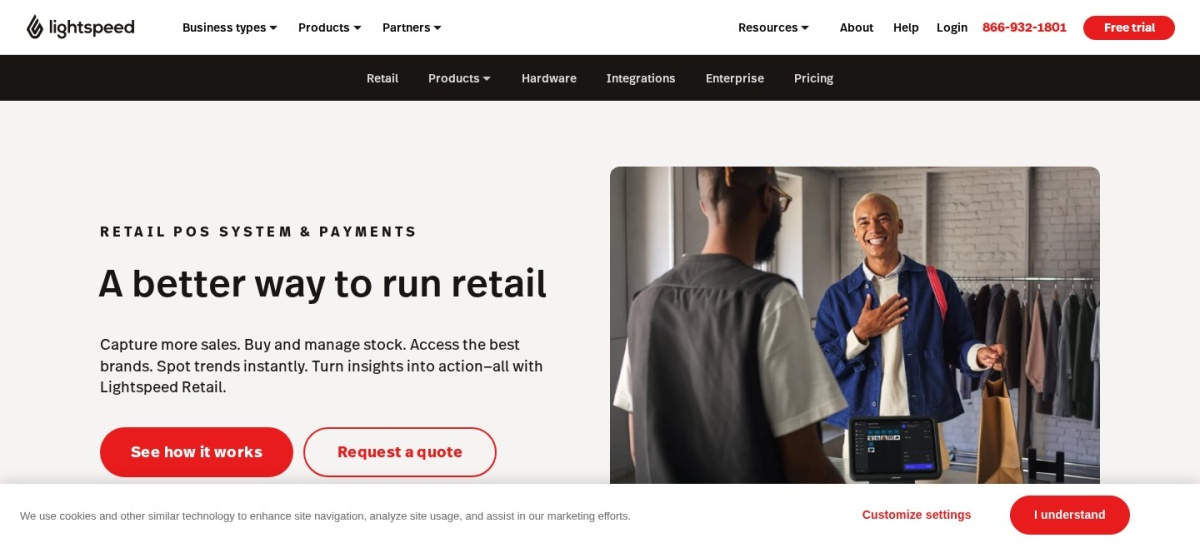
Lightspeed Analytics is built for retailers whose hardest problem is inventory, not traffic. The Basic plan pairs a retail POS with inventory management and basic reports, while Core adds advanced sales, staff and inventory reports, loyalty and accounting integrations. For a multi-location shop selling apparel, bikes or gifts, the stock and sales numbers live in the same place, which is the point.
The trade off is price and the register limit. It is the priciest way into POS analytics here, at $109 a month billed monthly, and each plan covers only one register, so extra registers cost more. Custom reporting and forecasting wait for the Plus plan at $289 a month billed annually, and reviewers cite high fees and expensive add-ons.
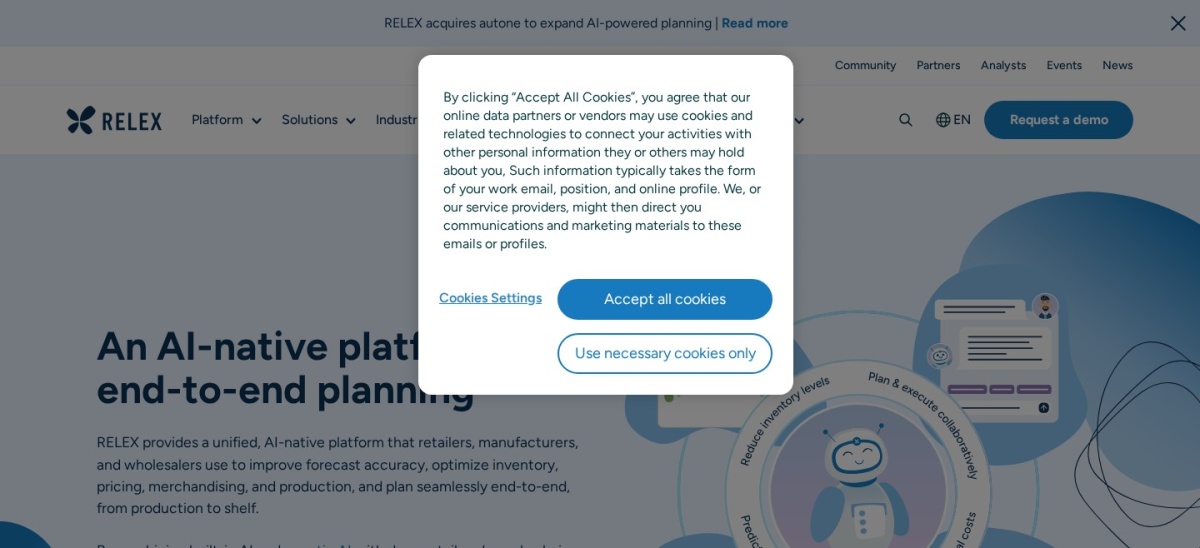
RELEX Solutions sits one level above store analytics: it predicts what customers will buy and makes sure the product is there. The platform combines demand signals, promotions, weather and supply constraints into forecasts that drive automated replenishment, assortment and workforce planning for grocery and specialty chains.
The trade off is price and complexity. Pricing is quote-based, so budget for implementation time as well as the subscription, though G2 lists a Basic plan at 3,000 euros a year. Some processes take several steps to configure, the interface takes time to learn, and reviewers say module pricing has become too commercially driven for the value delivered.
What we like
Demand signals, weather and promotions in one forecast
Placer.ai answers the question POS reports cannot: who walks past and into your stores, where they come from and how far they travel. Its location intelligence covers visits, trade areas, audience behavior and demographics with interactive maps and dashboards, and it needs no sensors or hardware in the store. Retailers use it to pick new sites and benchmark against competitors.
The trade off is price and the learning curve. Paid plans are priced high, with reviewers noting the cost even while praising the data, and the free edition covers only basic research. Advanced features and datasets can be hard to navigate without guidance, the site can feel sluggish, and some metrics need more context on how they are calculated.
Microsoft Power BI is the cheapest route to a proper retail dashboard once the POS reports run out. It connects to Shopify, Square, Excel, SQL databases and hundreds of other sources, then turns the joined data into shared reports with alerts, scheduled refreshes and mobile apps. At $14 per user a month paid yearly, a five-person team pays $70 a month, less than one Lightspeed register.
The trade off is skill and the licence math. DAX, the formula language behind custom measures, has a real learning curve, and everyone who views a shared report needs a Pro licence, so the bill grows with the audience. Copilot AI features sit on Premium Per User at $24 a month, and G2 still lists the older $10 Pro price.
Zoho Analytics is the budget BI pick for small retailers, and its pricing is the reason: a flat $24 a month billed annually covers two users and half a million rows, with a free plan below it. The Zia AI assistant builds dashboards from plain-language questions, and integrations with Zoho Books, Inventory and CRM keep sales and stock in one view.
The trade off is freshness and reach. Data arrives on scheduled syncs rather than live, so the dashboard is a snapshot, not a pulse, and near real-time needs a live database connection. Advanced features and higher row limits wait for the Standard, Premium and Enterprise tiers, and the connector library is smaller than Power BI.
Looker Studio is the free dashboard in this list. It connects to GA4, Google Ads, Sheets and BigQuery in a few clicks, has no cap on users or reports, and shares easily with staff, suppliers or an agency. For a retailer whose marketing and web data already live in Google, the first dashboard takes an afternoon and costs nothing.
The trade off is scale and the Google walls. Reports slow down with large datasets or many charts, and connecting a non-Google source usually means a paid third-party connector at $20 to $350 a month. The Pro tier at $9 per user per project per month adds team workspaces and support, but the billing multiplies per project. G2 still lists it under its old name, Data Studio.
Tableau makes the best-looking dashboards in this list, and that matters more than it sounds: a report managers actually open gets used, and Tableau's drag-and-drop builder, templates and community make the first dashboard fast. A Creator builds, Explorers tweak and Viewers watch at $15 a month, so sharing a finished dashboard across a company stays affordable.
The trade off is the seat price and the contract. A Creator seat costs $75 a month, every deployment needs at least one, and contracts are annual only, with no monthly billing. White-label branding and advanced governance wait for Enterprise, where Creator rises to $115, and dashboards can slow down with very large datasets.
What we like
Best interactive visuals in this list
Huge template community speeds up first dashboards
POS analytics read what already happened. Shopify, Square and Lightspeed report sales, inventory and customers from the store itself.
BI tools join data from everywhere. Power BI, Zoho Analytics, Looker Studio and Tableau combine POS, ads, spreadsheets and databases into shared dashboards.
Planning tools predict what happens next. RELEX forecasts demand and automates replenishment, while Placer.ai reads foot traffic for site and assortment decisions.
How we chose
We started from the retail analytics tools operators and analysts mention most, then kept the nine with a public rating on G2 and a published price or a free edition. Tools with no usable rating were left out.
Prices come from each vendor's pricing page or a vendor comparison page, checked on 23 November 2026, with the serpastra comparison re-checked on 2 November 2026. Ratings and review counts come from G2 pages opened the same day.
We left out Dor, which has no rating on G2, Capterra or Trustpilot, RetailNext, whose rating rests on 3 reviews, and Trax, whose rating rests on 2 reviews. No vendor paid for a place. This list is based on pricing, docs and reviews, not on using the tools ourselves.
How to choose retail analytics software
Start with the question you need answered, then pick the cheapest tool that answers it.
Name the question first. Sales and inventory questions belong to POS analytics. Foot traffic questions belong to Placer.ai. Forecasting questions belong to RELEX.
Start with the free tier you already own. Square, Shopify and Looker Studio reports are free or already paid for. Add a BI tool only when the built-in reports stop answering your questions.
Count the whole team, not one seat. Power BI and Tableau charge per user, and every viewer needs a licence. A five-person team pays $70 a month on Power BI Pro.
Ask for the quote early on enterprise tools. RELEX and Placer.ai price by quote, so implementation time and hardware belong in the budget beside the subscription.
FAQ
What is the best retail analytics software?
Shopify Analytics is the best pick for most sellers: 200+ reports on sales, inventory and customers from $29 a month billed annually.
Is there free retail analytics software?
Yes. Square Analytics is free with any Square account, Looker Studio is free with no user cap, and Power BI Desktop is free for individual use.
How much does Shopify Analytics cost?
Shopify Analytics comes with the Shopify plan: Basic costs $39 a month billed monthly or $29 a month billed annually.
How much does Power BI cost?
Power BI Pro costs $14 per user a month paid yearly. Power BI Desktop is free for individual use.
What is the best retail analytics tool for foot traffic?
Placer.ai is the best pick for foot traffic and site selection, with a free edition for basic research and quote-based paid plans.
How much does Lightspeed Analytics cost?
Lightspeed Retail Basic costs $109 a month billed monthly or $89 a month billed annually, with one register per plan.