Seller Snap is our top predictive pricing software for marketplace sellers, combining game theory AI with automated repricing for $100 monthly when billed annually. Repricer.com suits multichannel sellers who need automated pricing strategies, while Prisync offers accessible competitor monitoring and rule-based price optimization for online retailers.
How we make this list: we compare pricing pages, product documentation and public user reviews, then re-check every price before each update. No product paid for a place. Disclosure.
Seller Snap starts at $1,200 annually for 1,000 SKUs and earns 4.8/5 from 41 Capterra reviews.
Repricer.com Core costs $99 monthly and supports up to 3,000 SKUs across 3 marketplaces.
Prisync scores 4.7/5 from 173 G2 reviews, with competitor monitoring starting at $99 monthly.
Competera earns 4.8/5 from 58 Capterra reviews and specializes in enterprise price forecasting.
7Learnings scores 4.5/5 from 25 G2 reviews and models the relationship between pricing and customer demand.
3 of the 7 platforms publish concrete entry-level subscription prices in USD.
What to look for in predictive pricing software
Predictive pricing software estimates how price changes may influence demand, sales volume and profitability. Advanced platforms use historical transactions, competitor information, inventory levels and machine learning to recommend future prices.
Distinguish predictive optimization from rule-based repricing. Predictive models estimate customer responses to price changes, while rule-based platforms adjust prices according to predefined conditions. Both approaches can support ecommerce pricing, but they solve different problems.
Look for margin safeguards, minimum and maximum prices, scenario forecasting and approval workflows. These controls help prevent automated recommendations from producing commercially unsuitable prices.
Evaluate data requirements before purchasing enterprise pricing software. Reliable sales histories, product costs, inventory records and competitor information are important inputs for demand forecasting and price elasticity models.
Compare the price of the subscription that includes your required optimization features. Some vendors advertise affordable monitoring plans but reserve automated or AI-driven repricing for higher subscriptions.
Seller Snap is an AI marketplace repricing platform that uses game theory to guide automated pricing decisions. Starter costs $100 monthly when paid annually and supports 1,000 SKUs, 1 marketplace and 1 user, including AI repricing, analytics and integrations.
The trade off is that Starter limits monthly marketplace revenue to $15,000 and requires an annual commitment at the advertised price. Accelerator costs $250 monthly under annual billing. It suits marketplace sellers who want profit-focused pricing rather than continually undercutting competitors.
What we like
Game theory-based pricing algorithms
AI repricing included in Starter
Minimum and maximum price calculations
Sales and inventory analytics
4.8/5 Capterra rating
Watch out for
Starter has a monthly revenue ceiling
Entry plan supports only 1 marketplace
Limited relevance to independent storefront pricing
Starter includes AI repricing, analytics, integrations and automated price calculations.Visit sellersnap.io
02
Repricer.com
4.6/5on Capterra (37 reviews, checked Nov 2026)
Starts at$99/mo
Best for multichannel marketplace repricing
Core monthly price$99
Core SKU limit3,000
Core marketplaces3
AI optimization planScale at $299/mo
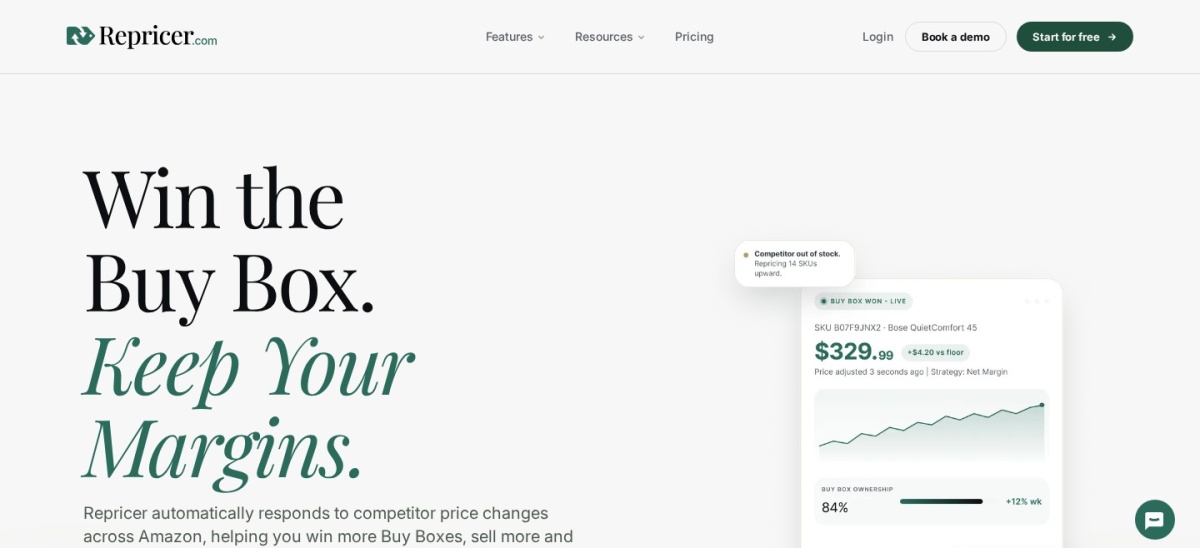
repricer.com
Repricer.com homepage, captured Nov 2026.
Repricer.com is a marketplace pricing automation platform combining competitor-responsive pricing, sales velocity adjustments and configurable strategies. Core costs $99 monthly and supports up to 3,000 SKUs across 3 marketplaces, including automated repricing for Amazon and eBay.
The trade off is that dedicated AI price optimization requires Scale at $299 monthly, rather than the $99 Core subscription. Scale supports up to 50,000 SKUs across 5 marketplaces. It suits sellers who want automated pricing across multiple sales channels.
What we like
Sales velocity-based repricing
Multichannel marketplace support
Automated pricing strategies
Published subscription prices
AI optimization on Scale
Watch out for
Dedicated AI optimization requires Scale
Advanced plans are considerably more expensive
Marketplace focus limits general retail applications
Core adds automated repricing; Scale introduces AI price optimization and higher product limits.Visit repricer.com
03
Prisync
4.7/5on G2 (173 reviews, checked Nov 2026)
Starts at$99/mo
Best for competitor-informed ecommerce pricing
Professional product limit100
Competitor trackingUnlimited competitors
Price updates3 times daily
Dynamic pricing planPremium at $199/mo
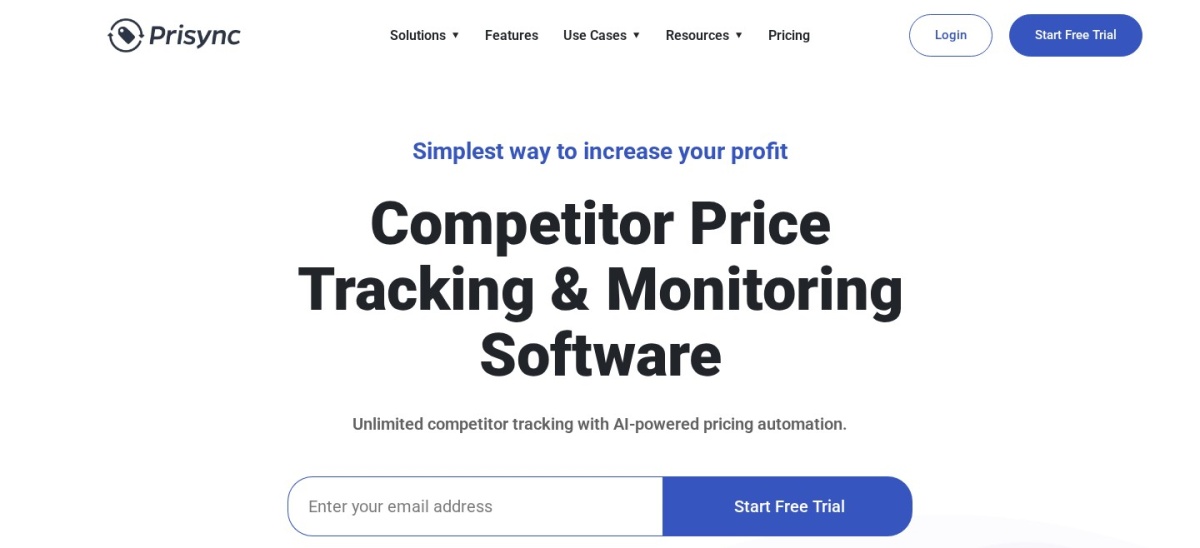
prisync.com
Prisync homepage, captured Nov 2026.
Prisync is an ecommerce pricing intelligence platform that monitors competitor prices, stock availability and historical pricing trends. Professional costs $99 monthly for up to 100 products and includes unlimited competitor monitoring, price position comparisons and spreadsheet reports.
The trade off is that automated dynamic pricing requires Premium at $199 monthly, supporting up to 1,000 products. Its optimization primarily follows configurable pricing rules rather than advanced predictive demand models. It suits online retailers establishing data-informed competitive pricing strategies.
What we like
Unlimited competitor monitoring
Transparent entry-level subscription prices
Historical price and stock information
Configurable dynamic pricing rules
14-day free trial
Watch out for
Professional excludes dynamic repricing
Limited advanced demand forecasting
Subscription costs increase with catalog size
Professional adds competitive intelligence; Premium unlocks automated dynamic pricing.Visit prisync.com
04
Competera
4.8/5on Capterra (58 reviews, checked Nov 2026)
PricingCustom pricing
Best for enterprise predictive retail pricing
Pricing methodologyMachine learning
Demand forecastingSupported
Competitive intelligenceAvailable
Target customerEnterprise retailers
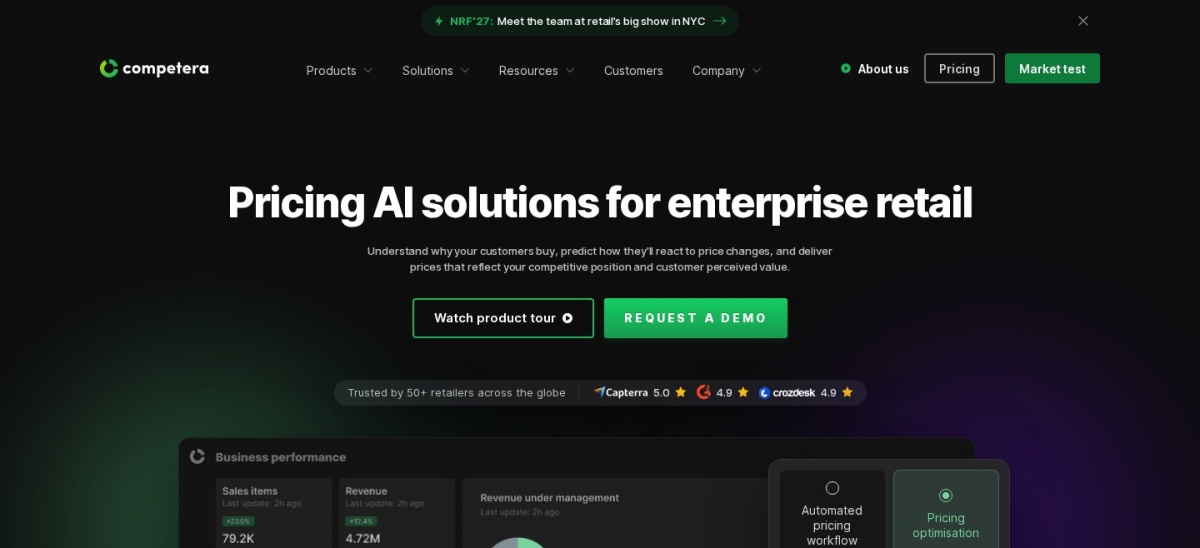
competera.ai
Competera homepage, captured Nov 2026.
Competera is an enterprise retail pricing platform that applies machine learning to price recommendations and demand forecasting. It combines internal transaction information with external competitive signals, accounting for more than 20 pricing and non-pricing factors when generating recommendations.
The trade off is that implementation requires substantial business data and a customized commercial agreement, with no public fixed subscription price confirmed. It suits established retailers managing extensive product catalogs and seeking predictive optimization beyond simple competitor matching.
What we like
Predictive demand modeling
Multiple pricing and non-pricing inputs
Competitive market intelligence
Enterprise catalog optimization
4.8/5 Capterra rating
Watch out for
No confirmed public subscription price
Implementation requires reliable historical data
Less accessible to small online stores
Custom enterprise packages provide predictive optimization and competitive intelligence capabilities.Visit competera.ai
05
7Learnings
4.5/5on G2 (25 reviews, checked Nov 2026)
PricingCustom pricing
Best for demand forecasting and markdown optimization
Pricing methodologyPredictive machine learning
Demand forecastingSupported
Markdown optimizationSupported
Commercial modelCustom agreement
7learnings.com
7Learnings homepage, captured Nov 2026.
7Learnings is a predictive retail pricing platform that models demand, price elasticity and the expected effects of pricing decisions. Its optimization capabilities help retailers coordinate product pricing, markdowns, promotional planning and business objectives, earning 4.5/5 from 25 G2 reviews.
The trade off is that the vendor does not publish a definitive fixed subscription price, and implementation requires historical transaction and product data. It suits established ecommerce businesses seeking to forecast the financial effects of pricing decisions before implementing them.
What we like
Predictive demand and elasticity modeling
Promotional pricing optimization
Markdown and clearance planning
Revenue and margin forecasting
Configurable pricing constraints
Watch out for
No confirmed public fixed subscription price
Data preparation can extend onboarding
Some pricing logic may be difficult to interpret
Custom packages provide predictive optimization, forecasting and retail planning capabilities.Visit 7learnings.com
06
Omnia Retail
4.4/5on G2 (100 reviews, checked Nov 2026)
PricingCustom pricing
Best for configurable AI retail pricing
SMB user limit5
SMB storefront limit1
Pricing strategy editorVisual decision tree
Enterprise subscriptionCustom
omniaretail.com
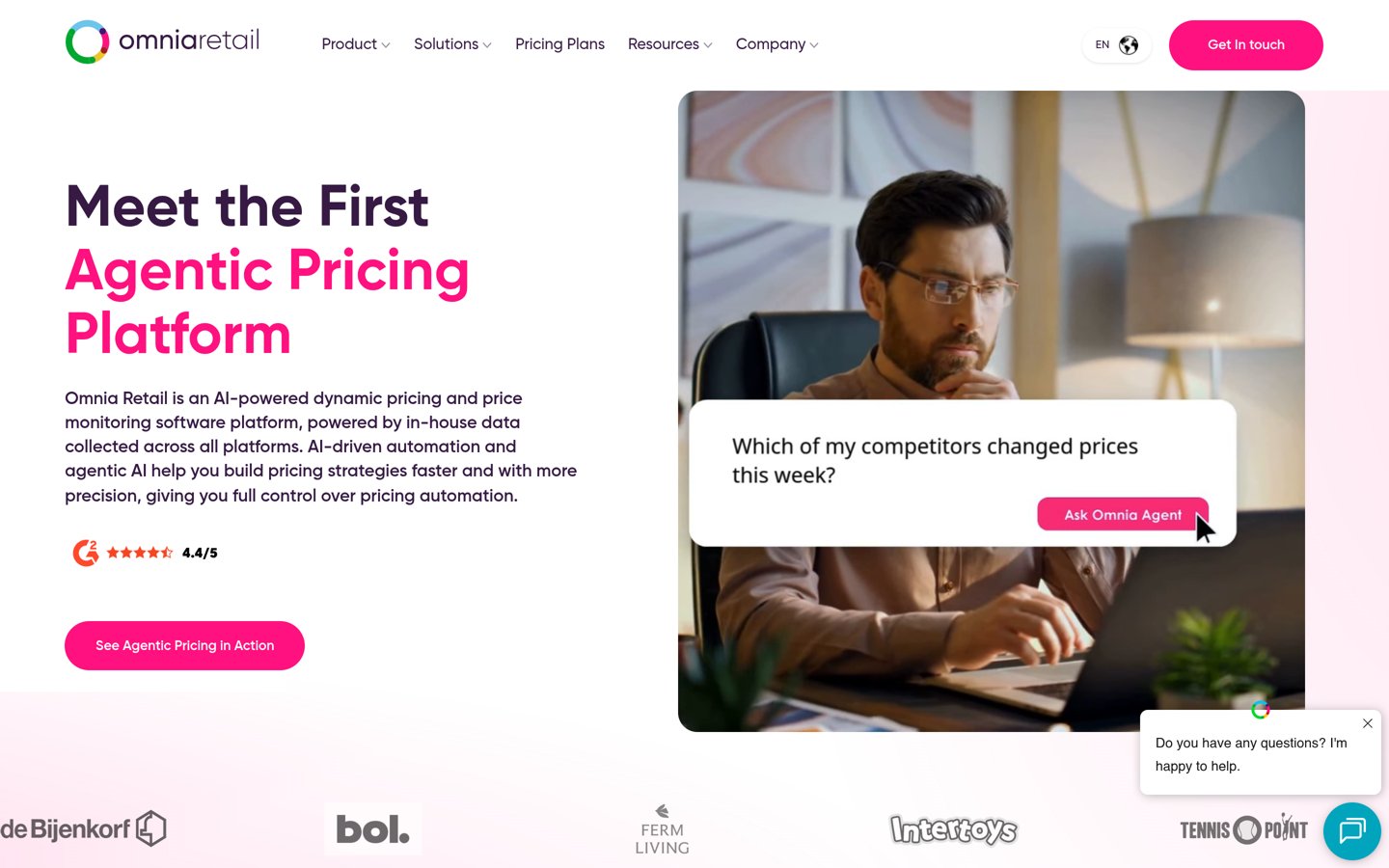
Omnia Retail homepage, captured Nov 2026.
Omnia Retail is an AI pricing platform combining market monitoring, dynamic price adjustments and configurable retail pricing strategies. Its SMB package supports a single storefront and up to 5 users, while advanced pricing controls include approval thresholds, strategy rollback and calculation explanations.
The trade off is that the vendor publishes its SMB starting price in a currency other than USD, so a fixed USD annual cost is not included here. Enterprise packages require custom quotes. It suits retailers that want configurable automation with oversight of pricing decisions.
What we like
Visual pricing strategy editor
AI-assisted retail price optimization
Configurable approval safeguards
Pricing strategy version history
Ecommerce platform integrations
Watch out for
No confirmed fixed USD entry price
SMB package supports only 1 storefront
Advanced implementations require configuration
Paid packages provide AI market monitoring, dynamic pricing and configurable safeguards.Visit omniaretail.com
07
Pricefx
4.4/5on G2 (145 reviews, checked Nov 2026)
PricingCustom pricing
Best for enterprise B2B price optimization
Pricing methodologyAI-assisted optimization
Price forecastingSupported
Commercial workflowsPricing and quoting
Target customerEnterprise B2B organizations
pricefx.com
Pricefx homepage, captured Nov 2026.
Pricefx is an enterprise pricing intelligence platform combining price management, optimization, analytics and configure-price-quote workflows. Its AI-focused approach helps businesses coordinate pricing decisions with commercial objectives, and the platform earns 4.4/5 from 145 G2 reviews.
The trade off is that subscription pricing requires a commercial discussion, and enterprise implementation can involve substantial data integration. It suits manufacturers, distributors and B2B ecommerce organizations managing complicated pricing structures, negotiated agreements and margin requirements.
What we like
Enterprise price optimization
Integrated pricing and quoting workflows
Pricing analytics and forecasting
Margin management capabilities
Established public review history
Watch out for
No confirmed public subscription price
Implementation can be complex
Excessive functionality for smaller ecommerce stores
What is the difference between predictive and dynamic pricing?
Predictive pricing estimates future demand and commercial outcomes under different price scenarios. Competera and 7Learnings use forecasting models to help retailers determine how price adjustments may affect revenue, profitability and inventory turnover.
Dynamic pricing changes product prices according to current market conditions or predefined rules. Prisync uses competitor information to support automated pricing strategies, while marketplace repricers respond to competition, sales velocity and other marketplace signals.
Some products combine both approaches. Evaluate whether you need demand forecasting, automated execution or a combination of these capabilities before selecting a subscription.
What data does predictive pricing software need?
Start with accurate product identifiers, transaction histories, selling prices, product costs and inventory records. Additional information about promotions, competitor prices and seasonal demand can improve the context available to optimization models.
Define commercial constraints before automating price changes. Minimum margins, maximum price adjustments and manual approval thresholds help prevent recommendations from conflicting with business objectives.
Monitor forecast accuracy against actual sales results. Pricing models should be reviewed when customer behavior, product availability or competitive conditions change significantly.
How we chose
We selected established predictive pricing, retail price optimization and automated repricing platforms with relevant ecommerce applications. We compared forecasting methods, pricing automation, competitor intelligence, commercial safeguards, subscription costs and public customer ratings.
Official product documentation, available pricing pages and G2 or Capterra ratings were checked on 25 Nov 2026. Published regular monthly prices are annualized where appropriate. Seller Snap uses its advertised annual billing commitment. Monitoring-only entry plans are identified separately from subscriptions containing AI optimization.
We excluded products without sufficient public reviews or relevant pricing optimization capabilities. Custom pricing indicates that a comparable fixed USD subscription was not confirmed, including Omnia Retail's non-USD entry price. Competera and Pricefx were evaluated using official product pages because standalone pricing URLs did not provide usable subscription information. No vendor paid for a place, and we do not claim testing for this list.
How to choose predictive pricing software
Evaluate your pricing objectives, available business data, sales channels and automation requirements before purchasing predictive pricing software.
Identify the pricing problem you need to solve. Choose predictive demand modeling for price elasticity forecasting, marketplace repricing for competitive listing adjustments or rule-based automation for straightforward competitor-informed pricing.
Evaluate your available historical data. Confirm that your transaction histories, product identifiers, costs and inventory information are accurate enough to support reliable forecasting and commercially useful pricing recommendations.
Compare the required subscription rather than the entry price. Repricer.com reserves dedicated AI optimization for its $299 monthly Scale subscription, while Prisync requires its $199 monthly Premium plan for automated dynamic pricing.
Establish safeguards and measure performance. Set minimum margins, permitted price ranges and approval requirements. Compare actual revenue, sales volume and profitability against forecast outcomes before expanding automation across your catalog.
FAQ
What is the best predictive pricing software in 2026?
Seller Snap is our top pick for marketplace sellers seeking AI-driven repricing, starting at $100 monthly with annual billing. For enterprise retailers requiring detailed demand elasticity forecasting and predictive scenario modeling, Competera and 7Learnings are more specialized alternatives.
How much does predictive pricing software cost?
Published entry subscriptions in this comparison start at $99 monthly for Repricer.com and Prisync. Seller Snap starts at $100 monthly with annual billing. Enterprise predictive optimization platforms such as Competera and Pricefx generally require customized commercial agreements.
Is predictive pricing the same as dynamic pricing?
No. Predictive pricing estimates how different prices may affect future demand, revenue and profitability. Dynamic pricing adjusts prices in response to market conditions or predefined rules. Some platforms combine forecasting models with automated price execution.
Which predictive pricing software is best for ecommerce retailers?
Competera and 7Learnings are particularly relevant for established ecommerce retailers requiring demand forecasting and price optimization. Smaller online stores can use Prisync for competitor monitoring and automated pricing rules without implementing a full enterprise forecasting system.
Can predictive pricing software improve profit margins?
Predictive pricing can help businesses identify opportunities to adjust prices based on demand, costs and customer behavior. However, financial improvements depend on data quality, pricing constraints, implementation and market conditions. Software recommendations do not guarantee higher profit margins.
What is the best AI pricing software for Amazon sellers?
Seller Snap provides game theory AI repricing through its Starter subscription at $100 monthly with annual billing. Repricer.com is another option for sellers needing multichannel automation, with dedicated AI optimization available through Scale at $299 monthly.
SaaS SEO and WordPress specialist with about 8 years of experience. Rakib compares WordPress plugins, themes, hosting and software using public pricing, documentation and user reviews. See how we rank.