Netstock is the best inventory forecasting software for most mid-market companies, starting at $900 a month and rated 4.6/5 on G2 from 182 reviews. Pick StockTrim from $49 a month for smaller teams, or Slimstock for demand sensing across channels.
How we make this list: we compare pricing pages, product documentation and public user reviews, then re-check every price before each update. No product paid for a place. Disclosure.
Netstock is the top pick for mid-market teams on an ERP, from $900 a month with a 4.6/5 G2 rating across 182 reviews.
StockTrim and Prediko both start at $49 a month, the cheapest entry points in this list.
Slimstock has the highest G2 rating among the mid-market platforms at 4.8/5 from 76 reviews.
Five of the nine tools sell by quote only, so budget for a sales process, not a signup.
Only StockTrim, Inventory Planner, Prediko and Forecast Pro offer a free trial; the rest start with a demo.
What inventory forecasting software should cover
Inventory forecasting software predicts demand for each product, usually per location, and turns those predictions into replenishment plans: what to order, how much, and when. It replaces spreadsheet-based reordering with models that account for seasonality, trends, and promotions.
Where your sales data lives decides the shortlist. A Shopify brand needs a tool that reads the store directly. A wholesaler on NetSuite needs forecasting that sits on top of the ERP. A distributor with 50,000 SKUs needs something that handles seasonality, promotions, and supplier lead times without manual work.
Pricing ranges from $49 a month to quote-only enterprise contracts. Count your active SKUs across all locations before requesting quotes, since vendors price by SKU count or revenue far more often than by headcount. If your store runs on WooCommerce, our guide to how much a WooCommerce store costs helps you budget the whole stack before adding a forecasting tool.
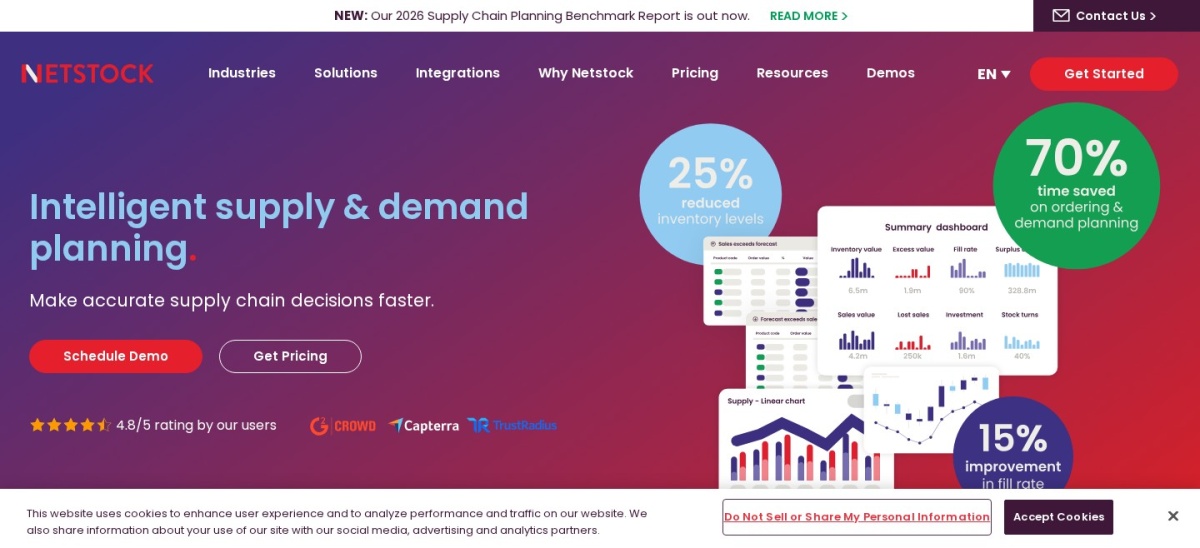
Netstock is cloud planning software that sits on top of an ERP and turns sales history into demand forecasts, safety stock levels and purchase orders. It connects to more than 60 ERP systems, including NetSuite, Sage and Acumatica, and implementation typically takes 6 to 10 weeks.
The trade off is price and commitment. Plans start at $900 a month on annual subscriptions, which rules out small businesses, and there is no free trial. It suits mid-market distributors and manufacturers that already run an ERP and plan thousands of SKUs.
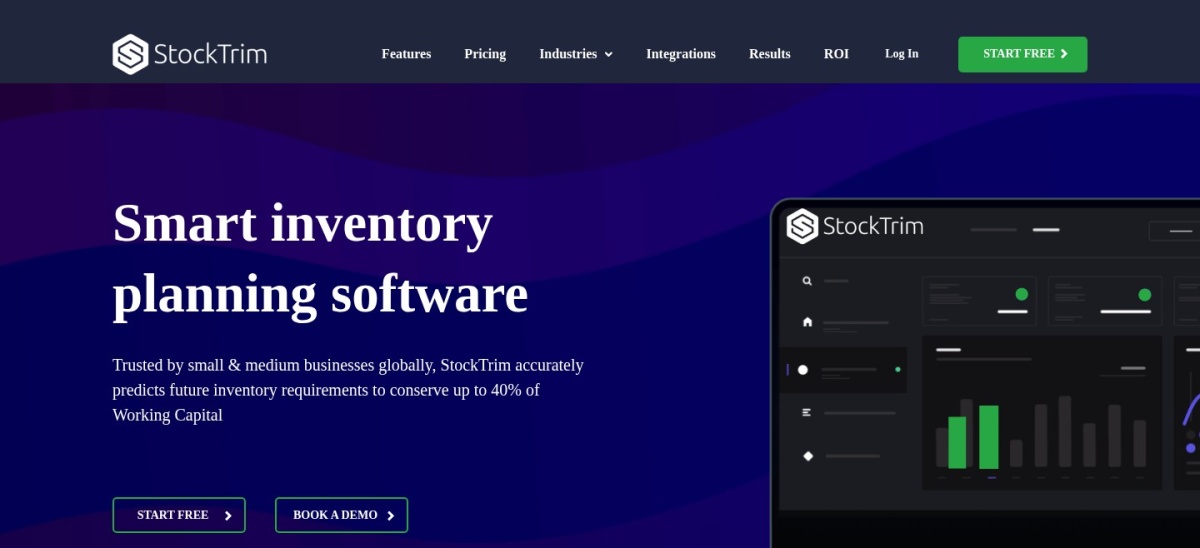
StockTrim is cloud demand forecasting software for small and mid-size wholesalers, manufacturers and ecommerce sellers. It uses machine learning to forecast demand, set safety stock and build order plans, with unlimited users and SKUs on every plan. A 14-day free trial runs on your own sales data.
The trade off is that the price follows your revenue. Plans start at $49 a month on the annual plan for businesses under $100,000 in annual revenue, and the bill climbs through the revenue bands as you grow. It suits growing SMBs that want published pricing and a quick start.
Slimstock is the company behind Slim4, a planning platform that combines AI forecasting with demand sensing across channels. It covers the full cycle from forecasting and replenishment through to S&OP, with scenario planning for promotions, assortment changes and supply disruptions.
The trade off is that pricing is quote-only and buying is a sales process, not a signup. Implementation needs planning expertise, and its reference base is stronger in Europe than in the US. It suits mid-market wholesalers and retailers that need more than an SMB app.
Inventory Planner by Sage homepage, captured Nov 2026.
Inventory Planner by Sage is replenishment planning software for businesses selling across several channels. It forecasts demand per SKU per location, generates purchase orders and tracks supplier performance, with integrations for Shopify, Amazon and major inventory systems. The 14-day free trial needs no credit card.
The trade off is pricing opacity. Sage does not publish prices, so every deal starts with a quote request, and third-party estimates vary widely. It suits multi-channel sellers doing serious volume who want a stable, Sage-backed planning tool.
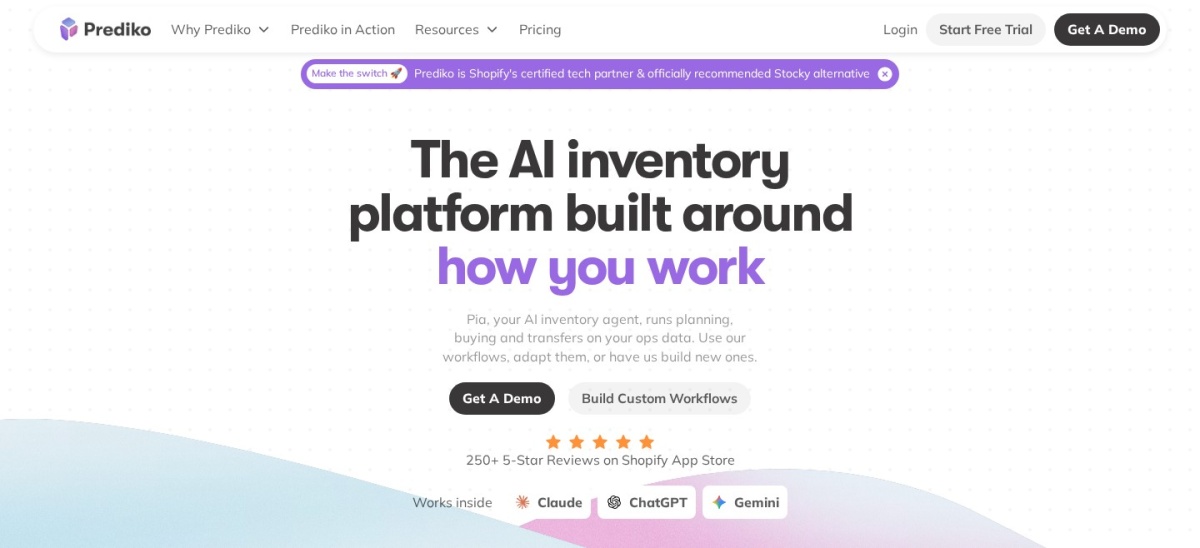
Prediko is a Shopify-native inventory forecasting app for brands that have never done formal demand planning. It connects to the store, forecasts demand, suggests reorders and flags stockouts, with unlimited SKUs, users and purchase orders on every plan. Plans start at $49 a month with a 14-day free trial.
The trade off is scope. Prediko only works with Shopify, so brands selling on Amazon or wholesale alongside direct sales will outgrow it or need a second tool. It suits Shopify brands buying their first forecasting tool.
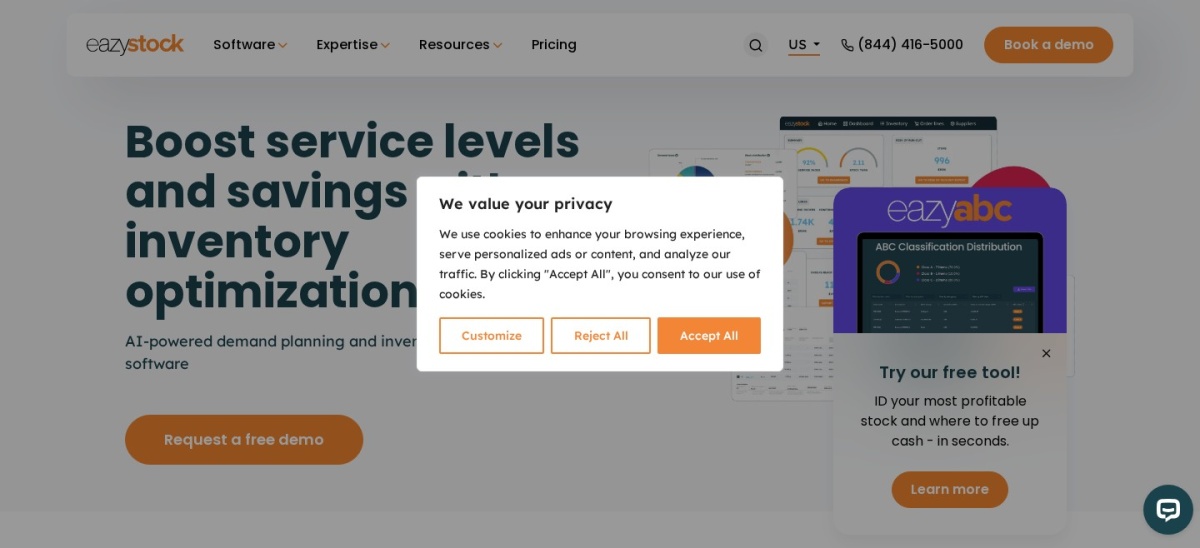
EazyStock is cloud inventory optimization software from the Syncron group, built for wholesale distributors. It classifies SKUs by demand pattern, forecasts daily with seasonality and trend detection, and produces replenishment proposals that respect minimum order quantities and lead times.
The trade off is the buying process. There is no self-serve trial, evaluation runs through demos, and pricing is quote-based, with Capterra listing a $750 per month starting price. It suits mid-size distributors with a supported ERP and no large IT team.
What we like
Cloud-based with quick deployment
Strong for wholesale distribution
Daily forecasting with seasonality
Rated 4.4 out of 5 from 74 G2 reviews
Watch out for
Demo-only evaluation, no self-serve trial
Quote-based pricing
Needs a supported ERP underneath
Pricing is quoted per customer from ROI, users and SKU countsVisit eazystock.com
07
RELEX Solutions
4.6/5on G2 (22 reviews, checked Nov 2026)
PricingQuote/yr
Best for enterprise retail networks
Starting priceQuote
Free trialNo, demo
Built forRetail networks
PlanningForecast to promotion
relexsolutions.com
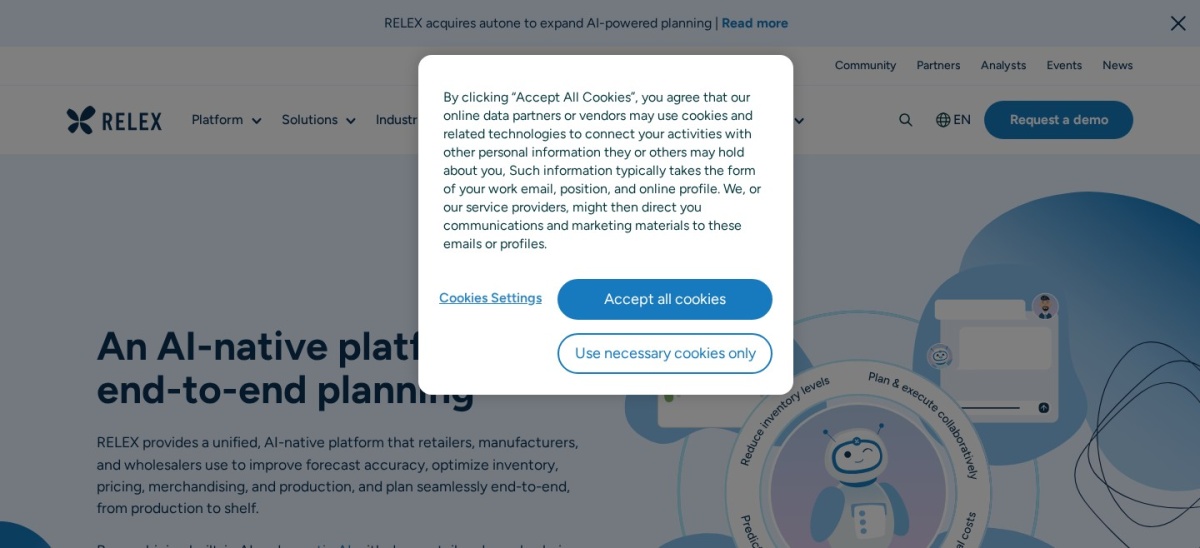
RELEX Solutions homepage, captured Nov 2026.
RELEX Solutions is an AI-native planning platform for large retailers, wholesalers and manufacturers. It unifies demand forecasting, replenishment, allocation and promotion planning across the whole retail network, so a promotion or disruption in one region flows through the plan.
The trade off is scale. Pricing is not published, evaluation is consultative and implementation is a multi-month project. It suits grocery and retail chains with thousands of stores, not a business reordering for a single warehouse.
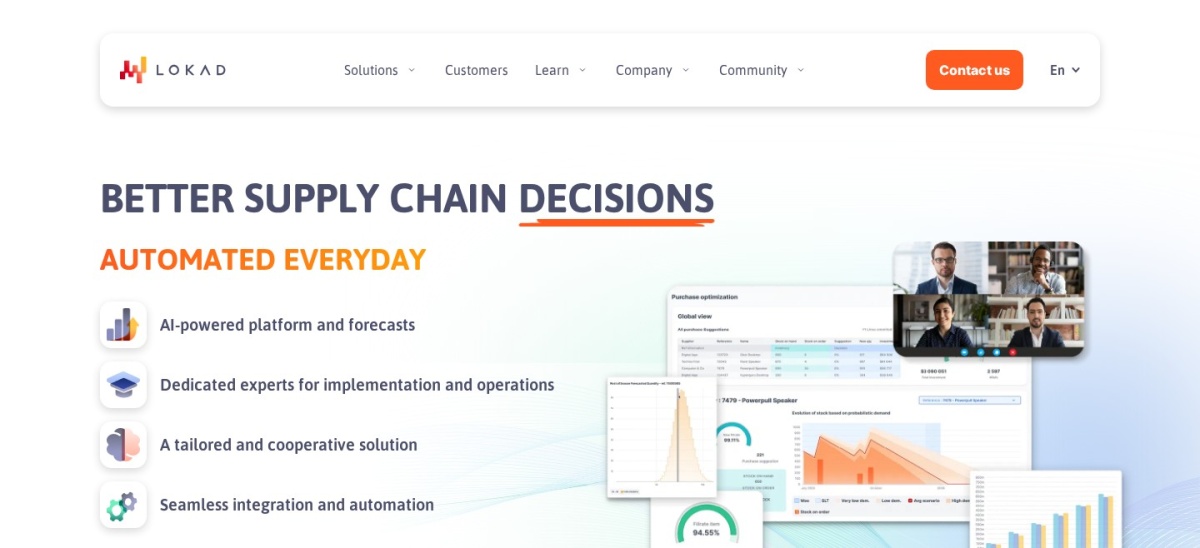
Lokad is a programmable forecasting platform rather than a packaged app. Its Envision language lets data teams write forecasting logic tuned to their exact economics, and its probabilistic forecasts quantify the chance of each demand scenario. Pricing is usage-based, not per seat.
The trade off is that Lokad needs technical staff or Lokad consultants to run it, and there is no click-and-try evaluation. It suits companies with data science capability that have outgrown packaged forecasting tools.
What we like
Fully programmable forecasting logic
Probabilistic forecasts quantify risk
Usage-based pricing can beat seat licenses
Handles extreme SKU counts
Watch out for
Requires technical skill to operate
Not a packaged app
Onboarding is consultative
Pricing is set per project with a dedicated expertVisit lokad.com
09
Forecast Pro
4.1/5on G2 (23 reviews, checked Nov 2026)
PricingQuote/yr
Best for statistical forecasting
Starting priceQuote
Free trialYes
Runs onDesktop
Model selectionAutomatic expert
forecastpro.com
Forecast Pro homepage, captured Nov 2026.
Forecast Pro is desktop forecasting software from Business Forecast Systems, built for planners who care about method. It offers a deep bench of statistical models with automatic expert selection, so the software picks the best-performing model per SKU. A free trial is available.
The trade off is the delivery model. Forecast Pro is desktop software in a category that has moved to the cloud, so there is no real-time collaboration and no automatic data connections to modern platforms. It suits a single expert planner rather than a planning team.
Five of the nine tools in this list sell by quote only: Slimstock, Inventory Planner, EazyStock, RELEX and Lokad. Expect a discovery call, a demo and a price that scales with SKUs, users or revenue.
Ask for the full first-year cost in writing, including implementation, onboarding and support. Quote-only tools often bundle services that self-serve tools charge separately.
Use the published prices in this list as leverage. Knowing that Netstock starts at $900 a month and StockTrim at $49 a month gives you a real anchor before the first sales call.
How we chose
We started from the forecasting tools that dominate buyer shortlists and review categories: the SMB apps like StockTrim and Prediko, the mid-market platforms like Netstock, Slimstock and Inventory Planner, and the enterprise names like RELEX, plus specialists EazyStock, Lokad and Forecast Pro.
Prices come from each vendor's pricing page, checked on 25 November 2026. Ratings and review counts come from G2 and Capterra on the same day; where a vendor sells by quote, the list shows Quote rather than an estimate.
We left out tools with no public rating and tools that are general inventory managers without a forecasting engine. No vendor paid for a place, and we do not claim hands-on testing for this list.
How to choose inventory forecasting software
Start with where your sales data lives, then match the tool to your SKU count.
Count your SKUs and locations first. Forecasting vendors price by SKU count, order volume or revenue far more often than by headcount. A 10-person wholesaler with 40,000 SKUs is a bigger forecasting customer than a 200-person company with 500 SKUs.
Match the tool to your system of record. Shopify brands should start with Prediko, while NetSuite, Sage and Acumatica users need Netstock, EazyStock or Slimstock. Check the integration list for your exact system and version.
Use the trial on your hardest SKUs. Bring the seasonal ones, the lumpy wholesale orders and the new products with no history. A demo on clean sample data proves nothing; your messy reality is the test.
Ask how the forecast becomes an order. A forecast nobody acts on is trivia. The tool should turn forecasts into purchase orders, respect supplier minimums and lead times, and handle multi-location transfers.
FAQ
What is the best inventory forecasting software?
Netstock is the best pick for most mid-market companies, with a 4.6 out of 5 G2 rating from 182 reviews and pricing from $900 a month. Smaller teams should start with StockTrim from $49 a month, while Slimstock fits mid-market teams that want demand sensing.
How much does inventory forecasting software cost?
Entry tools start at $49 a month: StockTrim and Prediko both list that price. Netstock starts at $900 a month for mid-market teams. Five of the nine tools in this list sell by quote only, so expect a sales conversation and a price that scales with SKUs or revenue.
What is the difference between inventory forecasting and inventory management software?
Inventory management software tracks what you have: stock levels, locations and movements. Forecasting software predicts what you will need and plans replenishment. Many companies need both, and some platforms combine them, but the forecasting engine is a separate capability worth judging on its own.
Can inventory forecasting software integrate with my ERP or ecommerce platform?
Most tools integrate with common systems, but the connections vary widely. Netstock lists more than 60 ERP integrations, while Prediko is built for Shopify and EazyStock connects to NetSuite, SAP Business One and Acumatica. Verify your exact system and version before trialing.
Do I need forecasting software or just better reorder points?
Static reorder points work when demand is stable and lead times are predictable. Forecasting software earns its price when you have seasonality, promotions, many SKUs, multiple locations or long supplier lead times. If stockouts and overstocks persist despite tuned reorder points, forecasting is the next step.
Does any inventory forecasting tool have a free plan?
None of the nine tools in this list offers a free plan. Four offer a free trial instead: StockTrim, Inventory Planner, Prediko and Forecast Pro all let you run your own sales data through the product for 14 days before paying.
How accurate is AI demand forecasting?
Accuracy depends more on your data quality and demand patterns than on vendor claims. Stable, high-volume SKUs forecast well, while new products, lumpy wholesale orders and promotion-driven spikes are harder for every tool. Run a backtest on your own history during the trial and measure the error yourself.
SaaS SEO and WordPress specialist with about 8 years of experience. Rakib compares WordPress plugins, themes, hosting and software using public pricing, documentation and user reviews. See how we rank.