WJewel is the best jewelry inventory software for most stores, covering serialized inventory, repairs, memo goods and full accounting from $159 a month at 4.8 out of 5 from 73 Capterra reviews. Jewel360 is the best cloud alternative, while The Edge suits stores that want their data on their own servers.
How we make this list: we compare pricing pages, product documentation and public user reviews, then re-check every price before each update. No product paid for a place. Disclosure.
WJewel leads on evidence: 4.8 out of 5 from 73 Capterra reviews, the largest review base of any jewelry-specific tool here.
Jewel360 is the cleanest cloud pick at $199 a month with unlimited users and products, but its 5.0 rating rests on only 3 reviews.
The Edge runs on your own servers and serves 4,000-plus stores, but pricing is quote-only and there is no cloud version.
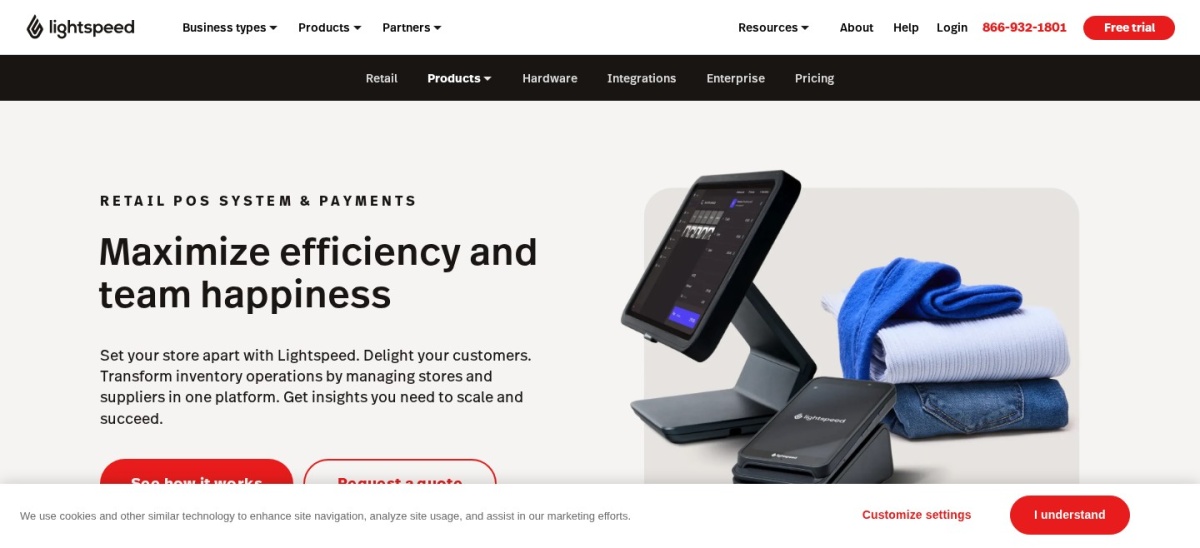
Lightspeed Retail is the cheapest way into omnichannel selling at $109 a month, yet it has no native repair ticketing or memo workflows.
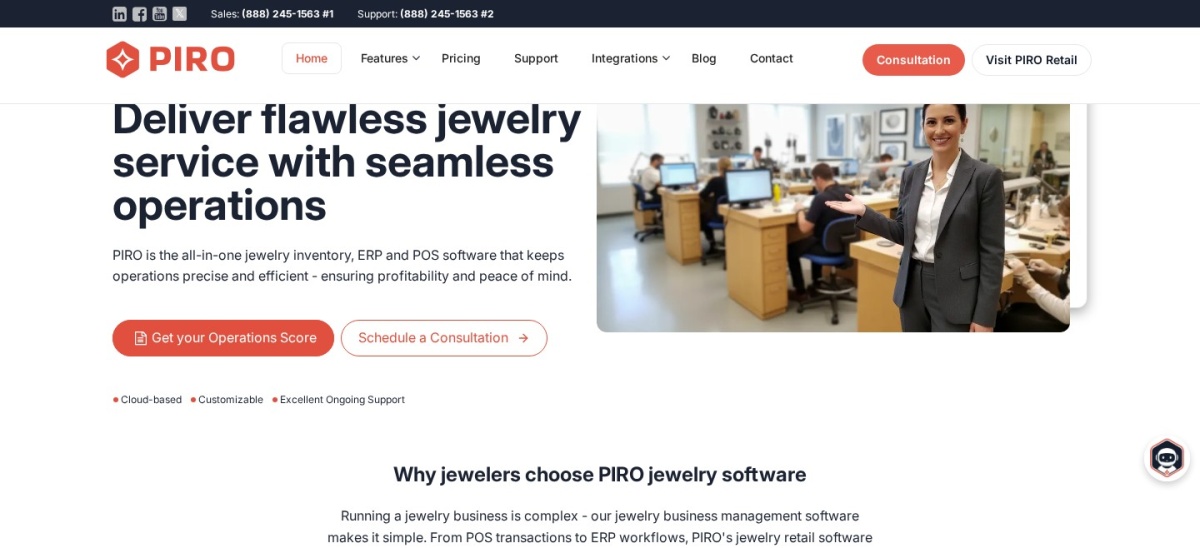
PIRO Fusion is the only true jewelry ERP here at $299 a month, while Jewelry Shopkeeper is the only one-time licence at $3,195.
What jewelry inventory software has to track
Two diamond solitaires can share a SKU and still be different pieces, with different carat weights, certificate numbers, costs and retail prices. A jewelry system must track each piece on its own record, not just count quantities per SKU.
Repairs, appraisals, memo goods, trade-ins and layaway are where jewelry stores lose money in generic systems. If a tool cannot run a repair ticket from intake to pickup, or keep memo stock separate from owned stock, the service side of the business ends up in spreadsheets.
Vendor links matter too. Stuller catalogues, Geller's repair pricing, GIA certificate lookup and your accounting system should connect to the same database. Our guide on managing inventory in WooCommerce shows the same idea at a smaller scale: stock, orders and records in one place.
Prices below come from each vendor's own pricing page, checked on 25 November 2026. Where a vendor does not publish pricing, the list says so instead of guessing.
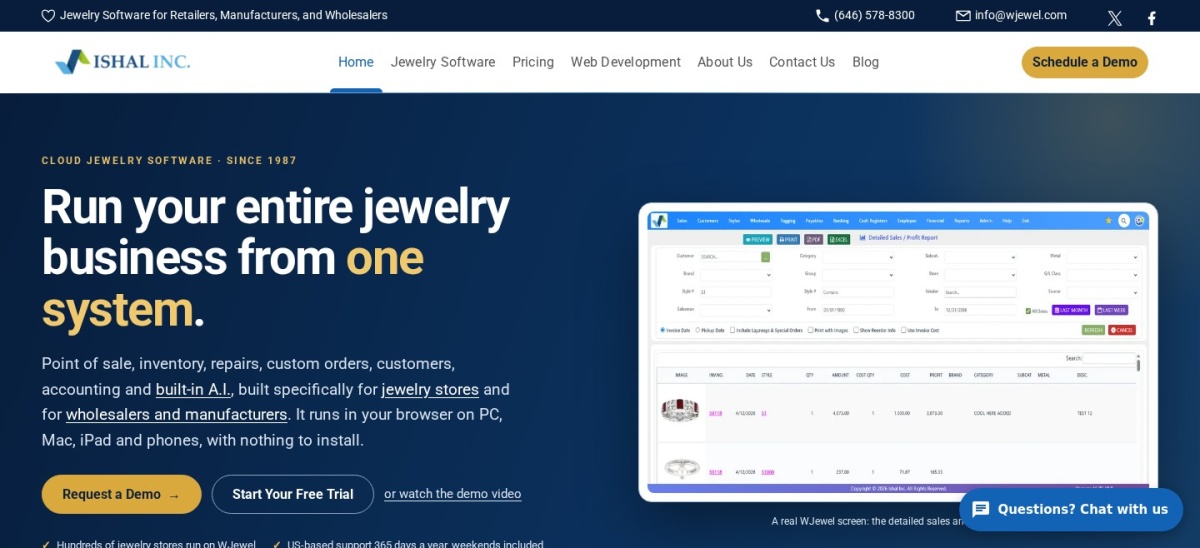
WJewel is jewelry store software built for retail jewelers, wholesalers and manufacturers, in business since 1987. It covers point of sale, serialized inventory, repairs, custom orders, memo and consignment, scrap gold buying and full accounting in one system, with a 30-day free trial and setup plus data migration included.
The trade off is the entry price. The $159 a month annual rate covers one user, and extra users and locations are quoted per store, so a larger team pays more than the headline price. It suits full-service stores that want accounting built in instead of stitched to QuickBooks.
What we like
Largest review base of any jewelry-specific tool here: 73 Capterra reviews
Full accounting built in, plus scrap gold buying and memo tracking
Setup, data migration and unlimited training included
Support 365 days a year by phone and email
Watch out for
Entry price covers a single user; more seats are quoted
Interface looks dated next to cloud-native rivals
No free plan, only a 30-day trial
Higher tiers add users, locations and wholesale featuresVisit wjewel.com
02
Jewel360
5/5on Capterra (3 reviews, checked Nov 2026)
Starts at$199/mo
Best cloud system for independents
Serialized trackingYes, with certificates
Users includedUnlimited
Repairs and appraisalsYes
Setup fee$750, rebated on go-live
jewel360.com
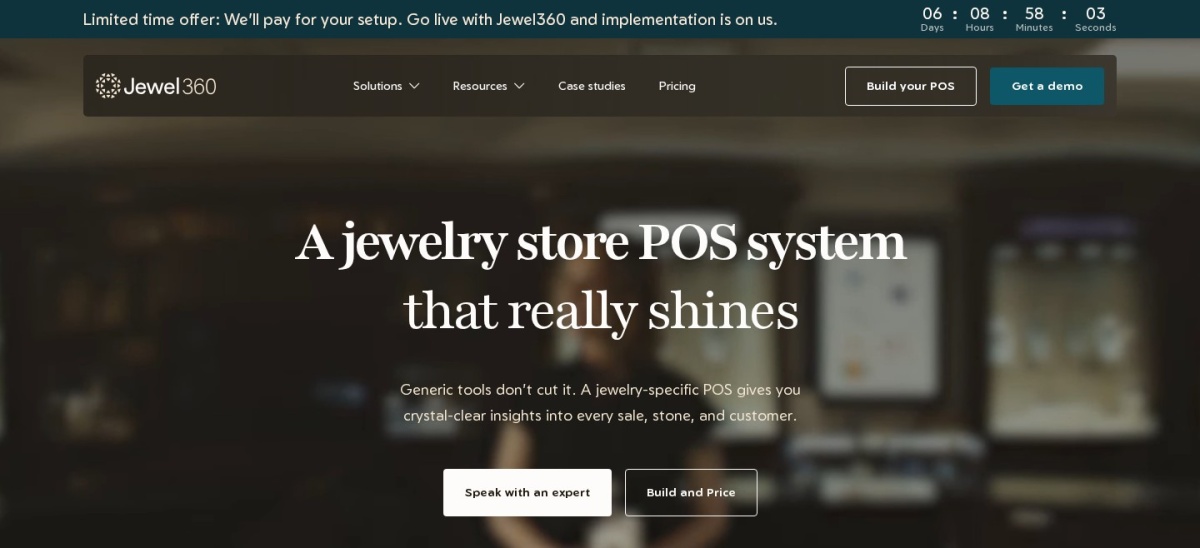
Jewel360 homepage, captured Nov 2026.
Jewel360 is a cloud point of sale built for jewelry from day one, not adapted from general retail. Every piece gets its own record with stone attributes, certificates and bin location, and the Startup plan at $199 a month billed annually includes unlimited users and products, Clientbook CRM and integrated payments.
The trade off is the thin review record. Its 5.0 out of 5 Capterra rating comes from only 3 reviews, so it carries less weight than WJewel's 73. It suits newer independent stores that want a modern cloud system with no per-user fees.
What we like
Unlimited users and products on every plan
Serialized tracking with GIA certificate integration
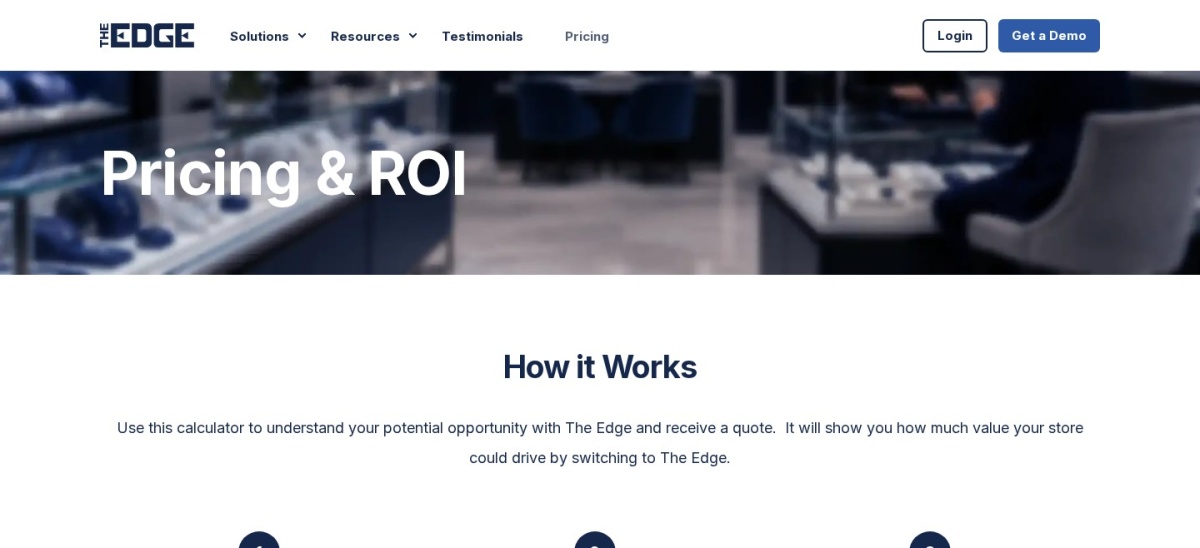
The Edge is the long-running jewelry store system from Abbott Jewelry Systems, used by more than 4,000 active stores across 16,000-plus workstations. It covers point of sale, inventory, repairs and custom work, appraisals, layaway and trade-ins, with memo and consignment tracked separately from owned stock.
The trade off is that it lives on your own servers. There is no cloud version, so checking inventory or repair status from home needs workarounds, and pricing is quote-only. It suits established jewelers that want their data local and a system that rarely changes.
What we like
Largest installed base of any jewelry-specific system here
Deep jewelry workflows: repairs, appraisals, layaway, trade-ins
Aged-inventory and sales reporting built for the trade
Data stays on your own servers
Watch out for
No cloud version for remote access
Pricing is quote-only, so comparison needs a sales call
Lightspeed Retail is a general retail point of sale with a jewelry business page, and it earns its place through omnichannel depth no jewelry specialist matches. Built-in e-commerce, marketplace and social selling, multi-location inventory and serial tracking start at $109 a month for the Basic plan, with a free trial.
The trade off is the missing jewelry layer. There is no native repair ticketing, no appraisal document generation and no memo or consignment workflow, so the service side needs spreadsheets or add-ons. It suits jewelers selling across their own site, Amazon, eBay and social channels.
What we like
Strongest omnichannel tools in this list
Multi-location inventory and serial tracking
295 G2 reviews, a strong base for a retail POS
Built-in e-commerce on the Basic plan
Watch out for
No native repair ticketing or appraisal documents
No memo or consignment workflows
Per-outlet pricing adds up for multi-store jewelers
PIRO Fusion is a jewelry ERP that happens to include a point of sale, built by MindSpark since 2007. It connects inventory, production workflow, custom jobs, repairs, purchasing and sales in one database, with casting-tree management, metal-loss calculation and RFID inventory control. Starter is $299 a month for 2 admin users.
The trade off is weight and price. Pro at $599 and Enterprise at $999 a month reflect the ERP scope, and the 3.8 out of 5 Capterra rating comes from only 4 reviews. It suits businesses that make, wholesale and retail jewelry from one system.
What we like
True ERP scope: production, inventory, repairs and sales in one database
Manufacturing depth no retail POS here matches
Published pricing with no contract
Broad channel integrations including Shopify and Etsy
Watch out for
Rating rests on only 4 Capterra reviews
Useful tiers jump to $599 and $999 a month
Implementation project, not a sign-up-and-sell POS
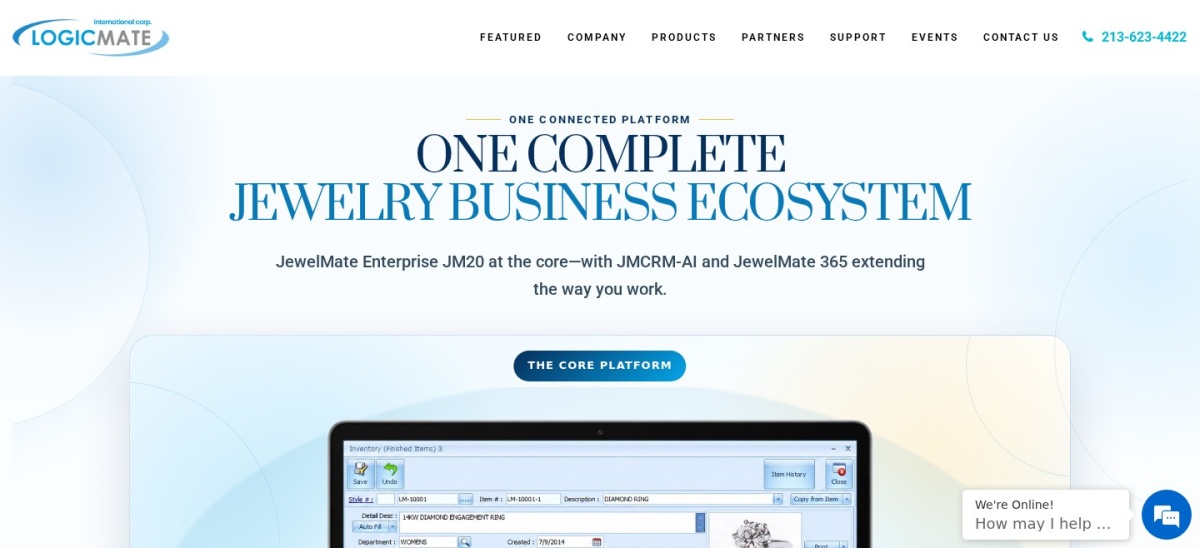
Logic Mate (JewelMate) homepage, captured Nov 2026.
Logic Mate (JewelMate) is a jewelry software company in business since 1989, and its JewelMate system shows it. It covers retail point of sale, inventory and CRM alongside wholesale distribution, multi-channel integrations and custom e-commerce, with accounts receivable and payable in the same system.
The trade off is modernity and pricing. JewelMate is a mature product line, so stores expecting a cloud dashboard on a phone will find it dated, and pricing is custom-quoted. It suits wholesalers and manufacturers that sell to other jewelers as well as consumers.
What we like
Deep wholesale, manufacturing and distribution workflows
In the jewelry software business since 1989
Retail, wholesale and e-commerce in one system
Long-tenured support team that knows the trade
Watch out for
Quote-based pricing with no published plans
Interface shows its age next to cloud rivals
Cloud access comes through the JewelMate 365 extension
AcctVantage is a jewelry ERP that answers a different question from the rest of this list: what if the accounting system and the inventory system were the same product. It bundles accounting, inventory, order management, purchasing, CRM, built-in POS, shipping, a B2B portal and payment processing, which removes the reconciliation work between QuickBooks and a separate inventory tool.
The trade off is scope. This is an ERP implementation with training and configuration, not a weekend POS rollout, and pricing is quoted per deployment. It suits multi-location jewelers and distributors that have outgrown a POS-plus-QuickBooks stack.
What we like
Accounting and inventory in one system, no QuickBooks stitching
Built-in POS, shipping, B2B portal and payments
Configurable rather than custom-built
No annual contracts
Watch out for
Quote-based pricing aimed at larger operations
ERP weight and implementation effort far beyond a POS signup
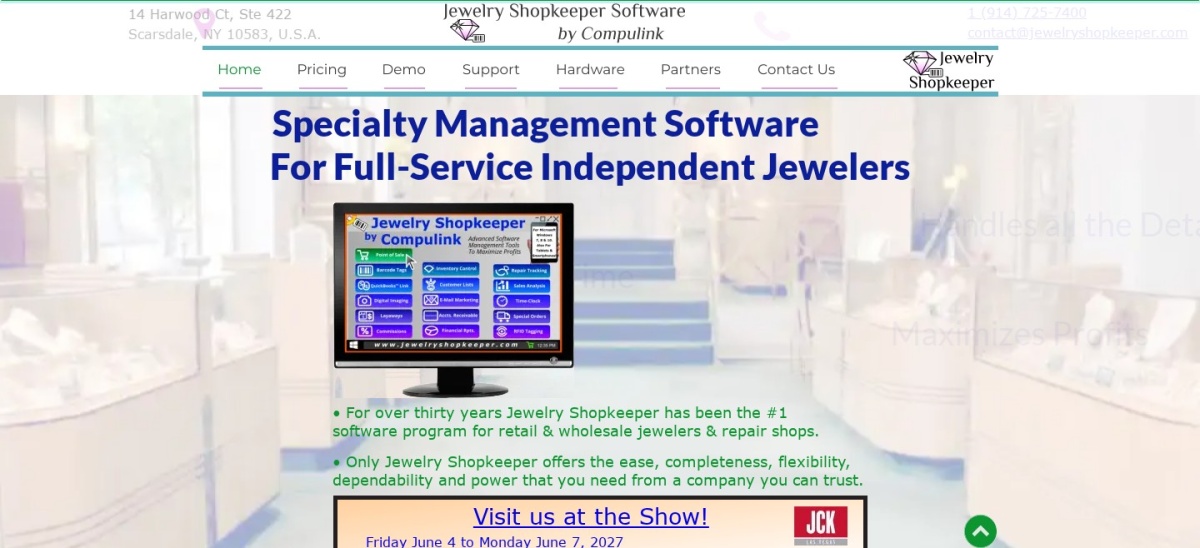
Jewelry Shopkeeper is Windows software from Compulink for full-service independent jewelers, sold as a one-time licence for over thirty years. The complete package costs $3,195 for one computer or $3,995 for a network of three, with repair tracking, appraisals, house accounts and accounting sold as modules.
The trade off is age on both counts. The 4.7 out of 5 Capterra rating comes from only 3 reviews, the most recent from 2020, and updates are paid separately. It suits a small single-store jeweler that would rather buy a licence once than rent software forever.
What we like
One-time licence, no monthly subscription
Published module-by-module pricing
Repairs, appraisals and house accounts available
Thirty-plus years serving independent jewelers
Watch out for
Rating rests on 3 reviews, most recent from 2020
Windows desktop only, no cloud access
Updates are paid, from $175 to $1,095 by version age
Shopify POS is the general-purpose alternative in this list, pairing an online store with in-store selling from $39 a month on the Basic plan. It covers multi-location inventory, draft orders, gift cards and reporting, and the full POS Pro features add $89 a month per location.
The trade off is that nothing here is jewelry-specific. Repairs, appraisals, memo goods and certificate tracking need apps or workarounds, and the Basic plan only includes the lighter POS. It suits jewelers whose main need is selling the same stock online and in store.
What we like
Lowest monthly entry price in this list at $39
Online store and in-store stock in one system
Largest G2 review base here at 368 reviews
Huge app store for add-on features
Watch out for
No native repair, appraisal or memo workflows
Full POS features need Pro at $89 per location a month
Jewelry-specific tracking needs apps or workarounds
Cloud systems such as WJewel, Jewel360, Lightspeed, PIRO and Shopify mean access from any device, automatic updates and no server to maintain. The cost is a monthly subscription forever and your data on someone else's infrastructure.
On-premise systems such as The Edge and Jewelry Shopkeeper keep the system and the data on your own servers. Stores choose them for control, for decades of stable workflows, and sometimes for insurance preferences.
For most independents opening a second location or selling online, cloud is the practical choice. If you go on-premise, ask the vendor directly about its cloud roadmap and how long the current version will be supported.
How we chose
We started from the searches buyers actually run: jewelry inventory software, jewelry POS software and jewelry store management software. For each candidate we checked the vendor's own site and pricing page, then looked for a public rating with a review count on G2 or Capterra.
Prices come from each vendor's pricing page, checked on 25 November 2026. Ratings and review counts come from G2 or Capterra on the same day. Where a vendor shows a sale, the list shows the regular price, and where a vendor does not publish pricing, the list says so.
We left out tools with no verifiable public rating, including CaratIQ and Deelo, even though both publish prices. No vendor paid for a place, and we do not claim to have used these tools ourselves.
How to choose jewelry inventory software
Start with serialized piece tracking, then map the service work your store actually does.
Check serialized tracking first. Every piece needs its own record with serial number, certificate number, carat weight, metal type, cost and retail price. If a vendor only counts quantities per SKU, keep looking.
Map repairs, appraisals, memo and layaway. Ask for a walkthrough of a repair ticket from intake to pickup and of an appraisal document made from the piece record. Count how many workflows would still need a spreadsheet.
Compare the real totals, not the headline price. Per-user fees, inventory caps, setup fees and add-on modules change the bill. A $199 flat plan can cost less than a $19 per-seat plan once the team grows.
Ask who migrates your data. Moving serialized inventory with certificates and customer history is the slow part of any switch. Vendors that include migration shorten the move by weeks.
FAQ
What is the best jewelry inventory software?
WJewel is the best pick for most stores. It covers serialized inventory, repairs, memo goods and full accounting from $159 a month, and it is rated 4.8 out of 5 from 73 Capterra reviews, the largest review base of any jewelry-specific tool here.
How much does jewelry inventory software cost?
Entry prices here run from $39 a month for Shopify POS and $109 for Lightspeed Retail to $159 for WJewel and $199 for Jewel360. PIRO Fusion starts at $299 a month, while The Edge, Logic Mate and AcctVantage quote per store. Budget for setup and data migration on top.
What is serialized inventory tracking?
It means every individual piece gets its own record, instead of tracking quantities per SKU. A serialized record carries the serial number, certificate number, carat weight, color, clarity, metal type, metal weight, cost, retail price, bin location and vendor.
Do I need jewelry-specific software, or will a general POS work?
A general POS like Lightspeed or Shopify handles sales and basic serial tracking, but it has no native repair ticketing, appraisal documents or memo workflows. If repairs, appraisals or custom orders are part of your revenue, jewelry-specific software saves staff time.
Can jewelry software sync with my website?
Yes, on the cloud systems. Jewel360 lists e-commerce order fulfilment, WJewel and PIRO connect to Shopify, and Shopify POS is an online store and a POS in one. Confirm two-way sync, so online orders update store inventory, rather than one-way catalog export.
How long does it take to switch jewelry software?
Plan on four to twelve weeks. The software setup is the fast part; migrating serialized inventory with certificates, customer histories and vendor data is the slow part. Avoid switching during the holiday season, when the store cannot afford downtime.
SaaS SEO and WordPress specialist with about 8 years of experience. Rakib compares WordPress plugins, themes, hosting and software using public pricing, documentation and user reviews. See how we rank.