Intruder leads for continuous external and cloud vulnerability scanning, holding a 4.8 out of 5 rating across 223 G2 reviews. Burp Suite suits web application testers starting at $499 per year, while Pentest-Tools.com offers browser-based scanning from $95 per month.
How we make this list: we compare pricing pages, product documentation and public user reviews, then re-check every price before each update. No product paid for a place. Disclosure.
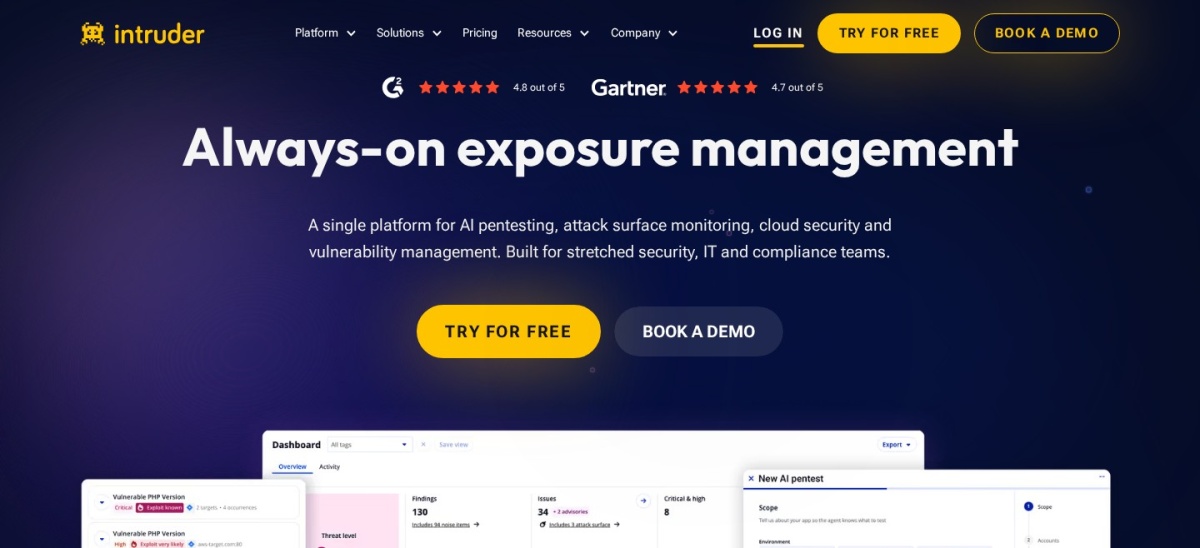
Intruder holds a 4.8/5 rating across 223 G2 reviews with a free tier and Cloud plans starting at $239/month.
Burp Suite Professional starts at $499/year per user with a 4.7/5 G2 rating across 142 reviews.
Pentest-Tools.com starts at $95/month for NetSec and holds a 4.8/5 rating across 111 G2 reviews.
Astra Pentest starts at $199/month (or $699/year for Scanner Lite) and holds a 4.7/5 G2 rating across 267 reviews.
Beagle Security offers a free tier with Essential plans starting at $119/month and a 4.7/5 G2 rating across 88 reviews.
What to look for in penetration testing software
Penetration testing software ranges from interactive proxy toolkits used by human testers to cloud platforms that run automated vulnerability checks and simulated attacks. Automated scanners find known CVEs, misconfigurations, and common web flaws quickly, while manual testing uncovers business logic and authentication flaws.
Check how a platform handles authenticated workflows, APIs, and cloud assets rather than only public-facing pages. Authenticated scans and API coverage matter when testing modern applications behind login walls or token flows.
Review pricing structure carefully before committing, as vendors bill per target, per asset, per user, or per monthly test. Some platforms also offer a free tier or trial to verify scan noise and workflow fit before paying.
For compliance frameworks such as SOC 2 or ISO 27001, check whether the tool provides structured reports, remediation re-scans, and audit evidence. Pairing automated checks between releases with periodic human validation helps teams manage risk without slowing shipping.
Intruder is an automated vulnerability scanner and exposure platform that includes a free plan with weekly external vulnerability scans for up to 3 users. Its Cloud tier adds daily cloud security checks across 3 cloud accounts, web app and API testing, and 15+ integrations.
The trade off is that paid plans start at $239 per month ($2,870 annually) on the Cloud tier, and internal server agent scanning requires the $399 per month Pro plan. It suits lean engineering and security teams that want ongoing external and cloud monitoring with clear finding prioritization.
What we like
Offers a free tier with weekly external scans and remediation checks
Covers web apps, APIs, container images, and cloud accounts
Holds a 4.8/5 rating across 223 G2 reviews
Watch out for
Paid monthly pricing starts higher than single-user proxy tools
Internal agent-based scanning sits on the Pro plan rather than Cloud
Paid plans add daily cloud and container checks, web and API testing, and custom schedules.Visit intruder.io
02
Burp Suite
4.7/5on G2 (142 reviews, checked Nov 2026)
Paid from$499/yr
Best for manual web and API testing
Free planYes (Community Edition)
Entry paid plan$499/yr per user
G2 rating4.7/5 (142 reviews)
Core focusManual web & API testing
portswigger.net
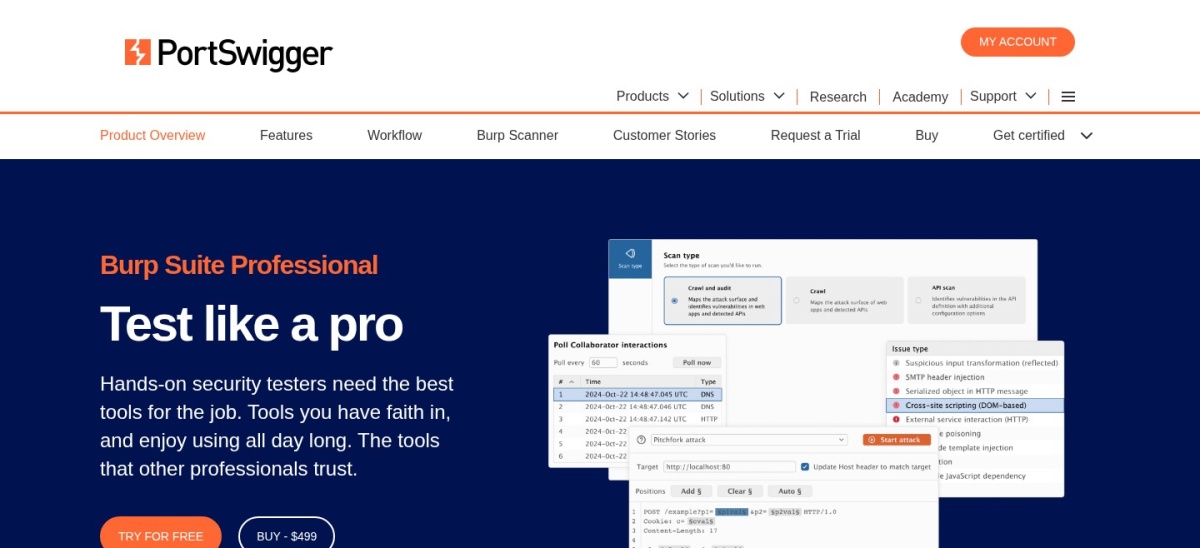
Burp Suite homepage, captured Nov 2026.
Burp Suite is a web security testing toolkit built around request interception and manual inspection, with a free Community edition for basic manual testing. Burp Suite Professional unlocks automated vulnerability scanning, saved projects, and the full extension ecosystem.
The trade off is that Burp Suite Professional costs $499 per user per year and has a steep learning curve for beginners. It suits penetration testers and security engineers who want granular control over HTTP requests, APIs, and custom extensions.
What we like
Low annual entry price at $499 per user per year
Extensive manual request inspection and extension support
Includes a free Community version and free trial option
Watch out for
Steeper setup and learning curve for new testers
Automated scanning requires the paid Professional edition
Paid Professional adds automated scanning, saved project files, and full extension access.Visit portswigger.net
03
Pentest-Tools.com
4.8/5on G2 (111 reviews, checked Nov 2026)
Paid from$95/mo
Best browser-based pentest toolkit
Free planYes (free tier available)
Entry paid plan$95/mo (NetSec)
G2 rating4.8/5 (111 reviews)
Core focusNetwork & web assessments
pentest-tools.com
Pentest-Tools.com homepage, captured Nov 2026.
Pentest-Tools.com is a browser-based offensive security platform that offers a free tier with basic exposure discovery and cloud vulnerability checks. Its paid NetSec plan starts at $95 per month with network scanning, cloud checks, continuous monitoring, and unlimited rescans.
The trade off is that prices scale with asset counts and billing terms, and web DAST or exploitation modules sit on higher tiers starting from $140 to $190 per month. It suits consultants, IT teams, and smaller security groups that want quick browser-based scans and structured reports.
What we like
Starts at $95/mo with a free plan and free trial available
Runs directly in the browser with unlimited rescans on paid plans
Holds a 4.8/5 rating across 111 G2 reviews
Watch out for
Costs increase as scanned asset counts and modules expand
Full DAST and exploitation tools sit above the entry NetSec tier
Astra Pentest provides continuous automated web vulnerability scanning alongside pentest reporting workflows designed for compliance audits. Its monthly entry pricing starts at $199 per month, with annual Scanner Lite listed at $699 per year.
The trade off is that there is no free plan, and pricing scales per target while manual pentest tiers cost more annually. It suits startups and SaaS teams preparing for SOC 2 or ISO 27001 reviews that want guided remediation and audit reports.
What we like
Strong 4.7/5 rating across 267 G2 reviews
Focuses on web security checks and compliance-ready reporting
Offers clear remediation guidance for development teams
Watch out for
No free tier available
Pricing scales per target and rises for manual pentest plans
Higher tiers expand scan frequency, target coverage, and manual pentest and re-scan support.Visit getastra.com
05
Beagle Security
4.7/5on G2 (88 reviews, checked Nov 2026)
Paid from$119/mo
Best for test-based web and API runs
Free planYes (free tier available)
Entry paid plan$119/mo (Essential)
G2 rating4.7/5 (88 reviews)
Core focusWeb & API security tests
beaglesecurity.com
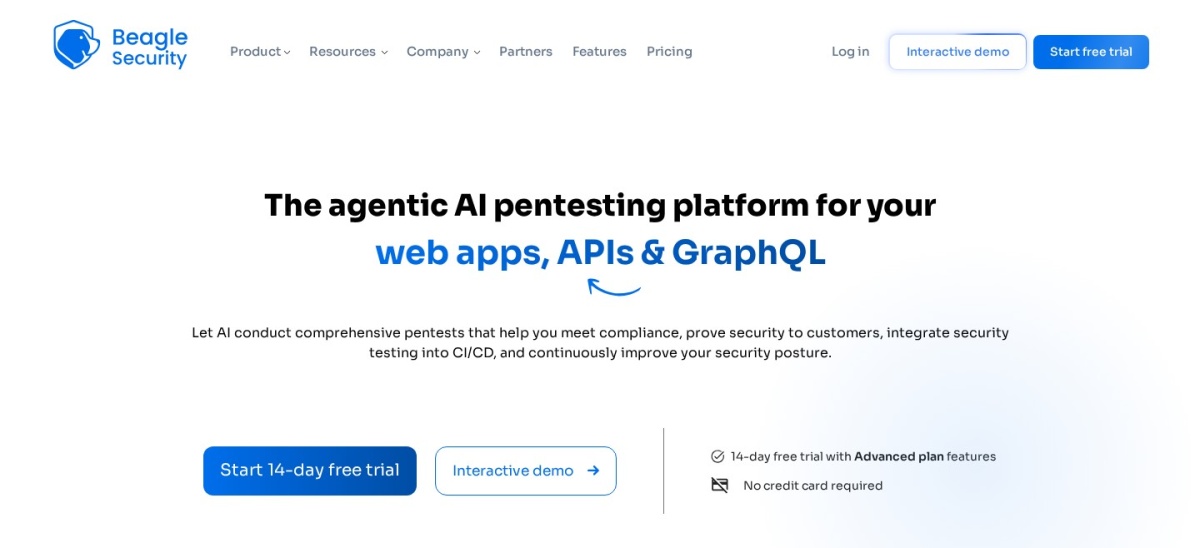
Beagle Security homepage, captured Nov 2026.
Beagle Security runs automated penetration tests across web applications and APIs with a free tier that includes basic surface testing. Its Essential plan starts at $119 per month with recurring monthly tests and security reporting.
The trade off is that test quotas cap how many runs you get per month before upgrading to Advanced at $359 per month. It suits engineering teams that want predictable test-based runs across web and API endpoints.
What we like
Includes a free tier and 14-day free trial option
Covers both web applications and API endpoints
Holds a 4.7/5 rating across 88 G2 reviews
Watch out for
Monthly test allowances limit frequent ad-hoc re-runs on lower tiers
Price jumps to $359/mo on the Advanced plan
Paid plans increase monthly test allowances, API coverage, and reporting depth.Visit beaglesecurity.com
06
Aikido Security
4.5/5on G2 (273 reviews, checked Nov 2026)
Paid from$350/mo
Best for developer-first AppSec workflows
Free planYes (free tier available)
Entry paid plan$350/mo (Basic)
G2 rating4.5/5 (273 reviews)
Core focusDeveloper AppSec & cloud
aikido.dev
Aikido Security homepage, captured Nov 2026.
Aikido Security combines application security checks across code repositories, cloud posture, and runtime workflows with a free plan to get started. Its Basic paid tier starts at $350 per month with pull request checks, issue sync, and compliance integrations.
The trade off is that moving from the free tier to Basic starts at $350 per month, and pentest credits require higher tiers. It suits software engineering teams that want low-noise findings tied directly to repositories and CI/CD workflows.
What we like
Offers a free tier to start before upgrading
Connects code, cloud, and pull request workflows in one place
Backed by 273 G2 reviews with a 4.5/5 score
Watch out for
Paid Basic plan starts at $350/mo
Included pentest credits sit on Pro and higher plans
Paid plans add pull request security reviews, compliance sync, and pentest credits on Pro tiers.Visit aikido.dev
07
Cobalt
4.5/5on G2 (185 reviews, checked Nov 2026)
Starts at$12,000/yr
Best for on-demand PTaaS engagements
Free planNo
Entry paid planFrom $12,000/yr
G2 rating4.5/5 (185 reviews)
Core focusPTaaS & tester workflows
cobalt.io
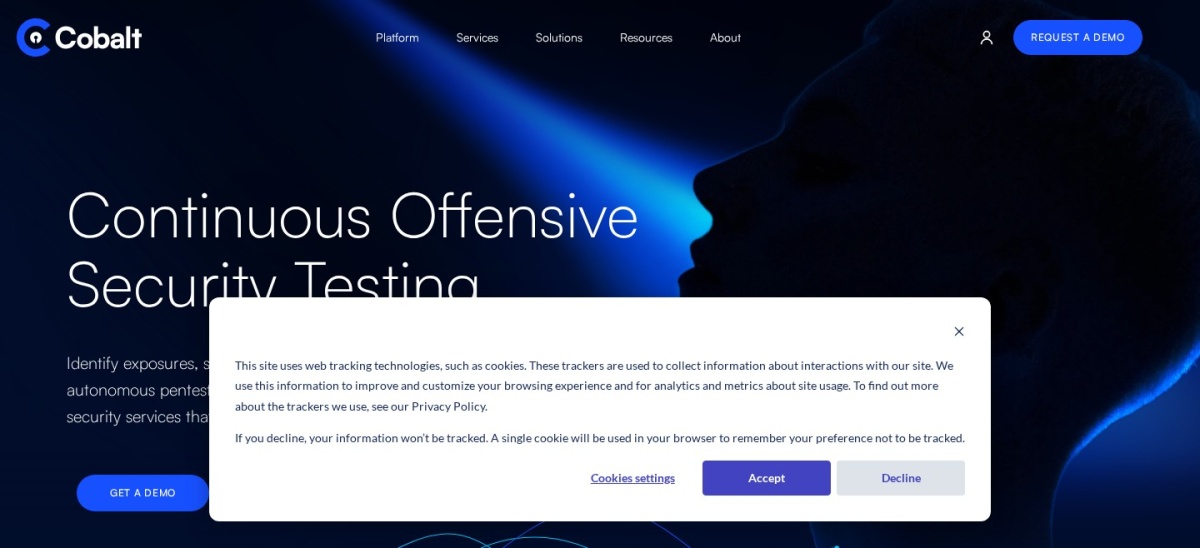
Cobalt homepage, captured Nov 2026.
Cobalt is a Pentest as a Service platform that pairs pentester workflows and DAST tooling with issue tracking and retesting support. Annual program pricing starts around $12,000 per year depending on scope and credits.
The trade off is that there is no free plan or free trial, and annual engagement costs are much higher than self-serve scanners. It suits mid-market and enterprise teams that need structured, compliance-ready pentest cycles with built-in retesting.
What we like
Built for structured PTaaS workflows and retesting
Integrates with developer tools like Jira, GitHub, and Slack
Paid engagements include scoped testing cycles, collaboration workflows, and retesting windows.Visit cobalt.io
Automated tools vs. manual testing
Automated vulnerability scanners and pentest tools excel at continuous monitoring, spotting known CVEs, and checking configurations across many assets at once. They also let teams re-run checks quickly after patching a bug.
Manual testing and interactive proxy tools remain essential for complex business logic, authorization bypasses, and multi-step user flows. Most teams get the best coverage by combining recurring automated checks with deeper manual or PTaaS reviews.
How we chose
We selected active penetration testing and offensive security platforms from vendor directories, pricing pages, and public software review listings. Every tool listed is actively maintained and targets standalone software, cloud, web, or API environments rather than WordPress plugins.
We checked pricing tiers and public G2 review scores on 22 Nov 2026 using published plan rates and verified review counts. Where vendors list multiple tiers or quote-based enterprise plans, we used their lowest published starting price for comparison.
We excluded WordPress-only plugins, abandoned tools, and products without verifiable public pricing or review data. No vendor paid for a place, and we do not claim testing for this list.
How to choose penetration testing software
Follow four practical steps to match a testing platform to your stack and budget.
Map your target attack surface first. List the web apps, APIs, cloud accounts, and internal networks you need to test so you pick a tool that covers every asset type.
Decide between continuous scans and manual depth. Choose automated scanning for ongoing checks between releases, and add manual or PTaaS testing for business logic and compliance audits.
Check how pricing scales with growth. Compare per-user, per-asset, per-target, and per-test pricing to see what your bill looks like as apps and team members grow.
Test on a staging or authorized target first. Use a free tier or trial where available to verify authentication handling, scan speed, and false-positive noise before buying.
FAQ
Does penetration testing software replace a human penetration test?
No. Automated tools catch known vulnerabilities, misconfigurations, and common patterns quickly, while skilled human testers are better at spotting complex business logic flaws and chained attacks.
Are there free penetration testing tools worth starting with?
Yes. Several tools offer a free tier or community edition, including Intruder, Burp Suite Community, Pentest-Tools.com, Beagle Security, and Aikido Security, though advanced scans and larger limits require paid plans.
How often should teams run penetration tests or scans?
Many teams run automated scans weekly or on major releases and conduct deeper manual or compliance-focused assessments at least annually. Higher-risk applications may warrant more frequent testing.
What is the difference between a vulnerability scanner and a pentest tool?
Vulnerability scanners focus on identifying known flaws and misconfigurations across systems, while penetration testing tools and workflows emphasize active exploitation checks, attack paths, and validation.
Do I need permission before running penetration tests?
Yes. Always test only systems, domains, APIs, or cloud accounts that you own or have explicit written authorization to assess, especially when running active or intrusive checks.
SaaS SEO and WordPress specialist with about 8 years of experience. Rakib compares WordPress plugins, themes, hosting and software using public pricing, documentation and user reviews. See how we rank.