Stripe leads for online businesses with standard domestic card pricing of 2.9% + 30¢ and no monthly fee, while Square suits in-person retail starting at 2.6% + 15¢. Choose Helcim for interchange-plus pricing with no monthly fee or PayPal for widely recognized wallet checkout.
How we make this list: we compare pricing pages, product documentation and public user reviews, then re-check every price before each update. No product paid for a place. Disclosure.
Stripe charges 2.9% + 30¢ per domestic card transaction with $0 monthly fee and holds a 4.2/5 score across 468 G2 reviews.
PayPal starts at 2.89% + 29¢ for expanded card checkout and carries a 4.4/5 rating across 2,929 G2 reviews.
Square starts at $0/mo with in-person card processing from 2.6% + 15¢ and earns 4.5/5 across 176 G2 reviews.
Helcim uses interchange-plus pricing starting at interchange + 0.40% + 8¢ in person with $0 monthly fee.
Authorize.net starts at $25/mo ($300/yr) for gateway or all-in-one processing and holds 4.2/5 across 227 G2 reviews.
What to look for when choosing a payment processor
Payment processors sit between your checkout or invoice and the banks that settle funds, shaping both your conversion rate and your per-sale margin. Flat-rate pricing is easy to forecast for low-volume or variable order sizes, while interchange-plus models pass through card-network wholesale costs plus a transparent markup.
Check every fee beyond the headline card percentage. International cards, currency conversion, manually keyed card numbers, ACH bank transfers, chargebacks, and instant payouts often carry separate charges that change your real cost on small tickets or high-value B2B invoices.
Match the processor to how and where customers buy. Online subscriptions and custom web apps benefit from flexible APIs and local payment methods, whereas brick-and-mortar shops need dependable card readers, inventory links, and clear payout schedules.
Review account underwriting and payout rules before committing. Processors that underwrite quickly can place reserves or hold funds if order patterns spike or chargebacks rise, so verify dispute procedures and withdrawal terms up front.
For B2B invoice collections, approvals, and vendor payouts
$588/yr
No free plan
4.4/5
Price ladder: cheapest paid plan per year
List prices, USD, checked Nov 2026
Stripe2.9% + 30¢
PayPal2.89% + 29¢
Square2.6% + 15¢
HelcimIC + 0.40% + 8¢
Authorize.net$300
Shopify POS$348
BILL AP/AR$588
The 7 best payment processors
01
Stripe
4.2/5on G2 (468 reviews, checked Nov 2026)
Pricing2.9% + 30¢ per-transaction fees
Best for online businesses and developer APIs
Domestic card rate2.9% + 30¢
ACH Direct Debit0.8% ($5 cap)
Monthly fee$0 standard
G2 rating4.2/5 (468)
stripe.com
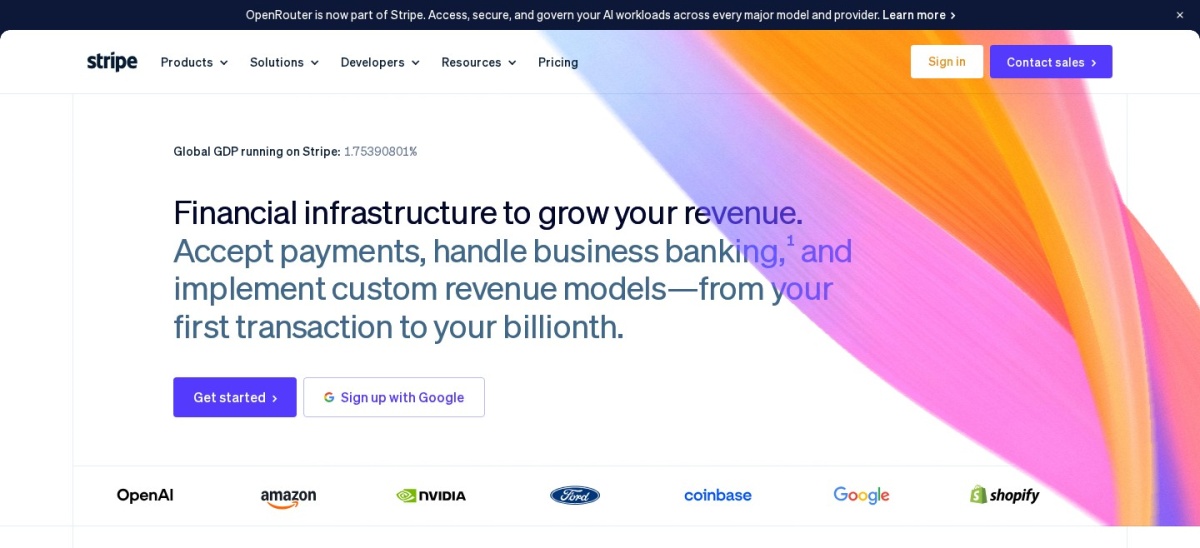
Stripe homepage, captured Nov 2026.
Stripe is a programmable payment infrastructure platform with standard pay-as-you-go pricing at 2.9% + 30¢ per domestic card charge and $0 monthly fee. It supports 135+ currencies, digital wallets, and ACH Direct Debit at 0.8% capped at $5.00.
The trade off is extra charges on international cards (+1.5%), currency conversion (+1%), manually entered cards (+0.5%), and $15.00 dispute fees on top of standard per-transaction fees. It suits online stores, SaaS billing teams, and marketplaces that want flexible APIs.
What we like
No monthly fee or setup fee on standard pay-as-you-go pricing
Strong developer documentation, APIs, and support for 135+ currencies
Low 0.8% ACH rate capped at $5.00 helps on larger bank transfers
Watch out for
International card and currency conversion add-ons raise cross-border costs
Flat 30¢ fixed fee takes a larger share on low-ticket purchases
Disputes carry a $15.00 fee and instant payouts cost 1.5%
Optional add-ons like Stripe Billing (0.7% of volume) and Stripe Tax (0.5% per transaction) expand recurring billing and sales tax automation.Visit stripe.com
02
PayPal
4.4/5on G2 (2,929 reviews, checked Nov 2026)
Pricing2.89% + 29¢ per-transaction fees
Best for familiar wallet checkout and buyer trust
Card checkout rateFrom 2.89% + 29¢
PayPal & Venmo3.49% + 49¢
Tap to Pay / POSFrom 2.29% + 9¢
G2 rating4.4/5 (2,929)
paypal.com
PayPal homepage, captured Nov 2026.
PayPal is a widely recognized payment network offering online checkout, card processing starting at 2.89% + 29¢ for expanded checkout, and in-person options starting at 2.29% + 9¢. Merchants can also accept PayPal, Venmo, and Pay Later options.
The trade off is higher per-transaction fees on PayPal and Venmo checkouts at 3.49% + 49¢ and Pay Later at 4.99% + 49¢ on top of per-transaction fees. It suits merchants that want familiar wallet buttons at checkout without heavy development.
What we like
High shopper familiarity with PayPal and Venmo buttons at checkout
Supports online checkout, invoicing, and in-person Tap to Pay or readers
No monthly platform fee required to start accepting payments
Watch out for
PayPal, Venmo, and Pay Later rates sit higher than standard card rates
Dedicated card readers and terminals require upfront hardware purchases
Cross-border and currency conversion fees can add cost on global sales
Optional hardware such as a Card Reader ($29) or Terminal ($199) supports counter sales alongside online checkout.Visit paypal.com
03
Square
4.5/5on G2 (176 reviews, checked Nov 2026)
Pricing2.6% + 15¢ per-transaction fees
Best for combined in-person and online small business sales
In-person card rateFrom 2.6% + 15¢
Online card rateFrom 2.9% + 30¢
ACH bank transfer1% ($1 min)
G2 rating4.5/5 (176)
squareup.com
Square homepage, captured Nov 2026.
Square is a payment processor and commerce suite for retail, restaurants, and service businesses with a $0 monthly entry plan and in-person card fees from 2.6% + 15¢. Online API card payments start at 2.9% + 30¢, and ACH bank transfers run 1% with a $1 minimum.
The trade off is higher rates for manually entered or card-on-file charges at 3.5% + 15¢ and Afterpay at 6% + 30¢ as per-transaction fees. It suits small businesses that need fast setup across counter, mobile, and web sales.
What we like
Start with no monthly base fee and clear flat-rate card pricing
Built-in tools for in-person readers, invoicing, and online payments
Free cash or check recording alongside card and ACH acceptance
Watch out for
Keyed-in card and installment options carry steeper percentage fees
Specialized retail or multi-location features require paid upgrades
Account reviews or holds can affect cash flow if sales patterns shift
Paid Square tiers and add-ons unlock lower volume rates, advanced POS tools, and expanded team or location controls.Visit squareup.com
04
Helcim
3.7/5on G2 (20 reviews, checked Nov 2026)
PricingIC + 0.40% + 8¢ per-transaction fees
Best for transparent interchange-plus pricing without monthly fees
In-person markupInterchange + 0.40% + 8¢
Online markupInterchange + 0.50% + 25¢
Monthly & PCI fees$0
G2 rating3.7/5 (20)
helcim.com
Helcim homepage, captured Nov 2026.
Helcim is a merchant processor built around interchange-plus pricing with $0 monthly fees, $0 statement fees, and $0 PCI compliance fees. Entry volume ($0 to $50K) starts at interchange + 0.40% + 8¢ in person and interchange + 0.50% + 25¢ online.
The trade off is variable card-network costs and a smaller review footprint (3.7/5 across 20 G2 reviews) instead of a single flat rate as per-transaction fees. It suits businesses with steady card volume that want transparent margins.
What we like
No monthly account fees, PCI fees, or long-term contract lock-ins
Automatic volume-based margin reductions as monthly processing grows
Includes invoicing, recurring billing, and virtual terminal tools
Watch out for
Interchange-plus fees fluctuate depending on card type and network
Smaller user review sample on G2 than larger processors
Requires merchant application approval rather than instant self-serve
Higher monthly processing tiers automatically lower Helcim's added margin down to interchange + 0.15% + 6¢ in person.Visit helcim.com
05
Authorize.net
4.2/5on G2 (227 reviews, checked Nov 2026)
Starts at$300/yr
Best for dedicated payment gateway control and eCheck billing
Starting plan$25/mo ($300/yr)
All-in-One card rate2.9% + 30¢
eCheck transaction fee0.75%
G2 rating4.2/5 (227)
authorize.net
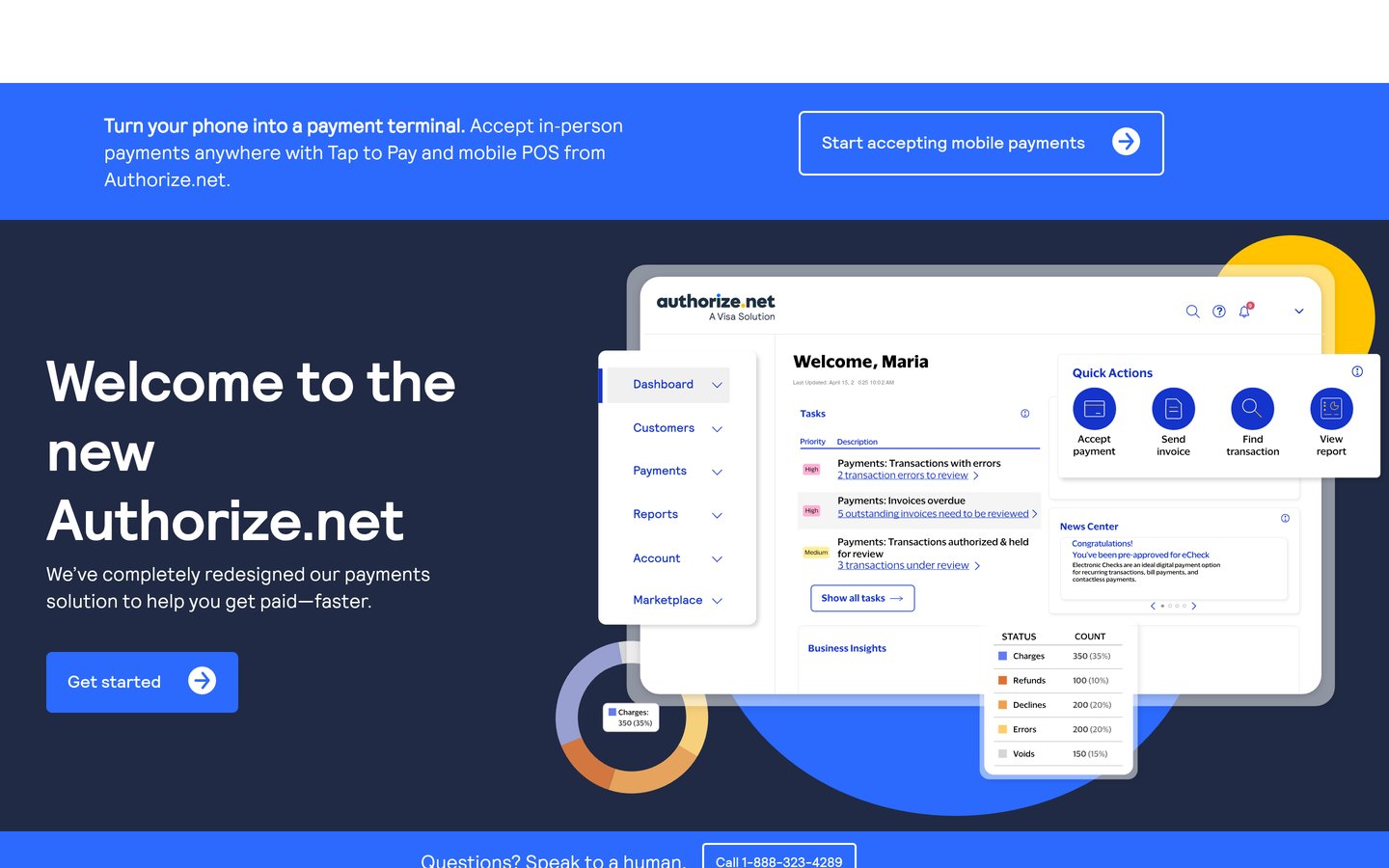
Authorize.net homepage, captured Nov 2026.
Authorize.net is a long-running payment gateway and processing service starting at $25/mo ($300/yr) with no setup fee. Its All-in-One plan charges 2.9% + 30¢ per card transaction, while eCheck payments run 0.75%.
The trade off is a recurring $25/mo base fee even in quiet months, plus a $10 minimum monthly fee on eCheck.Net at $300/yr. It suits merchants that want a dedicated gateway, recurring billing, and eCheck support.
What we like
Supports both all-in-one card processing and gateway-only connections
Competitive 0.75% eCheck fee for recurring or higher-value invoices
Established fraud detection suite and broad e-commerce integrations
Watch out for
Charges a $25 monthly base fee regardless of sales volume
Gateway-only plans add per-transaction and daily batch fees
Interface feels more traditional than newer developer-first platforms
Paid gateway and merchant plans add recurring billing profiles, customer vaulting, and fraud screening filters.Visit authorize.net
06
Shopify POS
4.4/5on G2 (390 reviews, checked Nov 2026)
Starts at$348/yr
Best for omnichannel retailers already running on Shopify
Base Shopify planFrom $29/mo yearly ($348/yr)
In-person card rateFrom 2.6% + 10¢
POS LiteIncluded with store plan
G2 rating4.4/5 (390)
shopify.com
Shopify POS homepage, captured Nov 2026.
Shopify POS is a point-of-sale system tied to Shopify stores, starting with POS Lite included on Shopify Basic at $29/mo billed yearly ($348/yr) or $39/mo billed monthly. US in-person card rates on Basic start at 2.6% + 10¢.
The trade off is requiring a Shopify store subscription—and an $89/mo per-location POS Pro add-on for multi-store inventory or staff permissions—at $348/yr minimum. It suits retailers uniting online and physical storefronts.
What we like
Shares products, orders, and inventory directly with Shopify storefronts
POS Lite is included at no extra monthly charge on every Shopify plan
Supports mobile readers and Tap to Pay on compatible phones
Watch out for
Cannot be used as a standalone processor outside a Shopify store
POS Pro adds $89/mo per location for advanced retail workflows
Hardware accessories like scanners and docks cost extra
Upgrading to POS Pro ($89/mo per location) adds exchange workflows, shift reporting, and expanded staff roles.Visit shopify.com
07
BILL AP/AR
4.4/5on G2 (1,828 reviews, checked Nov 2026)
Starts at$588/yr
Best for B2B invoice collections, approvals, and vendor payouts
Essentials plan$49/user/mo ($588/yr per user)
ACH / ePayment fee$0.59
Card payment fee2.9%
G2 rating4.4/5 (1,828)
bill.com
BILL AP/AR homepage, captured Nov 2026.
BILL AP/AR is a business payment and invoicing platform with Essentials starting at $49/user/mo ($588/yr per user) billed monthly. It supports ACH/ePayments at $0.59, mailed checks at $1.99, and credit or debit card payments at 2.9%.
The trade off is per-user monthly pricing plus separate payment-method and instant-transfer fees at $588/yr per user. It suits finance teams managing B2B invoices, approval chains, and accounting software sync.
What we like
Built for B2B invoicing, multi-step approval workflows, and vendor payouts
Two-way accounting sync with QuickBooks and Xero on Team and higher plans
Low $0.59 flat fee for standard ACH and ePayment transfers
Watch out for
Per-user monthly subscription adds up quickly for larger teams
Card payments carry a 2.9% fee and faster disbursements cost extra
Overbuilt for simple consumer e-commerce checkouts
Higher Team ($65/user/mo) and Corporate ($89/user/mo) plans add deeper approval rules and procurement controls.Visit bill.com
Flat-rate vs. interchange-plus pricing
Flat-rate processors such as Stripe, PayPal, and Square charge a predictable percentage plus a fixed cents fee per transaction. That simplicity makes unit economics easy to calculate when you are starting out or selling across mixed card types.
Interchange-plus processors like Helcim pass through wholesale card-network costs and add a disclosed markup. Businesses with higher monthly volumes or heavy debit and standard card usage often save with interchange-plus, while low-volume sellers may prefer flat rates.
How we chose
This list focuses on standalone payment processors and business payment platforms suited to online checkouts, retail counters, and B2B billing rather than WordPress plugins.
All pricing figures, per-transaction fee rules, and G2 ratings and review counts were checked on 22 Nov 2026 from vendor pricing pages and G2 product listings.
We excluded processors without clear public pricing or sufficient verified reviews, as well as tools tailored narrowly to a single niche such as fleet fuel cards or specialized vertical software. No vendor paid for a place, and we do not claim testing for this list.
How to choose a payment processor
Follow four practical steps to narrow down the right processor for your business:
Map your sales channels first. Decide whether you need online checkout APIs, in-person card readers, B2B invoicing, or a combination of all three.
Model your average order size and card mix. Compare fixed per-transaction cents, international surcharges, and ACH fees against your typical invoice or cart total.
Check recurring monthly fees and add-ons. Factor in monthly gateway charges, POS location add-ons, chargeback fees, and faster payout costs before signing up.
Verify accounting and payout workflows. Confirm that settlement timing, reconciliation reports, and accounting integrations match how your team closes books.
FAQ
Which payment processor is best for a new online store?
Stripe is a strong starting point for online stores because standard pricing has no monthly fee and charges 2.9% + 30¢ per domestic card transaction. Check international card and currency conversion add-ons if you sell globally.
What is the difference between a payment processor and a payment gateway?
A payment gateway securely captures and transmits payment details from a checkout or form, while a processor handles authorization and settlement with banks. Many modern platforms such as Stripe and Square bundle both roles.
Why do card fees include both a percentage and a fixed amount?
Card networks and processors combine a percentage of the sale with a fixed per-transaction charge to cover processing overhead. Fixed fees have a bigger impact on small purchases than on larger orders.
When should a business use ACH instead of credit cards?
ACH bank transfers usually cost less than card processing on larger invoices or recurring B2B payments. For example, Stripe charges 0.8% capped at $5.00 for ACH Direct Debit, and BILL charges $0.59 per ACH or ePayment.
Do payment processors charge extra for international cards?
Yes, many processors add cross-border or currency conversion fees when a card is issued abroad or settled in another currency. Always review international surcharges before launching cross-border checkout.
Can I accept payments in person without buying expensive hardware?
Yes, platforms such as PayPal and Square support mobile card readers or Tap to Pay on compatible smartphones. Dedicated countertop terminals and barcode scanners are optional extras for higher-volume retail counters.
SaaS SEO and WordPress specialist with about 8 years of experience. Rakib compares WordPress plugins, themes, hosting and software using public pricing, documentation and user reviews. See how we rank.