Cisco Duo is the best multi-factor authentication software for most businesses, offering a free plan for up to 10 users and paid plans starting at $3 per user monthly. Microsoft Entra ID is better for Microsoft environments, while Okta suits businesses managing access across multiple applications.
How we make this list: we compare pricing pages, product documentation and public user reviews, then re-check every price before each update. No product paid for a place. Disclosure.
Cisco Duo covers up to 10 users for free, with paid authentication plans starting at $3 per user monthly.
Microsoft Entra ID P1 costs $7 per user monthly and includes Conditional Access policies.
Okta starts at $6 per user monthly and has a 4.5/5 G2 rating from 1,435 reviews.
miniOrange offers workforce MFA starting at $2 per user monthly, the lowest published per-user rate in this comparison.
Auth0 offers application developers an entry-level paid plan at $35 monthly with professional MFA features.
Ping Identity and WatchGuard AuthPoint require custom quotes, while the other 6 products publish entry-level prices.
What multi-factor authentication software should cover
Multi-factor authentication (MFA) protects accounts by requiring independent forms of identity verification. A stolen password alone should not give an attacker access to protected applications, company networks or sensitive business data.
Look for phishing-resistant authentication through FIDO2 security keys, passkeys or certificate-based methods. Push notifications and temporary authentication codes offer additional protection, but they can still be vulnerable to certain phishing techniques.
Business MFA software should provide centralized enrollment, authentication policies, account recovery and access reporting. Integration with existing directories, VPNs, cloud applications and single sign-on systems can reduce administrative work.
Check how vendors license their products. Most workforce authentication platforms charge per user, while customer authentication platforms may charge according to monthly active users. Advanced risk detection, hardware tokens and desktop authentication can introduce additional costs.
The 8 best multi-factor authentication software tools
01
Cisco Duo
4.5/5on G2 (633 reviews, checked Nov 2026)
Paid from$3/mo
Best for overall business MFA
Free planUp to 10 users
AuthenticationPush, passkeys and security keys
DeploymentCloud with application integrations
Paid planEssentials, $3/user/month
duo.com
Cisco Duo homepage, captured Nov 2026.
Cisco Duo is a workforce authentication platform that protects cloud applications, remote access systems and internal business resources. Its free plan supports up to 10 users, while Essentials provides phishing-resistant authentication, passwordless access, single sign-on and unlimited application connections.
The trade off is that advanced risk detection and device health capabilities require higher subscription tiers, with Essentials starting at $3 per user monthly. Risk-based authentication is available through the $6 Advantage plan. It suits businesses looking for dedicated MFA without replacing their existing identity infrastructure.
What we like
Permanent free plan for small teams
Supports phishing-resistant authentication
Works with existing identity infrastructure
Unlimited application connections on Essentials
Watch out for
Advanced risk controls require an upgrade
Self-service licensing uses user increments
Device security features vary by plan
Essentials adds passwordless access, SSO and trusted endpoints.Visit duo.com
02
Microsoft Entra ID
4.5/5on G2 (915 reviews, checked Nov 2026)
Paid from$7/mo
Best for Microsoft 365 environments
Free planBasic MFA through security defaults
AuthenticationAuthenticator, FIDO2 and certificates
Access policiesConditional Access with P1
Paid planP1, $7/user/month
microsoft.com
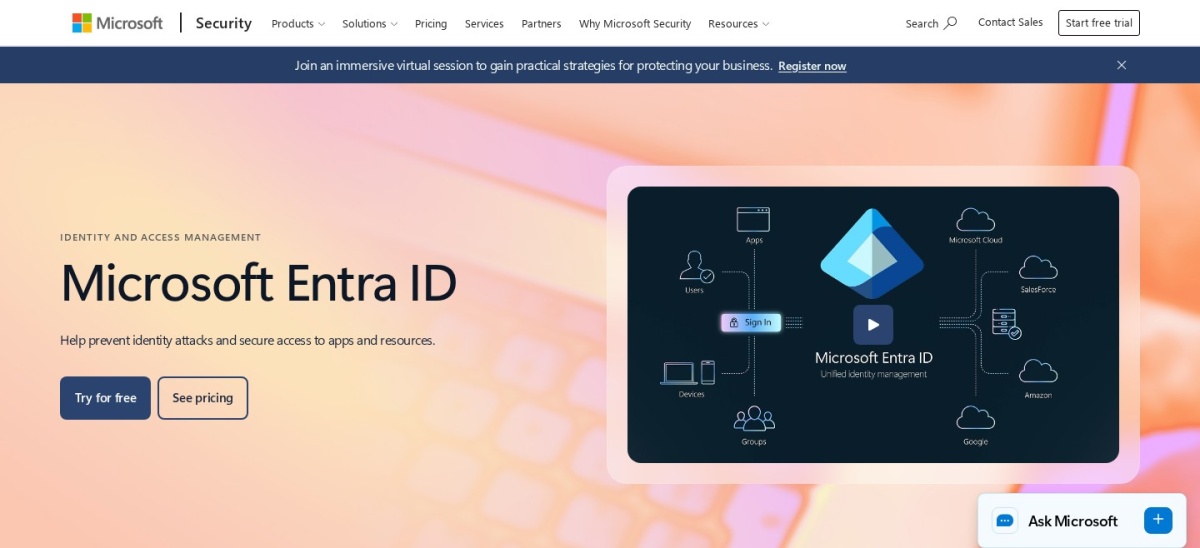
Microsoft Entra ID homepage, captured Nov 2026.
Microsoft Entra ID is an identity management platform with authentication controls for Microsoft services and external applications. Microsoft reports that more than 720,000 organizations use its MFA capabilities, and the free edition supports basic protection through security defaults.
The trade off is that customized Conditional Access policies require P1 at $7 per user monthly with annual billing, while P2 costs $10 and introduces risk-based controls. It suits organizations already using Microsoft productivity applications, cloud services or hybrid directory infrastructure.
P1 adds configurable Conditional Access policies and advanced reporting.Visit microsoft.com
03
Okta
4.5/5on G2 (1,435 reviews, checked Nov 2026)
Starts at$6/mo
Best for enterprise identity management
Free planNo, trial available
AuthenticationMFA and adaptive authentication options
Identity managementUniversal Directory
Paid planStarter, $6/user/month
okta.com
Okta homepage, captured Nov 2026.
Okta is a workforce identity platform combining multi-factor authentication, centralized user management and single sign-on. Its Starter suite includes standard MFA, Universal Directory and 5 automated workflows, providing a foundation for managing employee access across business applications.
The trade off is that Starter costs $6 per user monthly with annual billing, while the $14 Core Essentials suite or additional licensing is needed for advanced capabilities such as Adaptive MFA. It suits companies that want to consolidate authentication and application access management under one identity provider.
What we like
Combines MFA with centralized identity management
Supports varied business application environments
Includes workflow automation
Large public review base
Watch out for
No permanent free workforce plan
Advanced authentication features increase costs
Enterprise deployments require configuration
Starter includes workforce MFA, SSO, directory services and workflows.Visit okta.com
04
miniOrange
4.6/5on G2 (43 reviews, checked Nov 2026)
Starts at$2/mo
Best for affordable workforce and VPN MFA
Free planTrial for workforce IAM
AuthenticationPush, OTP and hardware tokens
InfrastructureVPN, VDI and desktop MFA
Paid planEssential, $2/user/month
miniorange.com
miniOrange homepage, captured Nov 2026.
miniOrange is an identity and access management platform for business applications, desktop computers and remote network connections. Its Essential workforce plan starts at $2 per user monthly and includes application SSO, desktop authentication, VPN protection and basic access policies.
The trade off is that passwordless FIDO2 authentication and advanced adaptive policies require the Premium plan, listed at $3 per user monthly. Final workforce pricing may depend on deployment requirements. It suits budget-conscious businesses protecting cloud applications alongside existing desktop and network infrastructure.
What we like
Low published workforce subscription price
Supports Windows, Linux and Mac authentication
VPN and virtual desktop protection
Cloud and self-hosted deployment options
Watch out for
Smaller G2 review base than major competitors
Passwordless MFA requires Premium
Final deployment costs may require a quote
Premium adds passwordless MFA, adaptive policies and provisioning.Visit miniorange.com
05
JumpCloud
4.5/5on G2 (4,151 reviews, checked Nov 2026)
Starts at$3/mo
Best for device and directory management
Free planNo, 30-day trial
AuthenticationMFA and passwordless options
Device managementAvailable through additional products
Paid planStandalone MFA, $3/user/month annually
jumpcloud.com
JumpCloud homepage, captured Nov 2026.
JumpCloud is a cloud identity platform that combines authentication with directory services and device administration. Its standalone MFA capability is listed at $3 per user monthly with annual billing, and organizations can evaluate the platform through a 30-day trial.
The trade off is that additional identity and device management products increase the total subscription cost, with standalone MFA costing $4 per user on monthly billing. It suits IT teams managing employee identities and computers across mixed operating systems that want to consolidate administrative tools.
What we like
Standalone MFA pricing available
Combines identity and device administration
Suitable for mixed operating system environments
Extensive public review history
Watch out for
Additional products increase subscription costs
Broader platform requires more administration
Several bundled packages require custom quotes
Additional subscriptions extend MFA into directory and device management.Visit jumpcloud.com
06
Auth0
4.3/5on G2 (314 reviews, checked Nov 2026)
Paid from$35/mo
Best for developers and customer authentication
Free planUp to 25,000 monthly active users
AuthenticationPasswordless and paid MFA options
Primary useCustomer-facing applications
Paid planEssentials, $35/month
auth0.com
Auth0 homepage, captured Nov 2026.
Auth0 is a developer-focused identity platform for adding authentication to websites, mobile applications and software products. Its free plan supports up to 25,000 monthly active users with passwordless authentication and basic attack protection, while Essentials introduces professional MFA capabilities.
The trade off is that the $35 monthly Essentials plan starts with an allowance of 500 monthly active users, and enterprise MFA features require Professional at $240 monthly for the same starting allowance. It suits development teams embedding identity verification directly into their products.
What we like
Free tier for application development
Supports customer-facing authentication
Customizable login experiences
Application integration and audit log options
Watch out for
Professional MFA requires a paid subscription
Costs depend on active user volume
Developer resources are needed for implementation
Essentials adds professional MFA, higher feature limits and standard support.Visit auth0.com
07
Ping Identity
4.4/5on G2 (173 reviews, checked Nov 2026)
PricingCustom pricing
Best for complex enterprise authentication
Free planNo permanent free plan
AuthenticationAdaptive MFA and passwordless access
DeploymentCloud, hybrid or self-managed
Paid planCustom identity package
pingidentity.com
Ping Identity homepage, captured Nov 2026.
Ping Identity is an enterprise identity platform offering 3 main deployment models: shared cloud, dedicated cloud and self-managed software. Its authentication services cover workforce and customer identities, with options for adaptive MFA, passwordless access and identity verification.
The trade off is that pricing requires a personalized quote based on identity volumes, deployment preferences and selected capabilities. Implementation can also require dedicated identity management resources. It suits large organizations with complex authentication requirements, existing identity systems or specialized deployment needs.
What we like
Flexible deployment architecture
Supports workforce and customer identities
Adaptive authentication capabilities
Suitable for complex enterprise environments
Watch out for
No public fixed entry-level price
Implementation can require specialist resources
Less suitable for very small businesses
Quoted packages combine MFA with selected enterprise identity services.Visit pingidentity.com
08
WatchGuard AuthPoint
4.3/5on G2 (124 reviews, checked Nov 2026)
PricingCustom pricing
Best for network security and managed IT providers
Free planNo, trial available
AuthenticationPush, OTP and hardware tokens
Network integrationRADIUS and VPN authentication
Paid planAuthPoint MFA, reseller quote
watchguard.com
WatchGuard AuthPoint homepage, captured Nov 2026.
WatchGuard AuthPoint is a cloud-managed authentication solution for business applications, desktop logins and remote network access. Its MFA subscription is available through 1-year or 3-year licenses and includes directory synchronization, RADIUS authentication, access reporting and mobile authentication.
The trade off is that WatchGuard directs buyers to authorized resellers for custom pricing, making direct cost comparisons difficult before obtaining a quote. Credential exposure monitoring requires the Total Identity Security package. It suits managed service providers and businesses already using WatchGuard network security products.
What we like
Integrates with network security infrastructure
Supports desktop and remote access protection
Centralized cloud administration
Hardware token support
Watch out for
Pricing requires a reseller quote
Directory integration may require technical setup
Support arrangements depend on purchasing channel
Total Identity Security adds monitoring for exposed credentials.Visit watchguard.com
Which multi-factor authentication method is safest?
FIDO2 security keys and properly implemented passkeys provide strong protection against credential phishing because authentication is tied to the legitimate website or service. Prioritize these methods for administrators and employees with access to sensitive systems.
Authenticator-generated temporary codes provide additional protection beyond passwords, but attackers can capture them through deceptive login pages. Push notifications are convenient, although repeated fraudulent requests can lead users to approve unauthorized access.
SMS authentication is generally less resistant to account takeover because phone numbers can be transferred or intercepted. Use stronger methods whenever possible and maintain secure recovery procedures for users who lose their authentication devices.
How much does multi-factor authentication software cost?
Published workforce MFA prices in this comparison start at $2 per user monthly for miniOrange and reach $7 for Microsoft Entra ID P1. Cisco Duo and JumpCloud offer entry-level authentication options equivalent to $36 per user annually.
The price ladder annualizes published subscription rates. Workforce prices are calculated per licensed user, while Auth0 uses application-level subscriptions with monthly active user allowances. These billing models are not directly equivalent.
Custom-priced products display no numerical annual estimate because their costs depend on contract terms. Request written quotes covering license minimums, authentication methods, implementation, support and optional security features before comparing total costs.
How we chose
We selected established authentication providers with commercial MFA products, active vendor documentation and public customer reviews. The comparison considers authentication methods, application compatibility, deployment options, administrative controls and entry-level subscription costs.
The editorial reference date is 22 Nov 2026. Pricing and ratings were verified against the available official vendor pages and G2 listings during preparation; some listings contain newer November updates, so the figures are not guaranteed to represent historical snapshots from the reference date. Annual costs are calculated from published subscription rates.
We excluded discontinued products, tools without sufficient public review evidence and providers whose pricing arrangements could not be confirmed. Products with verified quote-based licensing remain eligible outside the top three. No vendor paid for a place, and we do not claim testing for this list.
How to choose the best multi-factor authentication software
Compare authentication platforms against your existing infrastructure, security requirements and expected subscription costs before committing to a provider.
Identify the accounts you need to protect. List employee applications, administrative accounts, customer portals, desktop computers and remote network services. Confirm that the authentication provider supports the systems your organization depends on.
Prioritize phishing-resistant authentication. Choose software that supports FIDO2 security keys, passkeys or other phishing-resistant methods. Check whether these capabilities are included in the entry plan or require additional licensing.
Evaluate administration and account recovery. Review enrollment procedures, lost-device recovery, audit reporting and integration with your existing user directory. Ensure administrators can revoke access promptly without creating insecure recovery exceptions.
Calculate your complete subscription cost. Multiply the applicable subscription rate by your expected user count and include hardware tokens, advanced policies, implementation and support. Compare annual commitments with flexible monthly billing where available.
FAQ
What is the best multi-factor authentication software?
Cisco Duo is our top overall pick because it offers dedicated business authentication, broad application compatibility and a free plan for up to 10 users. Its Essentials subscription starts at $3 per user monthly.
What is the best free MFA software for small businesses?
Cisco Duo provides a permanent free business plan for up to 10 users. Microsoft Entra ID Free is another suitable option for organizations already using compatible Microsoft cloud services and requiring basic authentication controls.
What is the cheapest multi-factor authentication software?
miniOrange has the lowest published workforce entry price in this comparison at $2 per user monthly. Cisco Duo and JumpCloud also offer affordable authentication subscriptions, although their features, billing arrangements and licensing requirements differ.
What is the difference between MFA and 2FA?
Two-factor authentication requires two independent forms of identity verification. Multi-factor authentication is the broader category covering authentication with multiple independent factors, including two-factor authentication. Using multiple passwords alone does not qualify as MFA.
Is multi-factor authentication completely secure?
No. MFA reduces the risk associated with stolen passwords, but phishing, session theft, fraudulent push approvals and insecure account recovery can still compromise accounts. Phishing-resistant methods and carefully configured access policies provide stronger protection.
Is Microsoft Entra ID better than Cisco Duo?
Microsoft Entra ID is generally a better fit for organizations centered on Microsoft services and Conditional Access policies. Cisco Duo suits businesses seeking dedicated authentication protection across diverse applications without replacing their existing identity platform.
Which MFA software is best for developers?
Auth0 is a suitable option for developers adding authentication to customer-facing applications. It provides customizable login experiences, identity integrations and paid MFA capabilities, with subscription pricing based partly on monthly active user allowances.
Can MFA software protect VPN connections?
Yes. Providers such as Cisco Duo, miniOrange and WatchGuard AuthPoint support remote access authentication. Confirm compatibility with your particular VPN gateway, authentication protocol and user directory before purchasing or deploying a subscription.
Should businesses use SMS or authenticator apps?
Authenticator apps generally provide better protection against phone number theft than SMS verification. However, temporary codes and ordinary push approvals remain susceptible to certain phishing attacks. Prefer phishing-resistant passkeys or security keys for sensitive accounts.
SaaS SEO and WordPress specialist with about 8 years of experience. Rakib compares WordPress plugins, themes, hosting and software using public pricing, documentation and user reviews. See how we rank.