Best Marketing Analytics Platforms in 2026: 7 Tools Compared
WLWPLegible EditorsLast verified 22 Nov 2026How we rank12 min read
★ Short answer
AgencyAnalytics is our top marketing analytics platform for agencies, with 90+ marketing integrations and automated client reporting from $20 per client monthly on annual billing. HubSpot Marketing Hub suits teams connecting campaign performance with CRM contacts, while CallRail specializes in attributing phone leads to marketing channels.
How we make this list: we compare pricing pages, product documentation and public user reviews, then re-check every price before each update. No product paid for a place. Disclosure.
AgencyAnalytics costs $20 per client monthly on annual billing and includes 90+ marketing integrations.
HubSpot Marketing Hub Starter lists a regular price of $20 per seat monthly, with 1,000 marketing contacts included.
CallRail Lead Tracking starts at $50 monthly and includes 5 tracking numbers and 250 minutes, with additional usage charges.
Mouseflow offers 500 monthly sessions free; Essential provides 5,000 sessions for $25 monthly on annual billing.
Fathom starts at $15 monthly for 100,000 pageviews, with the same analytics features across its paid tiers.
Databox Business costs $399 monthly on annual billing, while Ruler Analytics starts at $400 monthly before annual discounts.
What to look for in a marketing analytics platform
Marketing analytics platforms help teams understand how campaigns attract visitors, generate leads and contribute to business results. They bring performance data into dashboards, reports or attribution models so marketers can decide where to invest.
Start with the data sources you use. A platform that connects advertising accounts, website analytics, CRM records and ecommerce systems reduces manual reporting. Check whether integrations are included or require additional subscriptions.
Next, decide whether you need campaign reporting, conversion attribution or visitor behavior analytics. These solve different problems. Reporting platforms summarize performance, attribution tools connect leads to campaigns, and behavior tools show where visitors encounter difficulties.
Pricing models also differ. Some products charge per client, seat or data source, while others use tracked sessions, pageviews or leads. Compare the regular annual cost against your expected usage rather than relying on introductory offers.
Finally, look at data freshness, dashboard customization, automated reports and permissions. Agencies may prioritize client portals and white labeling, while internal marketing teams often need CRM connections, goals and conversion reporting.
For unified KPI dashboards and AI-assisted analysis
$399/mo
No free plan
4.4/5
Price ladder: cheapest paid plan per year
List prices, USD, checked Nov 2026
Fathom$180
AgencyAnlyt$240
HubSpotFREE$240
MouseflowFREE$300
CallRail$600
Databox$4,788
Ruler$4,800
The 7 best marketing analytics platforms
01
AgencyAnalytics
4.7/5on G2 (465 reviews, checked Nov 2026)
Starts at$20/mo
Best for marketing agencies and multi-channel reporting
Entry price$20/client/mo annually
Integrations90+ marketing platforms
ReportsUnlimited
Staff accountsUnlimited
agencyanalytics.com
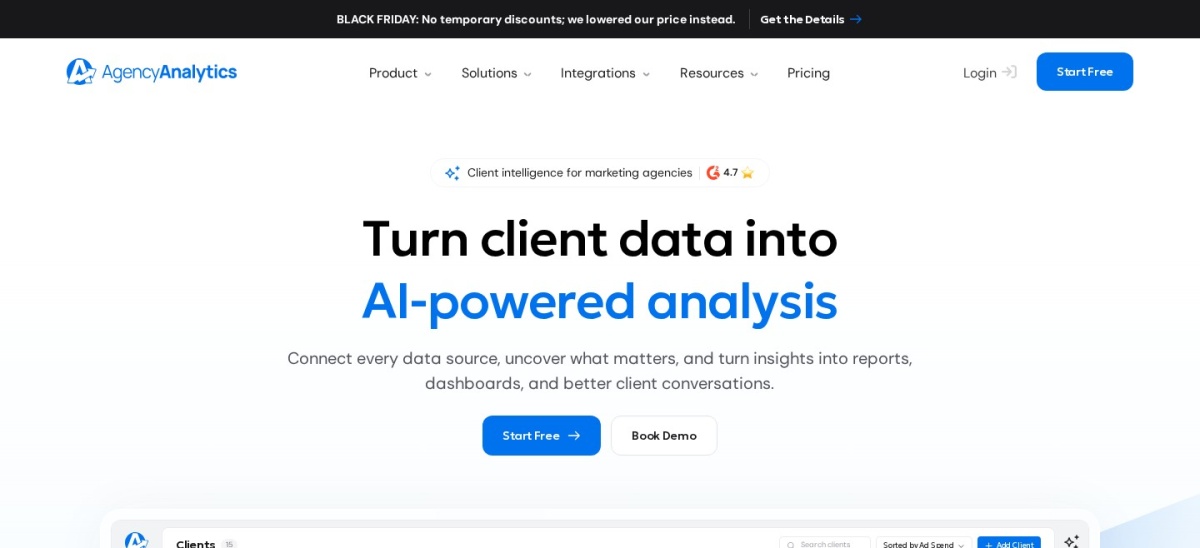
AgencyAnalytics homepage, captured Nov 2026.
AgencyAnalytics is a marketing reporting platform built for agencies managing multiple client campaigns. Its core plan costs $20 per client monthly on annual billing and includes 90+ marketing integrations, unlimited dashboards, automated reports, unlimited staff accounts and a white-labeled client portal. Teams can combine SEO, paid advertising and social performance in one reporting environment.
The trade off is per-client pricing, which increases the total bill as an agency expands. The $20 rate also requires annual billing, while AI visibility and rank tracking are separate add-ons. It suits SEO, PPC and digital marketing agencies that need repeatable reporting without rebuilding dashboards each month.
What we like
90+ integrations across marketing channels
Unlimited reports and dashboards
Automated white-labeled client reporting
Unlimited staff accounts
Client portals, alerts and forecasting included
Watch out for
Costs increase with the number of clients
Rank tracking and AI visibility require add-ons
Less focused on individual visitor behavior analysis
Best for connecting marketing campaigns with CRM data
Entry paid tierMarketing Hub Starter
Regular price$20/seat/mo
Marketing contacts1,000 included
Free usersUp to 2
hubspot.com
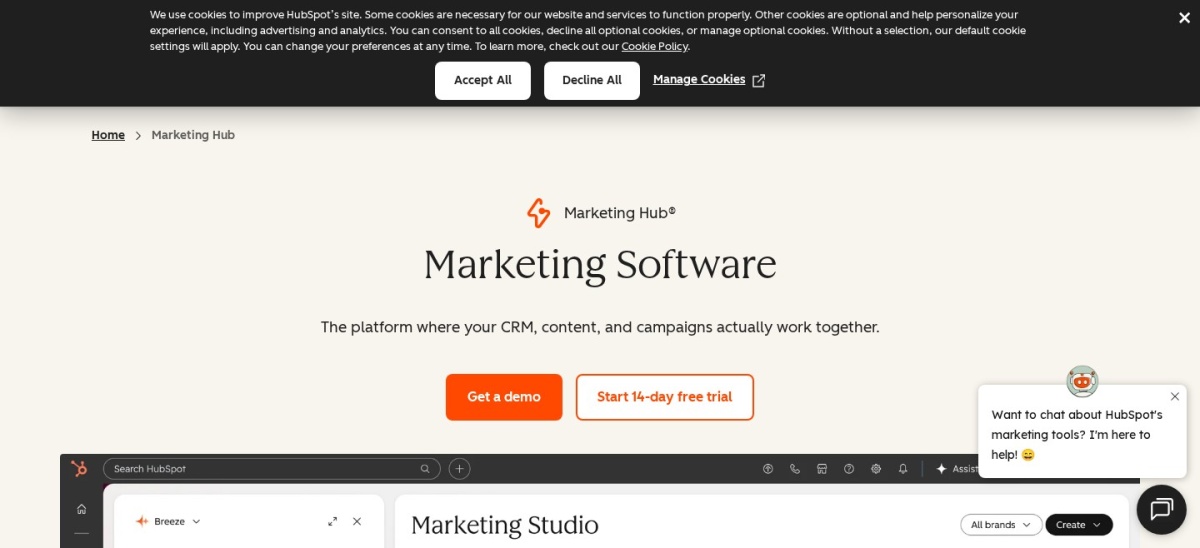
HubSpot homepage, captured Nov 2026.
HubSpot is a CRM-connected marketing platform that combines lead capture, campaign management, email marketing and performance reporting. Its free tools support up to 2 users, while Marketing Hub Starter lists a regular price of $20 per seat monthly and includes 1,000 marketing contacts. Marketers can connect campaign activity with contact records and lead-generation outcomes.
The trade off is that advanced attribution, customer journey analytics and broader marketing automation require more expensive tiers. Starter is also advertised with a reduced new-customer price, rather than its regular $20 monthly seat rate. It suits growing businesses that want marketing data connected directly to sales and customer relationships.
What we like
Marketing analytics connected to CRM records
Free tools for lead capture and reporting
Email, advertising and campaign features
Large ecosystem of integrations
Extensive public review history
Watch out for
Advanced attribution requires higher plans
Costs can increase with seats and marketing contacts
Reporting features vary significantly by tier
Professional and Enterprise add advanced automation and attribution reportingVisit hubspot.com
03
CallRail
4.5/5on G2 (1,978 reviews, checked Nov 2026)
Starts at$50/mo
Best for tracking phone leads and marketing attribution
Entry planLead Tracking
Tracking numbers5 included
Call minutes250 included
Starting price$50/mo plus usage
callrail.com
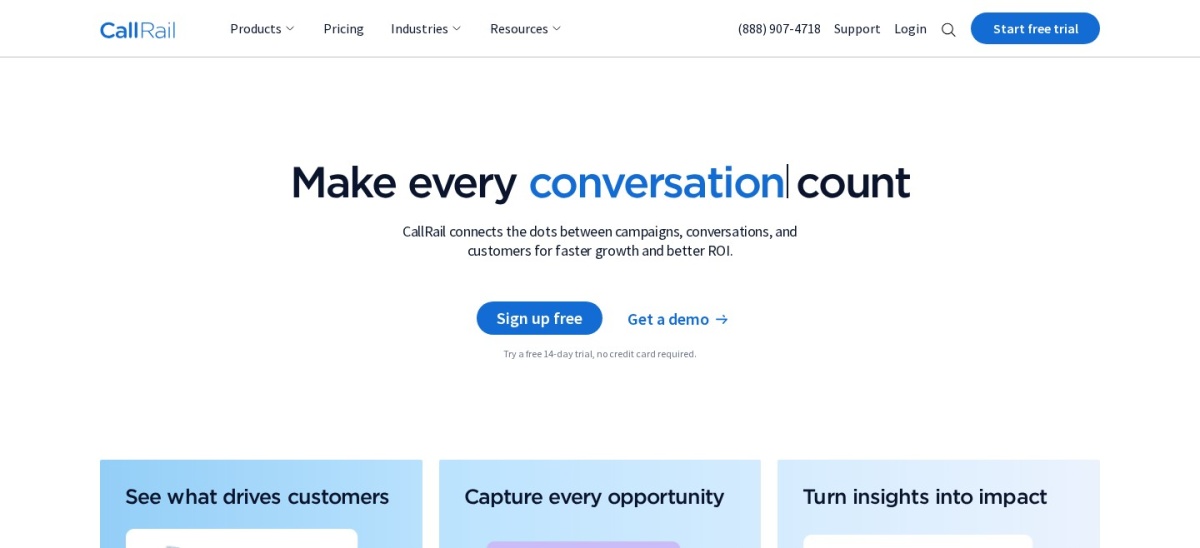
CallRail homepage, captured Nov 2026.
CallRail is a lead intelligence and marketing attribution platform that helps businesses identify which campaigns generate phone inquiries. Its Lead Tracking plan starts at $50 monthly and includes 5 tracking numbers, 250 minutes, call and text attribution, recording, routing and transcription. Teams can connect incoming calls with advertising and marketing sources.
The trade off is additional usage billing beyond the included tracking resources. Form attribution and multi-touch cost-per-lead reporting require Lead Tracking Complete at $95 monthly. It suits service businesses and marketing agencies where telephone inquiries represent an important part of the conversion funnel.
What we like
Connects phone inquiries to marketing sources
Includes call recording and transcription
Call routing and automation rules
Integrates with advertising and CRM workflows
Useful for measuring offline lead generation
Watch out for
Additional numbers and usage can increase costs
Form attribution requires a higher package
Less suitable for businesses without phone leads
Lead Tracking Complete adds form tracking and multi-touch CPL reportingVisit callrail.com
04
Mouseflow
4.6/5on G2 (694 reviews, checked Nov 2026)
Paid from$25/mo
Best for website behavior and conversion analysis
Free sessions500
Paid sessions5,000
Entry websites1
Paid data history3 months
mouseflow.com
Mouseflow homepage, captured Nov 2026.
Mouseflow is a website behavior analytics platform that records visitor interactions and highlights areas of friction. Its free plan includes 500 sessions, 1 website, session replay and heatmaps. The Essential plan costs $25 monthly on annual billing and raises the allowance to 5,000 sessions with 3 months of data history and access to Mina AI.
The trade off is that more advanced optimization features are reserved for higher tiers. Feedback surveys and broader friction analysis begin with Advanced at $109 monthly on annual billing, while the Essential plan covers only 1 website. It suits conversion specialists and marketers who want to understand why visitors abandon important pages.
What we like
Free session replay and heatmaps
Visualizes clicks, scrolling and visitor friction
Paid entry tier includes AI-assisted analysis
Useful alongside conventional website analytics
Free plan available for small websites
Watch out for
Advanced surveys and analysis require higher plans
Entry plan is limited to 1 website
Does not replace campaign attribution reporting
Advanced adds surveys, additional heatmaps and broader funnel analysisVisit mouseflow.com
05
Fathom
4.7/5on G2 (22 reviews, checked Nov 2026)
Starts at$15/mo
Best for privacy-focused website and campaign analytics
Entry pageviews100,000/mo
Entry price$15/mo
Free trial7 days
TrackingCookieless
usefathom.com
Fathom homepage, captured Nov 2026.
Fathom is a privacy-focused web analytics platform that tracks traffic, referrals, campaigns and conversions without cookies. Its entry plan costs $15 monthly for up to 100,000 pageviews, and every paid tier includes the same analytics features. Marketers can review traffic sources, campaign performance and goals through a streamlined dashboard.
The trade off is less detailed visitor and campaign analysis than dedicated attribution platforms provide. Pricing rises with monthly pageviews, and there is no permanent hosted free plan. It suits publishers, content marketers and small businesses that want clear website statistics without managing a complicated analytics setup.
What we like
Cookieless analytics approach
All paid tiers include the same feature set
Simple traffic and campaign dashboards
Goal and conversion tracking
Suitable for multiple websites
Watch out for
No permanent hosted free plan
Limited advanced attribution capabilities
Monthly costs increase with pageview volume
Higher tiers increase monthly pageview allowances without changing featuresVisit usefathom.com
06
Ruler Analytics
4.6/5on G2 (30 reviews, checked Nov 2026)
Starts at$400/mo
Best for revenue attribution across marketing channels
Entry planSmall
Monthly visitsUp to 10,000
Regular priceFrom $400/mo
Annual discount10%
ruleranalytics.com
Ruler Analytics homepage, captured Nov 2026.
Ruler Analytics is a marketing measurement platform that connects visitor interactions, lead activity and conversion information to campaign performance. Its Small plan starts at $400 monthly for up to 10,000 visits, with first-party tracking, integrations, multi-touch attribution and a dedicated customer success manager. It supports businesses that need more complete lead-to-revenue reporting.
The trade off is the higher starting cost and the need to connect marketing and CRM data correctly. Annual agreements can reduce the listed monthly price to $360, but the regular monthly starting rate is $400. It suits established lead-generation businesses that need to attribute sales outcomes to marketing activity.
What we like
First-party marketing tracking
Multi-touch conversion attribution
CRM and advertising integrations
Dedicated customer success support
Phone, email and live chat support
Watch out for
Higher entry cost than general reporting platforms
Implementation requires reliable source and CRM data
Pricing scales with traffic and requirements
Medium and higher tiers add traffic capacity and advanced attribution optionsVisit ruleranalytics.com
07
Databox
4.4/5on G2 (195 reviews, checked Nov 2026)
Starts at$399/mo
Best for unified KPI dashboards and AI-assisted analysis
Entry planBusiness
Data sourcesUp to 30
UsersUp to 10
AI credits1,500/mo
databox.com
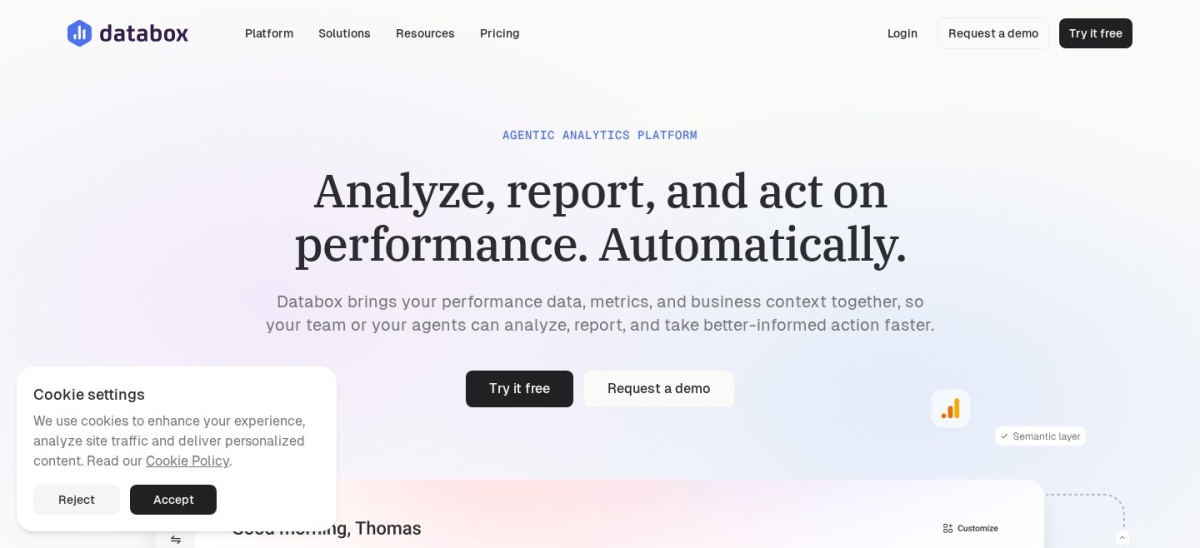
Databox homepage, captured Nov 2026.
Databox is a business analytics platform that unifies marketing, sales and operational metrics with dashboards, governed data and AI-assisted reporting. Its Business plan costs $399 monthly on annual billing and includes up to 10 users, 30 data sources and 1,500 monthly AI credits. The platform provides integrations, metric definitions, reporting and AI analysis tools.
The trade off is the $4,788 annual commitment, compared with $499 monthly when billed without an annual agreement. Its broader business intelligence capabilities may be unnecessary for teams that only need basic campaign reports. It suits growing organizations that want marketing performance connected to company-wide goals and operational metrics.
What we like
Connects marketing and business data sources
Dashboards, goals and KPI tracking
AI-assisted analysis and automation
Governed metric definitions
Supports custom integrations and APIs
Watch out for
Substantial annual cost for smaller teams
Entry plan limits users and data sources
Broader setup requirements than basic marketing dashboards
Custom implementation adds data engineering and tailored AI workflowsVisit databox.com
Campaign reporting, attribution and behavior analytics explained
Marketing analytics platforms often overlap, but they do not all answer the same questions. Choosing the right category matters more than choosing a product with the longest feature list.
Campaign reporting tools such as AgencyAnalytics consolidate performance metrics across advertising, search and social channels. They help marketers compare results, create dashboards and communicate progress.
Attribution analytics tools such as CallRail and Ruler Analytics connect marketing interactions with leads or sales outcomes. They are especially useful when conversions happen after a phone call, form submission or extended sales process.
Behavior analytics tools such as Mouseflow show what visitors do on websites through session recordings, heatmaps and funnel observations. They help identify usability problems but do not replace advertising performance measurement.
For many businesses, the right setup combines tools from different categories rather than relying on a single platform.
Which marketing analytics metrics should you track?
Start with metrics linked to business objectives. Website traffic matters, but visitor numbers alone do not show whether marketing activities produce valuable outcomes.
For paid campaigns, monitor cost per click, conversion rate, cost per lead and return on advertising spend where revenue data is available. Compare these alongside lead quality instead of evaluating advertising costs in isolation.
For organic marketing, examine search traffic, landing page engagement, conversions and assisted outcomes. Connect these results with campaign or CRM data where possible.
Lead-generation businesses should follow qualified leads, pipeline progression and revenue attribution. Ecommerce teams may prioritize purchase conversions, average order value and repeat customers.
Use consistent definitions across reporting systems. When advertising platforms and website analytics disagree, investigate differences in attribution windows, consent settings and tracking methods before drawing conclusions.
How we chose
We created this shortlist from established marketing analytics platforms with public customer reviews, published product documentation and identifiable paid plans. The selection includes multi-channel reporting, CRM-connected analytics, call attribution, visitor behavior analysis and business intelligence tools.
Official pricing pages and public review profiles were opened on 23 Nov 2026 for this November 2026 comparison, using the requested 22 Nov 2026 editorial verification date. We prioritized regular published prices rather than introductory promotions and converted monthly plan costs into annual equivalents. Usage-based charges and billing commitments are identified separately.
We excluded products without verifiable entry pricing, platforms with insufficient public review evidence and products whose current pricing could not be confirmed. The shortlisted platforms serve different analytics needs, so ranking reflects suitability for marketing workflows rather than a single technical benchmark. No vendor paid for a place, and we do not claim testing for this list.
How to choose the best marketing analytics platform
Identify the decisions your marketing team needs to make, then select a platform with the data connections, reporting features and pricing model that fit those goals.
Define your primary reporting objective. Decide whether you need campaign dashboards, customer journey analysis, revenue attribution or website behavior insights. An agency building client reports has different requirements from a company measuring phone inquiries or a product team investigating landing page abandonment.
Check integrations and data quality. List your advertising platforms, website analytics tools, CRM and ecommerce systems. Confirm the required integrations and whether they support the specific metrics you need. Pay attention to attribution settings, refresh frequency and differences between platform-reported conversions.
Match features to your reporting workflow. Prioritize automated reports and client access for agencies, revenue attribution for sales-led teams, and session analysis for conversion optimization. Look for flexible dashboards, permissions, useful alerts and the ability to track consistent KPIs over time.
Compare the total annual cost. Calculate the published regular rate using your actual number of clients, users, sessions, data sources or tracked leads. Include additional usage fees and required upgrades. Review annual commitments and confirm which features remain available on the entry package.
FAQ
What is a marketing analytics platform?
A marketing analytics platform collects, organizes or analyzes information about marketing performance. Depending on the product, it may track campaign traffic, leads, conversions, customer behavior or revenue attribution. The goal is to help marketing teams understand results and make decisions using consistent performance data.
Which marketing analytics platform is best for agencies?
AgencyAnalytics is our top choice for agencies because it combines more than 90 marketing integrations with automated reports, dashboards and client portals. Its per-client pricing also matches the way many agencies organize their accounts. Teams needing deeper revenue attribution may benefit from an additional specialized platform.
What is the difference between Google Analytics and marketing analytics software?
Google Analytics primarily measures website and application activity, including traffic sources, events and conversions. Broader marketing analytics software can combine those statistics with advertising accounts, CRM records, offline leads and financial outcomes. Some platforms focus on reporting, while others specialize in attribution or customer behavior.
How much does marketing analytics software cost?
Prices vary considerably by product and usage. Fathom starts at $15 monthly, AgencyAnalytics costs $20 per client monthly on annual billing, and CallRail begins at $50 monthly plus additional usage. More specialized attribution and business intelligence platforms can cost several hundred dollars each month.
Can marketing analytics platforms track return on investment?
Yes, when reliable spending and revenue data are available. Some tools directly connect campaign activity to leads or sales, while reporting platforms combine figures from separate sources. The quality of ROI calculations depends on consistent attribution methods, conversion tracking and access to accurate business outcomes.
Which platform is best for tracking marketing leads?
CallRail is particularly useful when telephone calls are important conversions. HubSpot connects marketing activity with CRM contacts, while Ruler Analytics focuses on linking customer interactions with attribution and revenue outcomes. The better choice depends on whether leads arrive by phone, online forms or a longer sales process.
Do small businesses need paid marketing analytics software?
Not always. Businesses with simple reporting needs can begin with free analytics and reporting tools. Paid platforms become more useful when teams need automated client reports, unified dashboards, advanced visitor behavior analysis or attribution across multiple channels. Choose paid software when the additional information supports specific decisions.
What is multi-touch marketing attribution?
Multi-touch attribution assigns conversion credit across several marketing interactions rather than giving all credit to one source. For example, a customer might discover a company through search, return through an advertisement and later submit a lead form. Attribution models help marketers evaluate how those interactions contribute to outcomes.
Can one marketing analytics platform replace every reporting tool?
Some platforms combine many reporting functions, but no single product necessarily covers every marketing requirement. Campaign dashboards, visitor behavior analysis and offline revenue attribution rely on different data and methods. A combined setup can be more appropriate when each tool addresses a specific measurement gap.