Best IoT Cloud Platforms in 2026: 8 Tools Compared
WLWPLegible EditorsLast verified 23 Nov 2026How we rank12 min read
★ Short answer
AWS IoT Core is the best IoT cloud platform for most teams. It charges $1 per 1 million messages with a 12-month free tier, and it scales from a prototype to millions of devices without a plan change. Pick Azure IoT Hub for Microsoft shops, or ThingsBoard for dashboards and self-hosting.
How we make this list: we compare pricing pages, product documentation and public user reviews, then re-check every price before each update. No product paid for a place. Disclosure.
AWS IoT Core charges $1 per 1 million messages with a 12-month free tier, and it is the default for AWS teams.
Azure IoT Hub Basic B1 costs $10 per unit a month, with a free edition for 8,000 messages a day.
ThingsBoard Cloud is free for 5 devices, with a paid Prototype plan at $49 a month and a free open-source edition.
TagoIO has the highest G2 rating here at 4.9 out of 5 from 63 reviews, with Starter at $49 a month.
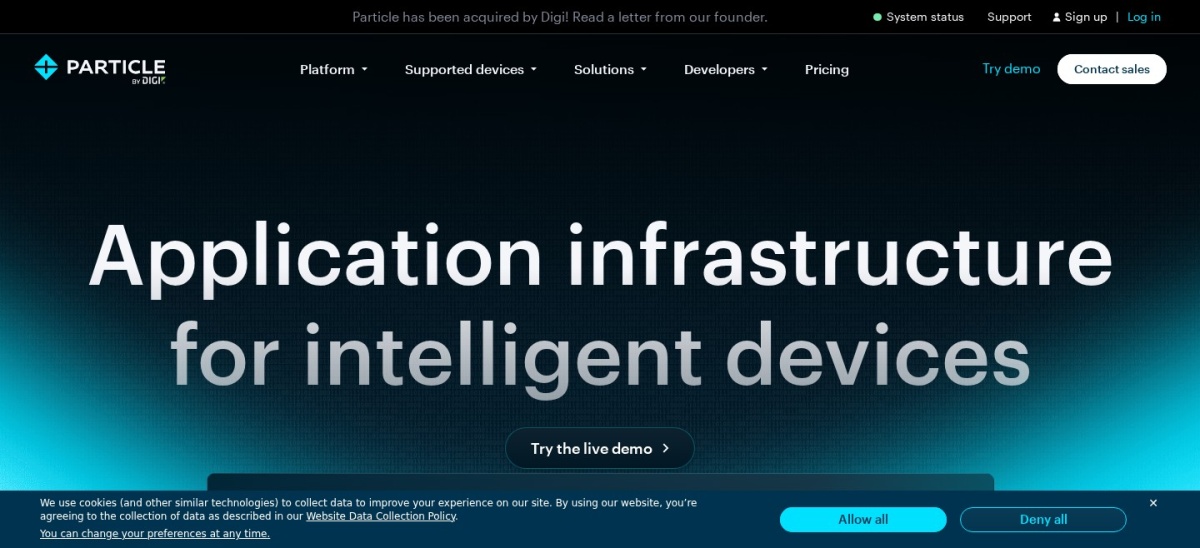
Particle bundles hardware, cellular connectivity and cloud from one vendor, with a free Sandbox for 100 devices.
What an IoT cloud platform should cover
An IoT cloud platform connects devices, collects their telemetry and turns it into dashboards, alerts and automation. Devices send data over MQTT or HTTP, and the platform handles identity, storage and rules.
Billing is the first thing to understand. AWS and Azure charge by message and connection time, while ThingsBoard, Blynk and Ubidots charge a flat monthly price per device count or plan tier.
The second test is what you get besides connectivity. Some platforms are mostly a message broker, while others add dashboards, device management, firmware updates and a rules engine in one place.
Self-hosting is a real option here. ThingsBoard offers a free open-source Community Edition, so teams that want full control of their data can run the platform on their own servers.
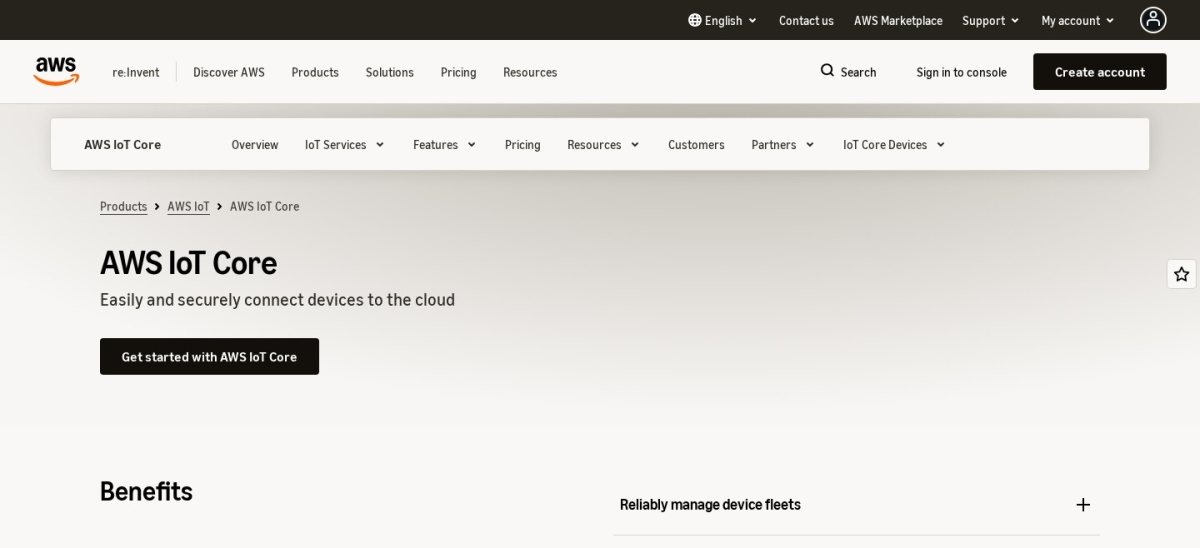
AWS IoT Core is Amazon's managed IoT platform for connecting devices and routing messages to other AWS services. Devices connect over MQTT, HTTP or LoRaWAN, a registry and device shadows keep their state, and the rules engine routes data to Lambda, S3 and DynamoDB.
The trade off is that pricing is pure usage. Messaging costs $1 per 1 million messages for the first 1 billion a month, and connectivity costs $0.08 per 1 million minutes, so the bill grows with the fleet. It suits engineering teams already running on AWS.
What we like
Scales from a prototype to millions of devices
Deep links to Lambda, S3 and other AWS services
12-month free tier for small workloads
Watch out for
Usage billing is hard to predict for large fleets
No built-in dashboards; you build them in other AWS tools
Needs AWS knowledge to set up well
Free tier covers 500,000 messages a month for 12 months; then pay as you goVisit aws.amazon.com
02
Azure IoT Hub
4.3/5on G2 (44 reviews, checked Nov 2026)
Paid from$10/mo
Best for Microsoft and Azure teams
Free editionYes, 8,000 msgs/day
Basic B1$10/unit/mo
Device twinsStandard tier
Paid planBasic B1, $10/unit/mo
azure.microsoft.com
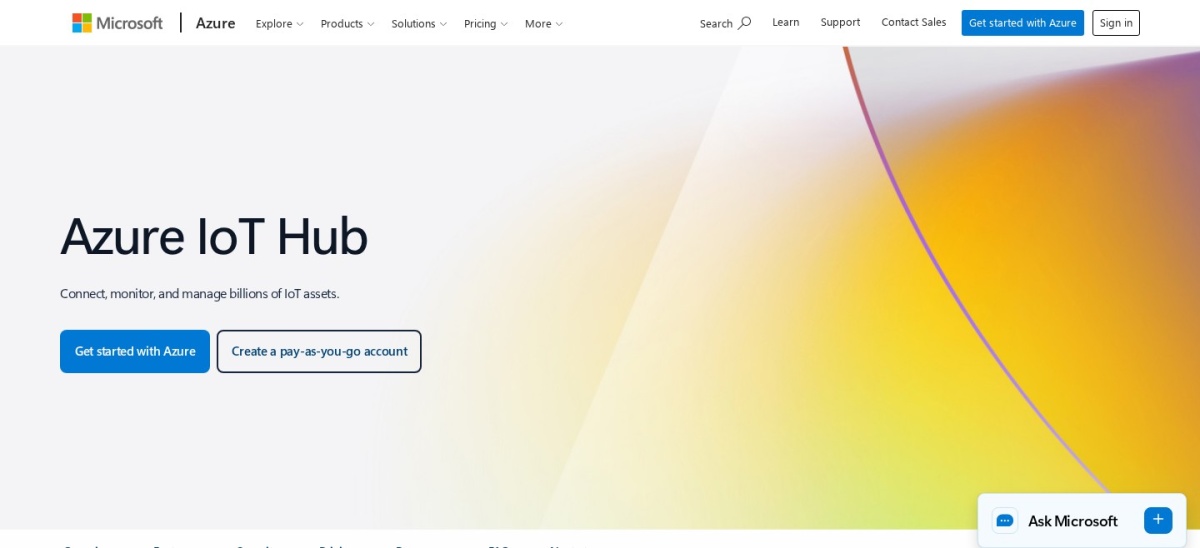
Azure IoT Hub homepage, captured Nov 2026.
Azure IoT Hub is Microsoft's device connectivity service for bi-directional messaging between devices and the cloud. It offers per-device authentication, device twins for state management and direct methods for commands, with a free edition for 8,000 messages a day.
The trade off is that the pricing page hides the dollar amounts behind a calculator. Basic B1 costs $10 per IoT Hub unit a month for 400,000 messages a day, and device management needs the Standard tier. It suits teams on Azure or Microsoft tooling.
What we like
Strong fit for Microsoft and Azure shops
Device twins keep device state in sync
Free edition for proofs of concept
Watch out for
Dollar prices are not shown on the pricing page
Device twins and direct methods need Standard tier
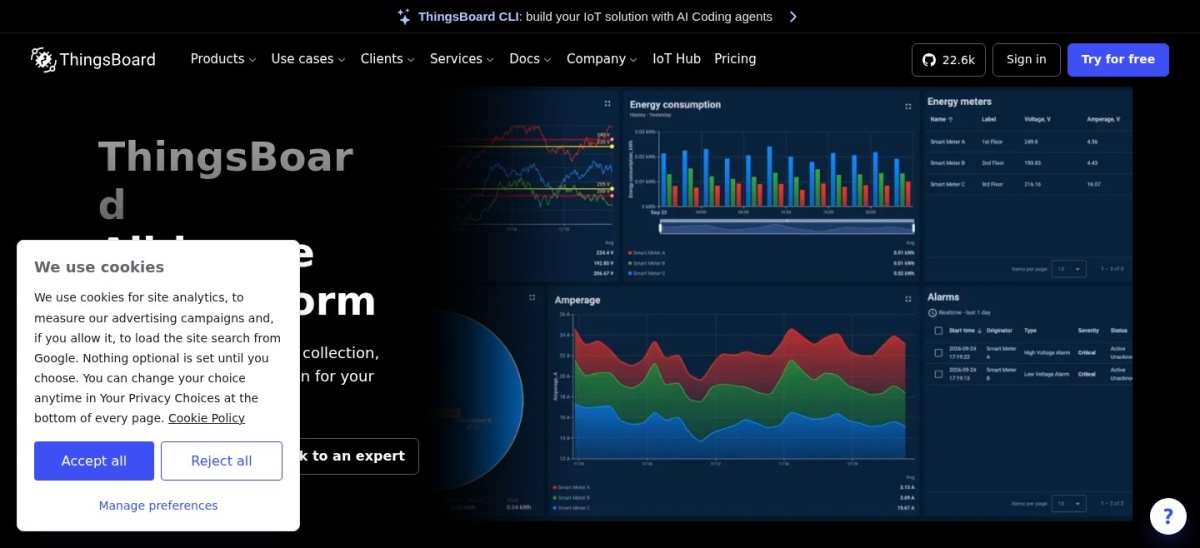
ThingsBoard is an open-source IoT platform with device management, data collection, dashboards and a rules engine. ThingsBoard Cloud is free for 5 devices, and the Prototype plan costs $49 a month for 50 devices and 10 million data points a month.
The trade off is that paid support and white labeling cost more. The $149 plan adds a help desk and white labeling, and the open-source edition needs your own servers. It suits teams that want dashboards and device management in one place.
What we like
Free open-source Community Edition
Dashboards, rules engine and device management in one place
Free cloud plan for 5 devices
Watch out for
Paid support starts on the $149 plan
Self-hosting needs your own servers and upkeep
G2 rating is based on only 8 reviews
Popular plan adds a help desk and white labeling for $149 a monthVisit thingsboard.io
04
Particle
4.5/5on G2 (195 reviews, checked Nov 2026)
Paid from$99/mo
Best for shipping connected hardware
Free planYes, 100 devices
CellularYes
Firmware updatesYes, over the air
Paid planGrowth, $99/mo
particle.io
Particle homepage, captured Nov 2026.
Particle combines IoT hardware modules with a cloud platform for device management, firmware updates and data routing. The free Sandbox plan covers up to 100 devices and 100,000 Data Operations a month, and the Growth plan starts at $99 a month for Wi-Fi devices.
The trade off is price for cellular fleets. The Growth block costs $299 a month for cellular devices, three times the Wi-Fi price. It suits hardware teams that want modules, connectivity and cloud from one vendor.
What we like
Hardware, connectivity and cloud from one vendor
Free Sandbox for up to 100 devices
Over-the-air firmware updates built in
Watch out for
Cellular Growth block costs $299 a month
Pricing is per block of 100 devices
Less useful if you already have hardware
Growth adds more Data Operations; Enterprise is quoted for large fleetsVisit particle.io
05
Blynk
4.6/5on G2 (28 reviews, checked Nov 2026)
Paid from$29/mo
Best for mobile-first IoT apps
Free planYes
Mobile app builderYes, drag and drop
Device provisioningYes
Paid planFrom $29/mo
blynk.io
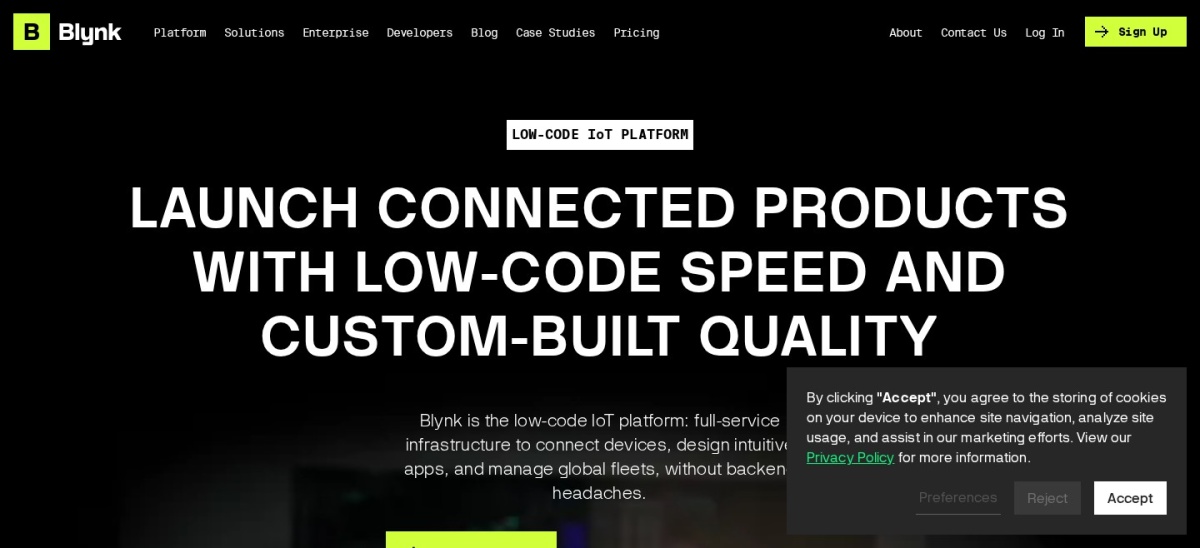
Blynk homepage, captured Nov 2026.
Blynk is a low-code IoT platform for building mobile apps and dashboards around connected products. It offers drag-and-drop widgets, device provisioning and a free plan, with paid plans starting at $29 a month.
The trade off is depth for industrial use. Blynk is built for products and prototypes, not for large industrial fleets with complex rules. It suits makers and small product teams that want a phone app without coding one.
What we like
Drag-and-drop mobile app builder
Largest ecosystem of ready widgets
Free plan for prototypes
Watch out for
Not built for large industrial fleets
Rules engine is lighter than ThingsBoard
G2 rating is based on only 28 reviews
Higher tiers add more devices, users and white labelingVisit blynk.io
06
Ubidots
4.9/5on Capterra (20 reviews, checked Nov 2026)
Starts at$99/mo
Best for simple dashboards and alerts
Free planNo, trial only
DashboardsYes, drag and drop
AlertsYes
Paid planFrom $99/mo
ubidots.com
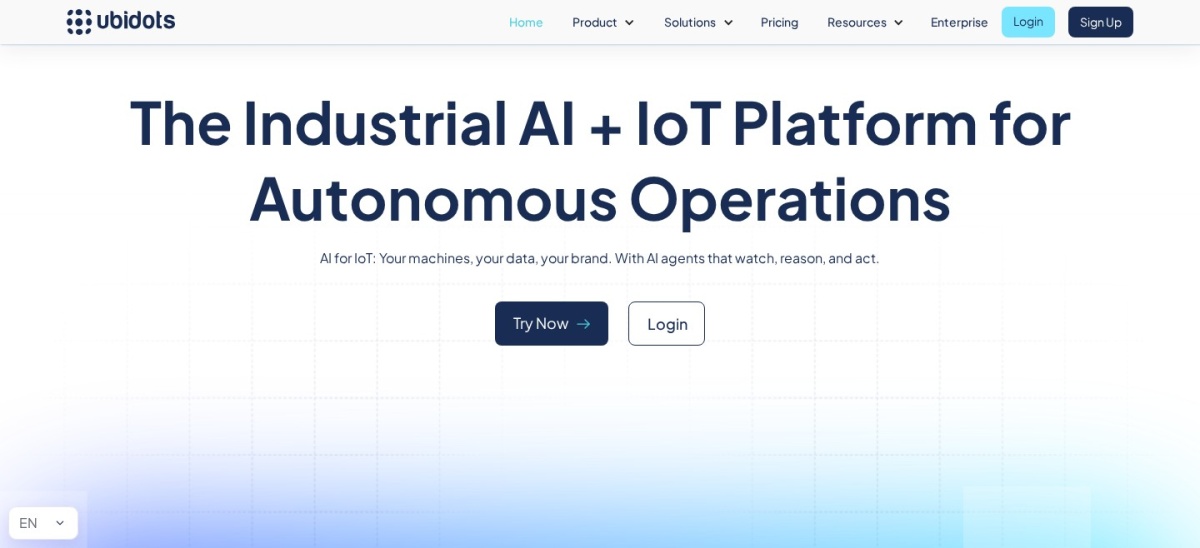
Ubidots homepage, captured Nov 2026.
Ubidots is an IoT platform for getting sensor data onto a dashboard fast. Devices send data over HTTP or MQTT, and users build real-time dashboards, alerts and reports without writing backend code. Paid plans start at $99 a month.
The trade off is the thin review base. Capterra shows 4.9 out of 5 from only 20 reviews, and there is no free plan, only a trial. It suits small industrial and monitoring projects that want dashboards on a simple monthly plan.
What we like
Highest rating here at 4.9 out of 5 on Capterra
Dashboards and alerts with no coding
Simple per-device commercial pricing
Watch out for
No free plan, only a trial
Capterra rating is based on only 20 reviews
Less depth for large fleets than AWS or Azure
Higher tiers add more devices, data retention and usersVisit ubidots.com
07
TagoIO
4.9/5on G2 (63 reviews, checked Nov 2026)
Paid from$49/mo
Best for fast prototypes to production
Free planYes, 5 devices
MQTT on FreeNo
Custom dashboardsYes
Paid planStarter, $49/mo
tago.io
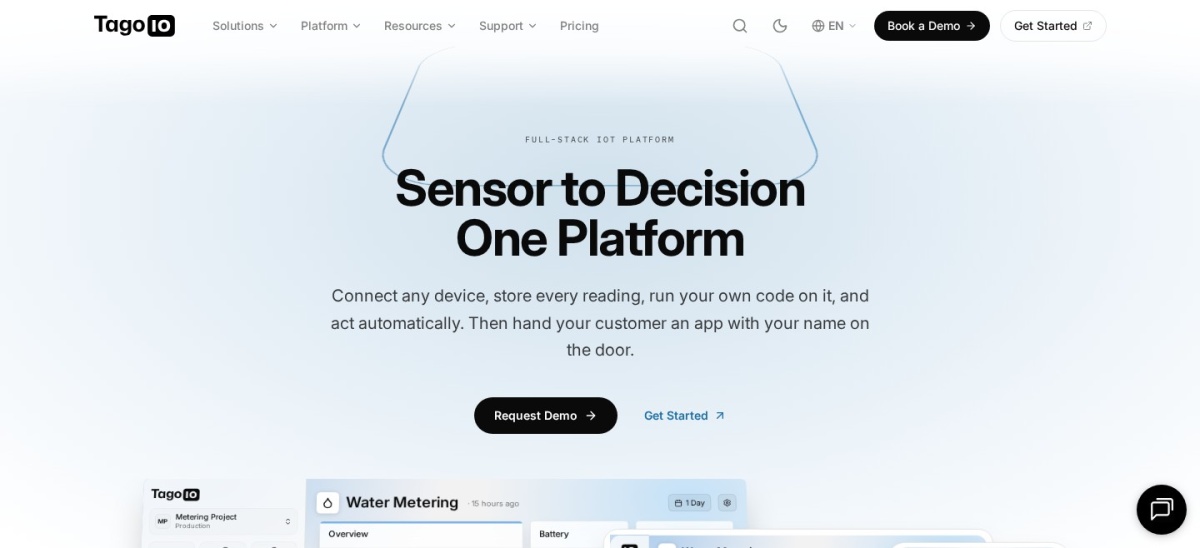
TagoIO homepage, captured Nov 2026.
TagoIO is a full-stack IoT cloud platform that connects devices, stores and analyzes data, and builds dashboards and applications. It is free for 5 devices, and the Starter plan costs $49 a month, with a 4.9 out of 5 G2 rating from 63 reviews.
The trade off is that the free account does not support MQTT, so paid plans are needed for that protocol. It suits teams that want to move from a prototype to production quickly with custom dashboards.
What we like
Highest G2 rating here at 4.9 out of 5
Fast path from prototype to production
Custom dashboards and applications
Watch out for
Free plan does not support MQTT
Some gaps in Python documentation
Smaller community than AWS or ThingsBoard
Higher tiers add more devices, data and usersVisit tago.io
08
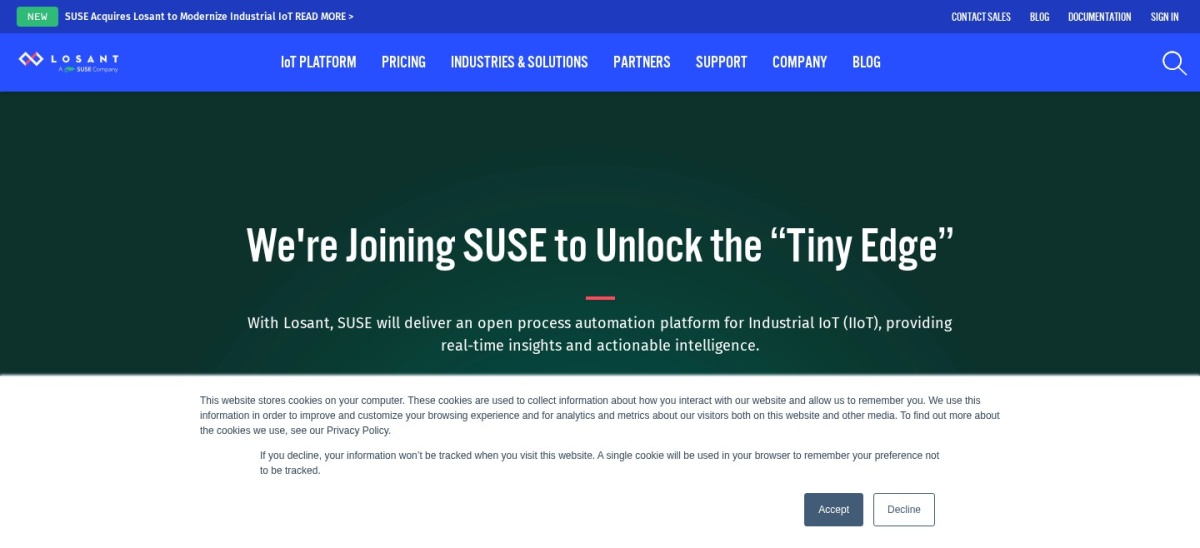
Losant
4.5/5on G2 (5 reviews, checked Nov 2026)
Starts at$250/mo
Best for enterprise visual workflows
Free planNo, sandbox trial
Visual workflowsYes
Branded dashboardsYes
Paid planFrom $250/mo
losant.com
Losant homepage, captured Nov 2026.
Losant is an enterprise IoT platform built around a visual workflow engine. Teams connect devices over MQTT, HTTP or edge agents, process telemetry in drag-and-drop workflows, and build dashboards and branded end-user experiences on top.
The trade off is price and review depth. Paid plans start at $250 a month, and G2 shows 4.5 out of 5 from only 5 reviews. It suits enterprises building custom IoT applications without heavy engineering.
What we like
Visual workflow engine for telemetry logic
Branded dashboards and end-user experiences
Edge agents for offline processing
Watch out for
Paid plans start at $250 a month
G2 rating is based on only 5 reviews
Overkill for small fleets or prototypes
Enterprise plans add more devices, support and white labelingVisit losant.com
Usage billing vs flat monthly pricing
AWS and Azure bill by usage, so a small fleet can cost a few dollars a month while a large fleet costs thousands. AWS charges $1 per 1 million messages and $0.08 per 1 million connection minutes, with a 12-month free tier.
Flat plans are easier to budget. ThingsBoard Prototype costs $49 a month for 50 devices, Blynk starts at $29 a month and TagoIO Starter costs $49 a month, with the price fixed whatever the message volume.
The break-even point depends on message frequency. A fleet that reports once an hour is cheap on usage billing, while a fleet that reports every few seconds is usually cheaper on a flat plan.
Watch the device limit. Most flat plans cap devices per tier, so a growing fleet can jump a tier and double the bill overnight.
How we chose
We started from the IoT platforms most often listed on G2 and Capterra, then kept those with a published price or a free plan and a real cloud use case.
Prices come from each vendor's pricing page, checked on 23 November 2026. Ratings and review counts come from G2 or Capterra on the same day. Where a vendor shows a sale, the list shows the regular price.
We left out Google Cloud IoT Core, which was discontinued, and platforms with quote-only pricing. No vendor paid for a place, and we do not claim hands-on testing for this list.
How to choose an IoT cloud platform
Start with your cloud and your hardware, then match the billing model to your message volume.
Check which cloud you already use. Teams on AWS should start with AWS IoT Core, and teams on Azure with Azure IoT Hub, because the IoT service plugs into storage, analytics and alerts you already pay for.
Estimate your message volume. Count devices, messages per hour and message size. Usage billing is cheap for quiet fleets and costly for chatty ones.
Decide whether you need dashboards built in. If you want dashboards without building them, pick ThingsBoard, Blynk, Ubidots or TagoIO. If you will build your own, a broker such as AWS IoT Core is enough.
Test the free tier with real hardware. Connect a few devices, send real telemetry and build one dashboard and one alert before committing to a paid plan.
FAQ
What is the best IoT cloud platform?
AWS IoT Core is the best pick for most teams. It charges $1 per 1 million messages with a 12-month free tier, and it scales from a prototype to millions of devices without a plan change.
Is there a free IoT cloud platform?
Yes. AWS IoT Core has a 12-month free tier, Azure IoT Hub has a free edition for 8,000 messages a day, ThingsBoard Cloud is free for 5 devices, and ThingsBoard Community Edition is free to self-host.
How much does an IoT cloud platform cost?
Usage platforms start near $0 for small fleets and scale with messages. Flat plans start at $29 a month for Blynk, $49 for ThingsBoard or TagoIO, and $99 for Particle or Ubidots.
What is the difference between AWS IoT Core and Azure IoT Hub?
Both are managed message brokers for large fleets. AWS IoT Core fits teams already on AWS, while Azure IoT Hub fits teams on Azure and Microsoft tooling, with device twins and direct methods.
Can I self-host an IoT platform?
Yes. ThingsBoard Community Edition is open source under the Apache 2.0 licence and can run on your own servers for free, while its cloud plans start at $49 a month.
Which IoT platform is best for a mobile app?
Blynk is the best pick for mobile-first products. It offers a drag-and-drop app builder so users can control devices from a phone, with plans starting at $29 a month.