Okta is the best IAM tool for most organizations, with SSO, MFA and lifecycle management from 72 dollars per user a year. Microsoft Entra ID suits Microsoft 365 shops, Duo is the fastest MFA rollout, and Keycloak is the best free open-source option.
How we make this list: we compare pricing pages, product documentation and public user reviews, then re-check every price before each update. No product paid for a place. Disclosure.
Okta is the best all-round IAM platform, with Starter at 72 dollars per user a year and the deepest app catalog in this list.
Microsoft Entra ID is the best pick for Microsoft 365 shops, with a free tier and P1 at 72 dollars per user a year.
Duo is the fastest MFA rollout, free for up to 10 users and 36 dollars per user a year on Essentials.
JumpCloud replaces on-premises Active Directory for small teams, with a free tier for up to 10 users and 10 devices.
Keycloak is the only fully free option here, with no license fee for self-hosted SSO and federation.
What to look for in an IAM tool
Identity and access management decides who can sign in, to what, and how strongly they must prove it. Get it wrong and a stolen password opens every app at once.
Most teams need two things first: single sign-on, so staff sign in once, and multi-factor authentication, so a password alone is not enough.
Bigger teams also need lifecycle management, which creates accounts when people join and removes access when they leave. That is where the pricier suites earn their keep.
Published prices hide the real bill. Okta has a 1,500 dollar yearly minimum and Ping Identity prices from a 5,000-user minimum, so small teams should check minimums before comparing per-user rates. Our guide on SSO software covers the single sign-on side in more detail.
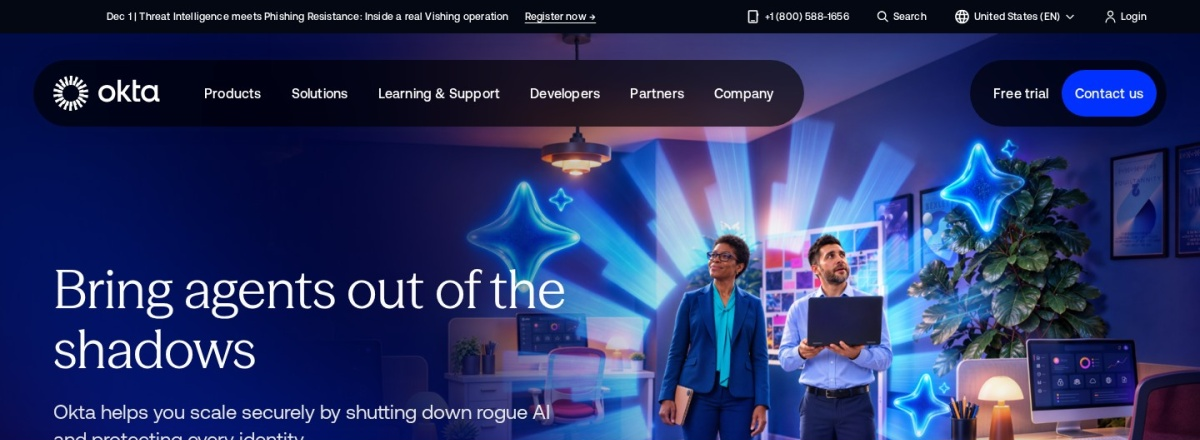
Okta is a workforce identity platform that covers single sign-on, MFA, directory and lifecycle management. The Starter suite costs 6 dollars per user a month and includes SSO, MFA, Universal Directory and 5 Workflows. Its integration catalog lists more than 8,000 apps, the deepest in this list.
The trade off is cost at scale. Starter is 72 dollars per user a year with a 1,500 dollar yearly minimum, and adaptive MFA, lifecycle management and governance sit in the 17 dollar Essentials suite. It suits mid-size and large teams with many SaaS apps to connect.
What we like
Deepest app integration catalog
SSO, MFA and lifecycle in one suite
Strong mid-market and enterprise reviews
Watch out for
1,500 dollar yearly minimum
Adaptive MFA and governance cost more
Essentials adds adaptive MFA, lifecycle and governanceVisit okta.com
02
Microsoft Entra ID
4.5/5on G2 (915 reviews, checked Nov 2026)
Paid from$72/yr
Best for Microsoft 365 shops
Free planYes, SSO and basic MFA
Paid planP1, $72/yr
Conditional AccessP1
P2 plan$108/yr, Identity Protection
microsoft.com
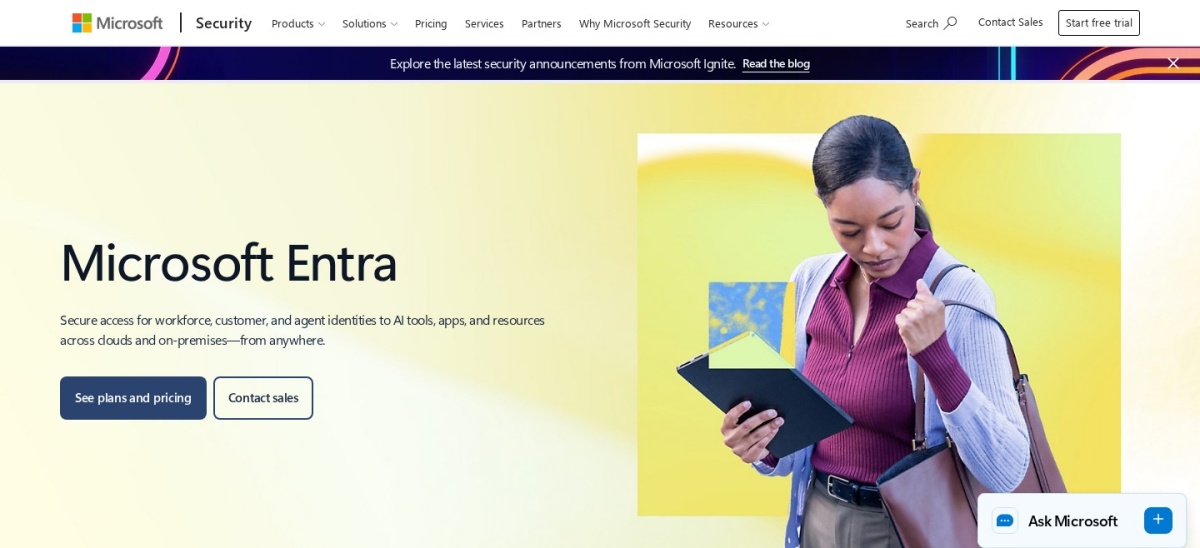
Microsoft Entra ID homepage, captured Nov 2026.
Microsoft Entra ID is the identity layer for Microsoft 365 and Azure. The free tier covers single sign-on, basic MFA and sign-in logs for apps in the Microsoft ecosystem. Premium P1 adds full Conditional Access, hybrid identity management and self-service password reset for 6 dollars per user a month.
The trade off is lock-in and licensing sprawl. Advanced features such as Identity Protection and Privileged Identity Management need P2 at 9 dollars per user a month, and costs are hard to predict across bundles. It suits organizations already running Microsoft 365 and Azure.
What we like
Bundles with Microsoft 365 and Azure
Free tier covers basic SSO and MFA
Full Conditional Access on P1
Watch out for
Advanced features spread across tiers
Licensing costs hard to predict
P2 adds Identity Protection and Privileged Identity ManagementVisit microsoft.com
03
Cisco Duo
4.5/5on G2 (590 reviews, checked Nov 2026)
Paid from$36/yr
Best for fast MFA rollout
Free planYes, up to 10 users
Paid planEssentials, $36/yr
MFAPush, passkeys, biometrics
SSOEssentials
duo.com
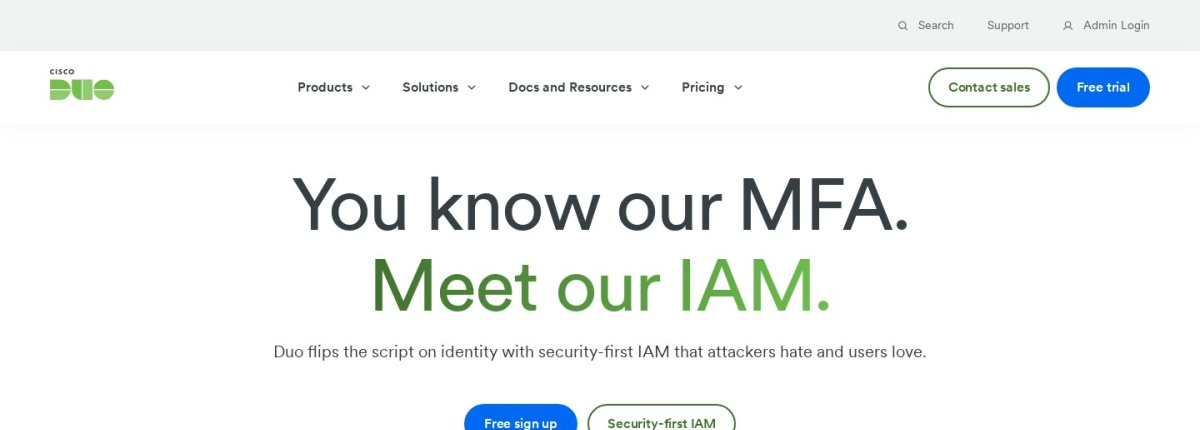
Cisco Duo homepage, captured Nov 2026.
Cisco Duo is an MFA-first identity tool built around push approvals on a phone. The free edition covers up to 10 users with strong MFA and the Duo authenticator app. Essentials adds Duo Directory, phishing-resistant MFA, complete passwordless sign-in, single sign-on and Trusted Endpoints for 3 dollars per user a month.
The trade off is scope. Duo is not a full directory or lifecycle platform, so joiner-mover-leaver automation needs another tool, and device health checks sit on higher tiers. It suits teams whose main gap is MFA and who want it live in days.
What we like
Fastest MFA rollout in this list
Free for up to 10 users
Phishing-resistant MFA on Essentials
Watch out for
No full directory or lifecycle tools
Device checks need higher tiers
Advantage adds risk-based authentication at 72 dollars a yearVisit duo.com
04
JumpCloud
4.5/5on G2 (4,104 reviews, checked Nov 2026)
Paid from$36/yr
Best cloud directory for small teams
Free planYes, 10 users and devices
Paid planDirectory, $36/yr
DevicesWindows, Mac, Linux
SSO and MFAYes
jumpcloud.com
JumpCloud homepage, captured Nov 2026.
JumpCloud is a cloud directory that replaces on-premises Active Directory for small and mid-size teams. It combines directory services, SSO, MFA, LDAP and RADIUS with device management for Windows, Mac and Linux. The free tier covers up to 10 users and 10 devices with the full platform.
The trade off is pricing confusion. The directory starts at 3 dollars per user a month, device management is listed near 9 to 11 dollars, and combined bundles are quoted by sales. It suits startups with mixed device fleets retiring an old domain controller.
Auth0 is a customer identity platform for adding login to apps and websites. The free tier supports up to 25,000 monthly active users with social logins, passwordless sign-in and basic attack protection. Essentials adds pro MFA, role-based access control, audit log streaming and separate development and production environments.
The trade off is cost as you grow. Essentials is a flat 35 dollars a month, but Professional jumps to 240 dollars a month at 500 monthly active users, and enterprise SSO sits higher still. It suits software teams that need login without building authentication themselves.
What we like
Generous free tier for new apps
Social and passwordless login built in
Strong developer docs and APIs
Watch out for
Costs jump sharply as users grow
Enterprise SSO sits on higher tiers
Professional costs 240 dollars a month at 500 MAUVisit auth0.com
06
Ping Identity
4.4/5on G2 (378 reviews, checked Nov 2026)
Starts at$36/yr
Best for hybrid enterprise estates
Free planNo, 30-day trial
Paid planEssential, $36/yr
User minimum5,000 users
FederationSAML, OIDC, OAuth, SCIM
pingidentity.com
Ping Identity homepage, captured Nov 2026.
Ping Identity is an enterprise IAM platform for workforce, customer and partner sign-in. PingOne for Workforce Essential covers SSO, MFA, a SCIM directory, an app portal and no-code orchestration for 3 dollars per user a month. It also supports federation across SAML, OAuth 2.0, OpenID Connect and SCIM.
The trade off is the minimum. Workforce plans carry a 5,000-user annual minimum, so the Essential rate implies a floor near 180,000 dollars a year before discounts. It suits large or hybrid estates with complex federation and regulated workloads.
OneLogin is a cloud IAM platform for mid-market teams that want simple SSO and MFA. The Basic plan covers authentication and limited user management for 3 dollars per user a month. It includes an app catalog, directory integration and context-aware access policies that smaller IT teams learn fast.
The trade off is depth and direction. Higher tiers add full user management and HR-driven provisioning, and some guides list the Advanced bundle at 4 dollars instead of Basic at 3. It suits mid-market companies that want affordable SSO without enterprise complexity.
CyberArk Workforce Identity homepage, captured Nov 2026.
CyberArk Workforce Identity is an access platform that layers SSO and adaptive MFA on privileged access management. Single Sign-On starts at 2 dollars per user a month and Adaptive MFA at 3 dollars, with device, location and behavior checks behind each sign-in. It also brings secrets management and privileged session controls.
The trade off is enterprise weight. Workforce identity bundles are sized per deployment and some guides list them as quote-only, while admin setup is heavier than Duo or OneLogin. It suits security teams that combine privileged access with workforce sign-in.
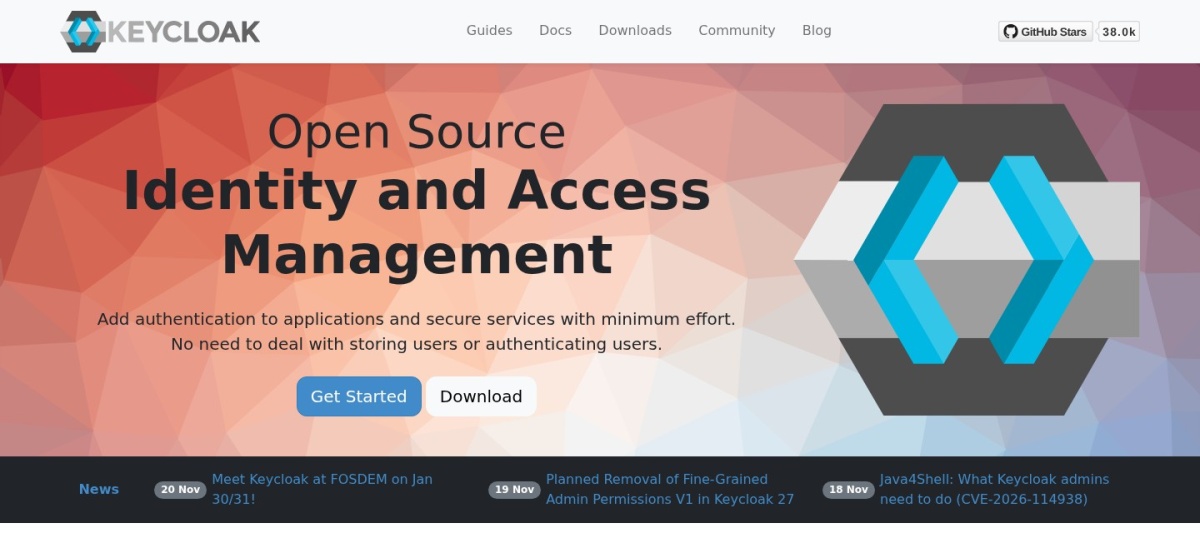
Keycloak is a free, open-source identity platform for SSO, federation and authorization. It covers SAML, OpenID Connect and OAuth 2.0, with user federation, social login and admin consoles included. There is no license fee for the community distribution, and it runs self-hosted or in containers.
The trade off is effort. Keycloak needs in-house identity engineering to install, configure and maintain, and there is no vendor support unless you pay a provider. It suits teams with the skills to self-host and a budget that rules out per-user pricing.
We started from the most-used workforce and customer IAM platforms with public G2 ratings, then kept 9 with published pricing or a free tier.
Prices come from each vendor's pricing page or vendor-supplied G2 listings, checked on 25 November 2026. Ratings and review counts come from G2 on the same day. Where a vendor shows a sale, the list shows the regular price.
We left out tools with no public rating and quote-only enterprise suites. No vendor paid for a place, and we do not claim hands-on testing for this list.
How to choose an IAM tool
Start with the apps and directories you already run, then pick the identity layer that fits them.
List the apps staff sign in to every day. SSO only helps if your apps are in the catalog. Check the vendor's integration list for your core tools first.
Decide how strong MFA must be. Push approvals suit most teams. Regulated work may need phishing-resistant MFA, security keys or device checks.
Check minimums, not just per-user prices. Okta has a 1,500 dollar yearly minimum and Ping Identity a 5,000-user minimum. Multiply the rate by your real seat count.
Try the free tier before signing. Duo, JumpCloud, Entra ID, Auth0 and Keycloak all let you run a real pilot. Test sign-in, MFA and deprovisioning first.
FAQ
What is the best IAM tool?
Okta is the best IAM tool for most organizations. It combines SSO, MFA, directory and lifecycle management, holds a 4.5 out of 5 G2 rating from more than 1,400 reviews, and its Starter suite costs 72 dollars per user a year.
What is the cheapest IAM tool?
Keycloak is the cheapest, because the open-source software has no license fee when you host it yourself. Among hosted tools, CyberArk SSO starts at 24 dollars per user a year, while Duo, JumpCloud, Ping Identity and OneLogin start at 36 dollars per user a year.
Is Microsoft Entra ID or Okta better?
Okta is better for vendor-neutral estates with many SaaS apps, because its catalog is deeper and it works the same everywhere. Entra ID is better for organizations already on Microsoft 365, where it bundles with licenses you may already pay for.
Do IAM tools have free plans?
Several do. Duo and JumpCloud are free for up to 10 users, Microsoft Entra ID has a free tier with SSO and basic MFA, Auth0 is free up to 25,000 monthly active users, and Keycloak is free to self-host with no user limit.
What is the difference between SSO and MFA?
Single sign-on lets staff sign in once and reach many apps without another password. Multi-factor authentication asks for a second proof, such as a phone approval or security key, so a stolen password alone does not open an account.
Which IAM tool is best for small teams?
Duo and JumpCloud are the best small-team picks here. Both are free for up to 10 users, Duo Essentials costs 36 dollars per user a year for SSO and passwordless sign-in, and JumpCloud adds device management for Windows, Mac and Linux from the same console.
SaaS SEO and WordPress specialist with about 8 years of experience. Rakib compares WordPress plugins, themes, hosting and software using public pricing, documentation and user reviews. See how we rank.