Best Headless CMS Software in 2026: 7 Tools Compared
WLWPLegible EditorsLast verified 22 Nov 2026How we rank12 min read
★ Short answer
Sanity is the best headless CMS software for most development teams, with a free plan supporting up to 20 users and Growth starting at $15 per seat monthly. Storyblok is better for teams needing visual editing, while Prismic offers a lower-cost paid entry point at $10 monthly with annual billing.
How we make this list: we compare pricing pages, product documentation and public user reviews, then re-check every price before each update. No product paid for a place. Disclosure.
Sanity earns 4.7/5 from 970 G2 reviews and offers Growth at $15 per seat monthly.
Storyblok scores 4.5/5 from 633 G2 reviews. Growth costs $99/month and includes 5 seats.
Prismic includes 4 million monthly API calls on its free plan, with Starter costing $10/month billed annually.
Strapi offers free self-hosted software, while Strapi Cloud Starter costs $35/month for 100,000 API requests.
Hygraph Growth costs $199/month with 10 seats, 10,000 entries and 1 million API calls.
Contentful Lite costs $300/month with 20 users, while ButterCMS Basic starts at $71/month.
What to look for in headless CMS software
A headless content management system separates content storage from website presentation. Developers retrieve content through APIs and display it using their preferred frontend frameworks, hosting platforms and applications.
The biggest advantage is content reuse. Articles, product descriptions, documentation and structured information can appear across websites, mobile applications and other digital channels without maintaining separate content databases.
Editing experiences vary considerably. Some platforms prioritize structured schemas and developer flexibility, while others provide visual page builders that let marketing teams create pages using reusable components.
API requests, bandwidth, user seats, locales and content records are important pricing factors. A free plan that supports a prototype may become restrictive when content volume or website traffic increases.
Also compare permissions, content versioning, previews, scheduled publishing, deployment requirements and export capabilities. These features become increasingly important as editorial and development teams grow.
For established teams managing multichannel content
$300/mo
Free plan
4.3/5
Price ladder: cheapest paid plan per year
List prices, USD, checked Nov 2026
PrismicFREE$120
SanityFREE$180
StrapiFREE$420
ButterCMSFREE$852
StoryblokFREE$1,188
HygraphFREE$2,388
ContentfulFREE$3,600
The 7 best headless CMS software
01
Sanity
4.7/5on G2 (970 reviews, checked Nov 2026)
Paid from$15/mo
Best headless CMS software overall
Free user seatsUp to 20
Free documents10,000
Free API CDN requests1M/mo
Paid planGrowth, $15/seat/mo
sanity.io
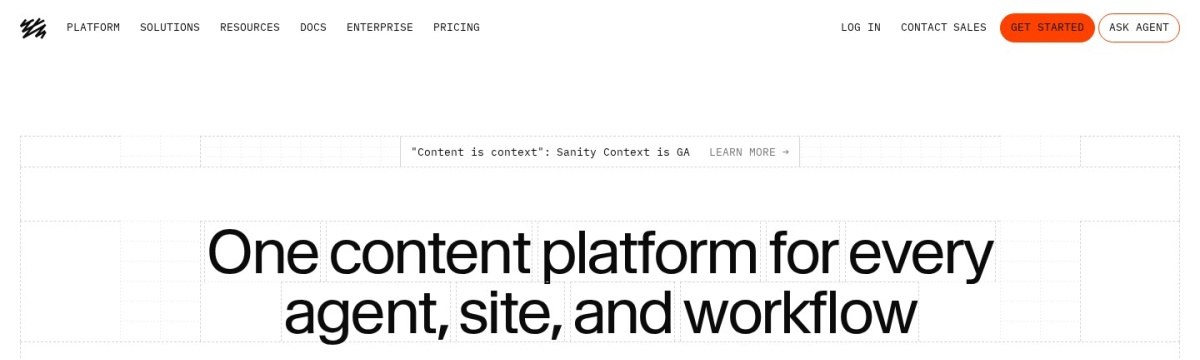
Sanity homepage, captured Nov 2026.
Sanity is a headless content platform built around customizable schemas, real-time collaboration and an API-driven content database. Its free plan supports up to 20 user seats, 10,000 documents, 2 public datasets and 1 million monthly CDN API requests. Visual editing and live previews are available.
The trade off is that Growth costs $15 per paid seat monthly, while additional usage and premium capabilities can increase expenses. Growth adds comments, tasks, scheduled drafts, private datasets and expanded permissions. It suits developers building structured websites and applications that need flexible content models and collaborative editing.
What we like
Generous free user allowance
Customizable content schemas
Real-time collaboration and visual editing
Hosted content database and CDN
Strong G2 rating with extensive reviews
Watch out for
Requires development work to configure content models
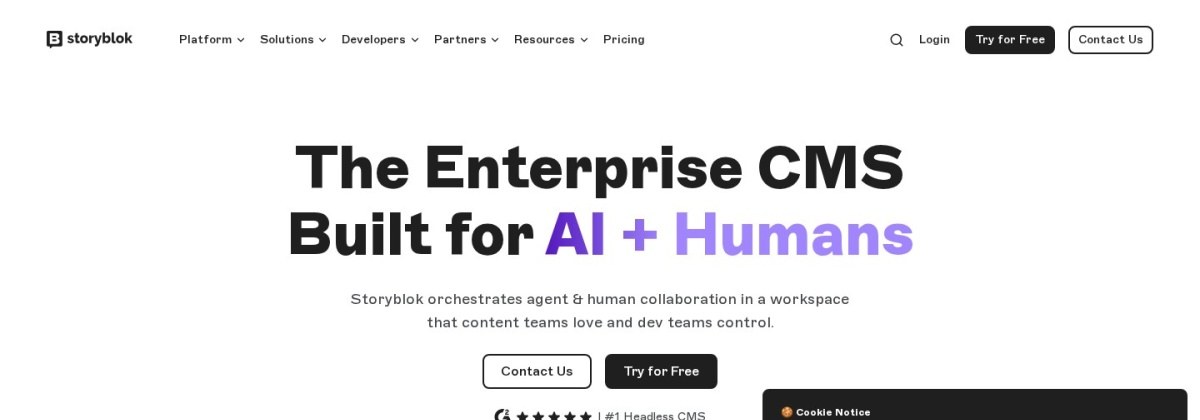
Storyblok is a headless CMS combining structured content APIs with a visual editor for building website pages. Its free Starter plan includes 1 space, 1 user seat and 100,000 monthly API requests. Editors can create pages from reusable components while developers control the frontend.
The trade off is that the free tier has limited collaboration and API capacity. Growth costs $99 monthly and includes 5 seats with expanded API allowances. Additional users and consumption may increase costs. It suits marketing teams that need visual control while developers maintain the underlying website.
What we like
Visual editing with contextual previews
Reusable content components
Framework-independent API delivery
Free plan for smaller projects
Growth includes multiple editorial seats
Watch out for
Growth costs more than budget alternatives
Additional seats and usage can cost extra
Advanced governance requires premium plans
Frontend integration requires development
Growth adds editorial seats, higher API allowances and expanded collaboration featuresVisit storyblok.com
03
Prismic
4.3/5on G2 (361 reviews, checked Nov 2026)
Paid from$10/mo
Best affordable headless CMS for marketing websites
Free users1
Free API calls4M/mo
Free CDN bandwidth100 GB/mo
Paid planStarter, $10/mo annually
prismic.io
Prismic homepage, captured Nov 2026.
Prismic is a headless CMS focused on marketing websites, reusable page sections and visual content editing. Its free plan includes 1 user, 4 million monthly API calls, 100 GB of CDN bandwidth and unlimited documents, content types and assets. The visual page builder is included.
The trade off is that the free plan supports only 1 user, while Starter costs $10 monthly billed annually and increases capacity to 3 users and 3 locales. Additional bandwidth is available through paid overages. It suits small teams building content-driven websites with predictable subscription costs.
What we like
Low-cost paid entry plan
Generous free API allowance
Visual page builder
Unlimited documents and assets
Built-in image optimization
Watch out for
Free tier supports only one editor
Starter has limited editorial seats
Additional bandwidth can incur charges
Advanced permissions require higher plans
Starter adds collaboration seats, another locale and paid bandwidth expansionVisit prismic.io
04
Strapi
4.5/5on G2 (206 reviews, checked Nov 2026)
Paid from$35/mo
Best for open-source and self-hosted projects
Self-hosted softwareFree
Cloud API requests100K/mo
Cloud asset storage50 GB
Paid planCloud Starter, $35/mo
strapi.io
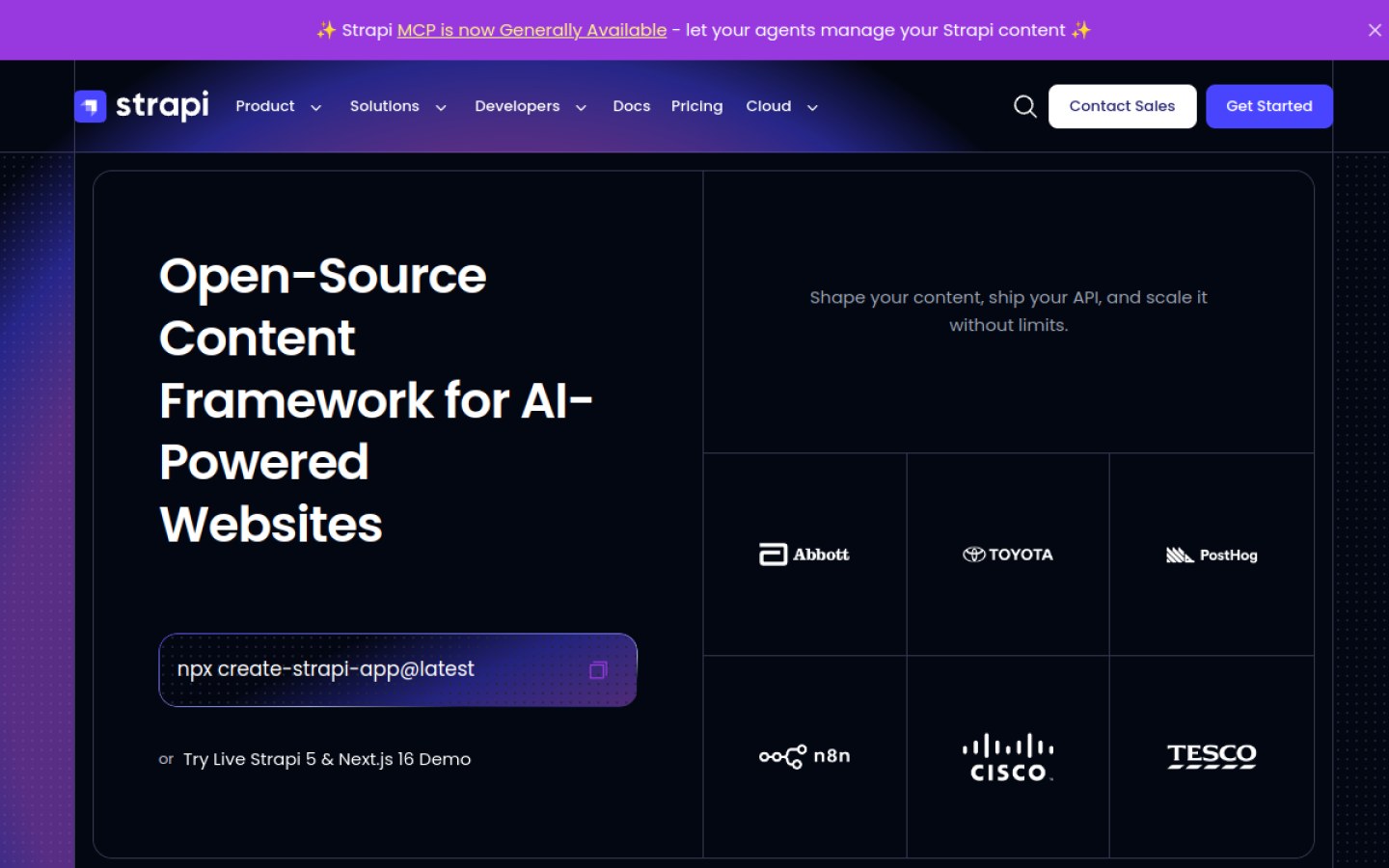
Strapi homepage, captured Nov 2026.
Strapi is an open-source headless CMS that developers can customize and host independently. Its Community edition is free to self-host, while Strapi Cloud Starter costs $35 monthly and includes 100,000 API requests, 50 GB asset storage, 50 GB asset bandwidth and unlimited database entries.
The trade off is that self-hosting requires server administration, maintenance and security management. Cloud Starter also has infrastructure limitations, while higher plans provide additional capacity and operational features. It suits development teams seeking backend control without building a content management system from scratch.
What we like
Open-source software with self-hosting freedom
Customizable content models and APIs
Managed cloud hosting available
Unlimited database entries on Cloud Starter
Established developer ecosystem
Watch out for
Self-hosting requires operational expertise
Cloud Starter has resource limits
Advanced cloud features require higher plans
Resource overages may increase costs
Cloud Starter adds managed hosting, API capacity, asset storage and CDN deliveryVisit strapi.io
05
ButterCMS
4.6/5on G2 (206 reviews, checked Nov 2026)
Paid from$71/mo
Best for adding content management to existing applications
Free API calls50K/mo
Free pages5
Basic API calls100K/mo
Paid planBasic, $71/mo
buttercms.com
ButterCMS homepage, captured Nov 2026.
ButterCMS is a hosted headless CMS for adding pages, blogs and structured content to websites or applications. Its free plan includes 50,000 monthly API calls, 100 GB bandwidth, 5 pages, 50 blog posts and 50 collections. Basic increases capacity to 100,000 API calls, 20 pages and 250 GB bandwidth.
The trade off is that Basic starts at a displayed $71 monthly with the annual-billing discount, while page limits and asset allowances remain restricted. Advanced features require higher plans. It suits teams adding editorial tools to an existing application without maintaining their own CMS infrastructure.
What we like
Hosted API-first content management
Free plan for smaller projects
Built-in blogging capabilities
Unlimited users across plans
Documentation for multiple frameworks
Watch out for
Basic has page and content limits
Advanced workflows require higher plans
Optional features can increase costs
Not intended for full self-hosting control
Basic increases API calls, bandwidth, pages, blog posts and asset allowancesVisit buttercms.com
06
Hygraph
4.4/5on G2 (743 reviews, checked Nov 2026)
Paid from$199/mo
Best for GraphQL and structured content federation
Free seats3
Free API calls500K
Growth seats10
Paid planGrowth, $199/mo
hygraph.com
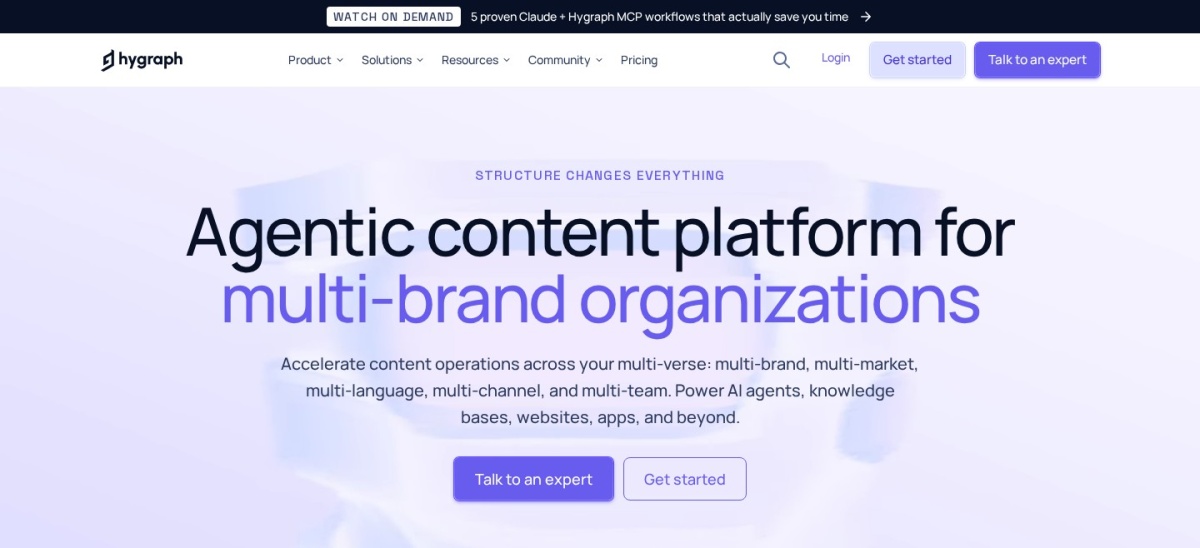
Hygraph homepage, captured Nov 2026.
Hygraph is a headless CMS centered on GraphQL, structured content modeling and combining content from external sources. Its free Hobby plan includes 3 seats, 1,000 entries, 500,000 API calls and 2 locales. Live previews, commenting and assignment workflows are available.
The trade off is the jump to Growth at $199 monthly. Growth increases capacity to 10 seats, 10,000 entries, 1 million API calls and 3 locales, with additional federation capabilities. It suits teams building complex content applications that depend on GraphQL and external data.
What we like
GraphQL-first content delivery
Supports connected external content sources
Free tier includes collaboration tools
Structured content modeling
Growth supports larger editorial teams
Watch out for
Large price increase from free to paid
Free plan limits content entries
Advanced governance requires upgrades
GraphQL expertise may be needed
Growth adds seats, entries, API capacity, locales and remote-source connectivityVisit hygraph.com
07
Contentful
4.3/5on G2 (402 reviews, checked Nov 2026)
Paid from$300/mo
Best for established teams managing multichannel content
Free users10
Free API calls100K/mo
Lite users20
Paid planLite, $300/mo
contentful.com
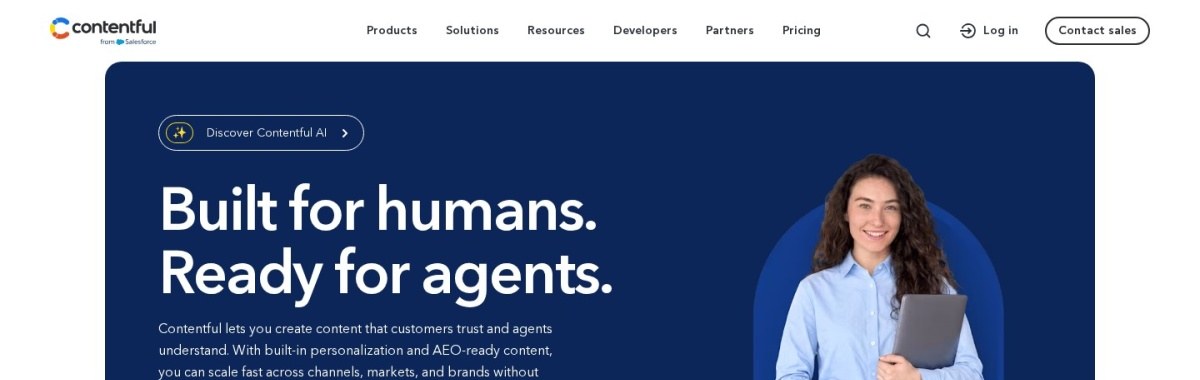
Contentful homepage, captured Nov 2026.
Contentful is a headless content platform for managing structured information across websites, applications and digital channels. Its free plan includes 10 users, 2 roles, 2 locales, 100,000 monthly API calls and 50 GB CDN bandwidth. Lite expands capacity to 20 users and 1 million monthly API calls.
The trade off is that Lite costs $300 monthly, considerably more than smaller-team alternatives. It includes 3 roles, 3 locales, 100 GB CDN bandwidth, comments, task management and scheduled publishing, while advanced governance requires Enterprise. It suits established organizations managing multiple content workflows and growing editorial teams.
What we like
Structured content delivery across channels
Free plan supports multiple users
Editorial collaboration on Lite
Scheduled publishing and task management
Enterprise governance options available
Watch out for
High paid entry price
Free plan has limited API capacity
Advanced security controls require Enterprise
Complex implementations need development resources
Lite adds users, locales, API capacity, collaboration and scheduled publishingVisit contentful.com
Headless CMS vs traditional CMS: which should you choose?
A traditional CMS commonly manages content and website presentation in the same environment. A headless CMS separates them, delivering structured content through APIs to an independently developed frontend.
Headless architecture makes sense when content must support several applications, when developers want framework flexibility or when teams need reusable content models across projects.
The drawback is additional development responsibility. A headless CMS generally does not provide a finished public website automatically. Teams must build and maintain the frontend, connect APIs and manage deployment.
For a straightforward blog or small business website, a traditional CMS may be simpler. For custom applications, multichannel publishing and structured content operations, headless software may be more suitable.
What affects headless CMS pricing?
A headless CMS subscription is only part of the budget. Development, frontend hosting, media delivery, API requests, team seats and third-party integrations can add expenses.
Pricing structures vary. Sanity Growth costs $15 per seat monthly, Storyblok Growth costs $99 monthly with 5 included seats, and Contentful Lite costs $300 monthly for 20 users.
API consumption also matters. Strapi Cloud Starter includes 100,000 monthly requests, while Prismic's free tier provides 4 million monthly API calls. These allowances cannot be compared without accounting for traffic patterns and API behavior.
Self-hosted open-source software avoids a mandatory CMS subscription but introduces infrastructure and maintenance costs. Estimate expenses using expected publishing activity, editorial team size and application traffic.
How we chose
We compared established headless content management platforms with active development, documented APIs and substantial public review histories. The selection includes hosted SaaS services, visual editing platforms, GraphQL-focused systems and open-source software with managed hosting options.
Official pricing pages and G2 review listings were consulted during the November 2026 comparison, using 22 November 2026 as the requested reference date. Published regular entry prices were used instead of temporary promotions, and annualized costs were calculated from the displayed monthly billing rates.
We excluded products without confirmed public paid pricing, sufficient review evidence or a clear fit for general headless content management. We evaluated published documentation and specifications rather than claiming implementation experience. No vendor paid for a place, and we do not claim testing for this list.
How to choose the best headless CMS software
Identify where your content needs to appear, then compare editing workflows, technical requirements and long-term costs.
Map your content types and publishing channels. Decide whether you need blog posts, product records, documentation, landing pages or reusable application content. Choose a platform whose modeling tools support those structures and can distribute content to your required frontends.
Evaluate the experience for developers and editors. Developers need clear APIs, documentation and deployment options, while marketers may prioritize visual previews and reusable page components. Sanity offers flexible schemas, Storyblok emphasizes visual editing, and Strapi gives teams more backend control.
Compare capacity against expected usage. Review API requests, bandwidth, content entries, locales, user seats and media storage. Estimate growth rather than choosing only by the free allowance. Check whether exceeding a limit blocks requests or results in additional charges.
Account for security, operations and migration. Check user permissions, version history, backups, export methods, hosting responsibilities and integrations. Consider the developer time needed to connect the CMS to your frontend and maintain it after launch.
FAQ
What is the best headless CMS software in 2026?
Sanity is our overall recommendation because its free plan supports up to 20 user seats and its Growth tier costs $15 per seat monthly. Storyblok is better for marketing teams seeking visual editing, while Prismic offers an inexpensive paid starting point for smaller websites.
What is a headless CMS?
A headless CMS stores and manages content independently of the presentation layer. Applications retrieve that content through APIs and display it using their own frontend code. This makes it possible to reuse structured information across websites, mobile apps and other digital experiences.
Is there a free headless CMS?
Yes. Sanity, Prismic, Storyblok, Hygraph, Contentful and ButterCMS provide free hosted plans with different usage limits. Strapi also provides open-source software that can be self-hosted without purchasing a CMS license, although hosting and maintenance may still involve costs.
Which headless CMS is best for developers?
Sanity is a strong general choice for developers needing flexible schemas and API-driven content management. Strapi is attractive when backend customization and self-hosting matter most. Hygraph is particularly relevant to projects using GraphQL and content from multiple external sources.
Which headless CMS is best for marketers?
Storyblok is a strong option for marketing teams because its visual editing approach makes page composition more accessible. Prismic also provides a visual page builder and reusable page sections. Both still require developers to establish frontend integrations and content structures.
How much does headless CMS software cost?
Several platforms offer free plans. Paid entry prices include Prismic at $10 monthly with annual billing, Sanity at $15 per seat monthly, Strapi Cloud at $35 monthly and Contentful Lite at $300 monthly. Hosting, API usage, additional seats and development work may increase total expenses.
Is headless CMS better for SEO?
A headless CMS can support search-friendly websites, but it does not automatically improve rankings. SEO performance depends on frontend rendering, crawlable content, metadata, canonical tags, structured data and site speed. Developers must implement these elements properly regardless of which headless platform stores the content.
Can I use a headless CMS with Next.js?
Yes. Headless systems such as Sanity, Strapi, Prismic and Storyblok can deliver content to Next.js applications through APIs. Implementation details vary by platform, especially around previews, caching, image delivery and content updates. Review framework documentation before choosing.
What is the difference between Strapi and Sanity?
Strapi is an open-source CMS that teams can host and customize themselves, with optional managed cloud hosting. Sanity provides a hosted content database and customizable editing environment. Strapi emphasizes infrastructure and backend control, while Sanity emphasizes hosted content operations and collaborative editing.