Device42 is the best DCIM software for most teams. It pairs agentless discovery and dependency mapping with rack, asset and capacity tools, rated highly on G2, while Sunbird suits operators who want pure DCIM with published pricing and Hyperview suits smaller sites on a budget.
How we make this list: we compare pricing pages, product documentation and public user reviews, then re-check every price before each update. No product paid for a place. Disclosure.
Device42 leads on G2 among the established tools at 4.7 out of 5 from 51 reviews, pairing discovery with DCIM.
Sunbird is the only established DCIM vendor with fully published prices: Power IQ from $5.50 per node a month.
Hyperview is the cheapest cloud DCIM here at $125 a month for 500 assets, with a 30-day free trial.
Nlyte, Device42 and FNT sell by quote, so budget for a sales process and an implementation project.
EcoStruxure IT is the pick for Schneider and APC estates, with cloud monitoring from $60 per node a year.
What DCIM software should cover
DCIM software keeps the record of what is in the data hall: racks, devices, power chains, cooling and cabling, and how they connect.
Capacity planning is the core job. The tool should show free rack space, stranded power and cooling headroom before you buy new hardware.
Discovery separates the IT-led tools from the facilities-led ones. Device42 finds devices on the network, while Sunbird and Nlyte document what operators place in the hall.
Pricing units do not match across vendors. Sunbird charges per cabinet or node, Hyperview per asset, Schneider per node and FNT per user, so compare the same room everywhere.
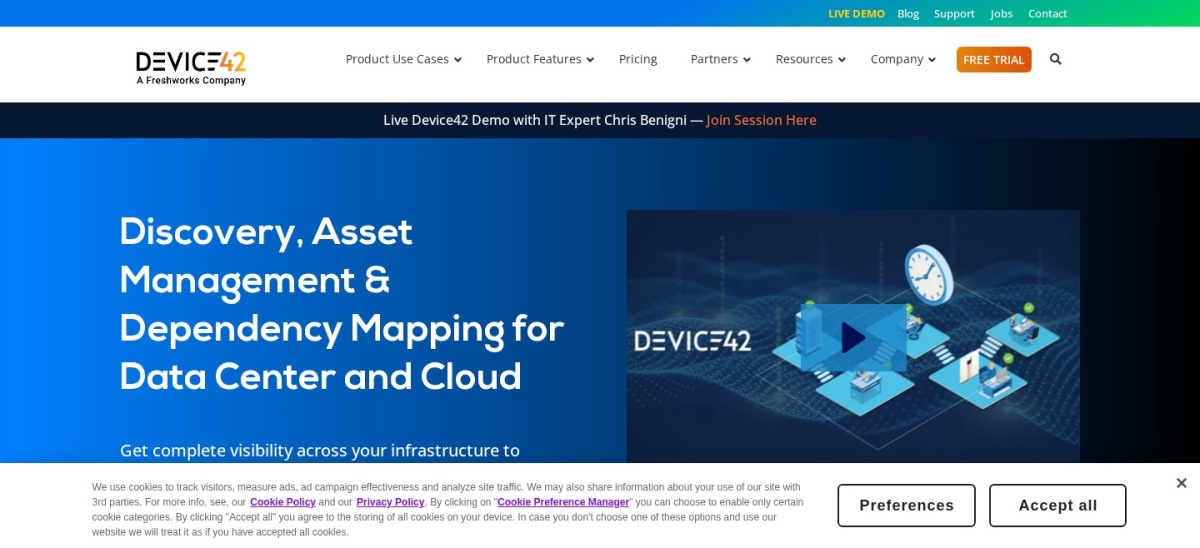
Device42 is a discovery-led DCIM platform that finds every device on the network without agents, then maps dependencies between applications, servers and racks. It also covers asset records, IP address management, certificates and power and capacity planning, with customers in 70+ countries.
The trade off is price and scope. Device42 is quote-only with no published figures, and teams that only need rack and power records may find it broad. It suits IT teams that need discovery, dependency mapping and DCIM in one system.
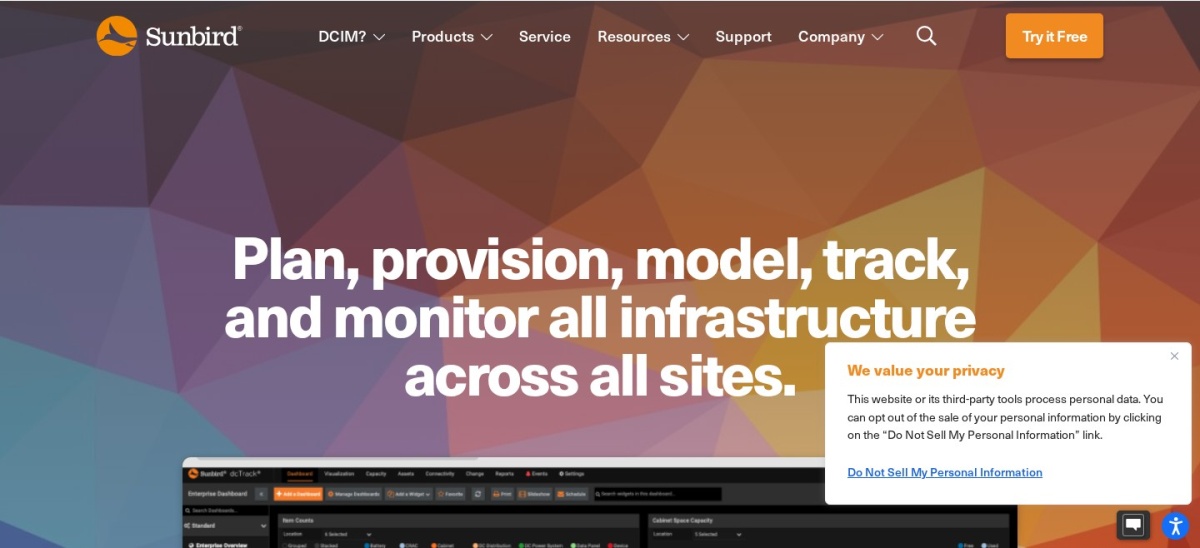
Sunbird DCIM is a pure DCIM platform built for data center operators, split into dcTrack for assets, capacity and changes and Power IQ for power, energy and environment monitoring. It publishes its prices, with Power IQ from $5.50 per node a month and dcTrack from $19.50 per cabinet a month.
The trade off is that Sunbird documents rather than discovers. It records what operators place in the hall instead of finding devices on the network. It suits operators whose main pain is capacity planning, power management and change control.
Nlyte is an enterprise DCIM platform for large estates, covering assets, capacity, power, environment and workflow from desktops to data centers to edge sites. Cisco deferred a $20 million data center build using Nlyte capacity data, and it now sits inside Carrier.
The trade off is price and project size. Nlyte is quote-only and built for large enterprises, so smaller teams face a sales process and an implementation project. It suits large organizations managing data centers, colocation, edge and cloud together.
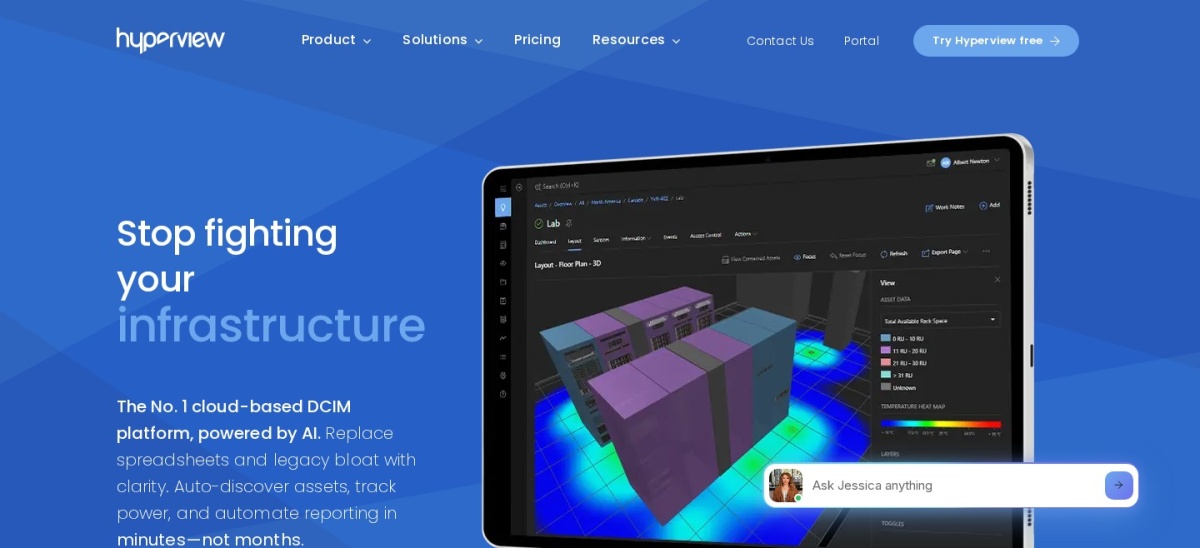
Hyperview is cloud DCIM priced at $3 per asset per year with a 500-asset minimum, so the floor is $1,500 a year or $125 a month. It covers auto-discovery, 2D and 3D views, power path mapping, capacity planning and alarms, with a 30-day free trial and no servers to maintain.
The trade off is depth at scale. Hyperview holds 4.8 out of 5 on G2 from only 21 reviews, and estates over 10,000 assets move to quote pricing. It suits smaller sites and edge estates that want real DCIM without an enterprise project.
EcoStruxure IT is Schneider Electric's DCIM portfolio, with IT Expert for cloud monitoring, Data Center Expert for on-premises management and IT Advisor for planning and capacity modeling. It aggregates many sites into one dashboard, which suits distributed edge estates.
The trade off is a thin review base and hardware ties. IT Expert holds 4.5 out of 5 on G2 from only 2 reviews, and it works best on Schneider and APC power and cooling. It suits organizations running Schneider gear that want vendor-backed monitoring.
What we like
One dashboard across many sites
Vendor-backed monitoring and support
Planning and capacity modeling included
Watch out for
Only 2 G2 reviews
Works best on Schneider and APC gear
Per-node price falls only at volume
Volume tiers fall to $43.50 per node a yearVisit se.com
06
Modius OpenData
4.3/5on G2 (23 reviews, checked Nov 2026)
PricingCustom/yr
Best real-time power monitoring
MonitoringReal-time, multi-site
AnalyticsPredictive
ProtocolsBACnet, SNMP, Modbus
Paid planCustom quote
modius.com
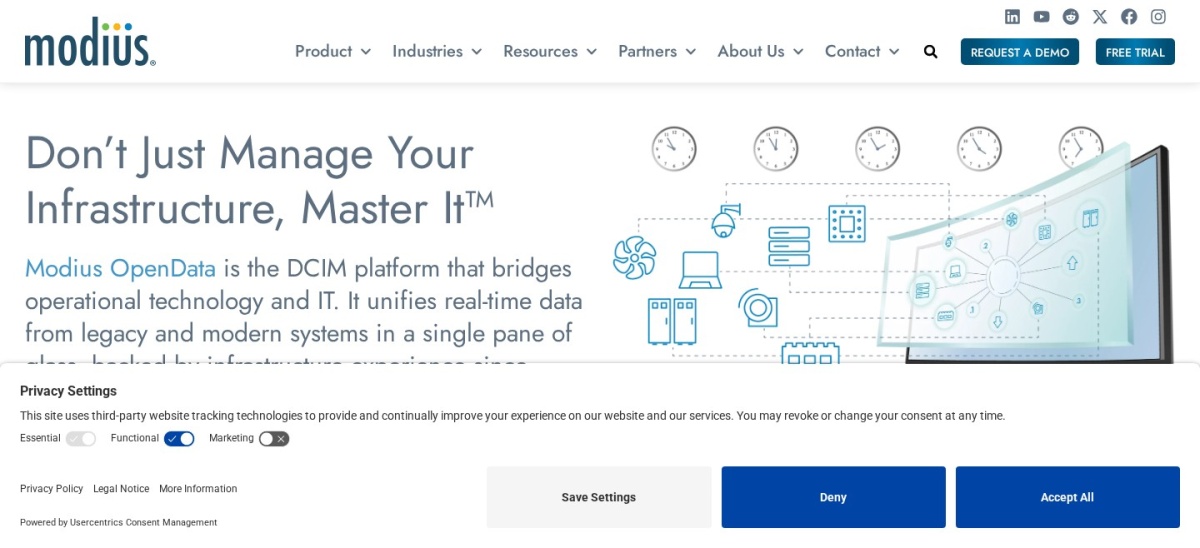
Modius OpenData homepage, captured Nov 2026.
Modius OpenData is a real-time monitoring platform for power, cooling and environmental sensors across many sites. It collects data from any vendor's equipment, normalizes it into one view and adds predictive analytics, with a modular design that lets teams buy only the parts they need.
The trade off is focus and price. Modius is a monitoring platform first, with less depth on asset and change workflows, and it sells by quote. It suits teams whose main problem is real-time power events across distributed sites.
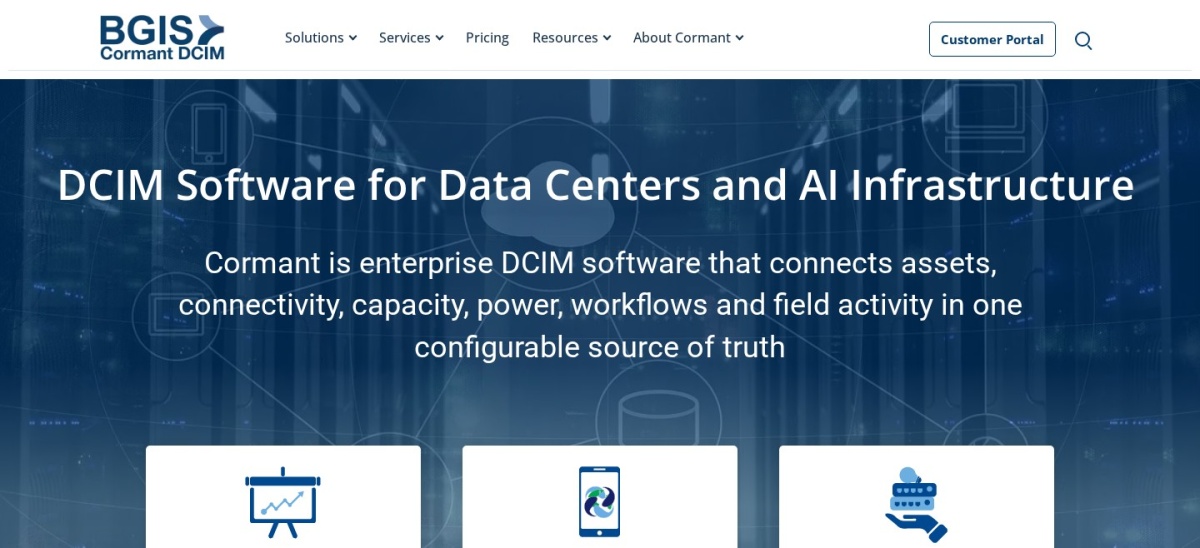
Cormant-CS is a connectivity management platform that documents every port, cable and patch panel, with moves and changes tracked. It is configurable and mobile-first, so technicians can audit the floor from a phone, and it covers assets and rack capacity alongside the cabling.
The trade off is a narrow focus and a thin review base. Cormant holds 4.4 out of 5 on G2 from only 5 reviews, and reported pricing starts around $600 a month. It suits data centers where cabling chaos causes outages.
FNT Command is a documentation platform for IT, facility and telecom assets and their relationships in one data model, from the physical layer through logical and virtual structures to services. It is used by 500+ customers with 25,000+ users, mostly in Europe.
The trade off is price in euros and a thin review base. FNT holds 4.1 out of 5 on Capterra from only 8 reviews, and reported pricing runs about 99 euros per user a month. It suits European enterprises with strict data rules.
Cloud DCIM such as Hyperview and EcoStruxure IT Expert needs no servers to maintain and updates without projects.
On-premises DCIM such as Sunbird dcTrack and Nlyte suits estates with strict data rules or no cloud connection in the hall.
Most teams mix the two. Monitoring often runs in the cloud while the asset record stays on premises, so check how the two sync.
How we chose
We started from every DCIM product with a G2 or Capterra listing, then kept those with a real data center product and a verifiable rating.
Prices come from each vendor's pricing page, checked on 25 November 2026. Ratings come from G2 or Capterra on the same day. Where a vendor shows no price, the list shows Custom and the notes record any reported figure.
We left out free open-source tools with no review listing and general monitoring tools with no DCIM features. No vendor paid for a place, and we do not claim hands-on testing for this list.
How to choose DCIM software
Start with what you manage: the hall, the network, or both.
Map what you need to track. List your racks, power chains, cooling and cabling. If the list is mostly IT assets, start with Device42; if it is mostly facilities, start with Sunbird or Nlyte.
Check discovery against documentation. Decide whether the tool should find devices itself or record what your team installs. Discovery saves audits; documentation suits change control.
Compare prices for the same room. Price every shortlisted tool for one hall with the same cabinet and node counts. Per-asset, per-cabinet and per-node prices hide very different totals.
Trial with your own data. Load a real rack and a real power chain into the trial. The tool that models your hall correctly in a week is the one to buy.
FAQ
What is the best DCIM software?
Device42 is the best DCIM software for most teams. It combines agentless discovery, dependency mapping and a CMDB with rack, asset and capacity tools, and it holds 4.7 out of 5 on G2 from 51 reviews. Sunbird is the strongest pure DCIM choice.
How much does DCIM software cost?
Published prices run from $5.50 per node a month for Sunbird Power IQ to $125 a month for Hyperview's 500-asset plan. Schneider lists IT Expert from $60 per node a year. Device42, Nlyte, Modius, Cormant and FNT sell by quote.
What is the difference between DCIM and network monitoring?
DCIM tracks the physical data center: racks, power, cooling, space and cabling. Network monitoring tracks traffic and device health on the network. Device42 covers both, while Sunbird and Nlyte focus on the physical side.
Is there a free DCIM tool?
Open-source tools such as openDCIM and RackTables are free, but they have no G2 or Capterra rating and no vendor support, so they did not make this list. Hyperview, Device42 and EcoStruxure IT offer 30-day free trials instead.
Which DCIM tool is best for a small data center?
Hyperview is the best DCIM tool for a small data center. It is cloud software with agentless discovery, 2D and 3D views and capacity planning from $125 a month for 500 assets, and it holds 4.8 out of 5 on G2.
Does DCIM software work for colocation?
Yes. Sunbird, Nlyte and Hyperview all support colocation, with per-customer views, billing data and capacity reports. Hyperview and Sunbird publish prices, which helps when you pass costs to tenants.
SaaS SEO and WordPress specialist with about 8 years of experience. Rakib compares WordPress plugins, themes, hosting and software using public pricing, documentation and user reviews. See how we rank.