Apache Airflow is the best data pipeline orchestration software for most teams: free, open source, and the scheduler every data engineer already knows. dbt Cloud leads for SQL-first teams at $100 per user a month, while the cloud services — Azure Data Factory, AWS Glue and Google Cloud Dataflow — suit teams already on their cloud.
How we make this list: we compare pricing pages, product documentation and public user reviews, then re-check every price before each update. No product paid for a place. Disclosure.
Apache Airflow is the best pick for most teams: free, open source, and the pipeline scheduler every data engineer already knows, with a 4.4 out of 5 G2 rating from 130 reviews.
dbt Cloud has the highest rating here at 4.7 out of 5 from 209 G2 reviews, with a free Developer tier and Starter at $100 per user a month — but dbt Labs merged with Fivetran in October 2025.
Dagster leads for asset-based pipelines with lineage built in, though its G2 rating rests on just 2 reviews, and Prefect is the lightest Python start at $100 a month.
The cloud services — Azure Data Factory at $1 per 1,000 runs, AWS Glue at $0.44 per DPU-hour and Google Cloud Dataflow at $0.056 per vCPU-hour — suit teams already on their cloud.
Matillion and Informatica IDMC are the enterprise platforms, both quote-only, and both now sell AI agents alongside their pipelines.
What to look for in pipeline orchestration software
Pipeline orchestration runs the whole pipeline, not just the schedule: it moves data from source to target, transforms it, retries failures and shows what broke. A scheduler alone is only half the job.
The tools split two ways: code-first orchestrators like Airflow, Dagster and Prefect that schedule anything, and cloud-native pipeline services like Azure Data Factory, AWS Glue and Google Cloud Dataflow that move and transform data inside one cloud.
dbt Cloud sits between them: it transforms data already in the warehouse with SQL, and schedules the jobs that run those models. It needs an orchestrator or a warehouse to trigger it, but for SQL teams it is the whole pipeline.
The billing meter decides the real cost. Airflow, Dagster and Prefect have free tiers; the cloud services bill per run, per DPU-hour or per vCPU-hour, and those meters do not map cleanly to each other. Our guide to data orchestration tools covers the schedulers on their own.
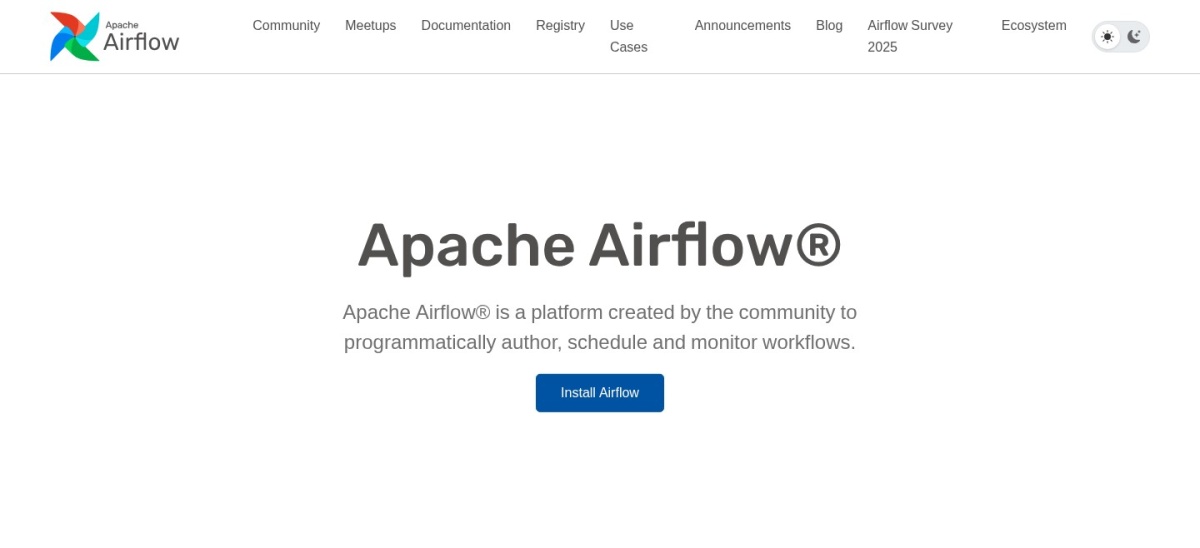
Apache Airflow is the open-source standard for orchestrating data pipelines. Pipelines are Python files called DAGs, operators cover every cloud service, and any data engineer the team hires will already know it.
The trade off is the operational load. Self-hosting Airflow means running the scheduler, workers, metadata database and upgrades yourself, and Airflow 3 changed enough that migrations take planning. It suits teams with a platform engineer.
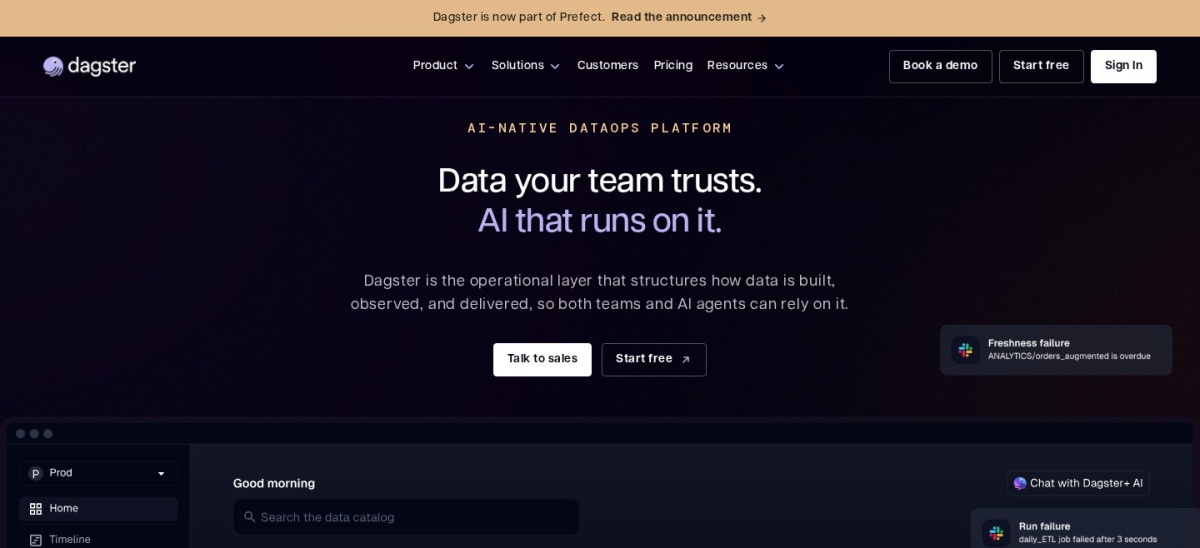
Dagster is a modern orchestrator that thinks in data assets rather than tasks. Declare the tables, files and models you want, and the platform figures out the execution order, tracks lineage and shows asset health.
The trade off is the thin review base and the new ownership. Its G2 rating rests on 2 reviews, and Prefect acquired Dagster Labs in July 2026, so buyers should watch how the two products converge. It suits teams that think in tables.
Prefect is a workflow orchestration platform built for Python teams that want the lightest setup. Add a decorator to existing functions and get scheduling, retries, observability and alerting without restructuring code into DAG files.
The trade off is the seat-based bill and the acquisition. Starter costs $100 a month for 3 users, Team costs $100 per user a month, and Prefect bought Dagster Labs in July 2026. It suits small Python-first teams.
dbt Cloud is the hosted home of dbt, the SQL-first tool for transforming data already in the warehouse. Models are SQL files with tests, docs and lineage, and the Cloud scheduler runs them on a timetable with CI checks on pull requests.
The trade off is the seat bill and the merger. Starter costs $100 per user a month with 15,000 model runs included and $0.01 per run beyond that, and dbt Labs merged with Fivetran in October 2025. It suits SQL-first teams.
Azure Data Factory is Microsoft's fully managed, serverless data integration service for building automated pipelines. Its low-code visual designer moves and transforms data across Azure services with 90+ connectors.
The trade off is the meter maze and the Azure lock-in. Orchestration bills per 1,000 runs, data movement per DIU-hour, and the vendor pricing page shows no dollar figures, so the $1 rate rests on secondary reads. It suits teams already on Azure.
AWS Glue is the serverless ETL service inside AWS. Write or generate Apache Spark, Spark Streaming or Python jobs, let crawlers discover schemas, and store metadata in the Glue Data Catalog that other AWS analytics services read.
The trade off is the meter and the lock-in. Jobs bill $0.44 per DPU-hour with a 1-minute minimum, and Glue 6.0 cut rates by 30 percent in August 2026, so older price reads are stale. It suits teams that already keep data in S3 and Redshift.
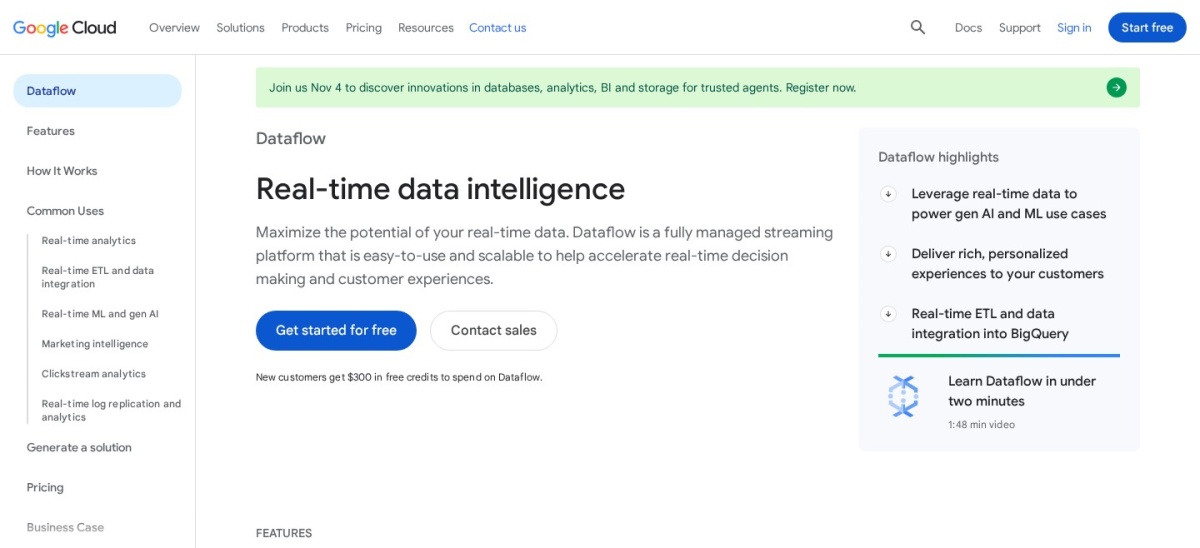
Google Cloud Dataflow homepage, captured Nov 2026.
Google Cloud Dataflow is a fully managed, serverless engine for batch and streaming pipelines built on the open-source Apache Beam model. Write pipelines in Python, Java or Go, and Dataflow handles autoscaling, work distribution and fault tolerance.
The trade off is cost control. Batch bills about $0.056 per vCPU-hour plus memory, streaming about $0.0828, and reviewers warn that unconfigured jobs run up bills. It suits Google Cloud shops with real-time pipelines.
Matillion is a cloud-native data integration platform that runs ETL and ELT inside the warehouse. Its visual designer builds pipelines without code, and the Maia AI agent now writes and documents pipelines on request.
The trade off is the quote-only pricing. Matillion publishes no dollar prices and bills by usage credits, so the only way to get a figure is a sales call. It suits enterprise teams on Snowflake, Databricks or BigQuery.
Informatica IDMC is the enterprise platform for data integration, quality, governance and catalog in one suite. Its CLAIRE AI engine automates pipeline building, and its connectors cover almost every enterprise source.
The trade off is price and complexity. IDMC bills by IPUs, a consumption unit with no public dollar rate, and implementations take months. It suits large enterprises consolidating many data tools.
A code-first orchestrator like Airflow schedules anything: it runs your Python, calls your APIs and triggers your dbt jobs. It moves no data itself, so you still need ingestion and transformation tools beside it.
A pipeline service like Azure Data Factory or AWS Glue moves and transforms data in one place, with scheduling built in. The trade is lock-in: the pipelines live inside one cloud, and moving them means rebuilding them.
Most teams end up with both: an orchestrator on top, pipeline services underneath. Airflow triggering dbt Cloud jobs, or Dagster orchestrating Glue jobs, is the normal shape — pick the orchestrator first, then the service that matches your cloud.
How we chose
We started from the data pipeline orchestration tools most commonly shortlisted for running end-to-end pipelines, then kept the nine with a verifiable G2 rating, a live product and orchestration as a core job.
Prices come from each vendor's pricing page, checked on 25 November 2026. Airflow is free and open source; Dagster and Prefect prices were confirmed on their vendor pricing pages today; Glue, Dataflow, dbt Cloud, Azure Data Factory and Matillion figures are second-hand, since their vendor pages show no dollar rates in fetched text.
We left out Qlik Talend Cloud, which overlaps our data integration comparison, and Fivetran, which is ingestion-first and belongs in our pipeline software comparison. No vendor paid for a place, and we do not claim hands-on testing for this list.
How to choose pipeline orchestration software
Start with where the data lives — your cloud, your warehouse or your code — then check the billing meter.
Name where the data lives. AWS shops start with Glue, Google shops with Dataflow, Azure shops with Data Factory. Code-first teams start with Airflow, Dagster or Prefect.
Check the billing meter. Glue charges per DPU-hour, Dataflow per vCPU-hour, Data Factory per 1,000 runs, dbt Cloud per user and Prefect per seat. Model your real volume before committing.
Weigh the review base. dbt Cloud, Airflow, Prefect and Informatica carry 100+ G2 reviews each; Dagster has 2 and Dataflow 45, so treat their scores as weak signals.
Start free, then decide. Airflow, Dagster and dbt Cloud all cost nothing to start, and Prefect's Hobby tier is free. Run a real pipeline before paying for a cloud service.
FAQ
What is the best data pipeline orchestration software?
Apache Airflow is the best data pipeline orchestration software for most teams: free, open source, and the scheduler every data engineer knows. dbt Cloud leads for SQL-first teams.
What is the difference between Airflow and Azure Data Factory?
Airflow is a code-first orchestrator that schedules anything but moves no data itself. Azure Data Factory is a cloud service that moves, transforms and schedules data inside Azure.
How much does AWS Glue cost?
AWS Glue costs $0.44 per DPU-hour, billed per second with a 1-minute minimum. Glue 6.0, released in August 2026, cut rates by 30 percent, so older price reads are stale.
Is dbt Cloud an orchestration tool?
Yes, partly. dbt Cloud schedules and runs SQL transformation jobs in the warehouse, with CI checks and lineage. It does not move data, so teams pair it with an orchestrator or an ingestion tool.
Did Fivetran buy dbt?
dbt Labs and Fivetran merged in an all-stock deal announced in October 2025. dbt Core remains open source, and nothing visible has narrowed so far.
Which pipeline orchestration tool is best for streaming?
Google Cloud Dataflow is the best pick for streaming pipelines, with unified batch and streaming on Apache Beam and exactly-once processing. AWS Glue covers Spark Streaming on the AWS side.
SaaS SEO and WordPress specialist with about 8 years of experience. Rakib compares WordPress plugins, themes, hosting and software using public pricing, documentation and user reviews. See how we rank.