Best AI Data Visualization Tools in 2026: 9 Tools Compared
WLWPLegible EditorsLast verified 24 Nov 2026How we rank15 min read
★ Short answer
Power BI is the best AI data visualization tool for most teams, rated 4.5 out of 5 on G2 from 1,667 reviews, with Copilot AI and a $14-a-month Pro plan; pick Hex for AI agents in notebooks or Julius AI if you want a chat-first analyst that turns a spreadsheet into charts.
How we make this list: we compare pricing pages, product documentation and public user reviews, then re-check every price before each update. No product paid for a place. Disclosure.
Power BI is the best all-round pick, rated 4.5 out of 5 on G2 from 1,667 reviews, with Pro at $14 a user a month confirmed on Microsoft's pricing page; Advanced AI needs the $24 Premium Per User tier.
Hex is the strongest AI-native workspace, rated 4.5 out of 5 from 433 reviews, with AI agents in notebooks and a free Community tier; Professional is $36 a month on vendor-supplied G2 pricing.
Julius AI turns a spreadsheet into charts by chat, from $20 a month confirmed on its own pricing page, but its 4.5-star G2 rating rests on only 4 reviews.
Three of the nine sell by quote: Domo, Sisense and Looker, whose Standard platform fee alone is $5,000 a month before user licences.
Polymer was dropped because its G2 rating could not be verified cleanly, and Hex replaced it; free tiers exist on Power BI, Hex, Julius, Tableau Public and ThoughtSpot.
What AI data visualization means
AI data visualization now splits two ways. Enterprise BI platforms such as Power BI, Tableau, Qlik Sense and Looker have layered AI onto governed dashboards, while AI-first tools such as Julius AI, Hex and ThoughtSpot start from a question in plain language and build the chart for you.
Prices are only half the story. The cheapest published paid plans are Power BI at $14 a user a month, Tableau Viewer at $15 and Julius AI at $20, while Domo, Sisense and Looker sell by quote, and Looker's Standard platform fee alone is $5,000 a month before licences.
The AI is often metered or gated. Power BI's Advanced AI needs the $24 Premium Per User tier, Hex and Julius charge AI by credits, and ThoughtSpot meters Spotter queries on Pro, so a month of real use can cost more than the headline plan. Free tiers soften the risk: Power BI, Hex, Julius, Tableau Public and ThoughtSpot Developer all cost nothing to start.
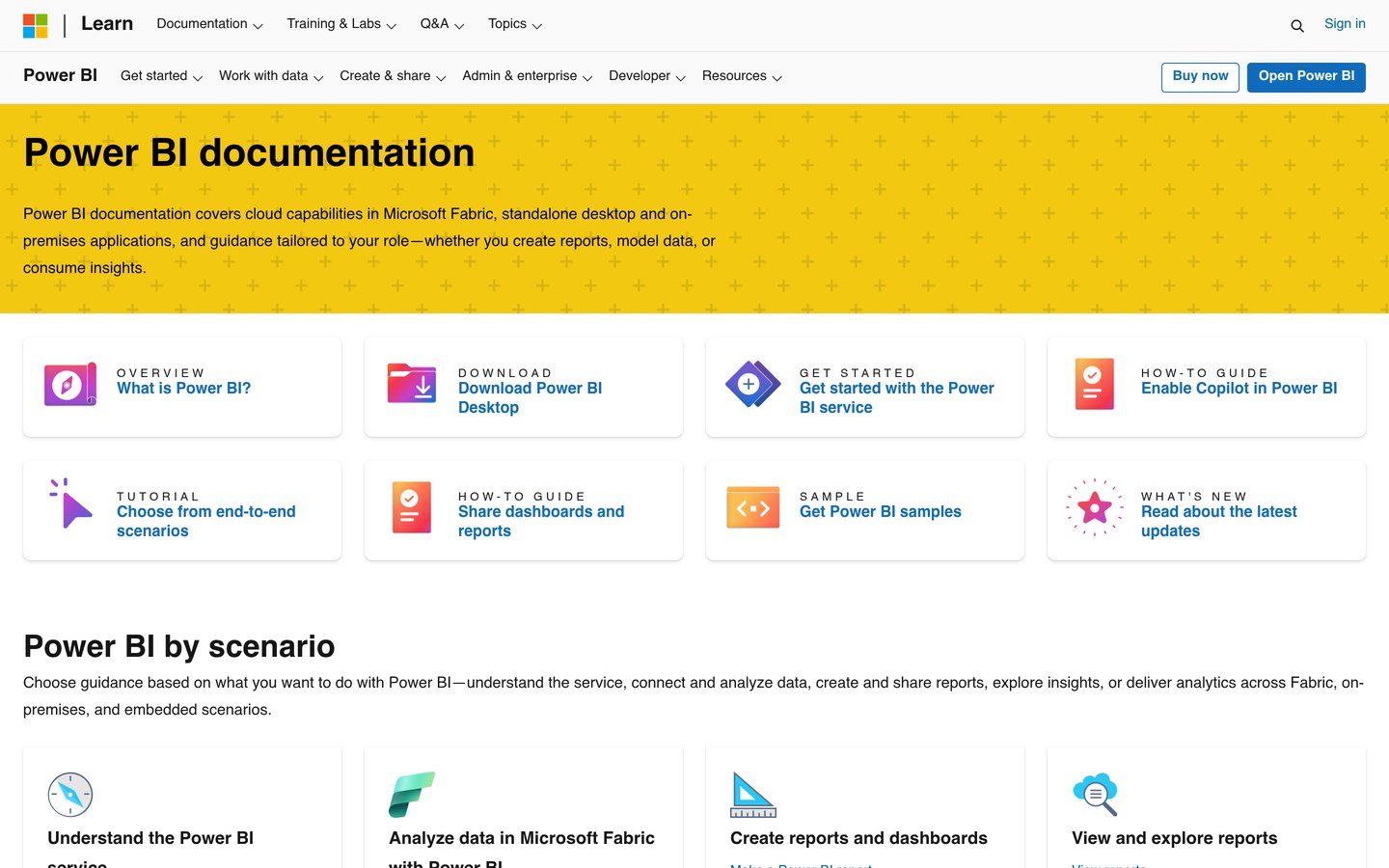
Power BI is Microsoft's enterprise BI platform, and the best AI data visualization tool for most teams. Copilot in Fabric answers questions in plain language, writes summaries and suggests visuals, while the semantic model keeps governed metrics consistent across reports. It is rated 4.5 out of 5 on G2 from 1,667 reviews.
The trade off is that the AI is tiered: the $14 Pro plan confirmed on Microsoft's pricing page does not include Advanced AI, which needs Premium Per User at $24 a month. G2's pricing listing still shows the old $10 Pro price, so expect older guides to quote it. It suits teams already on Microsoft 365 who want governed dashboards with AI help.
What we like
Highest review count here, 1,667 G2 reviews
Copilot AI writes summaries and suggests visuals
Free account included in Microsoft Fabric
Deep integration with Microsoft 365
Watch out for
Advanced AI needs the $24 Premium Per User tier
G2's own pricing page still shows the old $10 Pro price
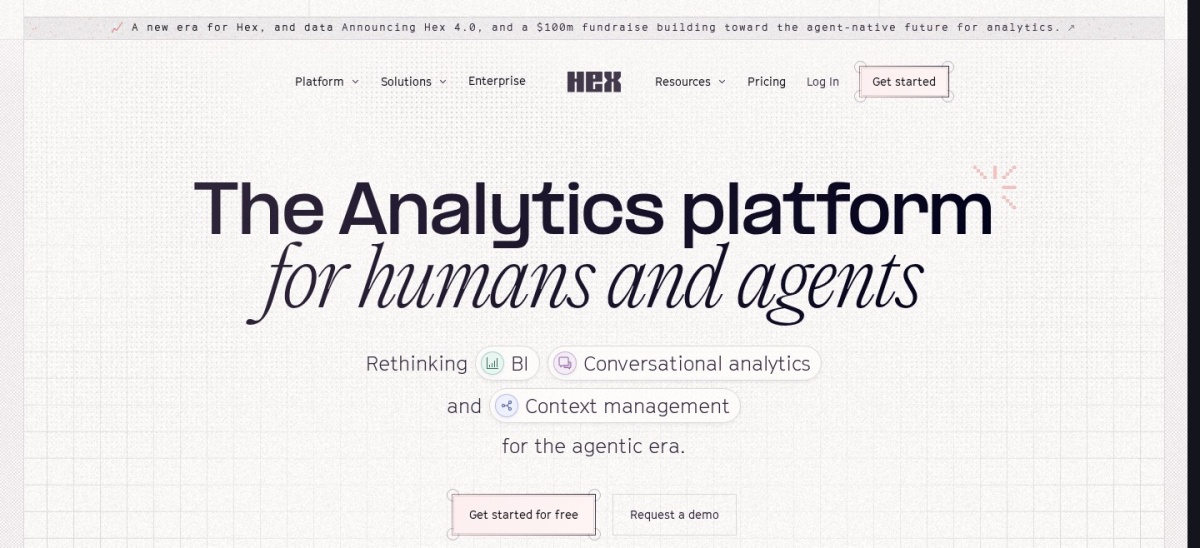
Hex is a collaborative data workspace where SQL and Python notebooks, AI agents and published data apps live in one place. Its Notebook agent writes and debugs code with full warehouse context, and Threads lets non-technical users ask questions in plain language. It is rated 4.5 out of 5 on G2 from 433 reviews.
The trade off is metering: AI features consume credits, with a monthly per-seat grant on paid plans and add-on credits beyond that, and one reviewer in June 2026 warned the proposed limits would gut the main benefit. The $36 Professional price comes from vendor-supplied G2 pricing, since the official pricing page did not render dollar figures. It suits data teams who want AI-assisted analysis in code, not just dashboards.
What we like
AI agents write and fix code in notebooks
Rated 4.5 out of 5 from 433 G2 reviews
Free Community tier to start
Threads for conversational self-serve analytics
Watch out for
AI use is metered by credits
$36 price is vendor-supplied, not on the official page
Notebook-first, weaker as a pure dashboard tool
Team at $75 a month adds unlimited published appsVisit hex.tech
03
Julius AI
4.5/5on G2 (4 reviews, checked Nov 2026)
Paid from$20/mo
Best chat-first AI analyst
Cheapest planPlus, $20/mo
AIChat analyst, writes Python
Free planYes, daily credits
Credits2,000 a month on Plus
julius.ai
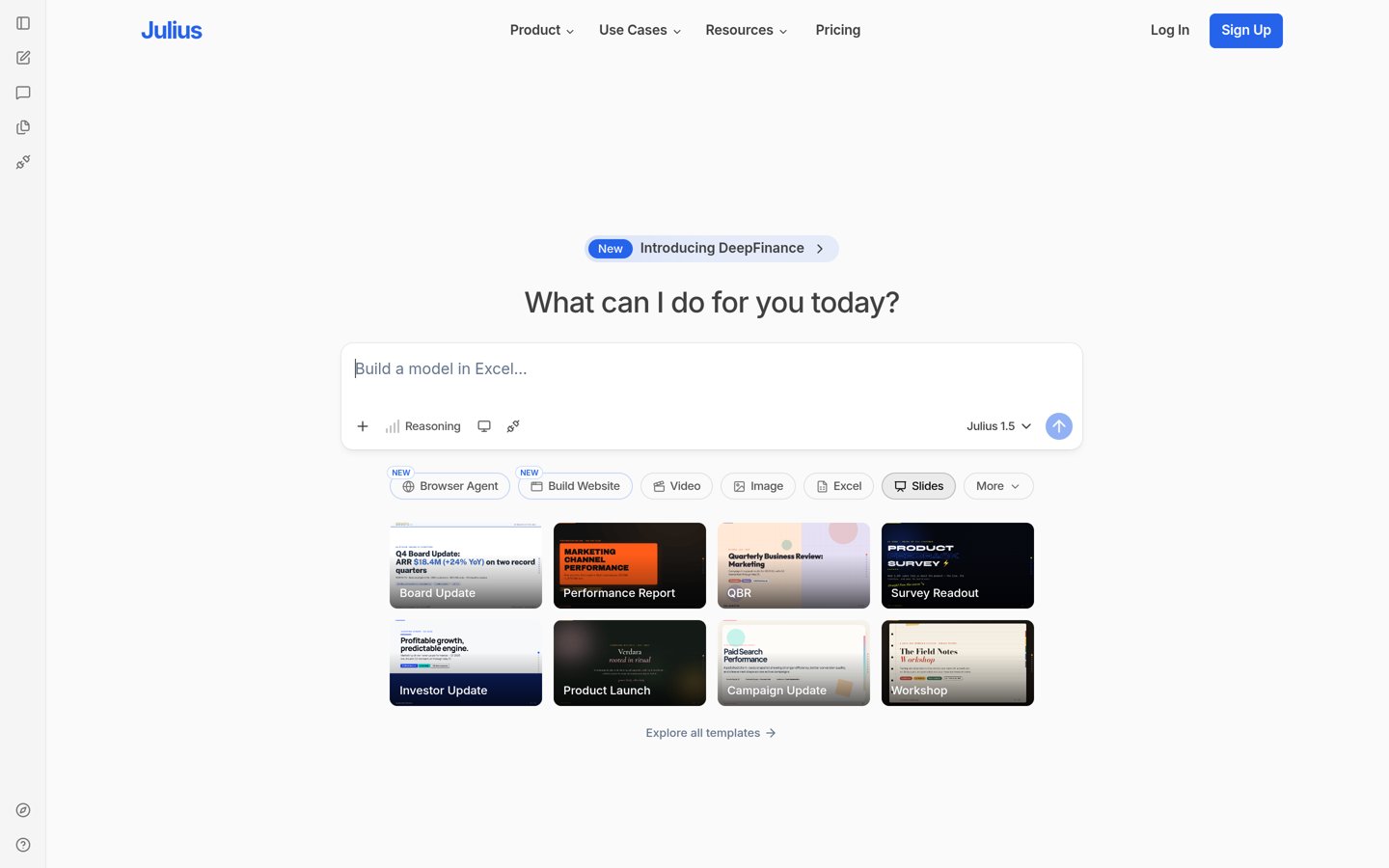
Julius AI homepage, captured Nov 2026.
Julius AI is a chat-first AI data analyst: upload a spreadsheet or connect a warehouse, ask a question in plain language, and it writes and runs Python to produce charts, forecasts and reports. It is rated 4.5 out of 5 on G2, though from only 4 reviews, and claims more than 2 million users.
The trade off is the thin review base: four G2 reviews cannot tell you how it holds up at scale, and the vendor's own site claims a 4.8 rating from 398 ratings that cannot be traced to G2, Capterra or Trustpilot. The $20 Plus price is confirmed on the official pricing page, after a cut from $35 in November 2026. It suits analysts who want fast answers from a spreadsheet without building a dashboard.
What we like
Chat-first: ask in plain language, get charts
Plus price confirmed on the official pricing page
2M+ users and 10M+ visualizations claimed
SOC 2 Type II and GDPR compliant
Watch out for
G2 rating rests on only 4 reviews
Plus plan cut from $35 to $20 in November 2026
Credits cap heavy analysis on cheaper plans
Pro at $45 a month adds 5,000 credits and priority supportVisit julius.ai
04
Tableau
4.4/5on G2 (4,237 reviews, checked Nov 2026)
Paid from$15/mo
Best visual design and exploration
Cheapest planViewer, $15/user/mo
AITableau Pulse and Agent
Free planYes, Tableau Public
Creator$75/user/mo
tableau.com
Tableau homepage, captured Nov 2026.
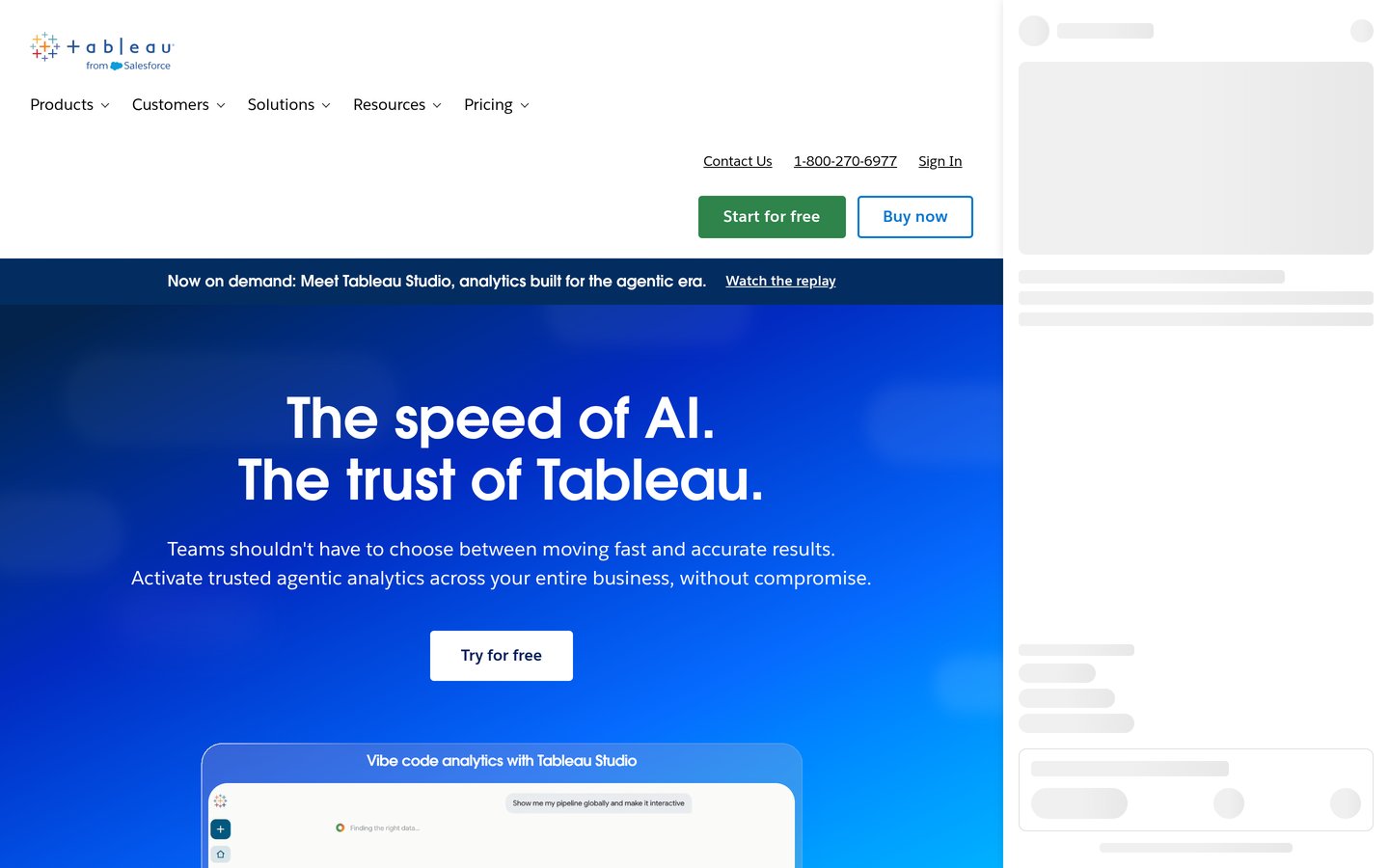
Tableau is Salesforce's visual analytics platform, and still the benchmark for exploring data by dragging fields onto a canvas. Tableau Pulse watches your metrics and flags what changed, Einstein answers questions, and Tableau Agent builds dashboards from a prompt. It is rated 4.4 out of 5 on G2 from 4,237 reviews.
The trade off is seat pricing: Viewer starts at $15 a user a month, but anyone building dashboards needs Creator at $75, and Cloud AI features are custom quoted rather than priced. Sources also disagree on whether Tableau Desktop is now free to download, so treat the free tier as Tableau Public. It suits teams that value visual exploration above all else.
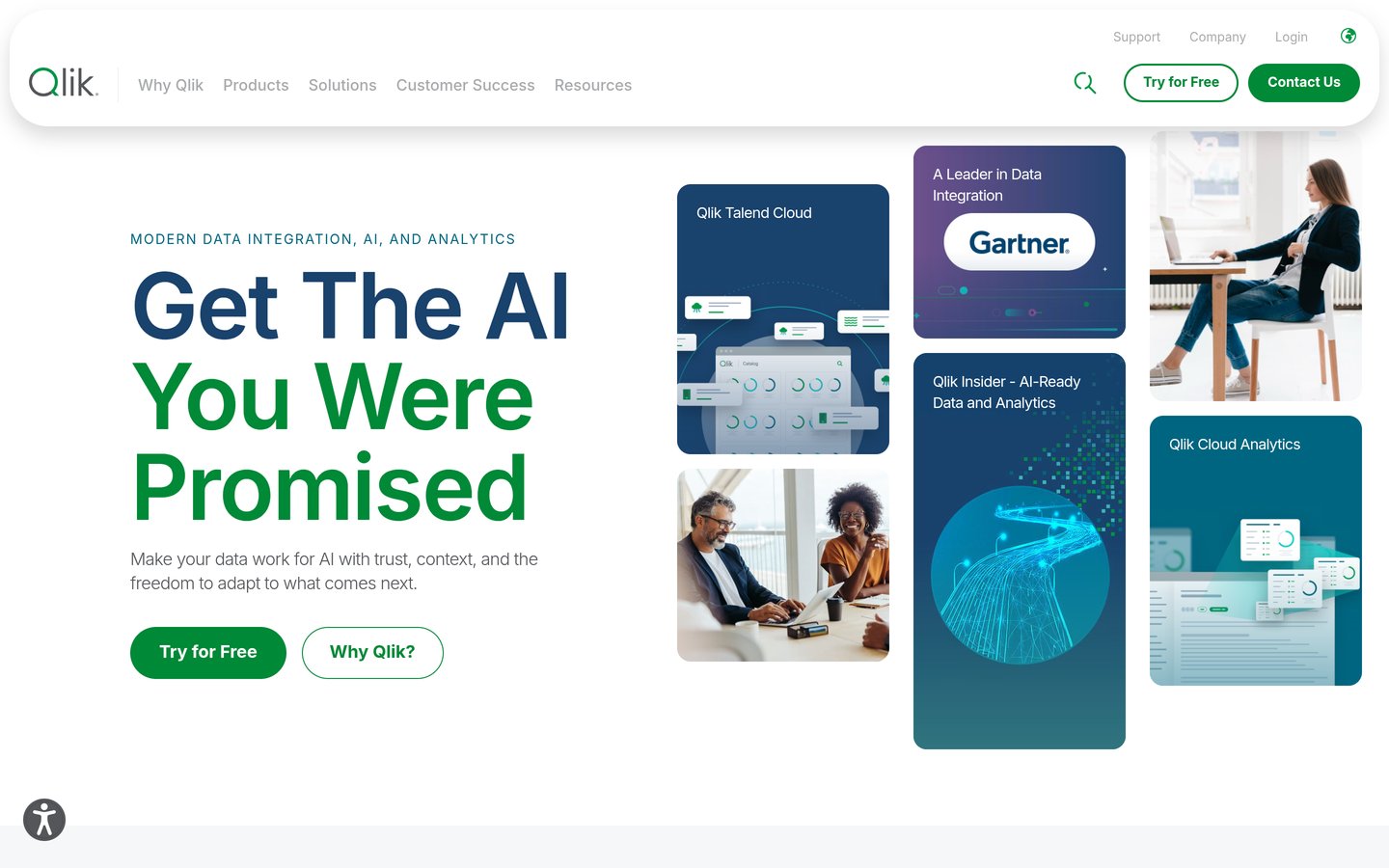
Qlik Sense is Qlik's self-service BI platform, built on an associative engine that links every field so users can explore in any direction without pre-built queries. Insight Advisor, its AI assistant, suggests charts and generates insights from natural-language questions. It is rated 4.4 out of 5 on G2 from 929 reviews.
The trade off is that Qlik Sense is a traditional BI platform with AI added on, not an AI-first tool: there is no free plan, only a trial, and the Enterprise tier is quote only. Implementation averages about three months according to G2 data. It suits mid-size and large teams that want governed self-service without the Tableau price.
What we like
Associative engine finds hidden relationships
Insight Advisor suggests charts automatically
Rated 4.4 out of 5 from 929 G2 reviews
Strong at governed, self-service BI
Watch out for
No free plan, trial only
Enterprise tier is quote only
Older interface next to AI-first tools
Enterprise is quote only with added governanceVisit qlik.com
06
ThoughtSpot
4.4/5on G2 (340 reviews, checked Nov 2026)
Paid from$25/mo
Best natural-language search
Cheapest planEssentials, $25/user/mo
AISpotter AI agent
Free planYes, Developer tier
Rows25M on Essentials
thoughtspot.com
ThoughtSpot homepage, captured Nov 2026.
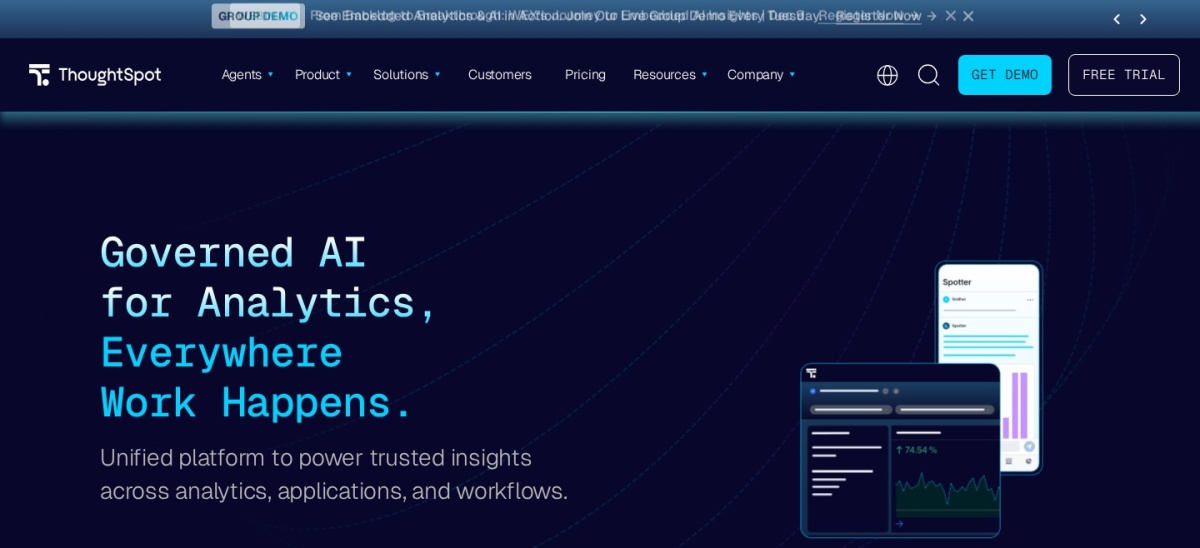
ThoughtSpot is a search-driven analytics platform: type a question in plain language and Spotter, its AI agent, builds the chart, while SpotterViz, SpotterModel and SpotterCode cover visualization, modelling and code. It is rated 4.4 out of 5 on G2 from 340 reviews and was named a Gartner Magic Quadrant Leader in 2026.
The trade off is scale limits: Essentials covers 5 to 50 users and 25 million rows, and Spotter AI Agent queries are metered on Pro at 25 a user a month. Independent purchase data puts the median ThoughtSpot contract near $100,000 a year, far above the $25 entry price. It suits business users who want answers without waiting on a data team.
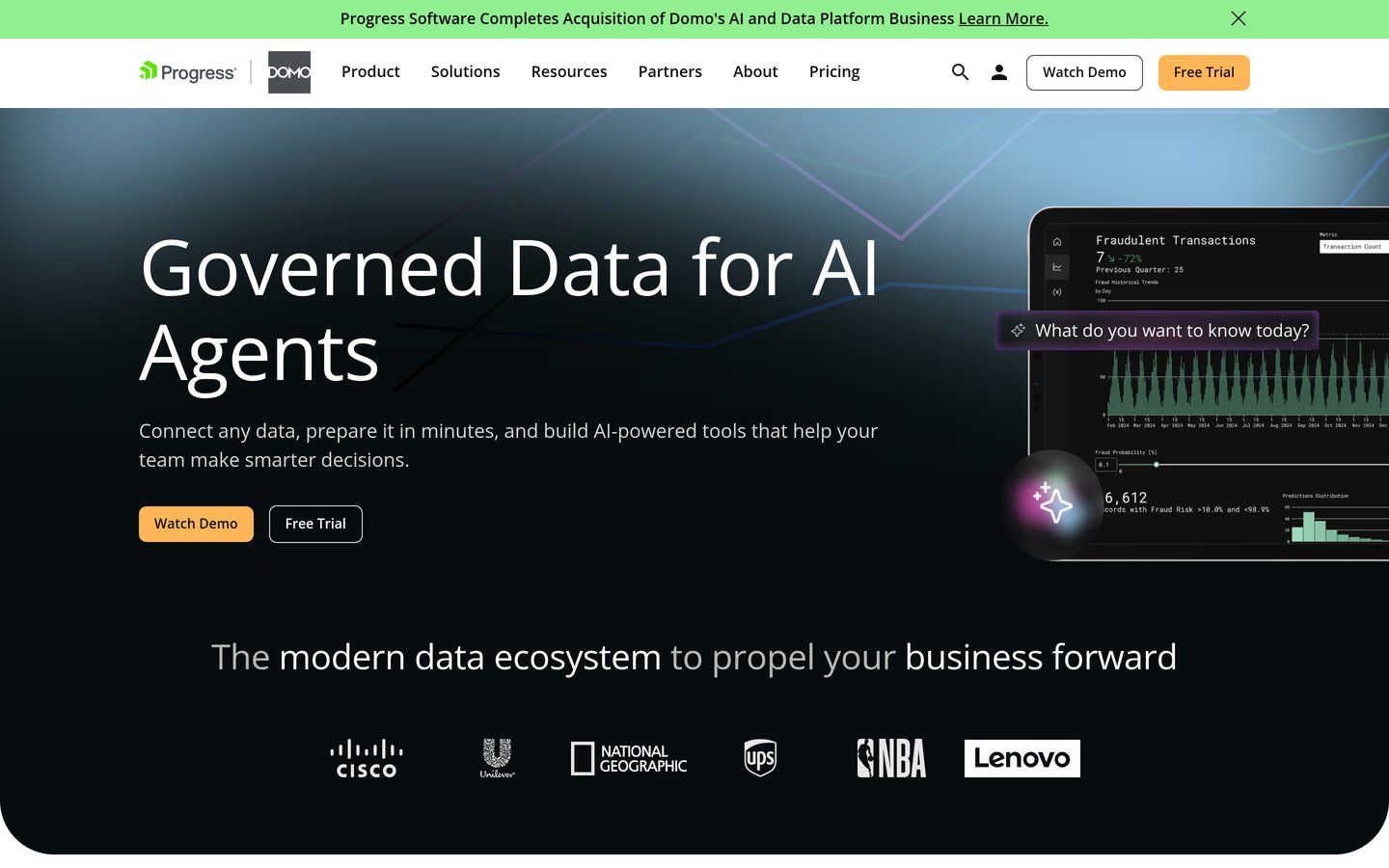
Domo is an all-in-one data platform that connects sources, transforms data, builds dashboards and pushes alerts without a separate stack. Domo AI adds natural-language summaries and anomaly detection, with Domo AI Pro for heavier AI workloads. It is rated 4.3 out of 5 on G2 from 1,092 reviews.
The trade off is price opacity: Domo sells on consumption-based credits with no published rates, and independent estimates put a minimum viable deployment near $30,000 a year, with average contracts near $134,000. It became part of Progress Software in September 2026. It suits mid-size and large teams that want one platform instead of stitching tools together.
What we like
Covers ingestion to dashboards in one platform
Domo AI Pro for advanced AI workloads
Rated 4.3 out of 5 from 1,092 G2 reviews
30-day free trial with no card
Watch out for
No published price, quote only
Minimum viable deployment near $30,000 a year
Consumption pricing is hard to budget
Average contract value near $134,000 a year per purchase dataVisit domo.com
08
Sisense
4.2/5on G2 (1,063 reviews, checked Nov 2026)
PricingCustom/yr
Best for embedded analytics
PricingCustom quote only
Typical range$25,000-$150,000/yr
AIGenAI features, embedded
Free trialDemo only
sisense.com
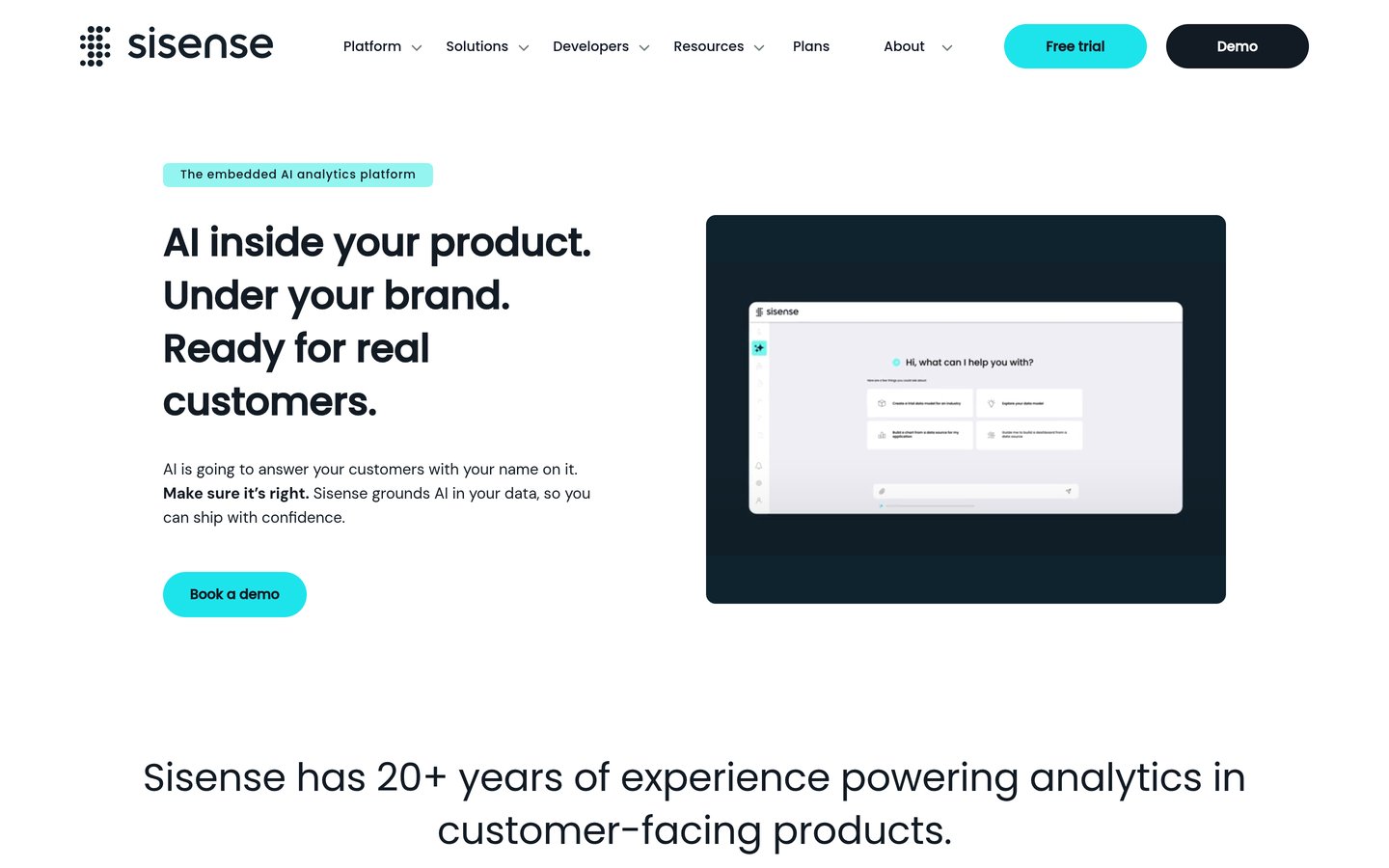
Sisense homepage, captured Nov 2026.
Sisense is an analytics platform built for embedding dashboards inside other products, with a strong in-memory engine for large datasets. Its GenAI features let users ask questions in natural language and get visualizations back. It is rated 4.2 out of 5 on G2 from 1,063 reviews.
The trade off is opacity and trust: Sisense publishes no prices, with mid-market deployments typically running $25,000 to $150,000 a year, and a 2024 security breach still comes up in buyer due diligence. It suits software companies embedding analytics in their product rather than teams buying dashboards for themselves.
What we like
Strongest embedded analytics in this list
Rated 4.2 out of 5 from 1,063 G2 reviews
GenAI features for natural-language queries
Handles large, complex datasets
Watch out for
No published price, quote only
A 2024 security breach still comes up in due diligence
Steeper setup than cloud-first rivals
Mid-market deployments typically run $25,000 to $150,000 a yearVisit sisense.com
09
Looker
4.1/5on G2 (379 reviews, checked Nov 2026)
Starts at$5,000/mo
Best governed semantic layer
Platform feeStandard, $5,000/mo
User licencesViewer $30, Standard $60
AIGemini in Looker
Free trial90-day trial instance
cloud.google.com
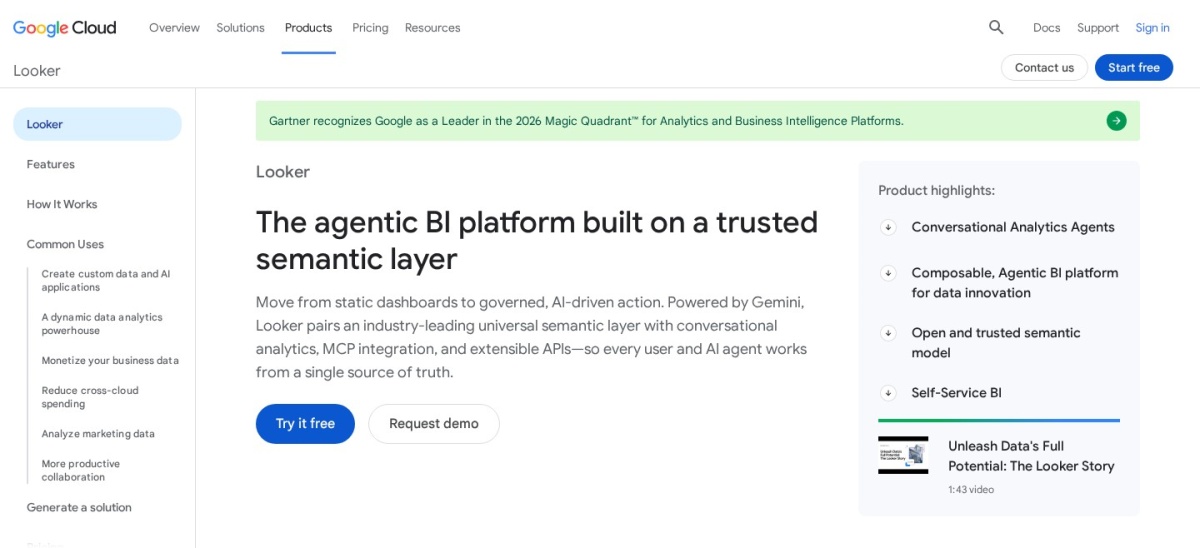
Looker homepage, captured Nov 2026.
Looker is Google Cloud's enterprise BI platform, built around LookML, a semantic layer that defines metrics once so every dashboard agrees. Gemini in Looker adds conversational analytics, and the platform is rated 4.1 out of 5 on G2 from 379 reviews.
The trade off is cost and confusion: the Standard edition alone costs $5,000 a month before user licences at $30 to $125 each, and Looker is not the free Looker Studio, which is a separate product rated 4.4 out of 5. Conversational Analytics moves to token billing from 1 February 2027. It suits Google Cloud teams that need one governed source of truth.
Looker is the clearest example: the Standard edition costs $5,000 a month, and user licences at $30 to $125 each sit on top, so a small team pays well over $60,000 a year before any AI. Domo and Sisense are quote only, with independent estimates putting typical deployments at $30,000 and $25,000 to $150,000 a year respectively.
Credit metering is the other hidden line. Hex grants a monthly per-seat credit allowance and charges for more, Julius sells credits by plan, and ThoughtSpot caps Spotter AI Agent queries at 25 a user a month on Pro. Ask each vendor what a month of your team's actual AI use costs before you sign.
The cheapest honest starting point is a free tier. Power BI's free Fabric account, Hex Community, Julius's free daily credits, Tableau Public and ThoughtSpot's one-year Developer tier all let you build a real dashboard before spending anything.
How we chose
We started from the best-known AI data visualization tools on G2, then kept those with a verifiable rating. Polymer was dropped because its G2 rating could not be verified cleanly: the G2 page shows 3.2 out of 5 from 3 reviews behind an ad, and another source says it has no G2 listing at all. Hex replaced it, with a verified 4.5 out of 5 from 433 reviews.
Prices were checked on 24 November 2026. Power BI at $14 a user a month and Julius AI at $20 a month were confirmed on the official pricing pages opened that day. Hex at $36 a month is vendor-supplied G2 pricing, since the official page did not render dollar figures. Tableau, Qlik Sense and ThoughtSpot prices come from recent independent checks. Domo, Sisense and Looker sell by quote.
Ratings and review counts come from G2 on the same day. No vendor paid for a place, and we do not claim hands-on testing for this list.
How to choose AI data visualization software
Start by deciding whether you need governed enterprise BI or a chat-first AI analyst, then count the whole first-year bill.
Decide enterprise BI or AI-first. Power BI, Tableau, Qlik Sense and Looker suit governed, shared dashboards, while Julius AI, Hex and ThoughtSpot suit chat-first, self-serve analysis. Pick the job before the tool.
Check where the AI actually lives. Power BI's Advanced AI needs Premium Per User at $24 a month, and Hex and Julius meter AI by credits. Ask what a month of real use costs, not just the headline plan.
Count the whole bill. Looker charges a $5,000-a-month platform fee plus per-user licences, and Domo and Sisense are quote only. Get the first-year total, licences and implementation included, in writing.
Try the free tier first. Power BI, Hex, Julius, Tableau Public and ThoughtSpot Developer all cost nothing to start. Build one real dashboard on your own data before you pay.
FAQ
What is the best AI data visualization tool?
Power BI is the best pick for most teams. It is rated 4.5 out of 5 on G2 from 1,667 reviews, and the Pro plan costs $14 a user a month, confirmed on Microsoft's pricing page. Advanced AI needs the $24 Premium Per User tier.
How much does AI data visualization software cost?
Published paid plans start at $14 a user a month for Power BI Pro, $15 for Tableau Viewer and $20 for Julius AI Plus. Domo, Sisense and Looker sell by quote, and Looker's Standard platform fee alone is $5,000 a month.
Is there a free AI data visualization tool?
Yes. Power BI has a free Fabric account, Hex has a free Community tier, Julius gives free daily credits, Tableau Public is free for public dashboards, and ThoughtSpot offers a free Developer tier for one year.
What is the difference between Power BI and Tableau?
Both are enterprise BI platforms with AI added. Power BI starts cheaper at $14 a user a month and fits Microsoft 365 teams, while Tableau leads on visual design and exploration, with Viewer from $15 and Creator at $75.
Why is Polymer not in this list?
Polymer's G2 rating could not be verified cleanly: its G2 page shows 3.2 out of 5 from only 3 reviews, and another source says it has no G2 listing at all. Hex replaced it, with a verified 4.5 out of 5 from 433 reviews.
Which tool is best for non-technical users?
Julius AI is the most chat-first option: ask a question in plain language and it builds the chart. ThoughtSpot's Spotter AI works the same way over connected data. Note that Julius's 4.5-star G2 rating rests on only 4 reviews.
Is Looker the same as Looker Studio?
No. Looker is Google Cloud's enterprise BI platform with a $5,000-a-month Standard platform fee, while Looker Studio is a separate free product for simple dashboards. They share a name but not a price or a feature set.