WLWPLegible EditorsLast verified 22 Nov 2026How we rank8 min read
★ Short answer
Twilio Segment is our top CDP platform because it routes events across 700+ integrations and includes a free tier for up to 1,000 monthly tracked users. For warehouse-first teams billing by event volume, RudderStack offers an open-source core, while Brevo fits small businesses needing built-in email and SMS campaigns.
How we make this list: we compare pricing pages, product documentation and public user reviews, then re-check every price before each update. No product paid for a place. Disclosure.
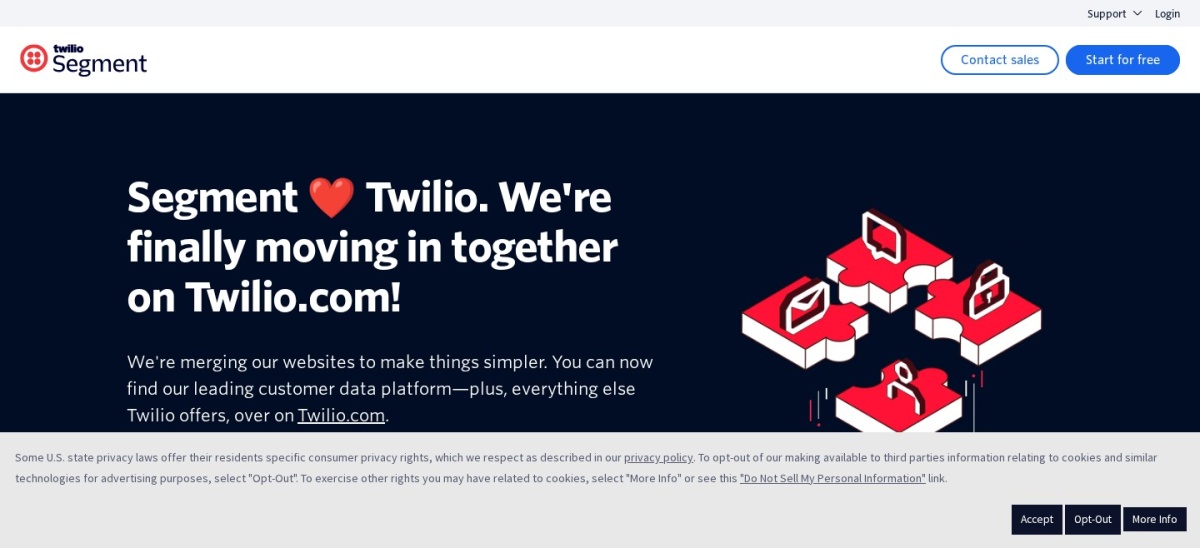
Twilio Segment includes 1,000 monthly tracked users free and starts at $120/mo ($1,440/yr) for 10,000 MTUs across 700+ integrations.
RudderStack bills by event volume instead of tracked users, offering 250,000 events/mo free and Growth plans from $265/mo ($3,180/yr).
Jitsu provides an open-source event pipeline with 200,000 active events/mo free and Business plans starting at $99/mo ($1,188/yr).
Brevo combines contact management with email, SMS, and WhatsApp starting at $9/mo ($108/yr) for 5,000 monthly email sends.
Able CDP focuses on server-side ad attribution, starting at $49/mo ($588/yr) for analytics or $145/mo ($1,740/yr) with ad platform sync.
What to look for in a customer data platform
A customer data platform (CDP) collects first-party behavioral, transactional, and profile data from websites, mobile apps, and backend servers, unifies it into single customer profiles, and routes those records to analytics, CRM, and ad tools. Unlike a traditional CRM that tracks manual sales interactions, a CDP automates real-time event streaming and identity stitching.
Billing meters determine your long-term cost more than headline entry tiers. Visitor-based platforms charge by Monthly Tracked Users (MTUs), which means high-traffic sites with many anonymous browsers face rapid overages. Event-based and warehouse-native tools bill by event volume or active syncs, which often saves money when a smaller group of users generates heavy activity.
Architecture also separates packaged CDPs from composable tools. Packaged CDPs store profiles inside the vendor cloud and include visual audience builders, while composable or warehouse-native tools read directly from Snowflake, BigQuery, or Databricks without duplicating raw tables.
Twilio Segment is a packaged customer data infrastructure platform that collects events once and routes unified profiles to more than 700 destinations. Its permanent Free plan covers up to 1,000 monthly tracked users, 2 sources, 1 data warehouse destination, 500,000 Reverse ETL records per month, and 10 workspace seats without a credit card.
The trade off is MTU-based billing, where anonymous visitors count toward your monthly quota and push costs up on high-traffic sites. The Team plan starts at $120/mo ($1,440/yr) for 10,000 MTUs and unlimited sources, with overages costing $10 to $12 per additional 1,000 MTUs. It suits product and growth teams needing reliable plug-and-play data pipelines.
What we like
Over 700 pre-built source and destination integrations
Permanent free tier with 1,000 MTUs and 10 seats
Live event debugger and schema enforcement tools
Supports Reverse ETL and warehouse destinations
Watch out for
Anonymous visitors count as MTUs and inflate bills
No built-in product analytics or campaign execution on entry tiers
Full identity resolution and governance require custom Business contracts
Team ($120/mo) raises limits to 10,000 MTUs, unlimited sources, and Public API access.Visit segment.com
02
RudderStack
4.7/5on G2 (52 reviews, checked Nov 2026)
Paid from$265/mo
Best for warehouse-first data engineering teams
Billing modelMonthly event volume
Free tier250,000 events/mo
Entry paid tier1M events/mo, unlimited seats
Destinations200+ cloud & warehouse tools
rudderstack.com
RudderStack homepage, captured Nov 2026.
RudderStack is a warehouse-native customer data platform with an open-source core built for engineering and data teams. Its Free plan includes 250,000 events per month, 16 SDK sources, over 200 cloud destinations, and Reverse ETL syncing without storing a separate copy of your customer database in a vendor silo.
The trade off is higher developer setup compared to no-code marketing platforms, alongside a $265/mo ($3,180/yr, or $225.25/mo billed annually) starting price for the Growth plan at 1 million events per month. It suits technical teams with Snowflake, BigQuery, or Databricks who prefer event-volume billing over per-visitor charges.
What we like
Bills by event volume rather than monthly tracked visitors
Warehouse-first architecture keeps raw data in your own storage
Unlimited team members and tracking plans on Growth
Open-source core available for self-hosted deployments
Watch out for
Requires engineering resources to configure SDKs and SQL models
Higher entry price ($265/mo) than Segment or Jitsu
Audience activation add-ons carry separate record-based pricing
Best for small businesses needing built-in messaging
Billing modelMonthly email send volume
Free tier300 emails/day, 500 contacts
Entry paid tier5,000 emails/mo on Starter
ChannelsEmail, SMS, WhatsApp, Push
brevo.com
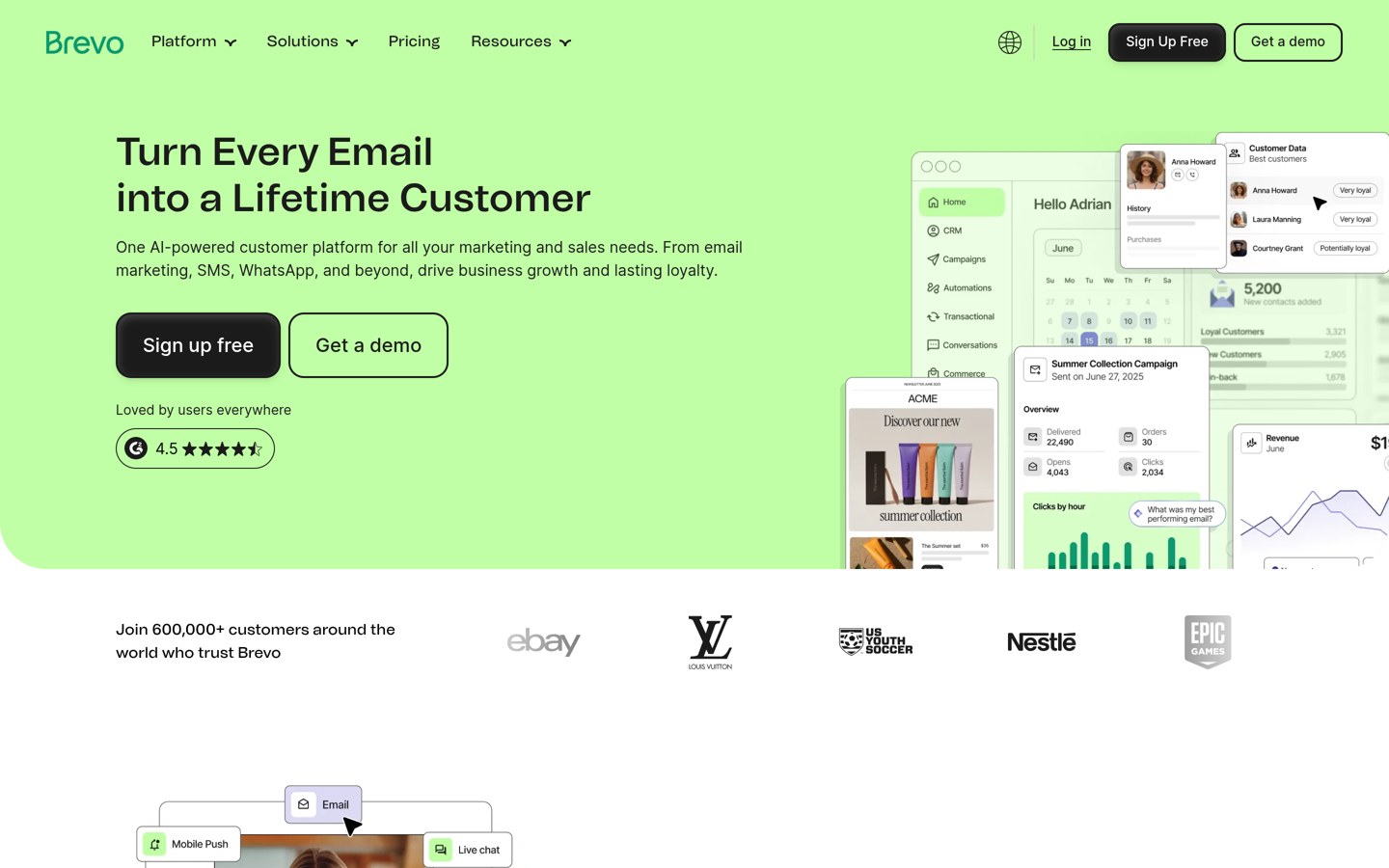
Brevo homepage, captured Nov 2026.
Brevo is an all-in-one customer data and multichannel marketing platform that combines contact unification, transactional SMTP, email, SMS, and WhatsApp in one workspace. Its Free plan supports up to 300 emails per day, drag-and-drop campaign templates, and basic list segmentation with no credit card required.
The trade off is that dedicated enterprise data warehouse connectors, custom objects, and AI segmentation sit behind higher tiers, and removing Brevo footer branding on the $9/mo ($108/yr, or $8.08/mo billed annually) Starter plan costs an extra $10.80/mo. It suits small businesses wanting contact storage and campaign activation without hiring data engineers.
What we like
Send-based pricing avoids subscriber taxes on large inactive lists
Combines customer profiles with email, SMS, WhatsApp, and CRM
Generous free tier with transactional SMTP and API access
Straightforward visual automation builder for non-technical teams
Watch out for
Steep price jump from Standard ($18/mo) to Professional ($499/mo)
Removing Brevo branding on Starter costs $10.80/mo extra
Starter ($9/mo) lifts daily caps to 5,000 monthly emails and adds AI content generation.Visit brevo.com
04
Jitsu
5/5on G2 (11 reviews, checked Nov 2026)
Paid from$99/mo
Best budget open-source event pipeline
Billing modelActive events delivered
Free tier200,000 active events/mo
Entry paid tier2M active events/mo
LicenseMIT open-source or cloud
jitsu.com
Jitsu homepage, captured Nov 2026.
Jitsu is an open-source customer data platform that captures behavioral events from websites, mobile apps, and servers and streams them to data warehouses and marketing destinations. Its Free cloud plan includes 200,000 active events per month, unlimited captured events, identity stitching, and Segment-compatible SDKs, plus an MIT-licensed self-hosted option.
The trade off is a smaller catalog of native SaaS destinations compared to Segment and fewer built-in marketer journey tools. Its Business cloud plan costs $99/mo ($1,188/yr) for 2 million active events per month, hourly syncs, and 5 monthly active syncs, with extra events at $40 per million. It suits startups wanting predictable event-based billing.
What we like
Only events delivered to destinations count toward active quotas
Supports Segment SDK syntax for faster migration
Low $99/mo cloud entry price for 2 million active events
Full MIT-licensed self-hosting option with no usage caps
Watch out for
Fewer pre-built third-party SaaS integrations than Segment
Developer-focused setup with no visual email or ad campaign builder
Smaller user review footprint than legacy enterprise CDPs
Business ($99/mo) expands capacity to 2M active events/mo and hourly connector syncs.Visit jitsu.com
05
Able CDP
5/5on G2 (11 reviews, checked Nov 2026)
Starts at$49/mo
Best for server-side ad tracking and attribution
Billing modelTracked events per month
Free tierFree trial only (no free plan)
Entry paid tier300,000 events/mo
Key integrationsMeta CAPI, Google Ads, Stripe
ablecdp.com
Able CDP homepage, captured Nov 2026.
Able CDP is a first-party customer data and attribution platform built to connect website visits and ad click IDs to downstream CRM deals and Stripe payments. It does not offer a permanent free plan, instead providing a free trial and an Analytics Only entry tier at $49/mo ($588/yr) covering 300,000 tracked events per month.
The trade off is that server-side ad platform integrations—including Meta Conversions API and Google Ads API—require upgrading to the Standard plan at $145/mo ($1,740/yr), with overages at $48 per 100,000 events up to 500,000. It suits ecommerce and lead-generation teams focused on recovering lost paid-ad conversions.
What we like
Matches offline CRM stages and Stripe payments back to original ad clicks
Server-side tracking reduces conversion loss from browser restrictions
Self-serve setup without lengthy enterprise onboarding calls
Flat event tiers starting at $49/mo for revenue journey analytics
Watch out for
No permanent free tier available
Ad platform Conversions API syncs require the $145/mo Standard tier
Narrower scope than full-suite omnichannel personalization CDPs
Standard ($145/mo) unlocks server-side conversion syncing to Meta, Google Ads, and TikTok.Visit ablecdp.com
06
Customer.io
4.4/5on G2 (1,013 reviews, checked Nov 2026)
Starts at$100/mo
Best for event-triggered SaaS lifecycle journeys
Billing modelPeak monthly profiles
Free tier14-day trial (no free plan)
Entry paid tier5,000 profiles, 1M emails/mo
ChannelsEmail, Push, In-App, SMS
customer.io
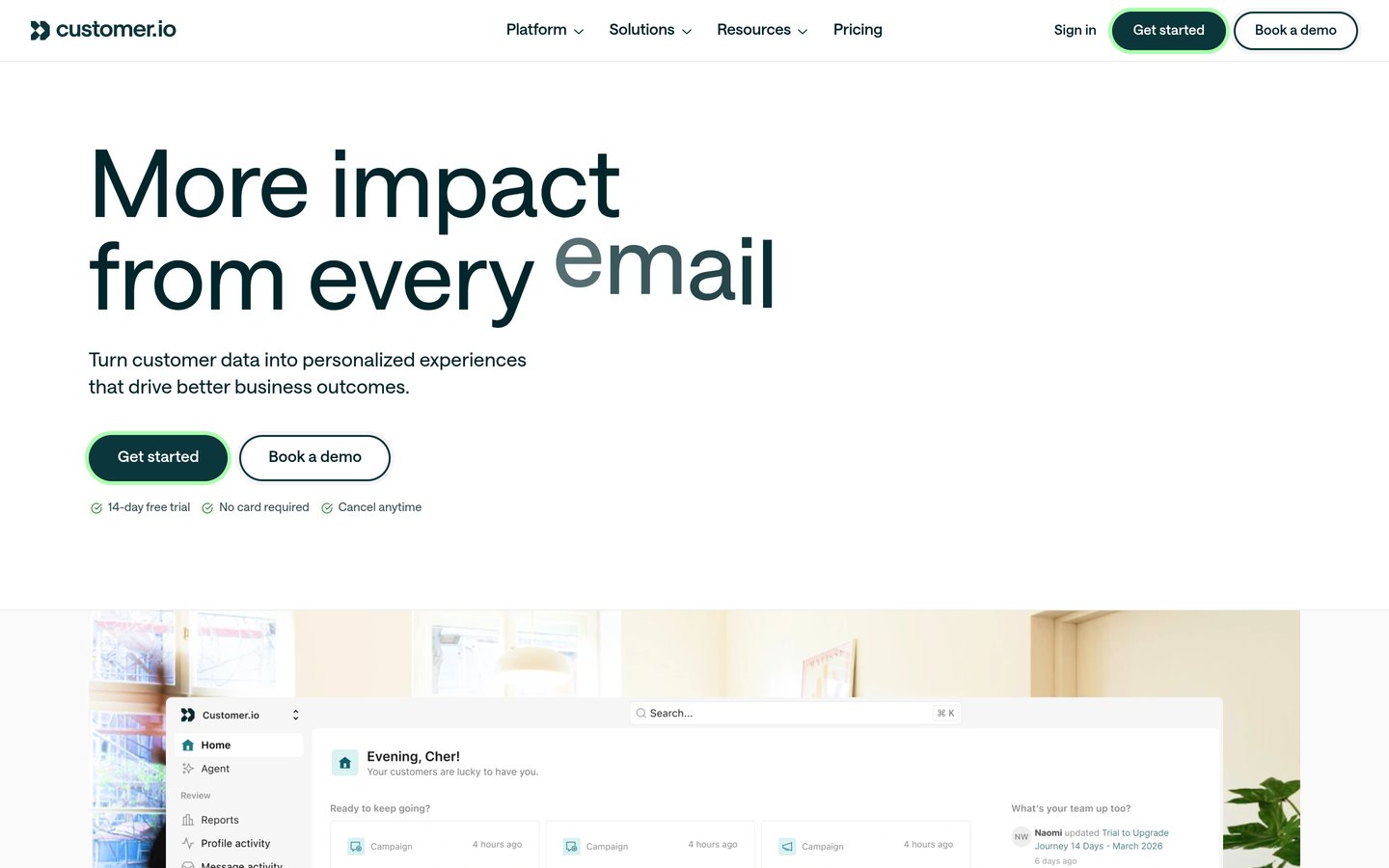
Customer.io homepage, captured Nov 2026.
Customer.io combines first-party data pipelines and Reverse ETL with automated lifecycle messaging across email, push, SMS, and in-app channels. There is no permanent free plan outside an application-based startup program, though a 14-day free trial is available before starting on the Essentials plan at $100/mo ($1,200/yr) for 5,000 profiles and 1 million emails.
The trade off is high-watermark profile billing, which charges $0.009 for every extra profile present at any point during the month, whether active or dormant. Premium plans with warehouse destinations and custom roles jump to $1,000/mo billed yearly. It suits SaaS and mobile app teams automating behavior-based user onboarding.
What we like
Unifies event ingestion, segmentation, and multi-channel messaging
Unlimited user seats included across all pricing tiers
Strong visual workflow builder for complex behavioral triggers
Supports custom objects to model B2B accounts and subscriptions
Watch out for
No permanent free tier for standard self-serve signups
High-watermark profile billing penalizes large inactive B2C lists
Steep jump from Essentials ($100/mo) to Premium ($1,000/mo)
Essentials ($100/mo) includes 5,000 profiles, 1M monthly emails, APIs, and Reverse ETL.Visit customer.io
07
Klaviyo
4.6/5on G2 (1,366 reviews, checked Nov 2026)
Paid from$20/mo
Best for ecommerce customer data and flows
Billing modelActive mailable profiles
Free tier250 profiles, 500 emails/mo
Entry paid tier500 profiles, 5,000 emails/mo
FocusEcommerce catalog & order data
klaviyo.com
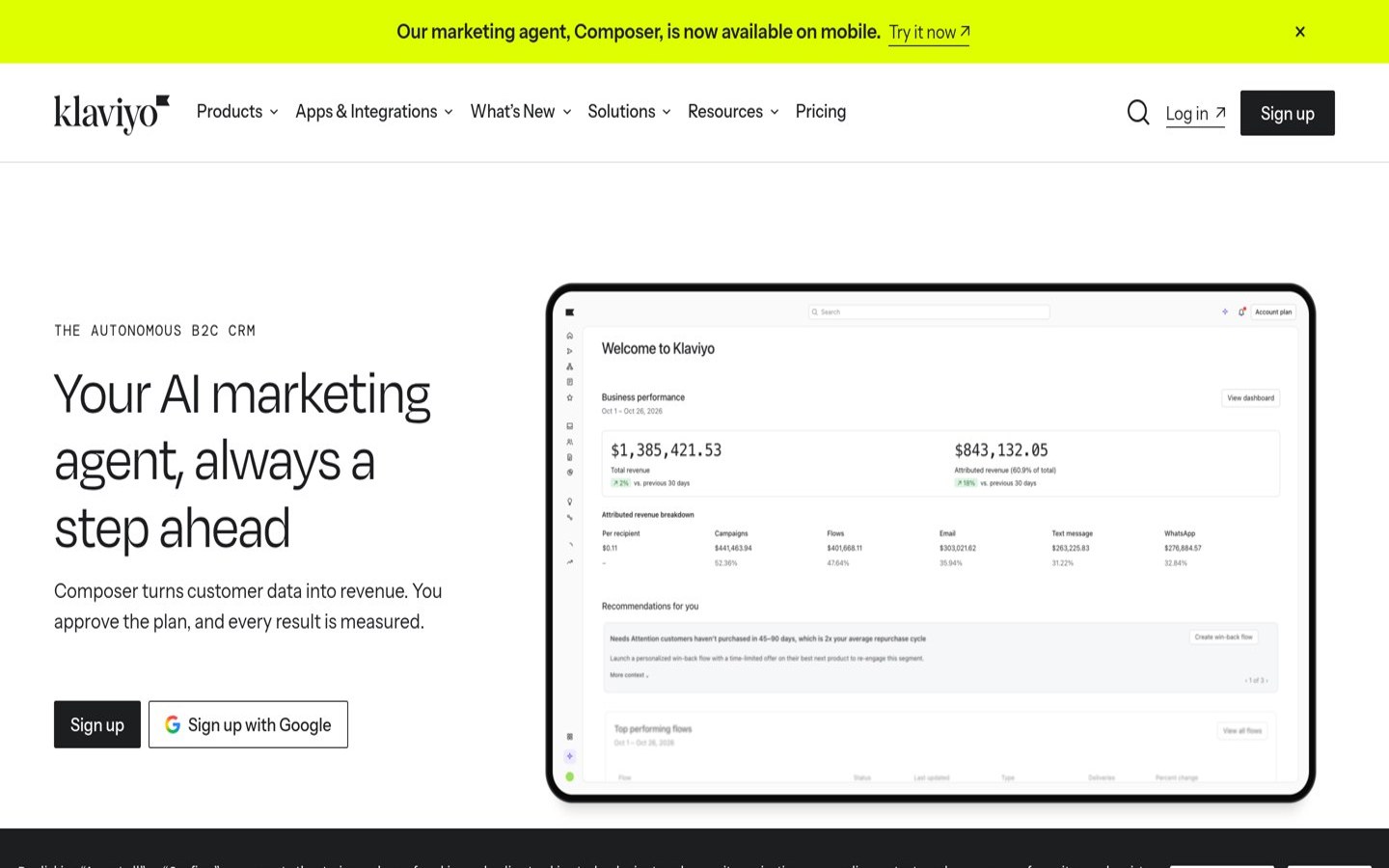
Klaviyo homepage, captured Nov 2026.
Klaviyo pairs an ecommerce-focused customer data platform with automated email, SMS, and mobile push marketing. Its Free plan supports up to 250 active profiles and 500 monthly email sends alongside deep catalog and order syncing for stores on Shopify and WooCommerce.
The trade off is profile-based scaling that gets expensive as contact lists grow, plus extra add-on fees for Advanced Klaviyo Data Platform features and warehouse syncs. The paid Email plan starts at $20/mo ($240/yr) for 500 active profiles and 5,000 emails, while the Marketing plan starts at $25/mo regular price (with a $1 first-month promo). It suits online retailers.
What we like
Deep native ecommerce integrations for order and catalog segmentation
Built-in revenue attribution tied directly to automated flows
Free tier covers small stores up to 250 active profiles
Combines customer profile storage with email, SMS, and reviews
Watch out for
Costs rise rapidly as active contact counts scale
Data warehouse syncs and advanced CDP tools require costly add-ons
Less suited to B2B SaaS or non-commerce event pipelines
Email ($20/mo) expands capacity to 500 active profiles, 5,000 emails/mo, and full flow automation.Visit klaviyo.com
MTU vs. event-based vs. profile billing
CDP vendors price their platforms around three primary meters, and picking the wrong one can multiply your annual bill without adding features. Twilio Segment charges by Monthly Tracked Users (MTUs), counting every unique logged-in user and anonymous visitor who triggers an event during the billing cycle.
RudderStack and Jitsu bill by monthly event volume, making them more predictable when a smaller user base generates frequent actions or when you filter out noisy anonymous traffic before delivery. Meanwhile, Brevo, Customer.io, and Klaviyo combine profile storage with direct messaging, charging by email send volume or active contact counts.
How we chose
We evaluated standalone data pipelines, warehouse-native CDPs, and messaging-integrated customer data platforms to cover both developer-led data stacks and marketer-led teams. Every candidate had to be actively maintained with transparent, publicly verifiable entry pricing and an established user review record.
All prices, plan limits, G2 ratings, and review counts were verified directly from official vendor pricing pages and public G2 listings on 22 Nov 2026. Where vendors offer promotional discounts, we recorded the regular recurring monthly rate and calculated annual costs as twelve times the monthly price.
Enterprise-only suites that hide all pricing behind custom sales quotes—including Salesforce Data 360, Adobe Real-Time CDP, Tealium, and Bloomreach—were excluded from the ranked list, as was Census following its consolidation into Fivetran Activations. No vendor paid for a place, and we do not claim testing for this list.
How to choose the right CDP platform
Match your data architecture, engineering capacity, and traffic volume to the right billing model before committing to a contract.
Audit your existing data warehouse and engineering resources. If you already run Snowflake, BigQuery, or Databricks with SQL-savvy analysts, warehouse-native tools like RudderStack or Jitsu avoid data duplication. Teams without dedicated developers should favor packaged platforms like Brevo or Klaviyo.
Model your traffic against MTU and event limits. High-traffic websites with large shares of anonymous visitors quickly exhaust MTU tiers on Twilio Segment. Calculate your monthly unique visitors versus total tracked actions to see whether per-user or per-event billing is cheaper.
Decide whether you need built-in campaign execution. Pure data pipelines like Segment and Jitsu collect and route data to external tools, whereas Customer.io, Klaviyo, and Brevo include native email and SMS builders inside the same subscription.
Verify destination connectors and server-side ad APIs. Confirm that the entry plan includes the exact CRM, analytics, or ad conversion endpoints you need, as platforms like Able CDP gate Meta and Google Ads server-side syncs behind higher tiers.
FAQ
What is the difference between a CDP and a CRM?
A CRM tracks direct sales interactions, deals, and manual account notes for sales teams. A CDP automatically ingests behavioral events from websites, apps, and servers in real time, unifies anonymous and known user records, and syncs those profiles to analytics and marketing tools.
Which CDP platform has the best free plan?
Twilio Segment offers the broadest free integration ecosystem with 1,000 monthly tracked users and 700+ destinations, while RudderStack provides 250,000 free monthly events for warehouse-centric teams. Brevo also offers a permanent free plan with 300 daily emails for small businesses.
What is a composable or warehouse-native CDP?
A warehouse-native CDP sits directly on top of your existing cloud data warehouse—such as Snowflake or BigQuery—to model audiences and sync data to downstream apps without storing a separate copy of customer records in a third-party database.
Why do some CDPs exclude public pricing?
Enterprise suites like Salesforce Data 360, Adobe Real-Time CDP, and Tealium tailor contracts around custom profile volumes, compliance modules, and multi-year commitments, requiring custom sales quotes rather than self-serve tiers.
Can a small business use a CDP without a developer?
Yes, marketing-focused platforms like Brevo and Klaviyo offer visual setup, pre-built ecommerce connectors, and drag-and-drop automation builders that marketers can run without writing tracking code or SQL queries.