Best AI Tools for Data Integration in 2026: 7 Tools Compared
WLWPLegible EditorsLast verified 22 Nov 2026How we rank10 min read
★ Short answer
Airbyte is the best AI data integration tool for most technical teams, offering managed pipelines from $20 per month alongside a free self-hosted edition. Hevo suits teams that prefer managed data pipelines, while Coupler.io is better for business reporting and AI-assisted analysis.
How we make this list: we compare pricing pages, product documentation and public user reviews, then re-check every price before each update. No product paid for a place. Disclosure.
Airbyte starts at $20 per month with 5 credits and managed hourly data synchronization.
Hevo supports 210+ connectors and offers its Starter plan for $299 per month.
Coupler.io combines 400+ data sources with AI analysis from $32 per month.
Zapier offers 100 monthly tasks on its free plan for smaller AI integration workflows.
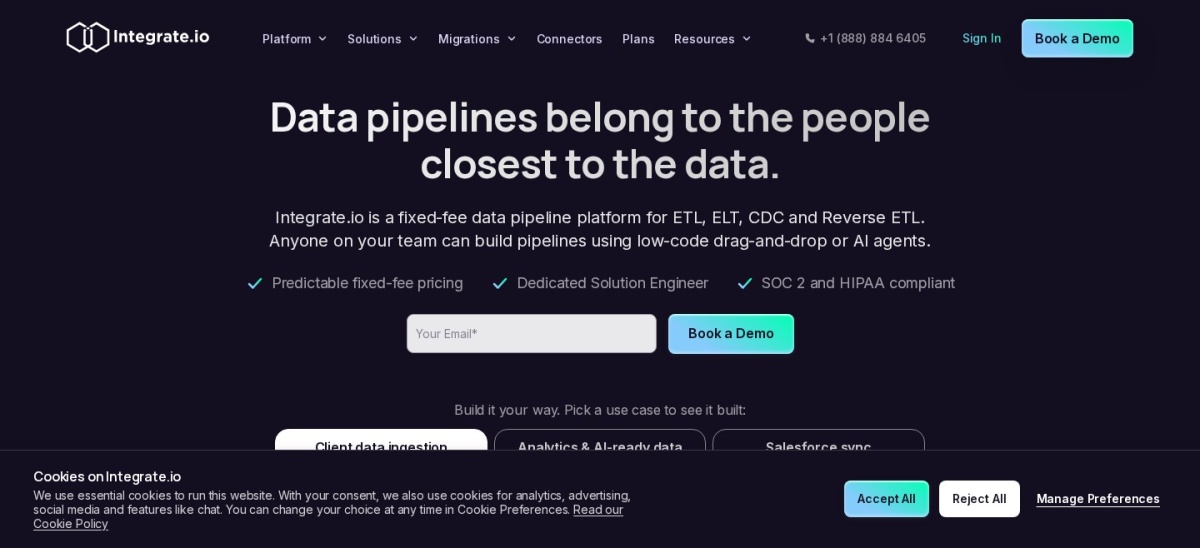
Integrate.io charges $1,999 per month for its Core plan with unlimited data volume.
What to look for in AI data integration tools
AI data integration tools connect business applications, databases, warehouses and AI systems. They reduce manual data movement and help teams maintain a consistent source of information for reporting, automation and AI applications.
Look for connectors that support your actual data sources and destinations. A large connector library matters less if the platform cannot handle your database structure, authentication requirements or incremental updates.
Check how the platform uses AI. Some tools generate connectors or pipeline configurations, while others prepare structured business data for AI assistants and agents. These are different capabilities with different practical benefits.
Pricing also varies considerably. Platforms may charge for data volume, workflow executions, credits or fixed subscriptions. Compare expected production costs rather than relying only on the advertised starting price.
Security deserves particular attention when AI systems access customer or financial information. Check access permissions, encryption, audit capabilities and whether administrators can restrict which datasets an AI agent receives.
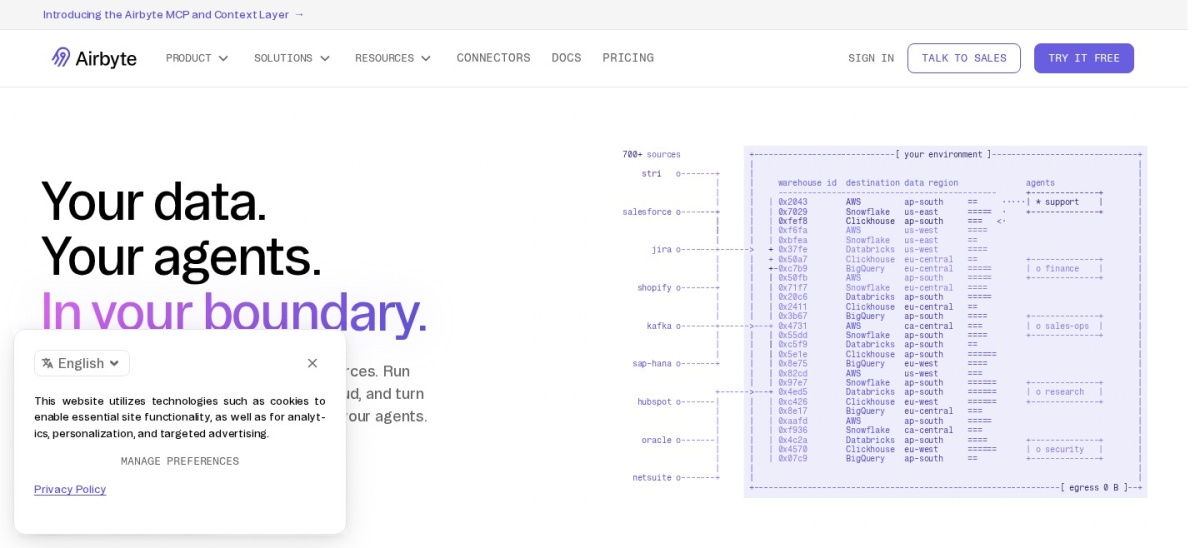
Airbyte is a data integration platform that combines automated replication with business data access for AI agents. Its Standard subscription includes 5 credits, managed cloud infrastructure and hourly synchronization, while Airbyte Core is available for self-hosting without a subscription.
The trade off is that credit consumption increases with data volume, and faster synchronization requires a higher subscription tier. Standard starts at $20 per month. It suits engineering teams that need flexible connectors, deployment choices and data infrastructure for AI applications.
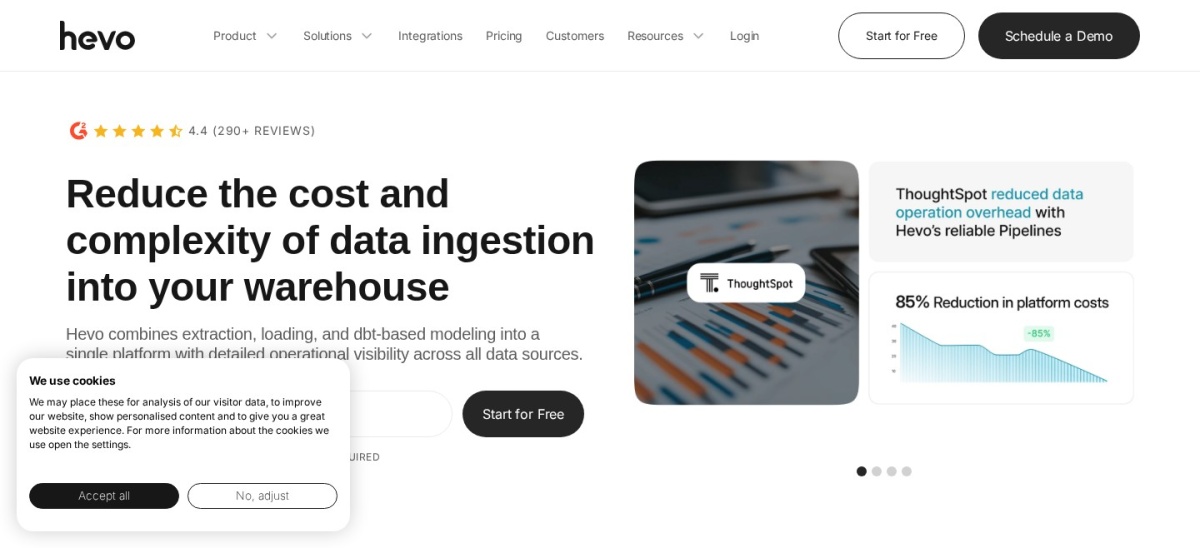
Hevo is a managed ELT platform that brings application and database information into cloud data warehouses. Its Starter subscription supports up to 10 users and includes scheduled synchronization and dbt integration, while its ConnectAI initiative focuses on generating connectors from API documentation.
The trade off is that advanced administration and streaming capabilities require higher plans, and ConnectAI is advertised through early access. Starter costs $299 per month, or an advertised $265 monthly equivalent with annual billing. It suits data teams that prefer managed infrastructure over maintaining their own ingestion systems.
What we like
Managed data pipeline infrastructure
Supports dbt transformations
Large connector selection
Pipeline monitoring and support
Watch out for
Higher entry cost than Airbyte
AI connector builder availability is limited
Streaming requires a higher tier
Starter adds managed pipelines, scheduled ingestion and support.Visit hevodata.com
03
Coupler.io
4.8/5on G2 (109 reviews, checked Nov 2026)
Starts at$32/mo
Best for AI-assisted business reporting
Data sources400+
Starter accounts3
Rows per run5,000
Refresh frequencyDaily
coupler.io
Coupler.io homepage, captured Nov 2026.
Coupler.io is a reporting automation platform that collects business information and makes it available for dashboards and AI analysis. Its Starter plan supports 3 connected accounts, 1 destination and 5,000 rows per run, making it useful for smaller reporting projects.
The trade off is that the Starter plan limits data refreshes to a daily schedule and restricts account capacity. Its advertised starting price is $32 per month, with annual billing discounts also available. It suits marketing, sales and finance teams that need accessible reporting data without building custom pipelines.
What we like
AI analysis included in Starter
Connects common business applications
Reporting dashboard templates
Configurable AI dataset access
Watch out for
Limited Starter account capacity
Daily refresh on the entry plan
Less suitable for complex database replication
Starter adds scheduled imports, dashboard templates and AI analysis.Visit coupler.io
04
Zapier
4.5/5on G2 (2,170 reviews, checked Nov 2026)
Paid from$19.99/mo
Best for no-code AI application integration
App integrations9,000+
Free monthly tasks100
Workflow builderNo-code
Paid entry planProfessional
zapier.com
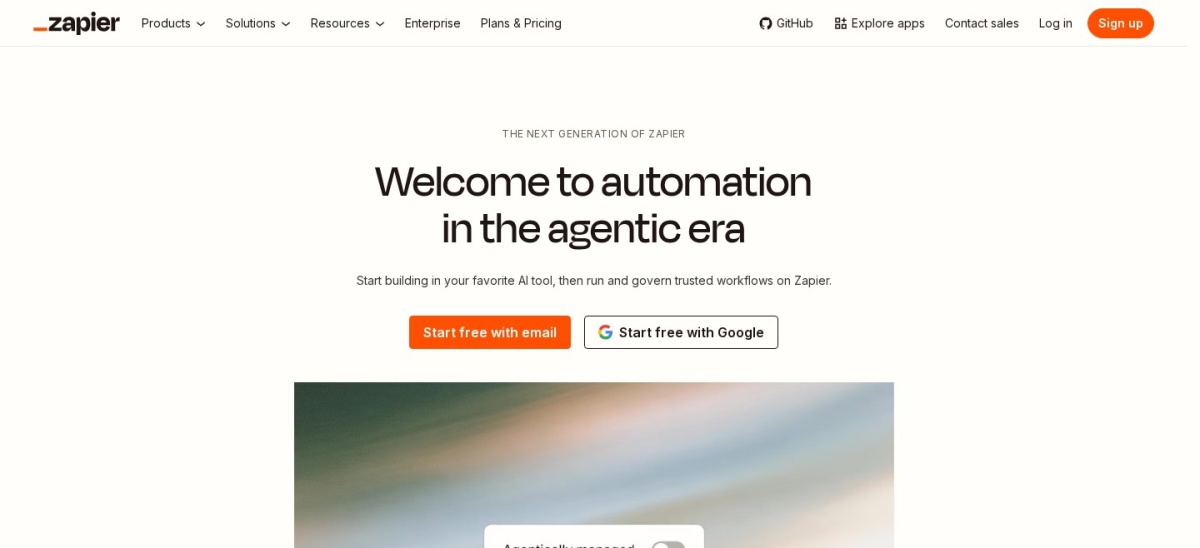
Zapier homepage, captured Nov 2026.
Zapier is a workflow automation platform that connects business applications and AI services without requiring custom integration code. Its free subscription includes 100 tasks per month and basic workflows, while its Copilot feature helps users construct automations.
The trade off is that complex workflows and frequent data processing can consume task allowances quickly. Professional starts at an advertised $19.99 per month, with multi-step workflows and webhook support. It suits business teams transferring records between applications and adding AI processing to routine operations.
What we like
Extensive application connector library
AI-assisted workflow creation
Free entry tier
Supports webhooks on paid plans
Watch out for
Task costs increase with workflow activity
Free workflows have limited complexity
Not designed primarily for bulk warehouse loading
Professional adds multi-step workflows, webhooks and premium applications.Visit zapier.com
05
Integrate.io
4.4/5on G2 (213 reviews, checked Nov 2026)
Starts at$1,999/mo
Best for fixed-price AI data pipelines
Entry planCore
Data volumeUnlimited
Pipeline frequency60 seconds
AI assistantHelm
integrate.io
Integrate.io homepage, captured Nov 2026.
Integrate.io is a data pipeline platform covering ingestion, transformation, replication and delivery. Its Core subscription includes unlimited data volume and pipeline capacity, with scheduling as frequent as 60 seconds. Helm and its MCP integration support AI-assisted pipeline management.
The trade off is the substantial starting subscription cost of $1,999 per month, which can make smaller workloads expensive. Advanced governance and security options may require a customized package. It suits established businesses that process large datasets and prefer predictable platform expenses.
What we like
Fixed subscription pricing
AI-assisted pipeline management
Supports operational ETL and reverse ETL
No standard data volume cap
Watch out for
Expensive for smaller projects
Advanced security options may cost extra
Requires more planning than simple app automation
Core provides full platform access and unlimited pipeline capacity.Visit integrate.io
06
Fivetran
4.3/5on G2 (857 reviews, checked Nov 2026)
Paid from$5/mo
Best for automated data warehouse replication
Managed connectors700+
Free monthly active rows500,000
Standard sync frequency15 minutes
Billing modelBase charge plus usage
fivetran.com
Fivetran homepage, captured Nov 2026.
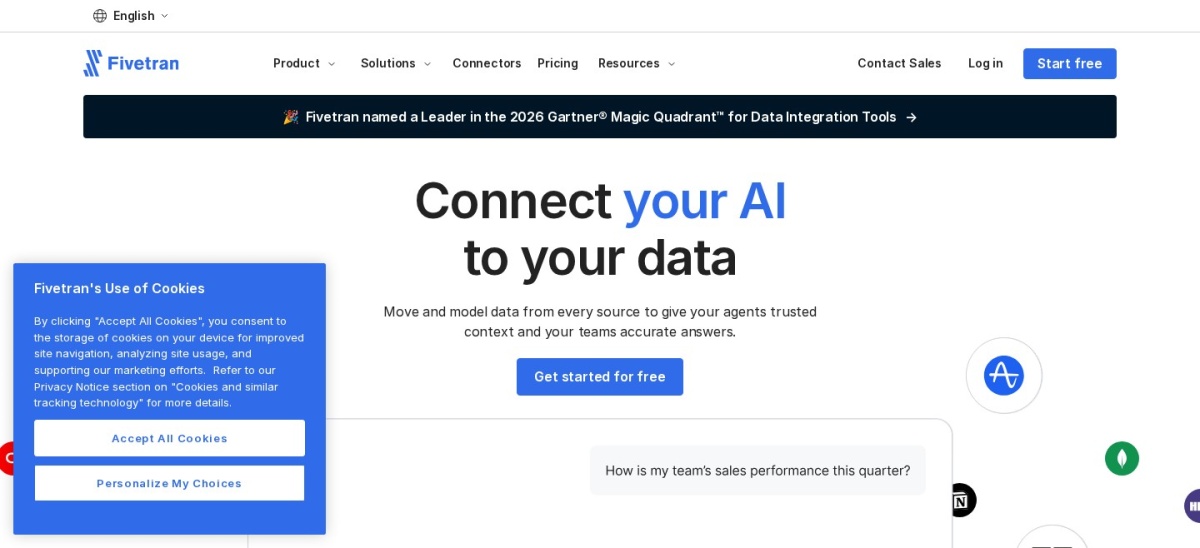
Fivetran is a managed data integration platform that prepares centralized business information for analytics and AI applications. Its free plan supports up to 500,000 monthly active rows for connections, while its managed connectors reduce the work involved in maintaining data pipelines.
The trade off is consumption-based billing, with a $5 monthly base charge per qualifying Standard connection plus applicable usage charges. The annual price shown represents the base charge rather than the complete subscription expense. It suits businesses that prioritize automated replication and consistent warehouse data.
What we like
Large managed connector library
Free plan for smaller data workloads
Automatic adaptation to source changes
Supports warehouse transformations
Watch out for
Total expenses depend on consumption
Multiple connections can increase costs
Not primarily an AI workflow builder
Standard removes free-tier usage limits and applies consumption-based billing.Visit fivetran.com
07
Skyvia
4.8/5on G2 (326 reviews, checked Nov 2026)
Paid from$99/mo
Best for no-code database and application integration
Connectors200+
Free monthly records10,000
Basic scheduled integrations5
AI connectivityMCP endpoints
skyvia.com
Skyvia homepage, captured Nov 2026.
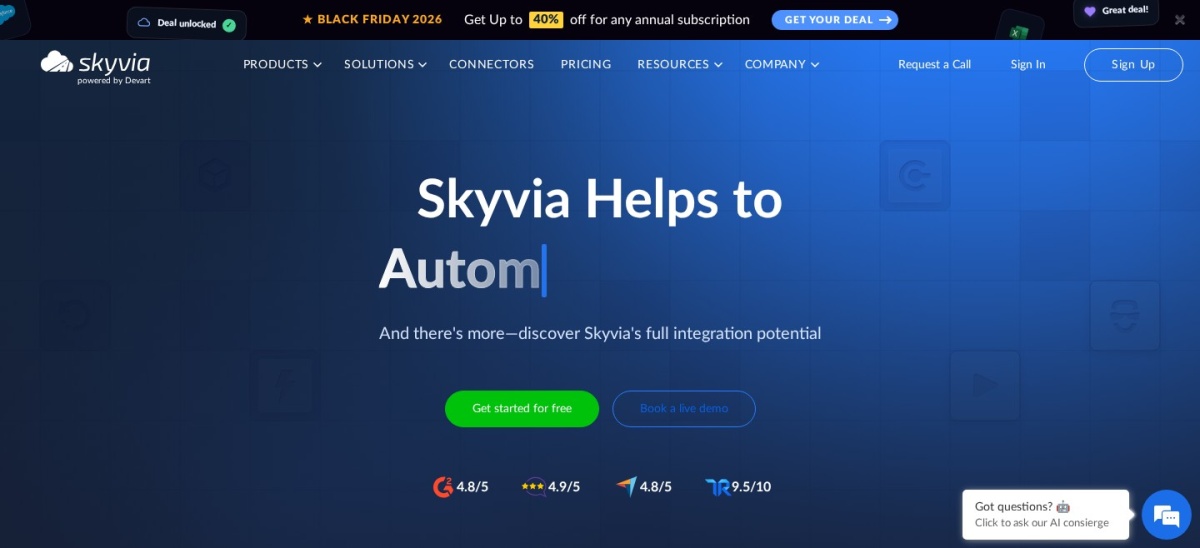
Skyvia is a cloud data platform for database integration, application synchronization and AI connectivity. Its free integration plan processes up to 10,000 records monthly, while its separate Connect product provides MCP endpoints through which compatible AI assistants can access business information.
The trade off is that Basic integration costs $99 per month and supports daily scheduling rather than frequent updates. AI connectivity uses the separate Connect product, so additional charges may apply. It suits businesses that need conventional database integration alongside controlled access for AI applications.
What we like
No-code data integration interface
Supports application and database connections
Free integration allowance
MCP endpoints for compatible AI assistants
Watch out for
Entry-level synchronization is limited to daily runs
Different products have separate pricing
Advanced mapping requires a higher plan
Basic increases scheduled integration capacity and removes schedule expiration.Visit skyvia.com
AI data integration vs. traditional ETL
Traditional ETL extracts information from source systems, transforms it into a consistent format and loads it into a destination. AI data integration builds on these processes by adding capabilities such as natural language pipeline configuration, automated connector creation and AI agent access.
Not every business needs AI to perform the actual integration. Reliable connectors and predictable synchronization may be more valuable than generated pipeline configurations, especially when financial reporting or operational databases are involved.
Airbyte and Hevo focus on data infrastructure, while Zapier focuses on connecting operational applications. Coupler.io brings business reporting and AI analysis together. Choose a platform according to where your information needs to go and how it will be used.
How much do AI data integration tools cost?
Subscription prices vary with the type of integration. Airbyte starts at $20 per month, while Hevo lists its Starter subscription at $299 per month. Integrate.io charges $1,999 per month for its Core package.
Consumption-based pricing makes entry costs difficult to compare directly. Fivetran charges a $5 monthly base fee for qualifying Standard connections, with additional charges determined by usage. Airbyte calculates cloud consumption using credits.
Consider expenses outside the platform subscription, including destination warehouse storage, computing resources, AI model usage and engineering support. A free self-hosted platform still requires infrastructure and maintenance.
Annual price figures in this comparison are calculated from published monthly rates. Consumption-based entries represent starting charges, not guaranteed annual expenses. Annual billing discounts and separate AI product subscriptions may change the final amount.
How we chose
We selected established data integration platforms with AI-assisted automation, AI connectivity or infrastructure capabilities that support AI applications. We compared their connector options, pricing structures, deployment models, free plans and published customer feedback.
Pricing and rating information was researched on 24 Nov 2026 using official vendor pricing pages and G2 product profiles. The article retains its assigned editorial date of 22 Nov 2026. Annual cost figures are calculated from published monthly starting rates, with usage-based pricing identified separately.
We excluded platforms without verifiable public pricing, products with insufficient review evidence and tools that primarily provide unrelated AI features. No vendor paid for a place, and we do not claim testing for this list.
How to choose the best AI data integration tool
Evaluate your data sources, integration requirements, AI capabilities and expected operating expenses before selecting a platform.
**Identify your data sources and destinations.** List every application, database, file system and warehouse involved in your integration. Confirm that the platform supports the necessary authentication methods, data types and synchronization patterns.
**Define the role of AI in your workflow.** Decide whether you need AI-generated connectors, natural language workflow creation, automated business analysis or governed data access for AI agents. Avoid paying for features that do not address your requirements.
**Calculate your expected production expenses.** Estimate data volume, synchronization frequency, workflow activity and required user access. Include consumption charges, infrastructure expenses and any separate subscriptions needed for AI functionality.
**Review security and operational requirements.** Check access controls, error handling, monitoring, recovery options and data retention policies. Use the vendor's available trial or free edition to evaluate whether the platform fits your actual integration requirements.
FAQ
What is the best AI tool for data integration?
Airbyte is our top pick for technical teams because it combines managed cloud pipelines, self-hosting flexibility and AI agent connectivity. Hevo is a suitable alternative for managed warehouse integration, while Coupler.io focuses on business reporting and AI analysis.
Are there free AI data integration tools?
Yes. Airbyte offers a free self-hosted edition, Fivetran provides a limited free subscription, and Zapier includes 100 monthly tasks on its free plan. Skyvia also offers free data integration with a monthly record allowance.
Can AI automate ETL pipelines?
AI can assist with connector generation, pipeline configuration, transformation logic and troubleshooting. However, teams should still validate generated configurations, review data quality and monitor production pipelines to prevent incomplete or inaccurate information from reaching downstream systems.
What is the difference between ETL and ELT?
ETL transforms information before loading it into the destination. ELT loads information into the destination before applying transformations. ELT is commonly used with cloud data warehouses, while ETL can be preferable when information must be processed before delivery.
Which AI data integration tool is best for beginners?
Zapier is suitable for beginners who need to connect business applications through visual workflows. Coupler.io is another accessible option for reporting automation. Both reduce the need to write custom integration scripts, although their capabilities address different workloads.
How do AI agents access integrated business data?
AI agents can retrieve integrated information through APIs, database connections, dedicated connectors or the Model Context Protocol. Administrators should restrict access to approved datasets and apply appropriate permissions before allowing AI agents to retrieve or modify business information.
How much does AI data integration software cost?
Published entry prices vary from $19.99 per month for Zapier Professional to $1,999 per month for Integrate.io Core. Consumption-based platforms can charge additional fees depending on data volume, connection activity and processing requirements.
Can AI data integration tools replace data engineers?
AI data integration tools can reduce repetitive engineering tasks, such as maintaining connectors and configuring routine workflows. They do not eliminate the need for technical oversight, particularly when organizations manage complex schemas, sensitive information or production data infrastructure.
Which data integration platform is best for large datasets?
Integrate.io is worth considering for high-volume workloads because its Core subscription includes unlimited data volume. Airbyte and Fivetran are also suitable candidates, but teams should calculate their expected consumption charges before committing to production deployments.