Best AI Software for FP&A in 2026: 9 Tools Compared
WLWPLegible EditorsLast verified 24 Nov 2026How we rank12 min read
★ Short answer
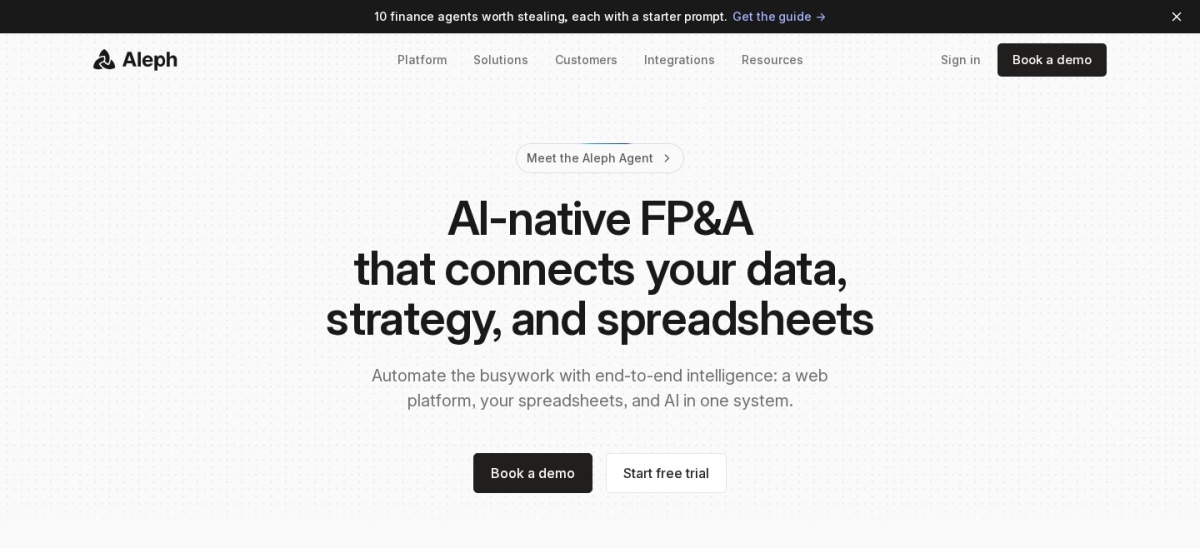
Aleph is the best AI software for FP&A for teams that work in Excel or Google Sheets. Its AI agent traces budget variances to the transaction and drafts the commentary, and it holds 4.9 out of 5 on G2. Pick Cube for the lightest spreadsheet layer and Datarails for Excel-centric reporting and close.
How we make this list: we compare pricing pages, product documentation and public user reviews, then re-check every price before each update. No product paid for a place. Disclosure.
Aleph leads on AI: its agent traces variances to the transaction and drafts commentary, with a 4.9 G2 rating.
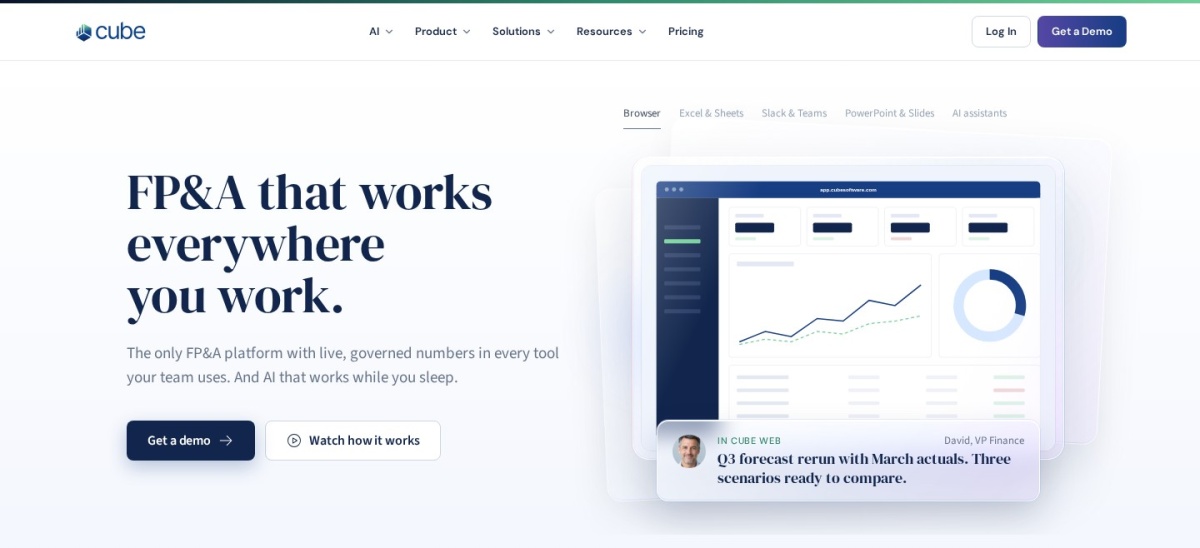
Cube is the lightest spreadsheet layer, starting at about $1,500 a month with two-way Excel and Sheets sync.
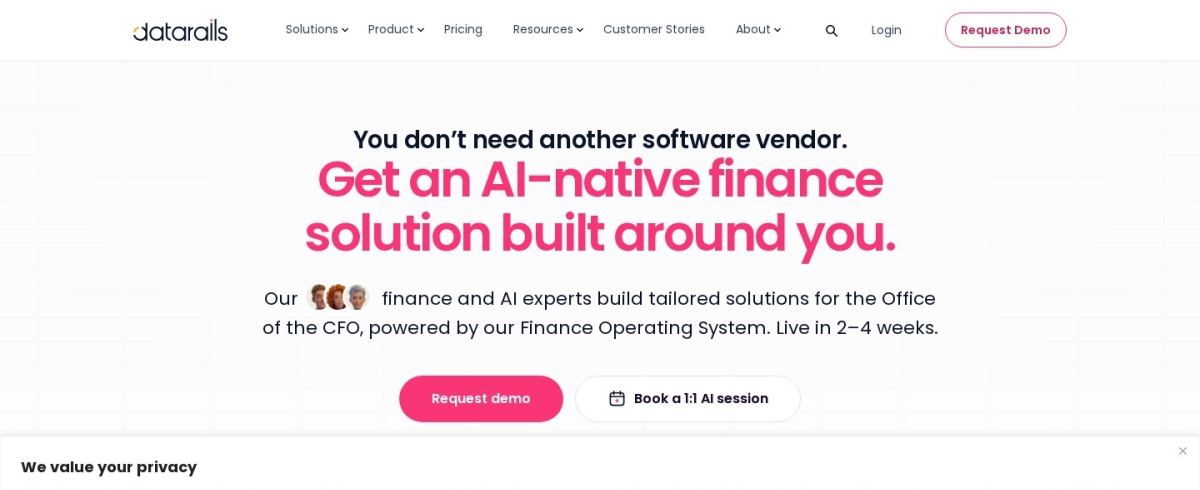
Datarails keeps finance teams in native Excel, with typical contracts around $33,300 a year.
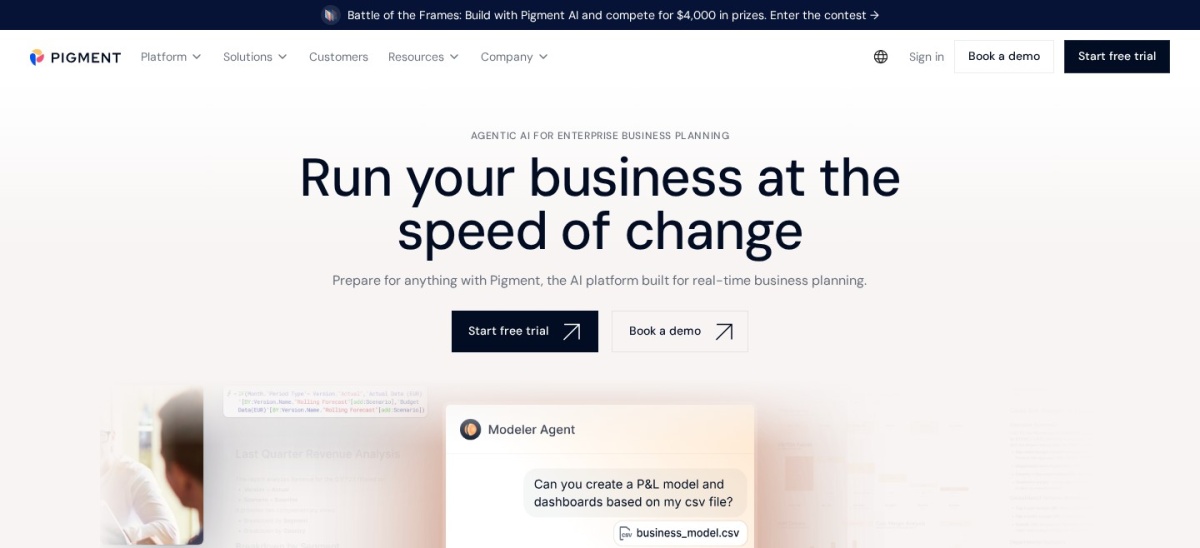
Pigment ships four coordinated AI agents for collaborative planning, but pricing is quote-only.
Only Centage and PlanGuru publish prices in this category, from $699 and $99 a month.
What AI software for FP&A should cover
FP&A software turns a finance team's spreadsheet models into a governed plan: budgets, rolling forecasts, consolidation and board reporting, all fed by live actuals from the ERP and CRM.
AI changed the job in 2026. Agents now draft variance commentary, flag anomalies and build models from a plain-language prompt, instead of only summarising reports. The best tools run that AI inside each user's permissions.
Almost nobody in this category publishes a price. Cube starts at about $1,500 a month, Datarails at about $2,000 a month, and the rest are quote-based, with typical mid-market contracts running $30,000 to $75,000 a year.
Pick by where your team already models. Spreadsheet-native teams do best with Aleph, Cube or Datarails, while visual, collaborative planning points to Pigment and enterprise scale to Anaplan.
Aleph is an AI-native FP&A platform that keeps modelling in Excel or Google Sheets. It connects finance data from ERP, CRM, HR and billing systems through 200+ integrations, and its AI agent traces budget variances to the vendor, department and transaction, then drafts the commentary.
The trade off is pricing. Aleph is quote-based with no public price, so you need a sales call to budget it, and a full-access trial is the way to test it. It suits spreadsheet-native teams that want AI-first FP&A without a migration.
Cube is a spreadsheet-native FP&A platform with two-way sync to Excel and Google Sheets, so analysts never leave the spreadsheet. It adds a governed control layer underneath, with scenario planning on top of existing models, and its FP&Agents run analysis workflows instead of only summarising reports.
The trade off is depth. Cube is the lightest version of the governed-layer idea, with fewer native integrations than Datarails, and costs climb fast with complexity. It suits lean FP&A teams that want governance without leaving their spreadsheets.
Datarails is an Excel-centric FP&A platform that extends into close management, cash flow and spend tracking. It automates data aggregation from 600+ integrations, builds report packs in Excel and PowerPoint from a central database, and its FP&A Genius assistant answers questions in plain language.
The trade off is price opacity and setup time. Pricing is quote-only, with typical contracts around $33,300 a year, and implementation usually takes 3 to 6 months. It suits Excel-centric teams that want automated consolidation and close.
Pigment is an AI-native planning platform for mid-market to upper-mid-market teams. It ships four coordinated AI agents, Analyst, Modeler, Planner and Supervisor, plus machine-learning predictions for revenue, expense and headcount, in a visual, real-time collaborative workspace.
The trade off is cost and maturity. Pricing is quote-only, with a typical annual contract around $74,000, and it is still maturing against Anaplan at enterprise depth. It suits high-growth teams that want agent-driven visual planning across finance, sales and HR.
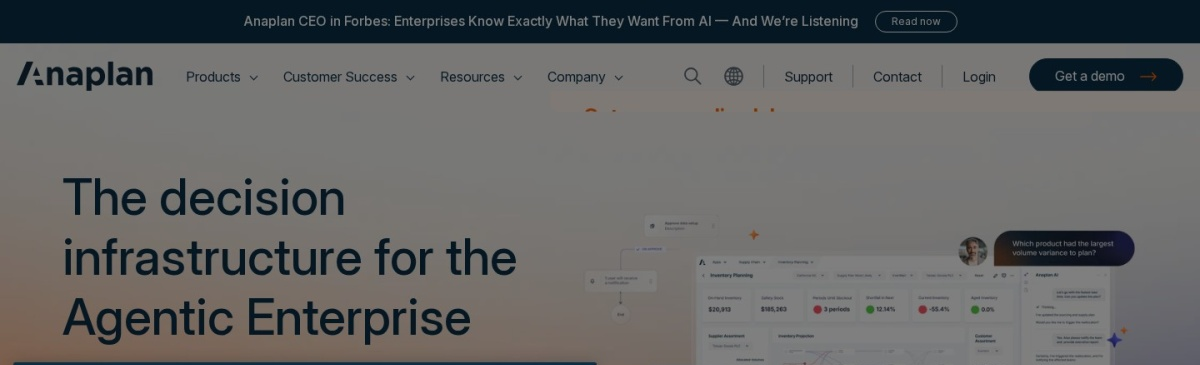
Anaplan is the enterprise standard for connected planning at real scale. Its Hyperblock engine models billions of cells across finance, sales, supply chain and workforce, with PlanIQ machine-learning forecasting and CoModeler agents, serving more than 2,800 customers including 48% of the Fortune 50.
The trade off is cost and staffing. Entry contracts run about $30,000 to $50,000 a year, with implementation at 50% to 150% of the first-year licence, and it assumes a team of model builders. It suits large enterprises with complex cross-functional modelling needs.
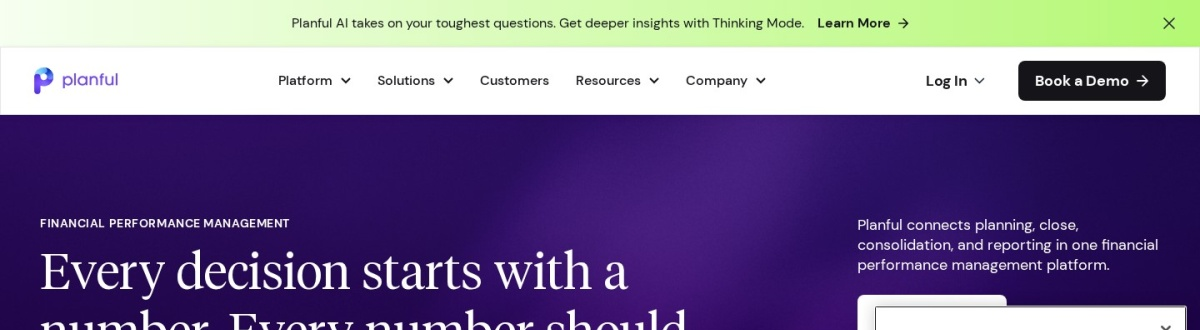
Planful is a cloud financial performance management platform covering planning, close, consolidation and reporting. Its AI suite covers Analyst, Planner, Projections, Signals and Predict, with anomaly alerts and smarter forecasts, plus an Excel add-in for teams that still model in spreadsheets.
The trade off is that the AI is a separate module. Predict is a paid add-on at about $35,000 to $90,000 a year, not included by default, and implementation takes 8 to 12 weeks. It suits mid-market to enterprise teams that want forecast integrity with close automation.
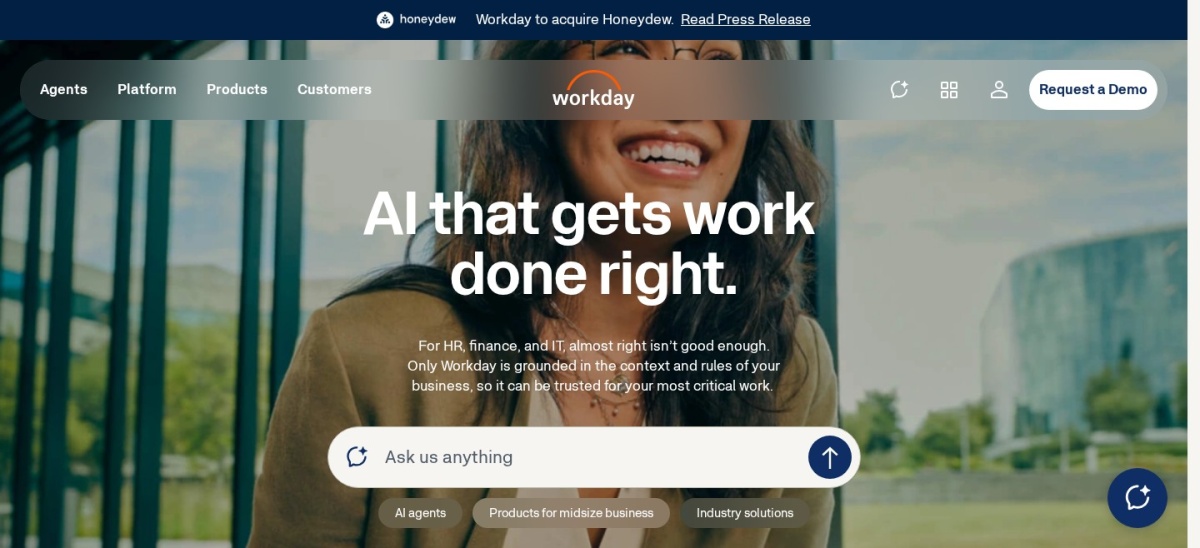
Workday Adaptive Planning homepage, captured Nov 2026.
Workday Adaptive Planning is a cloud planning platform for large enterprises on Workday. It covers rolling forecasts, scenario modelling and workforce planning, with Adaptive Decision Intelligence and machine-learning forecasts, plus Excel reports that refresh from the model.
The trade off is implementation weight. It is quote-based with a heavy setup, and its AI is lighter than Aleph or Pigment. It suits mid-market to enterprise teams that already run Workday and want unlimited what-if scenarios.
What we like
Unlimited what-if scenarios
Monte Carlo simulations
Excel reports that refresh from the model
Watch out for
Heavy implementation
Lighter AI than newer rivals
Monte Carlo simulations and unlimited scenarios includedVisit workday.com
08
Centage
4.4/5on G2 (28 reviews, checked Nov 2026)
Starts at$699/mo
Best FP&A tool with published pricing
Entry plan$699/mo, billed annually
ImplementationBundled, 4-6 weeks
Workforce planningYes
Free trialNo, demo
centage.com
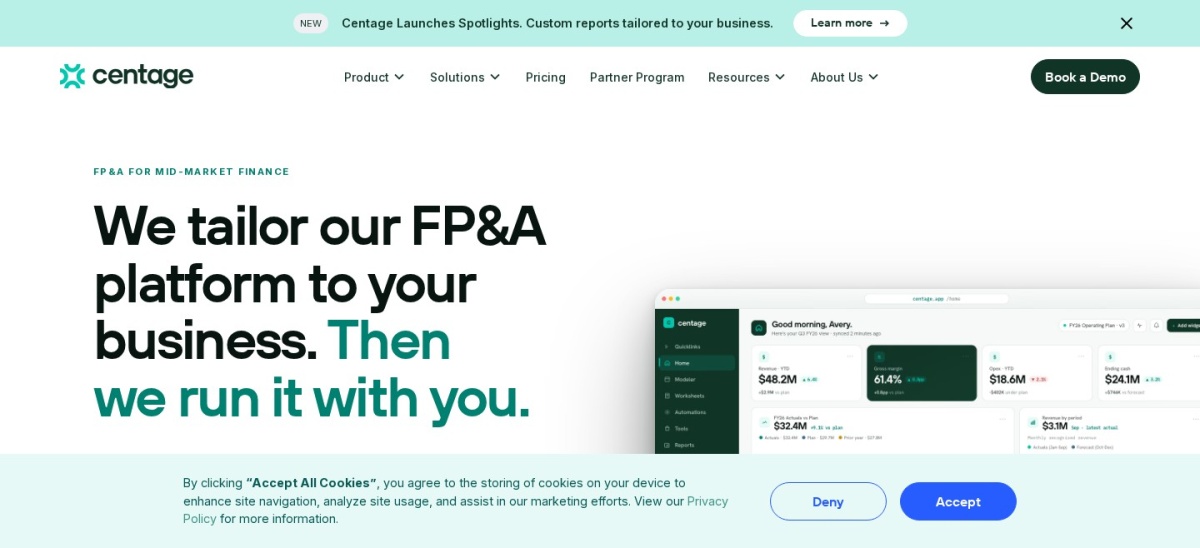
Centage homepage, captured Nov 2026.
Centage is a structured FP&A platform for mid-market teams, covering budgeting, forecasting and workforce planning through its Planning Maestro product. It is one of only two vendors in this category that publishes pricing, from $699 a month billed annually, with implementation bundled in 4 to 6 weeks.
The trade off is scope. It is a solid mid-market planner without the AI agent depth of Aleph or Pigment, and its G2 review base is small at 28 reviews. It suits mid-market teams that want a published price and no surprise fees.
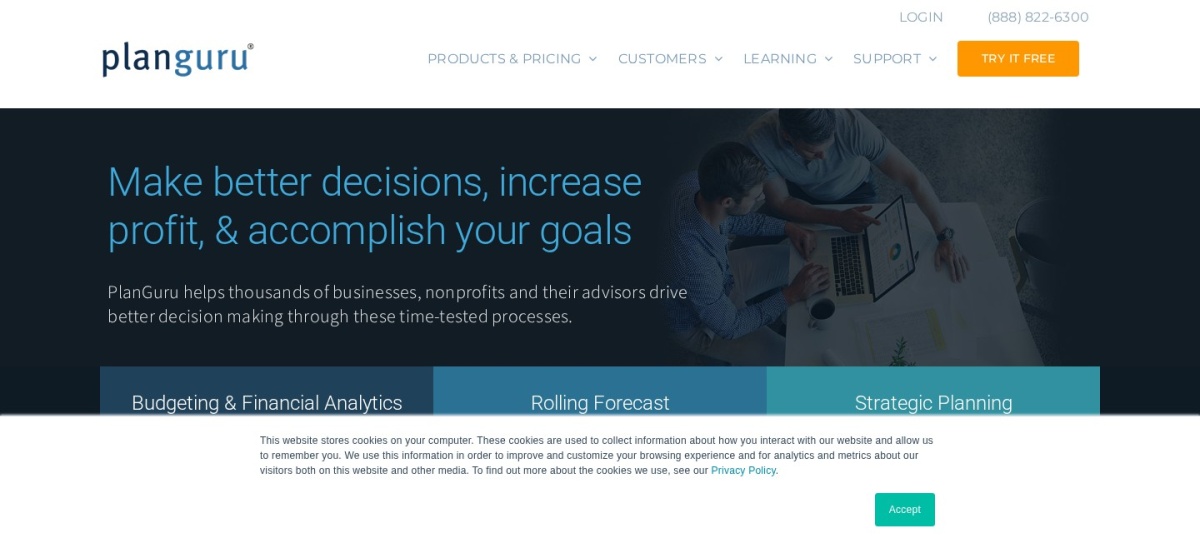
PlanGuru is the most accessible budgeting and forecasting tool in this list. Its single-entity plan costs $99 a month, or $83 a month billed annually, with analytics at $199 and multi-unit consolidations at $399 a month, plus extra users at $29 a month.
The trade off is scale. It is built for small businesses and nonprofits, not multi-entity enterprises, and its AI features are light. It suits small finance teams that need real budgeting and forecasting without an enterprise project.
Only two vendors in this category publish a price: Centage from $699 a month and PlanGuru from $99 a month. The rest quote, and the quote moves on seat count, module mix and contract term.
Third-party deal data puts typical annual contracts at about $33,300 for Datarails, $74,000 for Pigment and about $108,000 for Anaplan as of November 2026.
Budget 25% to 100% of the first-year subscription again for implementation. Enterprise tools commonly need 3 to 6 months to go live.
How we chose
We started from the FP&A platforms with AI agents in active sale in November 2026, then kept those that cover budgeting, forecasting and variance analysis.
Prices come from each vendor's pricing page where published, and from third-party deal data where vendors quote only, checked on 24 November 2026. Ratings and review counts come from G2 profiles as reported in November 2026.
We left out tools with no FP&A focus and no trial or demo path. No vendor paid for a place, and we do not claim hands-on testing for this list.
How to choose AI software for FP&A
Start with where your team already models, then check the AI and the implementation.
Name where your team models today. Excel, Google Sheets or a web app. The answer rules out half the shortlist at once.
Check the AI, not the marketing. Ask whether the agent drafts variance commentary, traces to transactions and runs inside user permissions.
Get a real implementation timeline. Ask for the go-live time in writing. Aleph reports about 1 month, Cube about 2, Datarails about 4 and Planful about 5.
Budget the first year, not the license. Add implementation, integrations and internal time, typically 25% to 100% of the first-year subscription.
FAQ
What is the best AI software for FP&A?
Aleph is the best pick for teams working in Excel or Google Sheets. Its AI agent traces variances to the transaction and drafts commentary, and it holds 4.9 out of 5 on G2 from 108 reviews.
How much does FP&A software cost?
Most mid-market teams land on $30,000 to $75,000 a year in subscription, plus implementation. Cube starts at about $1,500 a month, while Anaplan contracts typically run $30,000 to $300,000 a year.
What is the difference between FP&A software and a spreadsheet?
A spreadsheet is the model; FP&A software adds a governed layer underneath it, with live actuals, version control, permissions and audit trails. Spreadsheet-native tools keep the model in Excel or Sheets.
Which FP&A tool is best for a small business?
PlanGuru is the most accessible, from $99 a month for a single entity, and Centage publishes pricing from $699 a month. Both suit small teams that need real budgeting without an enterprise project.
Do FP&A tools work with QuickBooks?
Yes. Aleph, Datarails, Cube, Planful, Workday Adaptive Planning and Pigment all connect to QuickBooks, either natively or through a connector, so actuals flow into the plan without manual exports.
Is AI in FP&A software reliable?
AI drafts variance commentary and flags anomalies well, but it still needs a finance analyst to check the numbers. The best tools run AI inside existing user permissions, so it only sees data the user may see.