Databricks is the best Apache Spark alternative for most teams, since it runs Spark itself on a managed lakehouse and is rated 4.6/5 on G2 from 1,434 reviews. Pick Apache Flink for true real-time streaming, Snowflake for SQL warehousing, and Google BigQuery for serverless queries.
How we make this list: we compare pricing pages, product documentation and public user reviews, then re-check every price before each update. No product paid for a place. Disclosure.
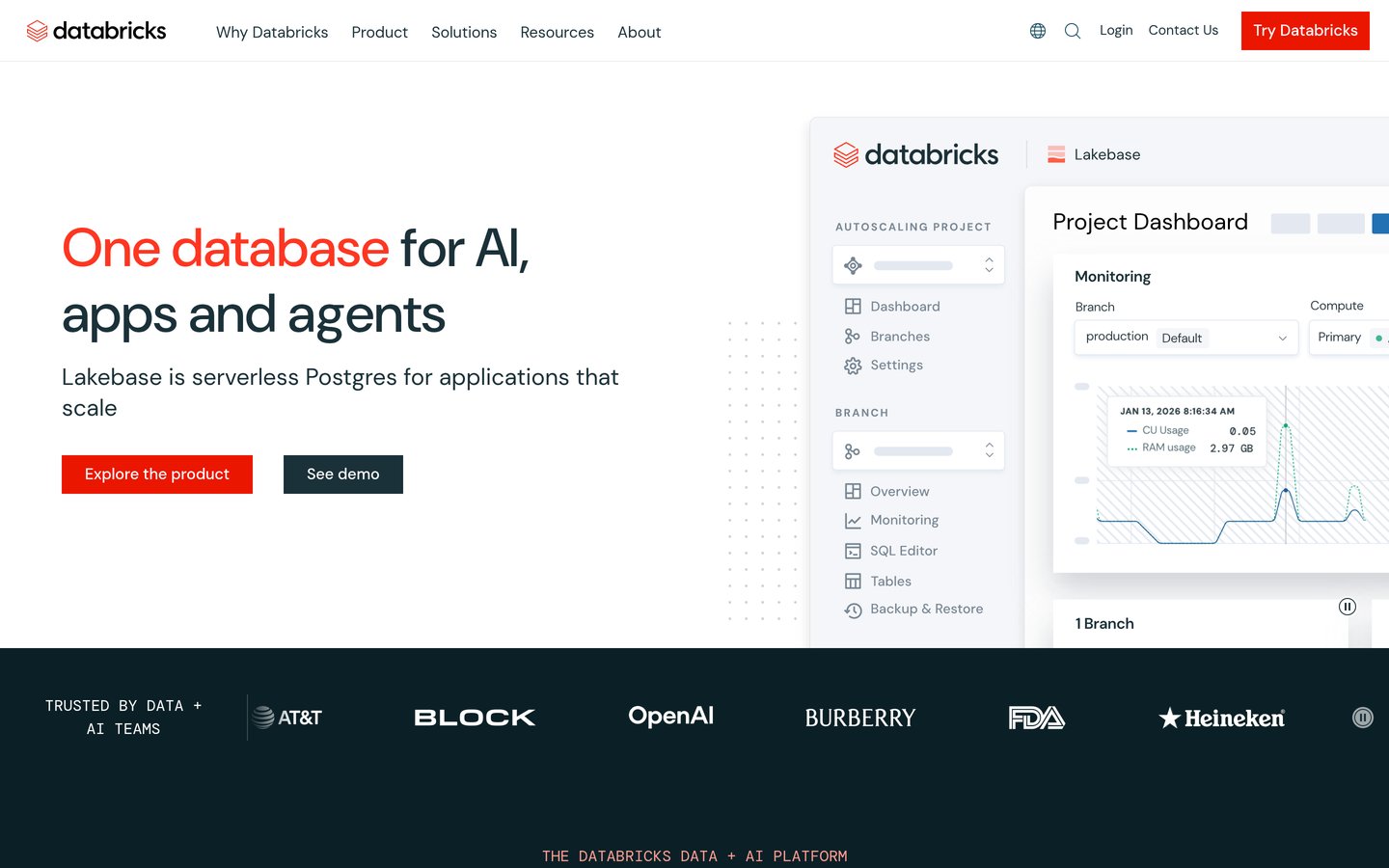
Databricks is the closest Spark replacement: managed Spark from its creators, rated 4.6/5 from 1,434 G2 reviews, with jobs compute from $0.15 per DBU.
Apache Flink is the only pick built for true streaming, with event-time handling and exactly-once state instead of Spark micro-batches.
Snowflake and BigQuery replace Spark SQL warehousing, not Spark jobs: $2.00 per credit against $6.25 per TiB scanned.
Four picks have a free tier or free edition: Databricks, BigQuery, Dremio and Starburst, while Flink and ClickHouse are free open source.
Every managed pick bills by usage, so the cheapest choice depends on your workload, not the headline rate.
How do you choose an Apache Spark alternative?
Start from the workload, not the brand. Spark covers batch, SQL, streaming and machine learning in one engine, so no single alternative replaces all of it at once.
Streaming teams should look at Flink first. It processes events as they arrive with event-time handling and exactly-once state, while Spark Structured Streaming works in micro-batches.
SQL-heavy teams can drop the cluster entirely. Snowflake, BigQuery, Dremio and Starburst run SQL over data in place, and only Databricks and AWS Glue keep a Spark engine underneath.
Price the same workload on each platform before choosing. Databricks bills DBUs, Snowflake bills credits, BigQuery bills TiB scanned and Glue bills DPU-hours, so headline rates do not compare directly.
Databricks is a managed lakehouse built by the creators of Apache Spark, running Spark, Delta Lake and SQL on one platform with Unity Catalog governance. Its free Community Edition gives individuals a sandbox to learn Spark, while production jobs compute starts at $0.15 per DBU on AWS.
The trade off is the bill. DBU rates vary by workload and tier, serverless SQL climbs to $0.70 per DBU, and classic clusters bill cloud virtual machines separately. It suits teams that want Spark without running clusters, plus SQL, ML and AI agents in one place.
What we like
Spark from the team that created it
Largest review base in this list at 1,434 G2 reviews
Free Community Edition for learning Spark
Unity Catalog governance across data and AI
Watch out for
DBU billing is hard to forecast without monitoring
Snowflake is a managed cloud data platform that separates storage and compute, so warehouses scale independently of the data they hold. It runs SQL analytics, data sharing and Iceberg lakehouse tables across AWS, Azure and Google Cloud, and new accounts get $400 in credits for 30 days.
The trade off is cost control. Standard compute starts at $2.00 per credit plus $23.00 per TB of monthly storage, and warehouses bill with a 60-second minimum on start. It suits teams that want SQL-first analytics and sharing without managing any cluster.
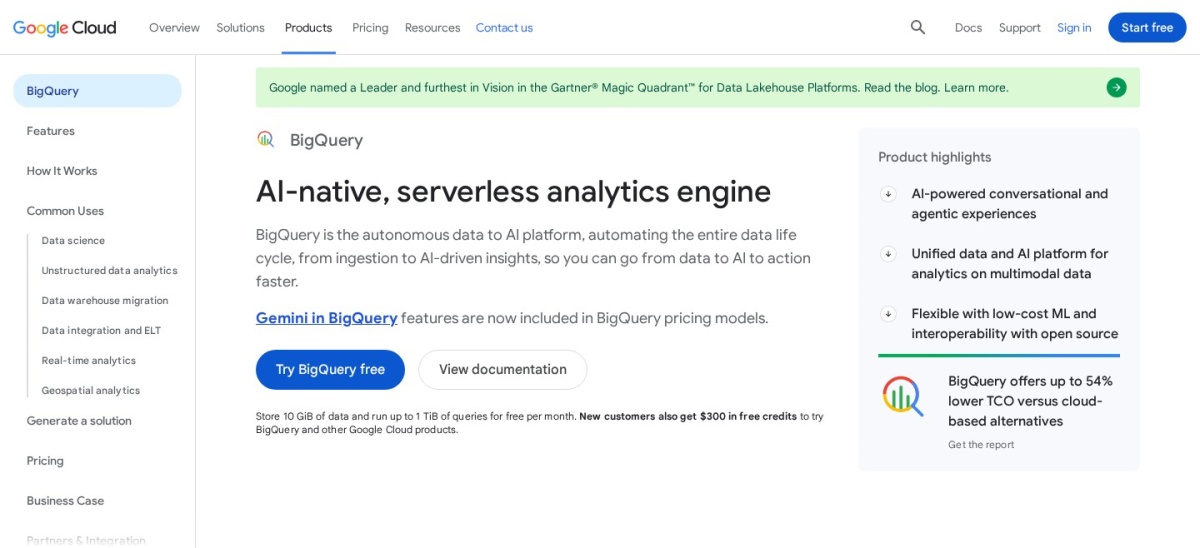
Google BigQuery is a serverless data warehouse that runs SQL over petabytes without any cluster to size or maintain. The first 1 TiB of queries each month is free, on-demand queries cost $6.25 per TiB scanned, and BigQuery ML builds models in SQL.
The trade off is scan billing. A query that reads a full unpartitioned table bills every byte it scans, so unoptimised queries get expensive fast. It suits Google Cloud teams with spiky or irregular query volume that want no servers to manage.
Apache Flink is an open-source distributed engine for stateful computations over unbounded and bounded data streams. It processes events as they arrive with event-time handling and exactly-once state, instead of Spark micro-batches, and it runs on YARN, Kubernetes or standalone clusters.
The trade off is operations. Flink itself is free, but running a production cluster, tuning checkpoints and state backends takes real platform work. It suits teams whose core workload is continuous streaming rather than batch.
Dremio is an open lakehouse platform built on Apache Iceberg and Apache Arrow that runs interactive SQL and BI queries directly on object storage. Dremio Cloud bills $0.20 per Dremio Compute Unit, with an XS engine at $6.40 an hour, and a free Community Edition is available for self-hosting.
The trade off is ownership change. SAP closed its acquisition of Dremio in July 2026 and has said nothing about Cloud pricing or the Community Edition roadmap, so multi-year buyers should ask about protections. It suits teams that want fast SQL on Iceberg tables without copying data into a warehouse.
What we like
Queries Iceberg data in place, no copies
Autonomous Reflections accelerate slow queries
Free Community Edition for self-hosting
Rated 4.6/5 on G2 from 71 reviews
Watch out for
SAP acquisition leaves the roadmap unclear
Managed Cloud runs on AWS only
Enterprise pricing is quote-only
Paid Cloud engines start at $0.20 per DCU, billed per secondVisit dremio.com
06
Starburst
4.3/5on G2 (132 reviews, checked Nov 2026)
PriceFree
Best for federated SQL across silos
Entry compute$0.50 / credit (Galaxy Pro)
Free tierUp to 3 clusters free
EngineEnterprise Trino
DeploymentGalaxy SaaS or self-managed
starburst.io
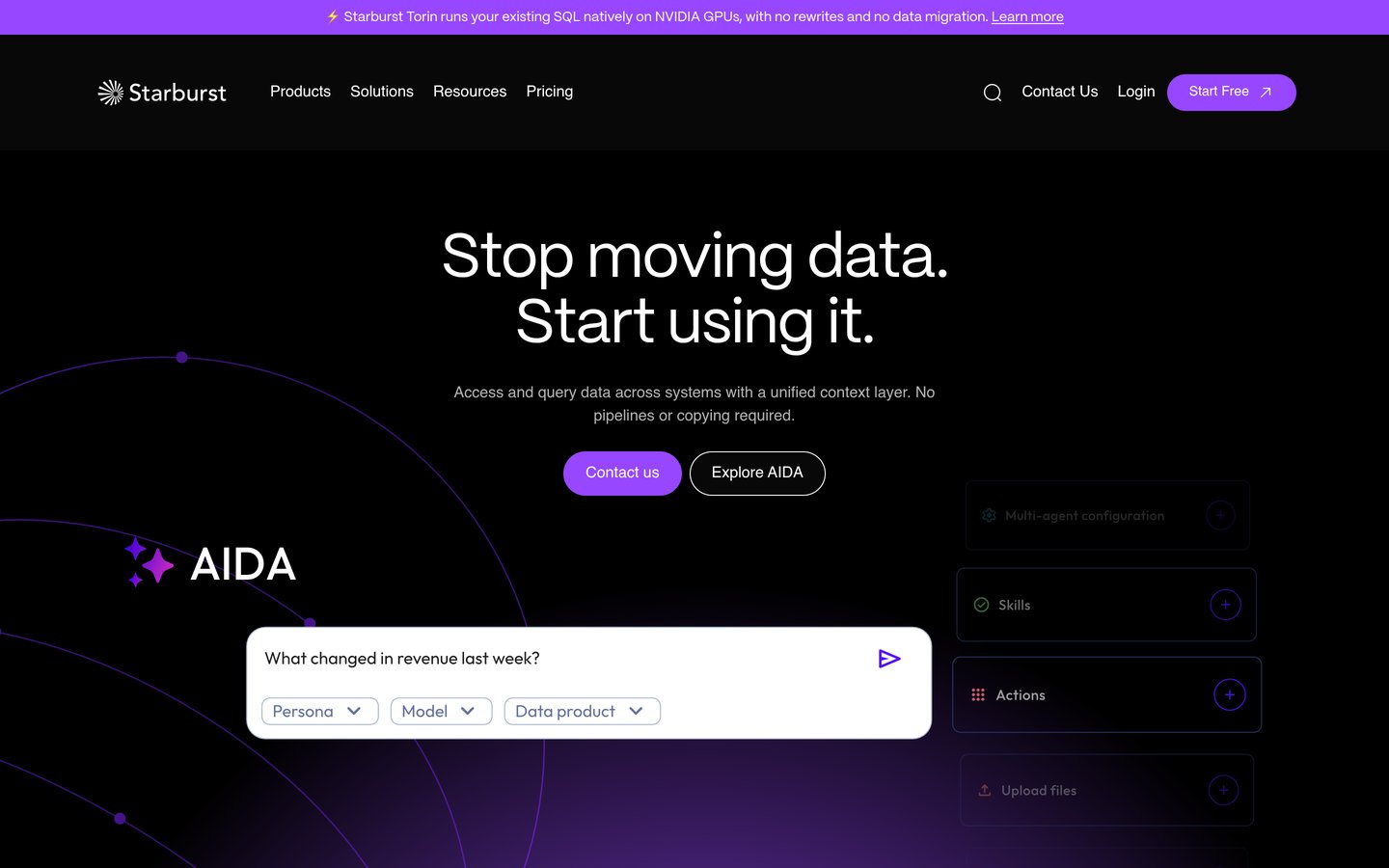
Starburst homepage, captured Nov 2026.
Starburst is an enterprise distribution of open-source Trino that runs federated ANSI SQL across cloud lakes, warehouses and databases without moving data. Its managed Galaxy service keeps up to 3 clusters free forever, and paid Pro plans start at $0.50 per credit.
The trade off is predictability. Credit consumption spikes with large joins across sources, and Enterprise features such as attribute-based access control raise the rate to $0.75 per credit. It suits teams that need to query data where it already lives.
ClickHouse Cloud is the managed version of the open-source columnar database, built for sub-second aggregations over billions of rows. Basic compute costs $0.2181 per unit-hour, storage costs $25.30 per TB a month, and services scale to zero when idle.
The trade off is fit. It is an analytical engine first, so frequent updates, deletes and heavy joins need care, and production tuning takes time to learn. It suits real-time dashboards, logs and event analytics where read speed matters most.
AWS Glue is a serverless data integration service from Amazon Web Services that runs Spark ETL jobs without provisioning servers. Jobs bill at $0.44 per DPU-hour with per-second billing, and the Data Catalog keeps the first million objects free each month.
The trade off is lock-in. Glue fits naturally inside AWS with S3, Redshift and Athena, but pipelines are hard to move elsewhere and costs climb if jobs are not tuned. It suits AWS teams that already run Spark and want ETL without cluster management.
Microsoft Fabric is a unified analytics platform that combines data engineering, warehousing, data science and Power BI in one SaaS service on Azure. Entry F2 capacity costs $262.80 a month pay-as-you-go, and Spark notebooks run inside the same workspace as reports.
The trade off is the floor. F2 is the smallest capacity, so small teams pay $262.80 a month even for light use, and the G2 review base is only 47 reviews. It suits Microsoft shops that want one platform for engineering, BI and AI.
Staying is the right call when your jobs already run and the pain is operations, not the model. Managed Spark on Databricks or AWS Glue removes cluster work without a rewrite.
Migration costs more than the licence saving. Rewriting Spark jobs as Flink streams or warehouse SQL takes engineering weeks, and every rewrite risks breaking a pipeline that currently runs.
Switch when the model itself is the problem. If most of your work is SQL dashboards, a warehouse is cheaper to run; if it is continuous event processing, Flink fits better than Spark micro-batches.
How we chose
We started from the engines and platforms most often named as Spark replacements in G2 comparisons and data-platform guides, then kept the nine with a public numeric rating and a published price.
Prices come from each vendor's pricing page or G2 listing, checked on 29 November 2026. Ratings and review counts come from G2 on the same day. Where a vendor shows a sale, the list shows the regular price.
We left out open-source engines with no public rating, such as Dask, Ray and Apache Beam, and warehouse-only tools that do not run Spark-style jobs. No vendor paid for a place, and we do not claim hands-on testing for this list.
How to choose an Apache Spark alternative
Start with the workload you run most, then price that workload on two or three picks.
Name the workload first. Batch ETL, SQL dashboards, continuous streaming and ML training point at different tools. Do not pick a warehouse for a streaming job.
Check whether you still need Spark. If your jobs are Spark code, Databricks or AWS Glue keep them running. If they are SQL, a warehouse replaces the cluster entirely.
Price the same workload everywhere. Run one representative job or query set on each shortlisted tool, and watch scan, credit and DBU burn. Partition and cluster tables before judging scan billing, as our database clean-up guide shows for slow queries.
Start on a free tier, then commit. Use the free tiers on Databricks, BigQuery, Dremio and Starburst to prove the fit before paying for capacity or reserved rates.
FAQ
What is the best Apache Spark alternative in 2026?
Databricks is the best Apache Spark alternative for most teams. It runs Spark itself on a managed lakehouse, is rated 4.6 out of 5 on G2 from 1,434 reviews, and jobs compute starts at $0.15 per DBU.
Is there a free Apache Spark alternative?
Yes. Apache Flink and ClickHouse are free open source, Databricks has a free Community Edition, BigQuery gives 1 TiB of queries free each month, and Starburst keeps up to 3 clusters free forever.
What is the best Apache Spark alternative for streaming?
Apache Flink is the best choice for streaming. It processes events as they arrive with event-time handling and exactly-once state, while Spark Structured Streaming works in micro-batches.
Databricks vs Snowflake: which replaces Spark better?
Databricks replaces Spark better, because it runs Spark itself with Delta Lake and Unity Catalog. Snowflake replaces the SQL warehousing part of Spark, not Spark jobs, MLlib or streaming.
Can I replace Spark with BigQuery?
Yes for SQL analytics, no for arbitrary Spark jobs. BigQuery runs petabyte SQL without a cluster, but it does not run Spark code, MLlib or custom streaming jobs, so keep Spark or Databricks for those.
How much does an Apache Spark alternative cost?
It depends on usage. Flink is free if you self-host, Databricks starts at $0.15 per DBU, AWS Glue at $0.44 per DPU-hour, BigQuery at $6.25 per TiB scanned, and Microsoft Fabric has a $262.80 a month floor.
SaaS SEO and WordPress specialist with about 8 years of experience. Rakib compares WordPress plugins, themes, hosting and software using public pricing, documentation and user reviews. See how we rank.