Backups & maintenance · Guide
How to Migrate Site to Managed GoDaddy WordPress Hosting (Step by Step)
Short answer
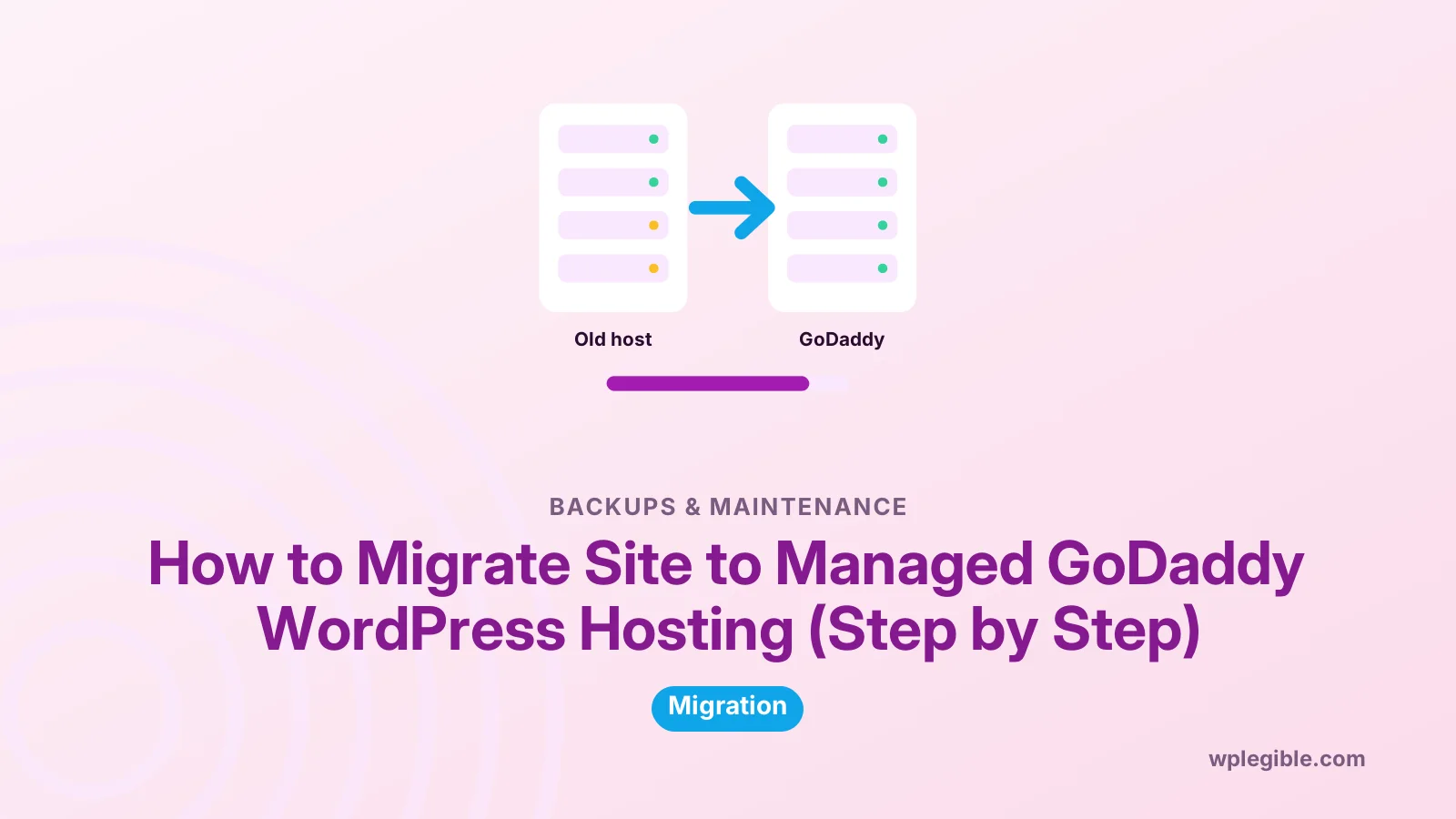
Open your GoDaddy Managed WordPress plan, choose the option to migrate an existing site, and enter your current site's address and admin login. Test the copy on the temporary domain, then point your domain to GoDaddy, set up SSL and keep the old host for a week.
Key takeaways
- GoDaddy's Managed WordPress plans include an automatic migration tool.
- The tool needs your old site's URL and an admin login.
- Use a migration plugin or manual move if the tool cannot reach your site.
- Test on the temporary domain before changing DNS.
- Move email records carefully and keep the old host active for a week.
How do you migrate a site to managed GoDaddy WordPress hosting?
Start a managed WordPress site in your GoDaddy account, choose to migrate an existing site, enter your current URL and admin login, then test the copy and point your domain to GoDaddy.
GoDaddy's Managed Hosting for WordPress includes a migration tool that copies your files and database for you. For most sites, that is the easiest route.
If the automatic tool fails, you can migrate with a plugin or by hand. This guide covers all three paths.
GoDaddy describes its automatic process in its help article on moving a WordPress site to Managed Hosting for WordPress. Screens change over time, so keep that article open as you work.
What do you need before migrating to GoDaddy?
You need an active GoDaddy Managed WordPress plan, admin access to your current site, a full backup, and access to your domain's DNS settings.
Checklist:
- The hosting plan. Buy a Managed Hosting for WordPress plan, not shared cPanel hosting, if you want the managed tools.
- Admin login for the old site. The migration tool signs in to copy your content.
- A full backup. Files and database, stored off the old server. Our guide on where to store WordPress backups covers good options.
- DNS access. You will update records at your domain registrar or DNS provider at the end.
- Site size. Very large sites can time out in automatic tools. Clear old backups and unused media first.
Take the backup even if GoDaddy's tool does everything for you. If anything goes wrong, you can restore the original site on any host. WordPress lists sensible approaches on its backups documentation page.
If you have not set up the GoDaddy side yet, our guide on setting up WordPress hosting with GoDaddy covers the first steps.
WordPress explains what a move involves in its official migration documentation.
How do you use GoDaddy's automatic migration tool?
In your GoDaddy account, open the Managed WordPress product, start setting up a site, pick the option to migrate an existing site, enter your current URL and admin details, and let the tool copy everything.
General steps:
- Sign in to your GoDaddy account and open My Products.
- Find Managed Hosting for WordPress and click Set up or open the site dashboard.
- Choose the option to migrate an existing WordPress site rather than create a new one.
- Enter your current site's address.
- Enter an administrator username and password for that site.
- Start the migration and wait for the confirmation email.
The tool usually installs a helper plugin on your old site to package the content. Leave the old site online and unchanged while it runs.
Migration time depends on site size. Small sites can finish in minutes; large ones take longer.
Avoid editing posts or taking orders on the old site during the copy. Changes made mid-migration may not come across.
For a busy shop or membership site, pick a quiet hour and put a short notice on the site. That keeps new orders and signups from landing on the old server after the copy has started.
Once the email arrives, open the new site's dashboard from your GoDaddy account and check that the post, page and plugin counts match the old site.
How do you migrate to GoDaddy with a plugin instead?
Install GoDaddy's migration plugin, or a general tool such as Duplicator or All-in-One WP Migration, on the old site, export a package, then import it into a fresh WordPress install on GoDaddy.
GoDaddy has a help article on migrating a WordPress site with a plugin. Use that route when the automatic tool cannot reach your old site, for example behind a firewall or login protection.
General-purpose plugins also work well:
- All-in-One WP Migration. Exports the site to a single file. See our guide on migrating with All-in-One WP Migration.
- Duplicator. Builds a package and installer. See our guide on migrating WordPress with Duplicator.
- UpdraftPlus. Backs up and restores across hosts, with migration in its premium add-on.
Managed hosts sometimes restrict certain plugins or file uploads. Check GoDaddy's help center if an importer refuses to run.
Can you migrate to GoDaddy manually?
Yes; copy your files over SFTP, export and import the database, update wp-config with GoDaddy's database details, and fix the site URL if the domain changes.
Manual migration takes longer but gives you full control. It suits large sites that time out in plugins.
Outline:
- Download all files from the old host.
- Export the database as an SQL file.
- Upload the files to the GoDaddy site with SFTP.
- Import the database through GoDaddy's database tool.
- Update database settings in wp-config.
- Search and replace old URLs if the address changes.
Our step-by-step guide on migrating WordPress manually covers each step in detail.
| Method | Best for | Main drawback |
|---|---|---|
| GoDaddy automatic tool | Most small and medium sites | Can fail on blocked or very large sites |
| GoDaddy migration plugin | Sites the tool cannot reach | Needs plugin installs on both ends |
| General migration plugin | People who already know the tool | Upload size limits on some plans |
| Manual SFTP and database | Large or custom sites | Slow and technical |
How do you test the site before switching the domain?
Open the site on GoDaddy's temporary domain, click through key pages, log in to the dashboard, test forms and checkout, and fix problems before changing DNS.
GoDaddy gives a new managed site a temporary address. Use it to check the copy while visitors still see the old site.
Test these:
- Homepage and key pages. Look for missing images or broken layouts.
- Admin login. Confirm you can reach the dashboard.
- Forms. Submit each form and confirm emails arrive.
- Shop pages. Add to cart and run a test checkout if you sell.
- Plugins. Check that licenses still validate on the new host.
If links point back to the old host or temporary domain later, our guide on fixing broken links after migration explains the fixes.
How do you point your domain to GoDaddy?
Update your DNS records so the domain points to the GoDaddy site, or connect the domain in the GoDaddy dashboard if it is registered there.
If your domain is registered with GoDaddy, the dashboard can usually connect it for you. If it is registered elsewhere, change the A record or nameservers at your registrar to the values GoDaddy shows.
DNS changes do not apply instantly. Our guide on how long DNS propagation takes explains the wait.
Lower your DNS record's TTL a day before the switch if you can. That shortens the time visitors see the old site.
Keep the old hosting active for at least a week. If something was missed, you can still copy it across.
What should you do after migrating to GoDaddy?
Install SSL, set your primary domain in the dashboard, check emails and caching, then cancel the old host only after a week of normal traffic.
After-move checklist:
- SSL. Managed plans usually include a certificate. Our guide on installing SSL on GoDaddy WordPress hosting covers it.
- Email. If email used the old host's servers, update MX records first, or mail will stop.
- Caching. GoDaddy's managed platform has its own cache. Remove duplicate cache plugins if they conflict.
- Backups. Turn on GoDaddy's backups and keep your own offsite copy.
- Search Console. Check for crawl errors in the week after the move. Google's site move guidance applies if your URLs changed.
Why did the GoDaddy migration fail?
Migrations usually fail because the old site blocks the tool, the site is too large, login credentials are wrong or protected by two-factor login, or a security plugin interrupts the transfer.
Fixes to try:
- Disable two-factor login for the admin account during the migration, then turn it back on.
- Pause security plugins and firewalls on the old site.
- Shrink the site. Remove old backups stored in wp-content, unused plugins and huge log files.
- Switch method. Use a plugin or manual migration if the tool keeps failing.
If you see a blank page after moving, our guide on fixing a white screen on GoDaddy covers the common causes.
Frequently asked questions
Is GoDaddy's WordPress migration free?
GoDaddy's automatic migration tool is included with its Managed Hosting for WordPress plans. Paid help from GoDaddy's experts may cost extra, so check your plan details or GoDaddy's help center for current options.
Will my site go down during the migration?
No. The tool copies your site while the old one stays online. Visitors only reach the GoDaddy copy after you change DNS, so downtime is usually minimal if you test first.
Do I need to move my domain to GoDaddy?
No. You can keep the domain at another registrar and simply point its DNS records to the GoDaddy site. Transferring the domain is optional and can happen later.
What happens to my email when I migrate?
Website files and email are separate. If your email ran on the old host, keep its MX records or move email to a new provider before you cancel, or messages will stop arriving.
Why does the migration tool reject my login?
Two-factor login, a custom login URL, or a security plugin can block the tool. Temporarily disable those protections for the migration, then turn them back on once the copy is complete.
Sources
- Move my WordPress site automatically GoDaddy Help
- Migrate a WordPress site with a plugin GoDaddy Help
- Moving WordPress WordPress Developer Resources
- Site moves with URL changes Google Search Central
- WordPress Backups WordPress.org
Is your product missing, or something out of date?
Tell us what to add or correct. We read every note and reply when we need a source. A message does not buy a ranking.
Thanks — we review requests within 3 business days.
Related guides
About the editors
Researched from the primary sources listed above and checked against our editorial rules before publishing.