Apideck is a top alternative to Rutter API for unified accounting and commerce integrations, with a 4.9 out of 5 rating from 61 G2 reviews and Launch plans starting at $599/month. Merge suits multi-category enterprise rollouts, while Unified.to and Nango fit teams that want usage-based or custom-schema API infrastructure.
How we make this list: we compare pricing pages, product documentation and public user reviews, then re-check every price before each update. No product paid for a place. Disclosure.
Apideck holds a 4.9/5 rating across 61 G2 reviews and starts at $599/month for up to 25 consumers.
Merge is rated 4.7/5 across 255 G2 reviews and starts at $650/month for up to 10 production linked accounts after 3 free ones.
Unified.to holds a 5.0/5 rating from 31 G2 reviews and starts at $750/month with 750,000 monthly API calls.
Nango offers a $0 free tier and pay-as-you-go pricing from $0.29 per connection per month with a 4.5/5 rating across 67 G2 reviews.
Codat is rated 4.6/5 across 28 G2 reviews and uses custom enterprise quotes after a free testing tier.
Who are Rutter API's top alternatives and how do they compare?
Unified APIs reduce engineering overhead by normalizing data across multiple accounting, commerce, and financial platforms under one integration. Instead of maintaining separate connectors for every accounting ledger or storefront, product teams write to one set of endpoints and webhook events.
Pricing structure often separates unified APIs more sharply than endpoint counts. Some vendors charge per active customer or linked account, while others bill by monthly API call volume or custom annual contracts.
Pre-built common schemas speed up initial rollout, whereas custom-schema platforms give engineers more control over fields and edge cases. Teams should match data freshness, write-back support, and compliance needs to their actual product workflows before signing an annual commitment.
For banking data aggregation and financial insights
Quote (custom pricing)
No free plan
4.7/5
Price ladder: cheapest paid plan per year
List prices, USD, checked Nov 2026
CodatFREEQuote
PlaidFREEQuote
MXQuote
NangoFREE$4
Apideck$7,188
MergeFREE$7,800
Unified.to$9,000
The 7 best who are rutter api s top alternatives
01
Apideck
4.9/5on G2 (61 reviews, checked Nov 2026)
Starts at$599/mo
Best for consumer-based unified API pricing
Entry planLaunch at $599/mo (25 consumers)
Scale tierStarts at $1,299/mo (100 consumers)
Trial30-day free trial
Rating4.9/5 on G2 (61 reviews)
apideck.com
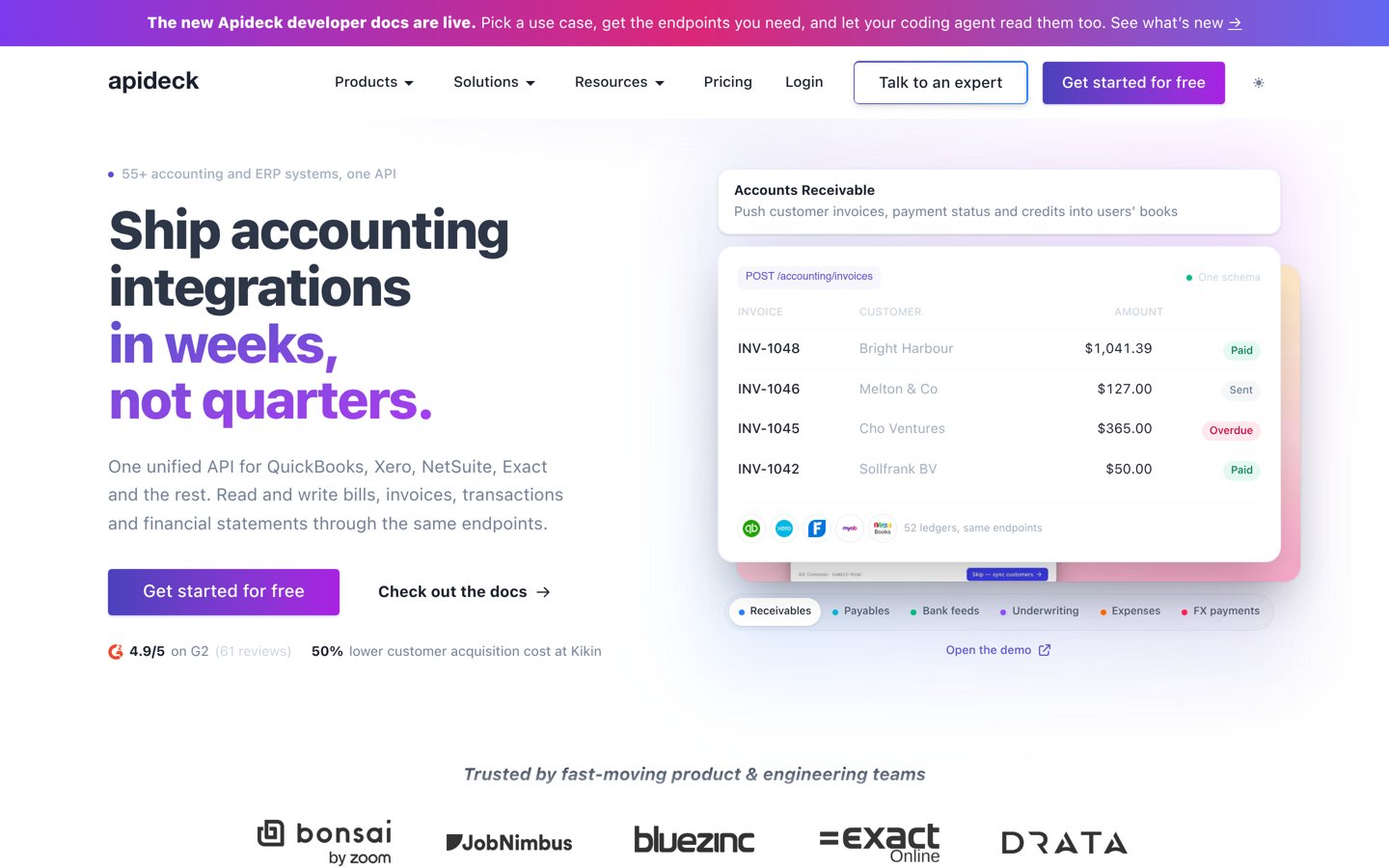
Apideck homepage, captured Nov 2026.
Apideck is a unified API platform that connects SaaS and fintech products to accounting, CRM, HRIS, and other business apps. Its Launch plan starts at $599 per month for 25 consumers with webhooks, logs, SDKs, and a 30-day free trial.
The trade off is that custom field mapping and data scopes are not included on the $599/month Launch plan and require moving up to Scale or Enterprise. It suits product teams that prefer billing per connected consumer rather than per individual connector.
What we like
Transparent monthly tiers starting at $599/month for 25 consumers
Includes proxy API access, webhooks, SDKs, and MCP support on Launch
High 4.9/5 rating across 61 verified G2 reviews
Watch out for
Custom field mapping and data scopes require higher-tier plans
Costs step up as active consumer counts grow past 25
Higher tiers add Scale plans from $1,299/month, custom field mapping, data scopes, and white-label Vault options.Visit apideck.com
02
Merge
4.7/5on G2 (255 reviews, checked Nov 2026)
Paid from$650/mo
Best for multi-category B2B SaaS integrations
Free start3 free production linked accounts
Entry paid$650/mo for up to 10 linked accounts
Overage$65 per linked account after limit
Rating4.7/5 on G2 (255 reviews)
merge.dev
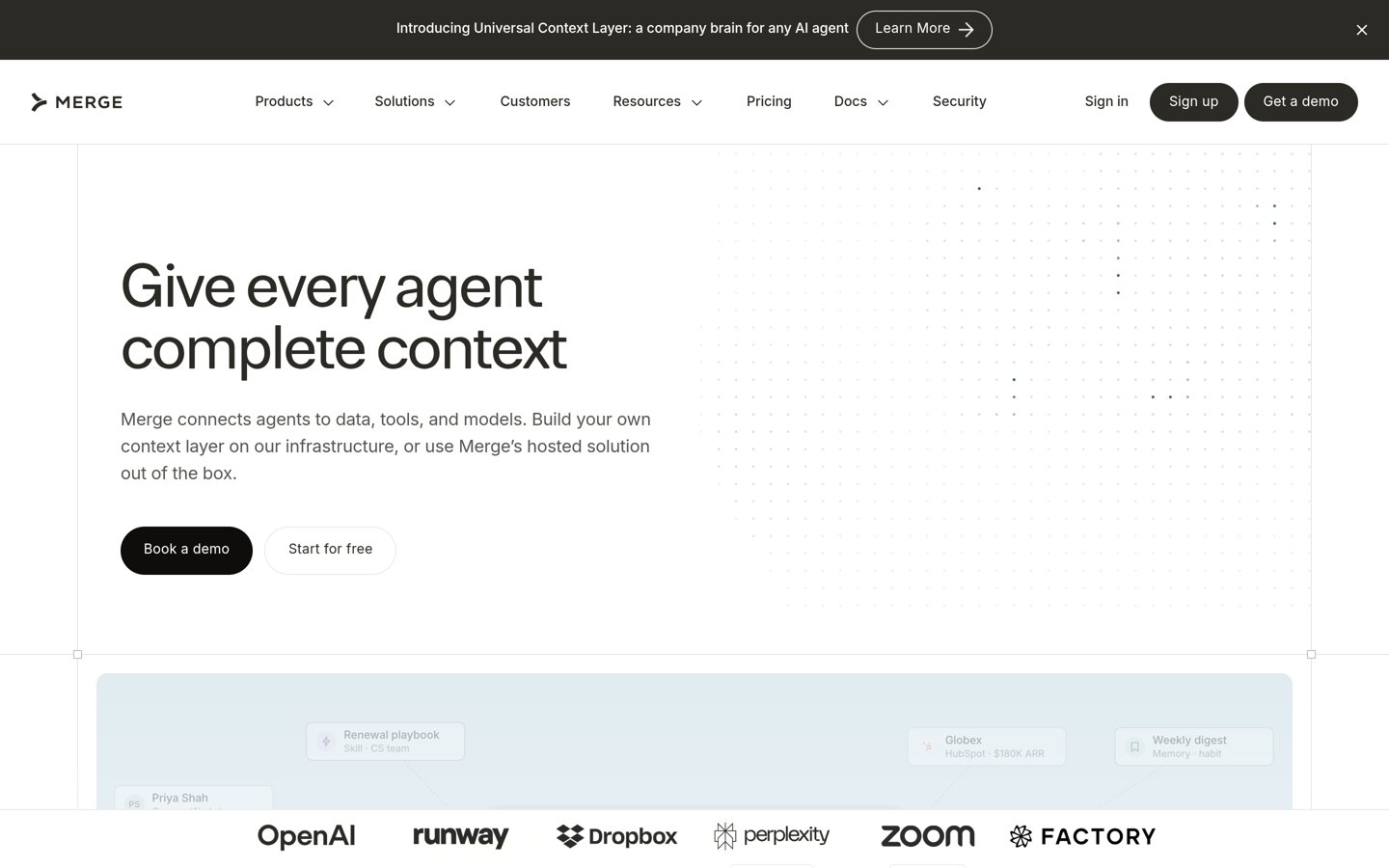
Merge homepage, captured Nov 2026.
Merge is a unified API platform covering accounting, HRIS, ATS, CRM, ticketing, and file storage across systems like QuickBooks, Xero, and NetSuite. It lets teams link 3 production accounts for free before paying $650 per month for up to 10 total production linked accounts.
The trade off is that adding linked accounts beyond the initial 10 costs $65 per linked account per month on the entry paid tier. It suits B2B software teams that want one vendor across accounting and non-accounting categories.
What we like
Includes 3 free production linked accounts to start
Covers accounting alongside HRIS, CRM, ATS, ticketing, and file storage
Established review footprint with 4.7/5 across 255 G2 reviews
Watch out for
Per-linked-account fees ($65/month above 10) add up across many connections
Certain enterprise controls and custom needs sit on higher-tier contracts
Higher tiers expand linked-account capacity with volume discounts and enterprise contract terms.Visit merge.dev
03
Unified.to
5/5on G2 (31 reviews, checked Nov 2026)
Starts at$750/mo
Best for API-call pricing with unlimited connections
Entry paidGrow from $750/mo (750,000 API calls)
ConnectionsUnlimited customer connections
Overage$1.00 per 1,000 API calls on Grow
Rating5.0/5 on G2 (31 reviews)
unified.to
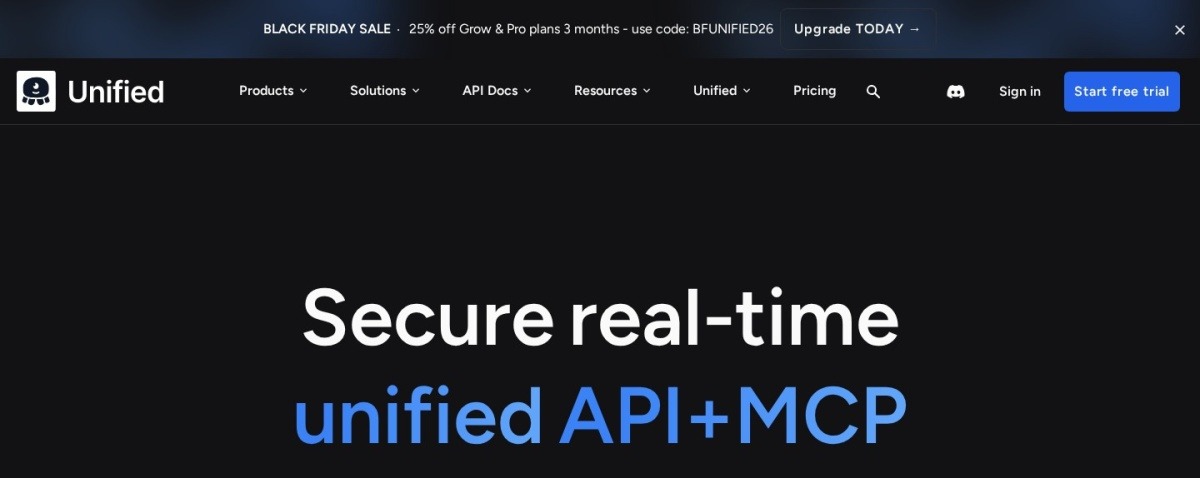
Unified.to homepage, captured Nov 2026.
Unified.to is a unified API platform covering accounting, e-commerce, payments, shipping, HR, and CRM with a 30-day free trial. Its Grow plan starts at $750 per month and includes 750,000 monthly API calls with unlimited customer connections.
The trade off is that heavy call traffic incurs overage fees at $1.00 per 1,000 calls on Grow. It suits teams that connect many customers or storefronts but want billing tied to API call volume rather than connection counts.
What we like
Unlimited customer connections on paid plans with a 30-day free trial
Covers accounting, e-commerce, and payments alongside other categories
Holds a 5.0/5 rating across 31 G2 reviews
Watch out for
Higher starting monthly price ($750/month) than simpler connection-based tools
API call overages apply above the monthly quota
Pro ($1,500+/month) and Scale ($3,000+/month) plans raise monthly call limits and lower per-1,000 overage rates.Visit unified.to
04
Nango
4.5/5on G2 (67 reviews, checked Nov 2026)
Paid from$0.29/connection/mo
Best for code-defined schemas and pay-as-you-go scale
Free plan$0/mo with hard-capped limits
Pay-as-you-go$0.29/connection/mo + compute & transfer
Compute rate$0.72/hr plus $0.50/GB data transfer
Rating4.5/5 on G2 (67 reviews)
nango.dev
Nango homepage, captured Nov 2026.
Nango is an open-source integration and unified API platform supporting over 1,400 APIs across categories including accounting and e-commerce. It offers a $0/month free tier and pay-as-you-go pricing starting at $0.29 per connection per month plus compute and data transfer.
The trade off is that total monthly spend depends on connection count, function compute hours, and egress data volume rather than a single flat number. It suits engineering teams that want to define schemas in code and start with low entry costs.
What we like
Starts with a $0/month free tier and $0.29/connection/month pay-as-you-go rates
Lets developers define custom unified schemas and mappings in code
Rated 4.5/5 across 67 G2 reviews
Watch out for
Multi-metric billing (connections, compute time, data transfer) requires usage tracking
Requires more code-level configuration than rigid out-of-the-box schemas
Best for fintech underwriting and commercial lending data
Pricing modelCustom quote for production access
Free tierFree testing up to 50 live companies
Core focusAccounting, banking, and commerce data
Rating4.6/5 on G2 (28 reviews)
codat.io
Codat homepage, captured Nov 2026.
Codat is a financial data API connecting platforms to accounting, banking, and commerce systems for lending, expense management, and reconciliation. G2 lists a free tier supporting testing across up to 50 live companies alongside custom enterprise pricing.
The trade off is that production pricing requires a sales quote rather than a self-serve public rate card. It suits fintech lenders, commercial banks, and financial platforms with specialized underwriting workflows.
What we like
Purpose-built financial data models for accounting, commerce, and banking
Supports two-way data sync and webhook alerts for financial workflows
Rated 4.6/5 across 28 G2 reviews
Watch out for
Production pricing is quote-based rather than published upfront
Some write operations run asynchronously rather than instantaneously
Custom enterprise agreements unlock unlimited live production access, volume pricing, and dedicated support.Visit codat.io
06
Plaid
4.2/5on G2 (65 reviews, checked Nov 2026)
PricingQuote (custom pricing)
Best for bank account linking and financial verification
Pricing modelCustom sales quote / usage-based
Coverage12,000+ financial institutions
Entry accessFree trial / sandbox testing
Rating4.2/5 on G2 (65 reviews)
plaid.com
Plaid homepage, captured Nov 2026.
Plaid is a financial data and payments API connecting applications to more than 12,000 financial institutions for account verification, transactions, and transfers. Teams can start in testing and trial environments before moving into custom or usage-based production agreements.
The trade off is that production rates and add-ons depend on sales negotiations and product mix rather than fixed public pricing. It suits fintech apps focused on bank account linking, cash-flow checks, and payment flows rather than full accounting ledgers.
What we like
Broad bank connectivity across 12,000+ financial institutions
Familiar end-user account linking flow for consumer and SMB users
Rated 4.2/5 across 65 G2 reviews
Watch out for
Custom production quotes make early unit-cost modeling harder
Focuses on bank and payment rails rather than accounting software schemas
Production plans expand transaction volume, verification modules, and dedicated support under negotiated terms.Visit plaid.com
07
MX
4.7/5on G2 (14 reviews, checked Nov 2026)
PricingQuote (custom pricing)
Best for banking data aggregation and financial insights
Pricing modelCustom vendor quote
Core strengthAccount aggregation and data insights
Primary buyersBanks, fintechs, and mid-market firms
Rating4.7/5 on G2 (14 reviews)
mx.com
MX homepage, captured Nov 2026.
MX is a financial data connectivity platform used by banks, fintechs, and financial apps for account aggregation and transaction data insights. Production access is arranged through custom vendor pricing tailored to deployment scale.
The trade off is that pricing requires contacting sales and review volume on G2 is smaller than some broader API platforms. It suits financial institutions and fintech teams prioritizing bank connectivity and transaction categorization.
What we like
Strong focus on financial data aggregation and user-facing insights
High 4.7/5 rating among reviewed financial and mid-market users on G2
Onboarding and integration support noted by reviewers
Watch out for
No self-serve public pricing tier
Smaller G2 review count (14 reviews) than higher-volume developer APIs
Custom contracts scale institution connectivity, analytics modules, and support SLAs for production deployments.Visit mx.com
How unified API pricing models affect total cost
Per-connection and per-consumer billing models behave very differently as customers connect multiple accounts. A flat fee per connected customer can lower costs when one user links both an accounting tool and a commerce store.
API-call pricing aligns spend with request volume, while custom enterprise contracts often bundle volume tiers and support SLAs. Always model peak sync frequency and overage rates before launching to production.
How we chose
We selected established API platforms that cover accounting, commerce, payments, or adjacent financial connectivity for software and fintech builders. Each candidate was evaluated on category coverage, billing structure, and public user ratings.
All prices, plan limits, and G2 ratings in this guide were checked on 29 Nov 2026 from vendor pricing pages, product documentation, and G2 listings. Where a vendor does not publish self-serve rates, we list custom quote pricing rather than estimating.
We excluded platforms that lack verified current ratings or do not fit accounting, commerce, or financial API replacement needs. No vendor paid for a place, and we do not claim testing for this list.
How to choose a Rutter API alternative in 4 steps
Follow these four steps to narrow down the right unified API for your stack:
List required accounting, commerce, and banking connectors. Confirm whether your product needs deep two-way ledger sync, storefront orders, or bank account feeds.
Match the billing unit to how customers connect accounts. Compare per-consumer, per-linked-account, per-API-call, and custom contract pricing against projected usage.
Check schema flexibility and write-back support. Verify whether pre-built common models cover your custom fields or if you need passthrough or custom code mappings.
Test sandbox limits, webhooks, and support response terms. Review free trial or sandbox caps, sync latency, and overage rules before committing to annual production volume.
FAQ
What are the best alternatives to Rutter API in 2026?
Apideck, Merge, Unified.to, and Nango are leading unified API alternatives, alongside Codat, Plaid, and MX for specialized financial and banking workflows. The best fit depends on whether you prioritize consumer-based pricing, multi-category breadth, API-call billing, or custom schemas.
Which Rutter API alternative has transparent starting pricing?
Apideck lists Launch plans starting at $599 per month, Merge starts at $650 per month after 3 free linked accounts, and Unified.to starts at $750 per month. Nango also publishes pay-as-you-go rates starting at $0.29 per connection per month.
Are there free tiers or trials for Rutter API alternatives?
Yes. Nango offers a $0/month free tier with hard-capped limits, Merge includes 3 free production linked accounts, and Codat offers free testing up to 50 live companies, while Apideck and Unified.to provide 30-day free trials.
Which option works best for small teams or early-stage products?
Early-stage teams often start with Nango's free tier or low-cost pay-as-you-go rates, or test on free trials and sandboxes from Apideck, Merge, or Codat. Choosing a plan with predictable entry thresholds helps avoid overcommitting before customer adoption scales.
How do Apideck and Merge compare as Rutter alternatives?
Apideck is rated 4.9/5 on G2 and starts at $599/month for 25 consumers, while Merge is rated 4.7/5 on G2 and starts at $650/month for 10 production linked accounts. Apideck bills by consumer count, whereas Merge bills by linked account and spans more non-accounting categories.
SaaS SEO and WordPress specialist with about 8 years of experience. Rakib compares WordPress plugins, themes, hosting and software using public pricing, documentation and user reviews. See how we rank.