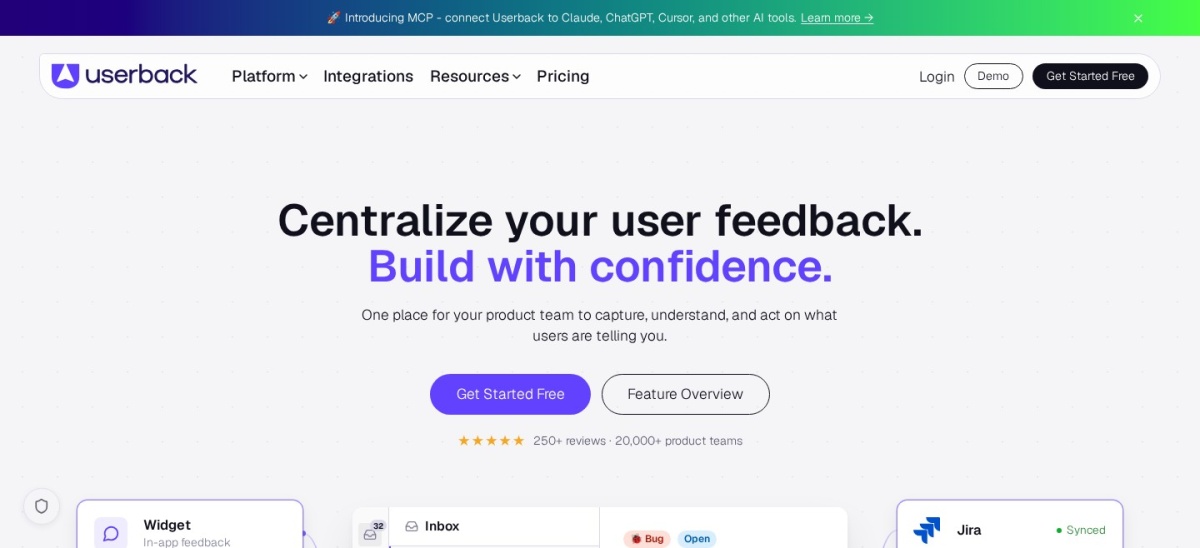
Userback is the closest Usersnap alternative in 2026, matching its widget, surveys, and feature portal with a 4.7/5 G2 rating and a free plan (paid plans from $39/mo). Agencies needing an on-page Kanban board should pick BugHerd ($50/mo regular), while SaaS teams prioritizing public voting roadmaps should use Canny.
How we make this list: we compare pricing pages, product documentation and public user reviews, then re-check every price before each update. No product paid for a place. Disclosure.
Userback offers the closest like-for-like feature parity with Usersnap, starting at $0 free or $39/mo for 5 seats.
BugHerd and Marker.io drop public feature portals in favor of deep visual website annotation and issue-tracker sync.
Regular monthly entry prices across these 7 alternatives span from $39/mo (Userback, Qualaroo) up to $99/mo (Canny).
Five of the seven tools provide a permanent free tier, whereas BugHerd and Marker.io require paid plans after a free trial.
How do you choose the best Usersnap alternatives?
Usersnap sits at the intersection of two distinct jobs: visual bug reporting on live websites and ongoing voice-of-customer product discovery. Because it bundles annotated screenshots, micro-surveys, and feature-request boards into seat- and project-capped tiers, teams often overpay for modules they never turn on.
Web agencies and QA teams usually want fast, no-login client annotations that route straight into Jira, Asana, or a built-in Kanban board. Replacing Usersnap with a focused visual review tool removes project caps and simplifies client sign-off.
SaaS product managers typically leave Usersnap for different reasons, such as needing deeper public voting roadmaps, unlimited survey responses, or behavioral session heatmaps. Matching the replacement to your primary workflow prevents paying for redundant seats.
Userback is a visual feedback and product discovery platform that mirrors Usersnap's core toolkit. Its Free Forever tier covers 2 team seats and 2 sites with unlimited feedback submissions, though entries lock after 7 days. Upgrading to the Team plan at $39/mo regular ($29/mo billed yearly) unlocks unlimited feedback history, 5 team seats, custom widgets, and MCP connectors.
The trade off is that session replay, in-app surveys, and the public Feature Portal stay gated behind the Business tier at $99/mo regular ($79/mo yearly). It suits product teams and agencies wanting an all-in-one Usersnap replacement with a gentler entry price.
What we like
Permanent free tier with unlimited feedback reporters
Combines visual bug widgets, session replay, surveys, and a feature portal
Includes an MCP server for AI coding agents on paid plans
Watch out for
Free plan locks access to submitted feedback after 7 days
Surveys, session replay, and feature portals require the $99/mo Business plan
Team ($39/mo) unlocks unlimited feedback retention, 5 seats, and Zapier.Visit userback.io
02
BugHerd
4.7/5on G2 (226 reviews, checked Nov 2026)
Starts at$50/mo
Best for agency website reviews
Entry paid plan$50/mo (5 members)
Free tierNo (7-day free trial)
Core workflowLive site pins + Kanban board
ProjectsUnlimited on all plans
bugherd.com
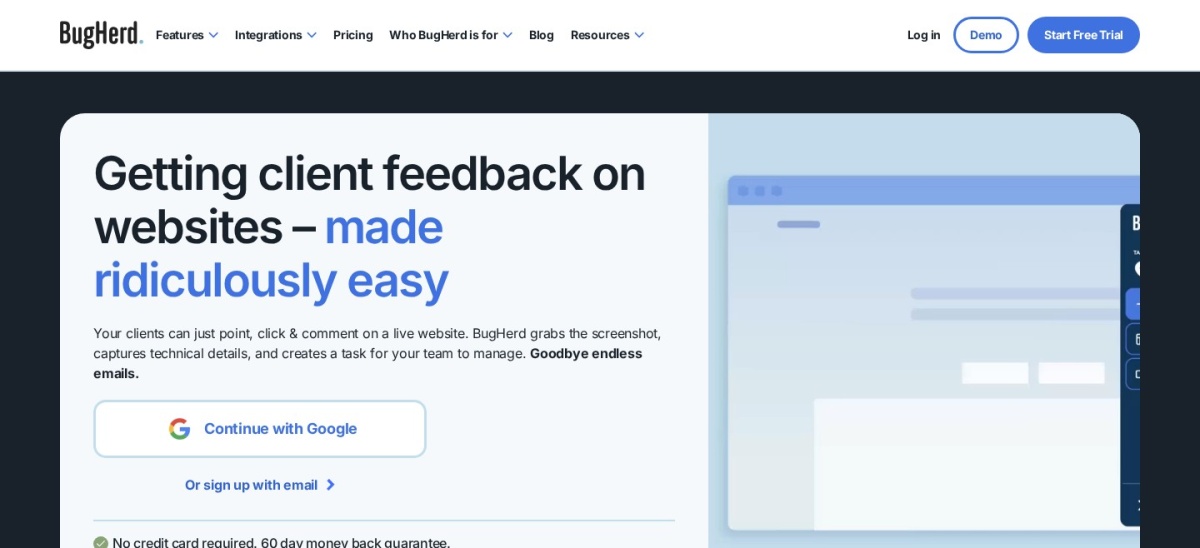
BugHerd homepage, captured Nov 2026.
BugHerd is a visual website feedback tool that pins client comments directly onto live web pages, Figma designs, and PDFs. Every plan includes unlimited projects, unlimited client guests, video feedback, and a built-in Kanban task board starting on the Standard plan at $50/mo regular ($42/mo billed annually) for 5 team members.
The trade off is that BugHerd lacks Usersnap's in-app micro-surveys, NPS tracking, and public feature-request portals, and clients must register a guest account to comment. It suits web agencies managing multi-site client sign-offs.
What we like
Unlimited projects and client guests on every paid tier
Built-in Kanban board eliminates needing a separate tracker
Supports live websites, Figma prototypes, PDFs, and images
Watch out for
No permanent free plan (7-day trial only)
Two-way Jira and Asana sync requires the $150/mo Premium plan
Standard ($50/mo) includes 5 members, unlimited projects, and video feedback.Visit bugherd.com
03
Marker.io
4.8/5on G2 (42 reviews, checked Nov 2026)
Starts at$59/mo
Best for developer QA workflows
Entry paid plan$59/mo (3 members)
Free tierNo (15-day free trial)
Core workflowAnnotated screenshots + dev logs
Monitoring10 pages included
marker.io
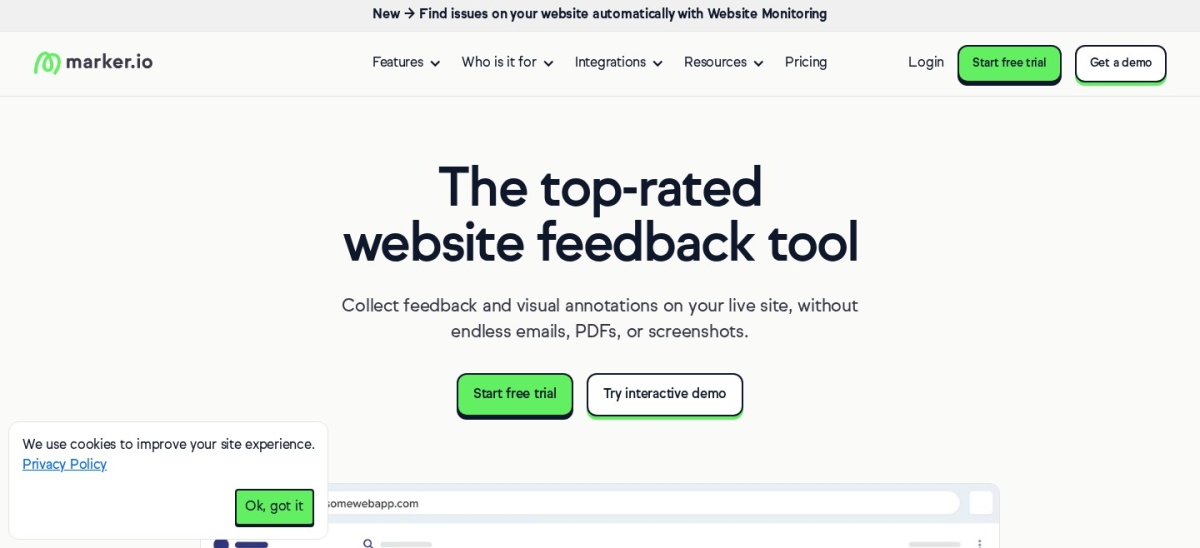
Marker.io homepage, captured Nov 2026.
Marker.io is a visual bug-reporting widget that captures annotated screenshots, console logs, and network metadata and syncs them two-way with Jira, GitHub, Linear, and Trello. Its Starter plan costs $59/mo regular ($39/mo billed yearly) and covers 3 team members, unlimited feedback reporters, and website monitoring for 10 pages.
The trade off is that Marker.io has no free tier, omits product roadmaps or customer surveys, and gates session replay behind the $199/mo Team plan ($149/mo yearly). It suits engineering and QA teams living inside external issue trackers.
What we like
Deep two-way status sync with Jira, GitHub, GitLab, and Linear
Clients submit visual bug reports without creating an account
Bundles automated website monitoring for 10 pages on every plan
Watch out for
No free plan and only 3 member seats on Starter
Session replay and developer console tools require the $199/mo Team tier
Gleap combines Usersnap-style visual bug reporting with a customer support inbox, live chat, and an AI support agent named Kai. Its Starter plan costs $49/mo regular ($29/mo billed yearly) and includes 1 seat, 1 project, in-app bug reporting, and live chat.
The trade off is that multi-seat team inboxes, in-app surveys, and public feature roadmaps do not unlock until the Team tier at $149/mo regular ($99/mo yearly). It suits SaaS startups wanting bug capture and customer chat inside one widget.
What we like
Combines visual bug reporting, session replay, and live customer chat
Includes Kai AI chatbot and automated issue summaries
Supports web apps as well as native iOS and Android SDKs
Watch out for
No permanent free tier (7-day trial requires a card)
Entry plan limits accounts to 1 seat and 1 project without surveys
Starter ($49/mo) includes 1 seat, 1 project, bug reporting, and live chat.Visit gleap.io
05
Canny
4.5/5on G2 (114 reviews, checked Nov 2026)
Paid from$99/mo
Best for public feature voting boards
Entry paid plan$99/mo (100 tracked users)
Free tierYes (25 tracked users)
Core workflowPublic voting boards & roadmap
Admin seats5 on Free, 10 on Pro
canny.io
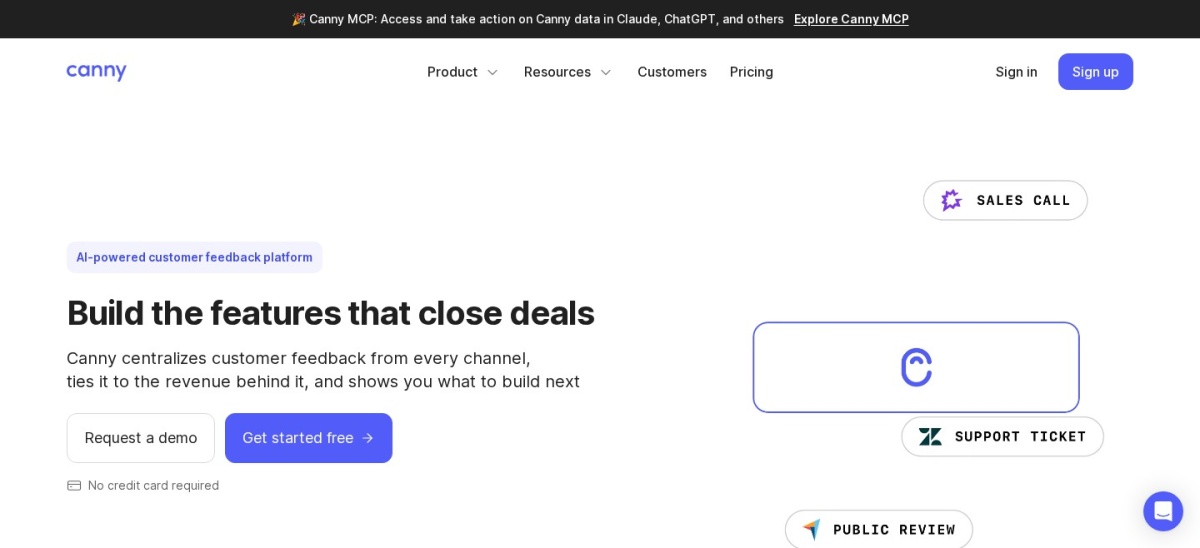
Canny homepage, captured Nov 2026.
Canny replaces Usersnap's feature-request board and changelog modules with structured public voting boards and revenue-weighted prioritization. Its Free plan includes 5 manager seats, unlimited feedback posts, private boards, and an MCP server for up to 25 tracked users.
The trade off is that Canny has no visual screenshot annotation widget, and Pro pricing starts at $99/mo regular ($79/mo billed yearly) for 100 tracked users, scaling rapidly as more voters engage. It suits B2B SaaS product teams prioritizing feature requests.
What we like
Generous free tier with 5 manager seats and unlimited feedback posts
Connects feature votes to customer revenue data via CRM integrations
Built-in public product roadmap and release changelog
Watch out for
No live-page visual bug reporting or screenshot annotation tools
Tracked-user pricing scales sharply once active voters pass 100
Pro ($99/mo) expands capacity to 100+ tracked users and adds Jira/Linear sync.Visit canny.io
06
Qualaroo
4.3/5on G2 (49 reviews, checked Nov 2026)
Paid from$39.99/mo
Best for low-cost targeted micro-surveys
Entry paid plan$39.99/mo (unlimited responses)
Free tierYes (50 responses total)
Core workflowTargeted website & app Nudges
Languages70+ supported
qualaroo.com
Qualaroo homepage, captured Nov 2026.
Qualaroo focuses on Usersnap's micro-survey side, deploying unobtrusive Nudge pop-ups triggered by user behavior, exit intent, or page URL. Its Forever Free tier includes 50 total responses and 10,000 pageviews, while the Essentials plan costs $39.99/mo regular ($19.99/mo billed annually) for unlimited survey responses.
The trade off is that Qualaroo does not offer visual screenshot annotations, Kanban boards, or feature voting portals, and removing its branding costs an extra $300/yr. It suits UX researchers running targeted on-site questionnaires on a budget.
What we like
Entry paid tier includes unlimited survey responses at $39.99/mo regular
Supports branching skip logic and surveys in 70+ languages
Permanent free tier includes 10,000 monthly pageviews
Watch out for
No visual bug capture, annotated screenshots, or feature boards
White-label branding removal requires a $300/yr add-on
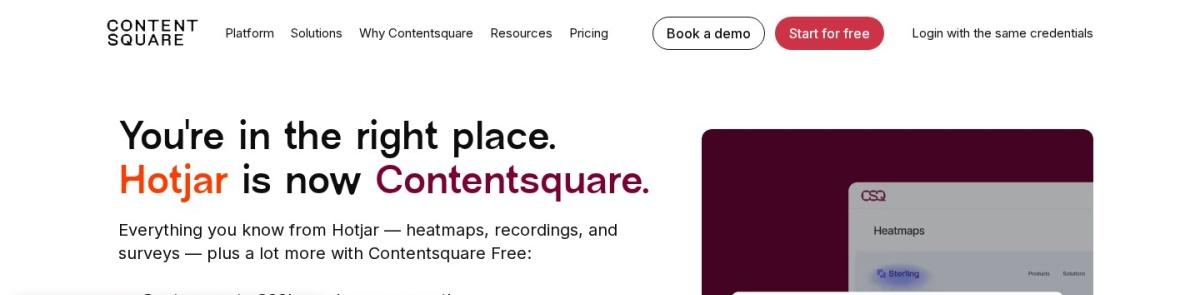
Hotjar (now unified under Contentsquare) pairs behavioral heatmaps and session recordings with lightweight on-site feedback widgets. Its Free plan tracks up to 200,000 monthly sessions and 10,000 replays with 1-month data retention, while Growth starts at $49/mo regular ($39/mo billed yearly) for 13-month retention.
The trade off is that Hotjar lacks annotated screenshot bug workflows, and full Voice of Customer survey suites are sold as a separate product starting at $99/mo. It suits UX and growth teams diagnosing why users drop off before asking them.
What we like
Generous free tier covering up to 200,000 monthly sessions
Combines click/scroll heatmaps with session recordings in one script
Growth plan extends historical data access to 13 months
Watch out for
No visual bug-pinning tool or developer console log capture
Dedicated survey suites are billed separately from Experience Analytics
Growth ($49/mo) extends data retention to 13 months and removes sampling caps.Visit hotjar.com
Why teams switch away from Usersnap
Usersnap enforces strict caps on active projects, team seats, and monthly page views across every tier, and its free trial ends after 20 feedback items or 90 days. Growing web agencies hit the project ceiling quickly, while smaller SaaS teams often need an ongoing free tier.
Splitting the job usually saves money. Pairing a dedicated visual review tool like BugHerd or Marker.io with a free voting board from Canny or heatmaps from Hotjar often costs less than upgrading Usersnap to higher seat brackets.
How we chose
We evaluated 12 visual feedback, bug-tracking, and voice-of-customer platforms to identify established replacements for Usersnap's two primary use cases: annotated website bug capture and in-app product feedback.
All ratings, review counts, and regular monthly entry prices were verified directly against official vendor pricing pages and G2 product profiles on 29 Nov 2026.
We excluded early-stage tools with fewer than 20 verified G2 reviews, open-source self-hosted projects without public review profiles, and enterprise suites without transparent entry pricing. No vendor paid for a place, and we do not claim testing for this list.
How to pick the right Usersnap alternative
Narrow down your shortlist by separating visual bug capture from ongoing user research:
Separate client sign-off from customer research. If you only collect design and QA edits on staging sites, choose BugHerd or Marker.io instead of paying for survey and roadmap modules.
Check how your pricing scales with growth. Agencies with dozens of client domains should prioritize unlimited-project plans like BugHerd rather than project-capped tiers.
Verify whether reporters need an account. Tools like Userback and Marker.io let clients submit annotated screenshots with zero login friction, whereas BugHerd creates guest accounts.
Confirm two-way issue tracker synchronization. Ensure your chosen tool updates ticket status automatically in Jira, Linear, or GitHub so developers do not manage two separate inboxes.
FAQ
What are the best Usersnap alternatives in 2026?
Userback is the best all-around Usersnap alternative, combining visual bug widgets, session replay, surveys, and a feature portal from $39/mo with a permanent free tier. BugHerd ($50/mo) is best for agency website reviews, and Marker.io ($59/mo) leads for developer bug tracking.
Is there a free alternative to Usersnap?
Yes. Userback, Canny, Qualaroo, and Hotjar all offer permanent free plans with no time expiry. Userback Free supports 2 seats and unlimited feedback submissions (with a 7-day viewing window), while Canny Free allows unlimited posts for up to 25 tracked users.
Which Usersnap alternative is best for web agencies?
BugHerd is built specifically for web agencies, offering unlimited projects, unlimited client guests, and a built-in Kanban board starting at $50/mo regular ($42/mo yearly). Userback is a strong runner-up if you prefer zero-login client submissions.
How does Userback compare to Usersnap?
Userback matches Usersnap's core visual widget, micro-surveys, and feature-request portal while adding an MCP server for AI coding agents and a permanent free plan. Usersnap remains stronger if you need mobile SDKs or multi-lingual survey suites on entry tiers.
Which alternative is cheapest for small teams?
Userback ($39/mo regular for 5 seats) and Qualaroo ($39.99/mo regular for unlimited survey responses) have the lowest regular monthly entry prices. Both also offer free tiers if your team is small enough to stay within their usage caps.
SaaS SEO and WordPress specialist with about 8 years of experience. Rakib compares WordPress plugins, themes, hosting and software using public pricing, documentation and user reviews. See how we rank.