Postmark leads the SendGrid alternatives in this list for most senders, because it delivers transactional email fast and its support answers quickly, from $15 a month. Resend suits developers who want a modern API, while Brevo suits teams that want email marketing and transactional mail in one place.
How we make this list: we compare pricing pages, product documentation and public user reviews, then re-check every price before each update. No product paid for a place. Disclosure.
Postmark is the best SendGrid alternative for transactional email, starting at $15 a month with a free plan.
Resend is the best developer pick, with a modern API and a free plan of 3,000 emails a month.
Brevo is the best all-rounder, combining transactional and marketing email from $9 a month.
Amazon SES is the cheapest at scale, at $0.10 per 1,000 emails with no monthly fee.
Most tools here have free plans, but free volumes run from 100 to 6,000 emails a month.
What should you look for in SendGrid alternatives?
Delivery is the only metric that matters for transactional email. A password reset that lands in spam is a failed product, and Postmark, Mailgun and Resend exist because delivery is their whole focus.
Free plans are real but small. They run from 100 emails a month on Postmark to 6,000 a month on Mailjet, which is enough to test a tool and not enough to run a business on.
Price follows volume, not features. Entry plans cost $9 to $20 a month, while Amazon SES charges $0.10 per 1,000 emails with no monthly fee, which wins for high-volume senders.
Marketing and transactional email are different jobs. Brevo and Mailjet do both in one place, while Postmark, Resend and Mailtrap are transactional-first and do that job better.
Support is the hidden cost of cheap email. Slow support is the complaint that drives most SendGrid switches, and Postmark's fast human support is its main selling point.
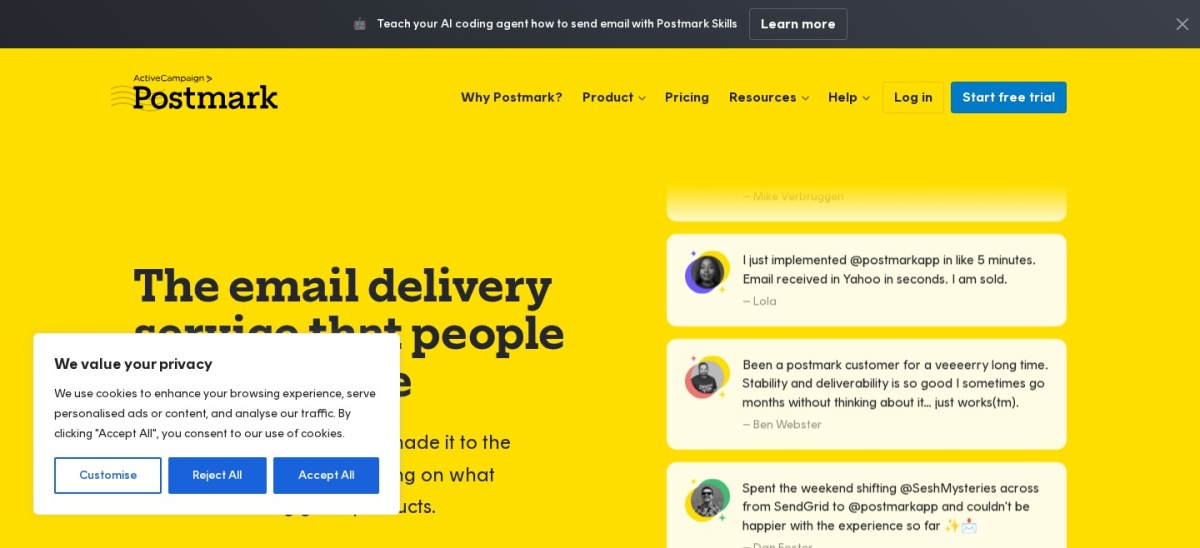
Postmark is a transactional email service built for delivery speed, with message streams that keep receipts, password resets and notifications separate from bulk mail. Basic costs $15 a month for 10,000 emails, and the free plan covers 100 emails a month.
The trade off is scope. Postmark does transactional email only, so there are no marketing campaigns, and the free plan is the smallest in this list. It suits teams whose mail must arrive fast and who want support that answers in minutes.
Resend is a developer-first email API with a clean dashboard, modern documentation and Broadcasts for the occasional marketing send. Pro costs $20 a month for 50,000 emails, and the free plan covers 3,000 emails a month.
The trade off is youth. Resend is newer than Postmark or Mailgun, so its review base is small and support is email-only on lower plans. It suits developers who want a modern API and generous free sending without legacy baggage.
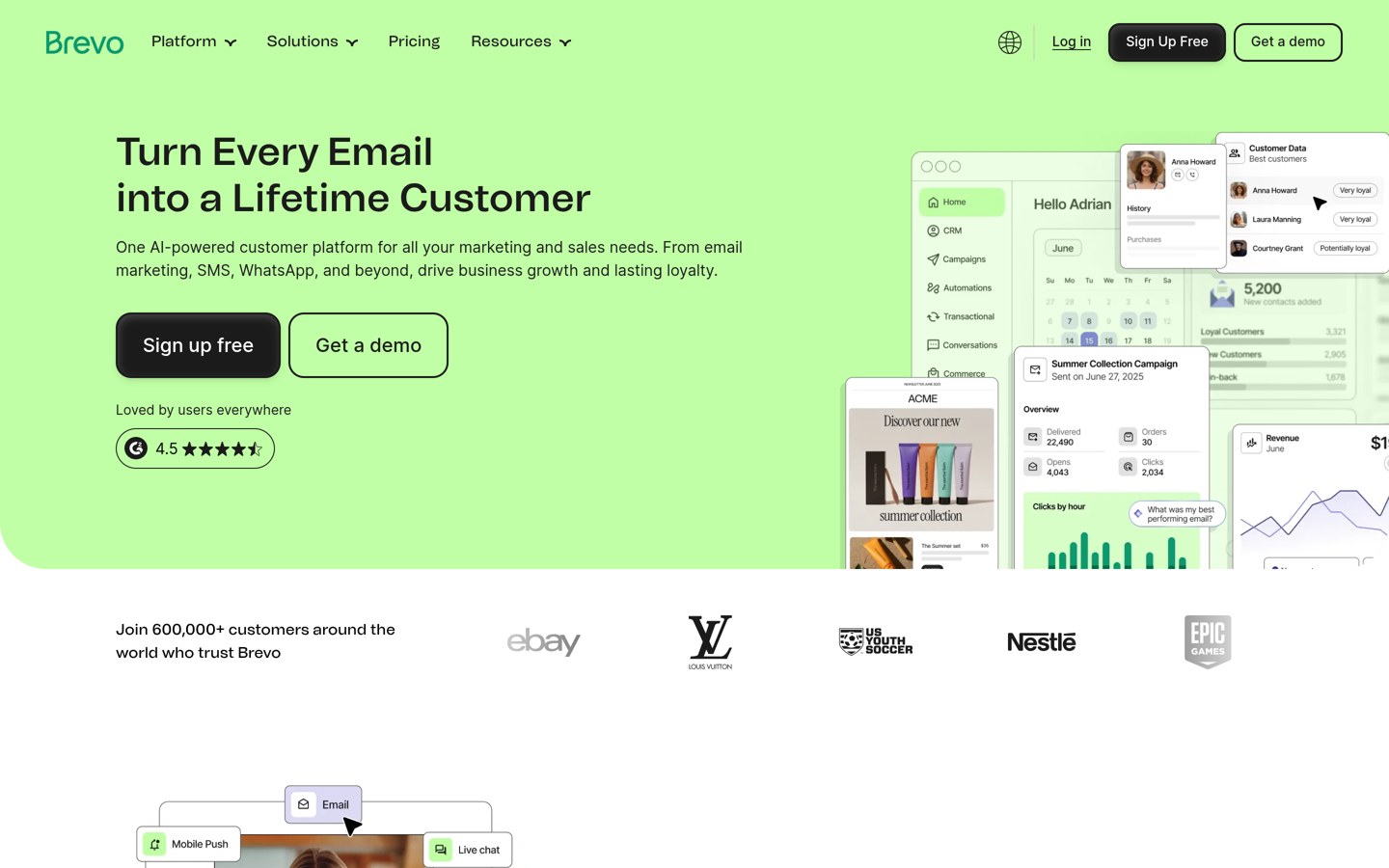
Brevo is an all-in-one platform that combines transactional email, marketing campaigns, SMS and a CRM in one account. Starter costs $9 a month, or $97 a year on annual billing, and the free plan covers 300 emails a day.
The trade off is focus. Brevo does everything, so its transactional delivery trails Postmark, and the interface can feel busy. It suits small teams who want one tool for marketing and transactional mail instead of two.
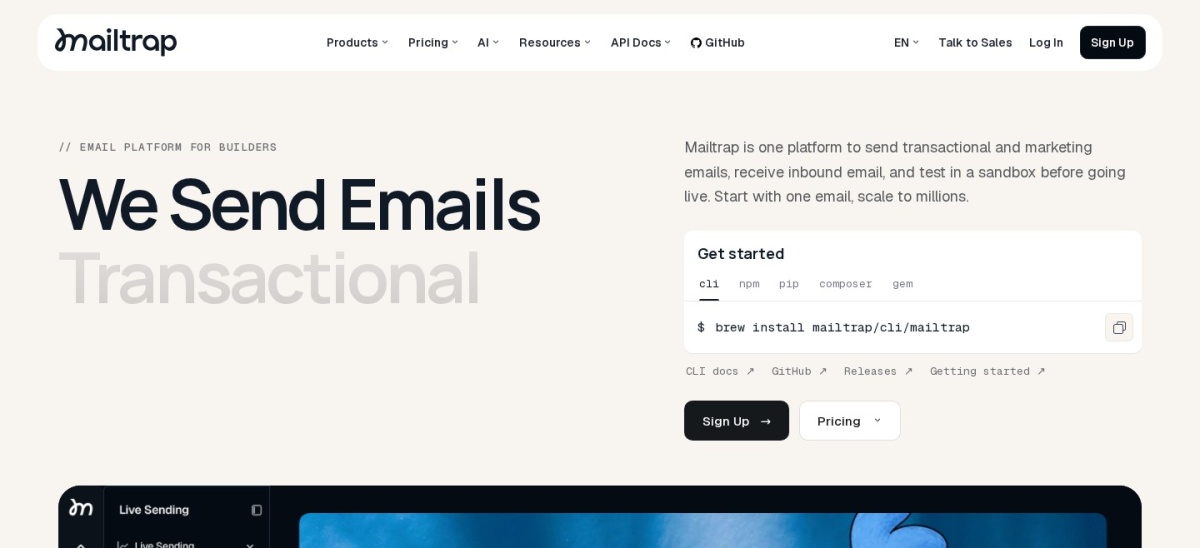
Mailtrap is a transactional email service with a built-in testing sandbox, so you can inspect every email before it reaches a real inbox. Basic costs $15 a month for 10,000 emails, and the free plan covers 4,000 emails a month.
The trade off is scope. Mailtrap does transactional email only, with no marketing campaigns, and its paid plans climb fast with volume. It suits teams that test heavily and want to catch broken emails before customers see them.
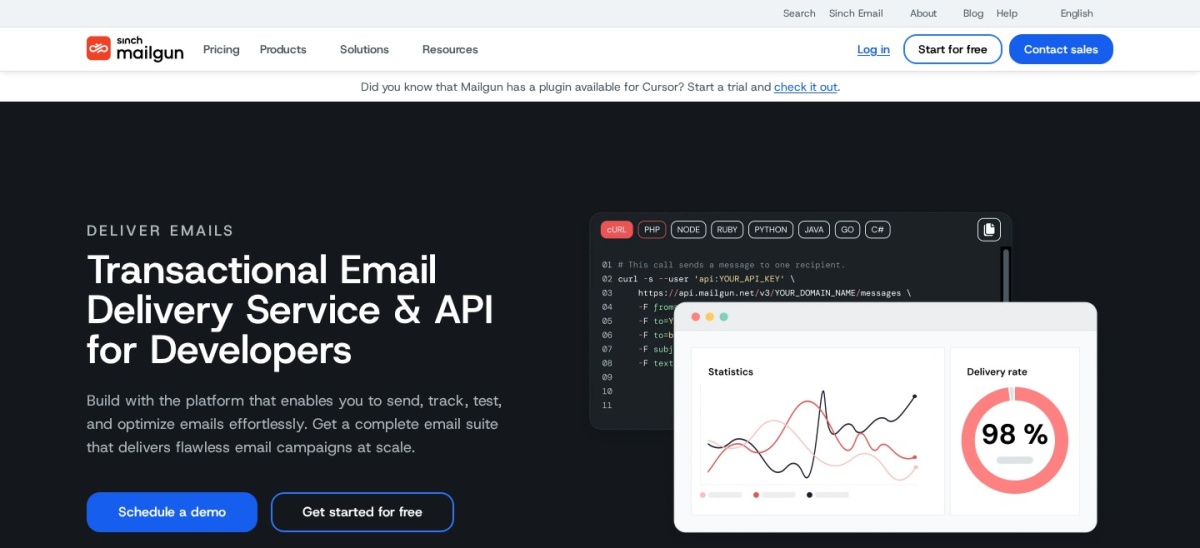
Mailgun is a long-running transactional email API built for scale, with strong webhooks, routing and deliverability tooling. Basic costs $15 a month for 10,000 emails, and the free plan covers 100 emails a day.
The trade off is support. Mailgun's support is a known weak spot, and setup takes more work than Postmark or Resend. It suits teams that send high volumes and have developers to run the integration.
Amazon SES is Amazon's pay-as-you-go email service, charging $0.10 per 1,000 emails with no monthly fee and no free plan beyond AWS credits for new accounts. It runs on the same infrastructure as the rest of AWS.
The trade off is the missing product. SES has no dashboard, no templates and no support included, so setup and monitoring are developer work. It suits teams already on AWS who send high volumes and want the lowest possible per-email cost.
SMTP2GO is a transactional email service that leans on deliverability support, helping customers fix the authentication and reputation issues that send mail to spam. Starter costs $10 a month, or $100 a year on annual billing, and the free plan covers 1,000 emails a month.
The trade off is a price conflict. The vendor's pricing page shows Starter at $10 a month while its page title says plans start from $15 a month, and G2 lists $15. It suits teams who want a human to help with deliverability rather than a dashboard alone.
Mailjet is a transactional and marketing email platform with an easy drag-and-drop editor, part of the Sinch group. Starter costs $9 a month for 8,000 emails, and the free plan covers 6,000 emails a month, the largest free plan in this list.
The trade off is confidence in the price. Mailjet's own pricing page did not render a clear price when we fetched it, so the $9 figure rests on recent reviews and listicles. It suits teams who want a big free plan and simple campaign tools.
MailerSend is a transactional email service with a clean modern interface and good API documentation. Hobby costs $7 a month, or $67.20 a year on annual billing, and the free plan covers 500 emails a month.
The trade off is scale. MailerSend has the smallest review base in this list, the free plan is only 500 emails a month, and it has fewer features than Brevo. It suits small senders who want the cheapest paid plan and a simple setup.
Transactional vs marketing email: pick the right tool
Transactional email is triggered by an action: a password reset, an order confirmation, a receipt. It must arrive fast and never land in spam, which is why Postmark, Resend and Mailtrap optimise for delivery above all else.
Marketing email is sent in bulk to a list: newsletters, promotions, announcements. It needs templates, segmentation and analytics, which is where Brevo and Mailjet earn their keep.
If you need both, Brevo is the simplest answer in this list, because it handles transactional and marketing mail in one account. If you only need one job done well, pick the specialist.
How we chose
We started from the tools people compare with SendGrid most often, keeping only tools with a G2, Capterra or Trustpilot rating we could verify in November 2026.
Prices come from each vendor's pricing page, checked on 29 November 2026. The top three tools' prices were confirmed on the vendor's own page today. Where a vendor page did not render a clear price, the notes record that the figure is second-hand.
We left out tools with no public review record. No vendor paid for a place, and we do not claim hands-on testing for this list.
How to choose a SendGrid alternative
Start with the kind of email you send most.
Decide transactional or marketing. If you send password resets and receipts, shortlist Postmark, Resend or Mailgun. If you send newsletters too, look at Brevo or Mailjet.
Check the free plan against your real volume. Free plans run from 100 to 6,000 emails a month, so count what you actually send before you assume a free plan covers it.
Compare the per-1,000-email cost at your volume. A $15 monthly plan is dear for 500 emails and cheap for 50,000, while Amazon SES at $0.10 per 1,000 wins once volume climbs.
Test deliverability before you migrate. Send real mail from the trial to Gmail, Outlook and Yahoo inboxes and check where it lands, because a price means nothing if the mail goes to spam.
FAQ
What are the best SendGrid alternatives in 2026?
Postmark is the best SendGrid alternative for most senders, because it delivers transactional email fast and its support answers quickly. Resend suits developers who want a modern API, while Brevo suits teams that want marketing and transactional email in one place.
How much do SendGrid alternatives cost?
Most tools in this list start at $9 to $20 a month. Postmark, Mailtrap and Mailgun all start at $15 a month, Brevo and Mailjet at $9, and Amazon SES charges $0.10 per 1,000 emails with no monthly fee.
Is there a free SendGrid alternative?
Yes. Postmark, Resend, Brevo, Mailtrap, Mailgun, SMTP2GO, Mailjet and MailerSend all have free plans, ranging from 100 emails a month on Postmark to 6,000 a month on Mailjet. Amazon SES has no free plan, only AWS credits for new accounts.
Which SendGrid alternative is best for transactional email?
Postmark is the best pick for transactional email, because delivery speed and inbox placement are its whole focus. Resend is a close second for developers, and Mailgun suits teams that send high volumes.
Which SendGrid alternative is best for small businesses?
Brevo is the best small-business pick, because it combines transactional email, marketing campaigns and a CRM from $9 a month, with a free plan of 300 emails a day. MailerSend is the cheapest paid start at $7 a month.
Postmark vs Resend: which SendGrid alternative should I pick?
Pick Postmark if you want proven delivery and fast human support for transactional mail, and Resend if you want a modern developer-first API with generous free sending. Both have free plans, and both start from $15 and $20 a month.
SaaS SEO and WordPress specialist with about 8 years of experience. Rakib compares WordPress plugins, themes, hosting and software using public pricing, documentation and user reviews. See how we rank.