Hoppscotch is the best of the Postman alternatives for most developers, rated 4.9/5 on G2 with a free plan that has no seat limit. Pick Apidog for all-in-one design, testing and docs from $9 a user a month, or Bruno if you want collections stored as plain files in Git.
How we make this list: we compare pricing pages, product documentation and public user reviews, then re-check every price before each update. No product paid for a place. Disclosure.
Hoppscotch leads on rating at 4.9/5 from 84 G2 reviews, and its free personal plan has no seat limit.
Apidog is the highest-rated full platform at 4.8/5 from 237 reviews, with a free plan for up to 4 users.
Bruno and Hoppscotch both start paid plans at $6 a user a month, half of Insomnia's $12 Pro plan.
Thunder Client is the cheapest paid pick at $3 a user a month, and it runs inside VS Code.
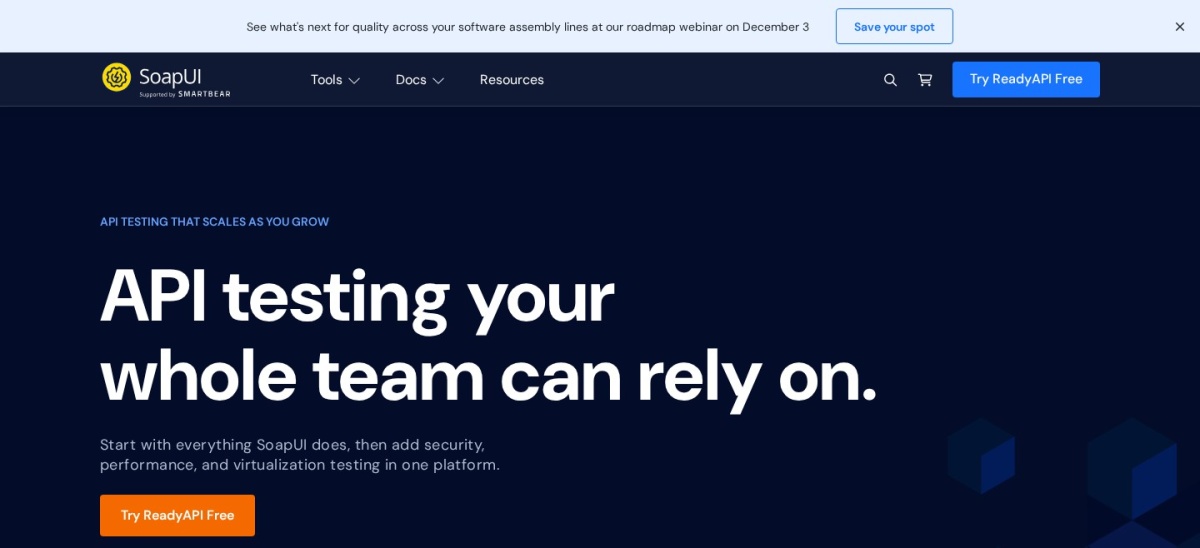
SoapUI Open Source is free and the only pick built first for SOAP and WSDL-based testing.
What should you look for in Postman alternatives?
Price per seat is the first thing to check. Postman charges per user for team plans, so a free alternative with no seat limit can save a small team hundreds of dollars a year.
Where your requests live matters as much as price. Cloud tools sync through an account, while Git-native tools such as Bruno store collections as plain files in your repository, so changes go through normal code review.
Protocol support decides whether a tool can replace Postman for your stack. Every tool here handles REST, but only some cover GraphQL, gRPC, WebSocket and SOAP, so match the list to the APIs you actually call. Our guide on how to use the WordPress REST API shows the basics of REST requests.
Free-plan limits are where the cheap picks differ. Some cap collections, runs or team seats, and others keep the free plan generous but charge for sharing, mocks or docs.
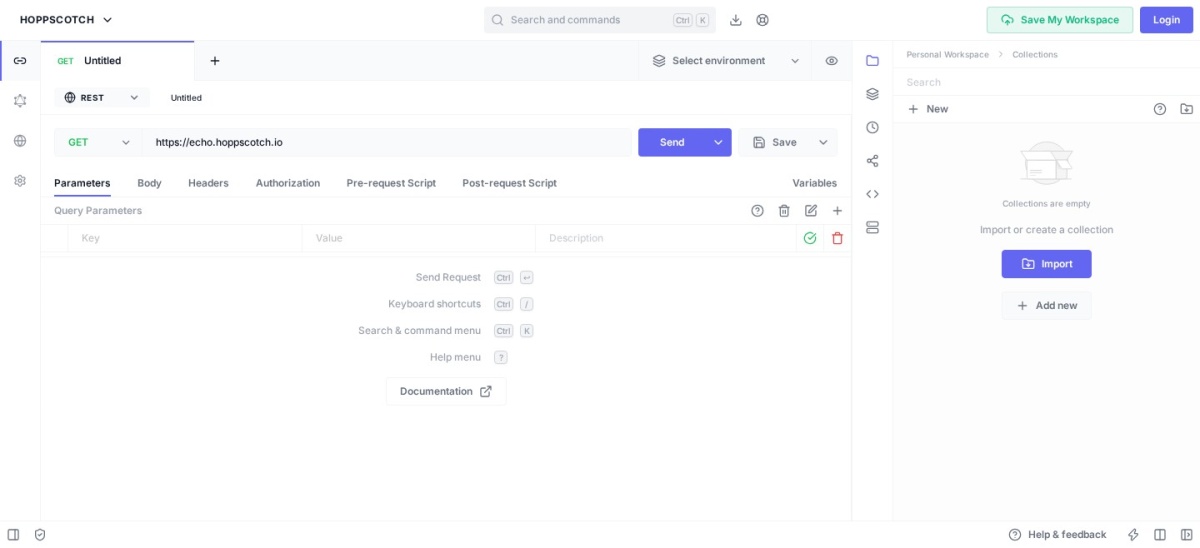
Hoppscotch is a fast, open-source API client that runs in a browser tab, so there is nothing to install before sending a first request. The free personal plan includes unlimited collections and requests, plus REST, GraphQL, WebSocket, Server-Sent Events, Socket.IO and MQTT support.
The trade off is team sharing. Shared team workspaces need Business at $6 per seat a month with annual billing, and browser CORS rules can block some requests. It suits solo developers and small teams that want a free client with no seat limit.
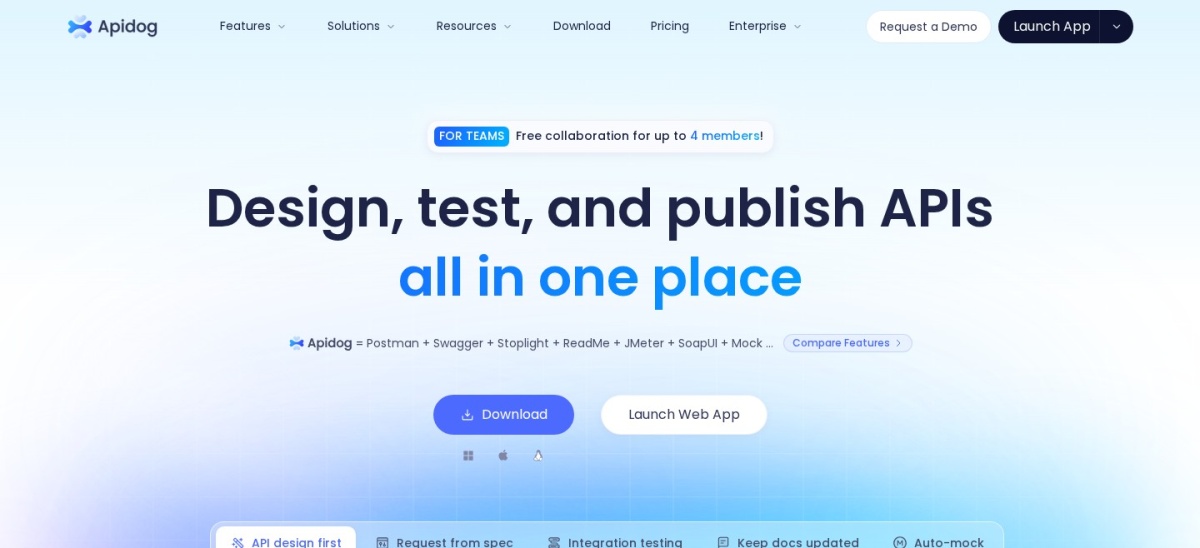
Apidog is an all-in-one API platform that combines a request client with design, testing, mocking and documentation in one workspace. The free plan covers up to 4 users with full API client support, mocking, unlimited test runs and 10,000 cloud mock calls a month.
The trade off is the per-seat price. Teams larger than 4 users need Basic at $9 per user a month with annual billing, and longer change history sits on higher tiers. It suits teams that want one tool for the whole API workflow instead of three.
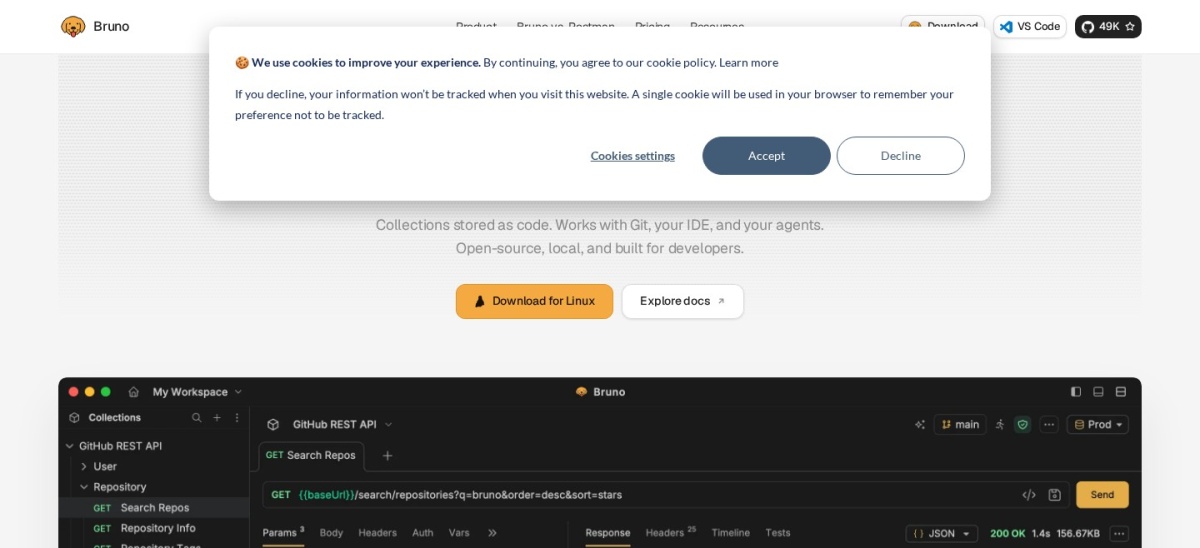
Bruno is an open-source API client that stores every collection as plain files on your machine, so requests version-control in Git beside the code they test. The free Open Source edition needs no account, runs fully offline and includes 2 workspaces, with 5 OpenAPI syncs a month.
The trade off is the small review base and paid Git extras. Its G2 rating rests on only 13 reviews, and private Git providers plus unlimited workspaces need Pro at $6 per user a month. It suits developers who want their API work in Git with no cloud account.
SoapUI is a free, open-source tool for testing REST, SOAP and GraphQL services, and it is the strongest pick here for SOAP work. It imports WSDL files, generates requests from them, chains calls into functional tests and runs mock services and command-line automation without a paid plan.
The trade off is age and weight. The interface feels dated next to newer clients, and large projects can load slowly. Security and load testing need the paid ReadyAPI upgrade. It suits QA teams testing SOAP services or WSDL-based APIs.
What we like
Free open-source SOAP and REST testing
WSDL import builds requests for you
Mock services and CLI automation included
Long track record with 142 G2 reviews
Watch out for
Interface feels dated
Slow with large projects
Security and load testing cost extra
ReadyAPI adds security, load and virtualization testingVisit soapui.org
05
Insomnia
4.3/5on G2 (20 reviews, checked Nov 2026)
Paid from$12/mo
Best lightweight desktop client
G2 rating4.3/5 (20 reviews)
Free planYes, Essentials
Paid planPro, $12/user/mo
Free mock requests1,000/month
insomnia.rest
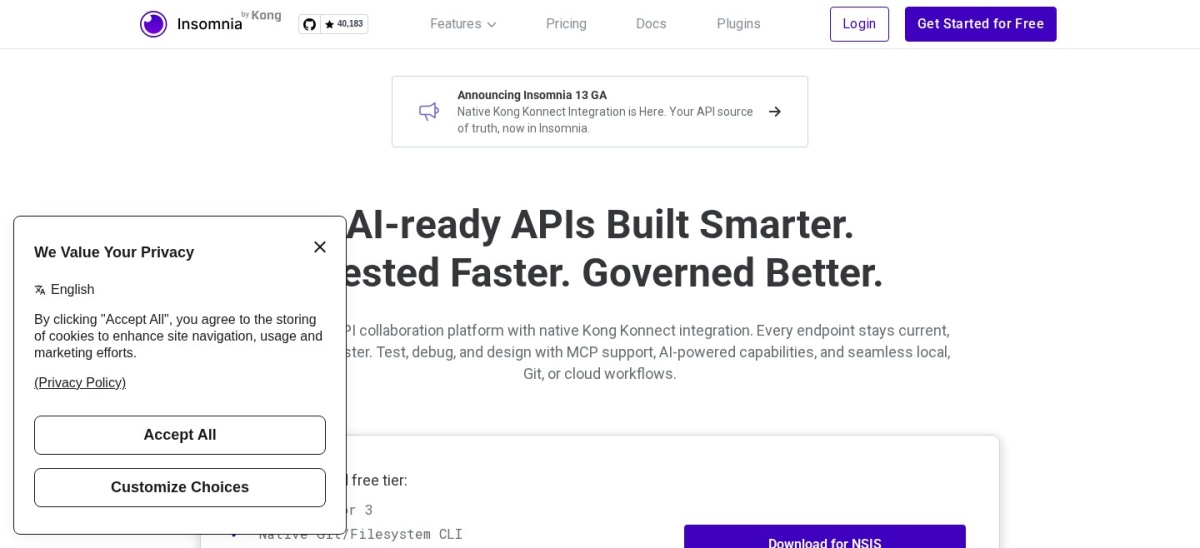
Insomnia homepage, captured Nov 2026.
Insomnia is a lightweight API client from Kong for sending REST, GraphQL, gRPC, SOAP and WebSocket requests. The free Essentials plan includes unlimited local projects and collection runs, Git Sync for up to 3 users and 1,000 mock server requests a month.
The trade off is collaboration cost. Unlimited Git Sync users, role-based access control and 10,000 mock requests a month need Pro at $12 per user a month, twice the price of Bruno or Hoppscotch. It suits developers who want a fast desktop client with broad protocol support.
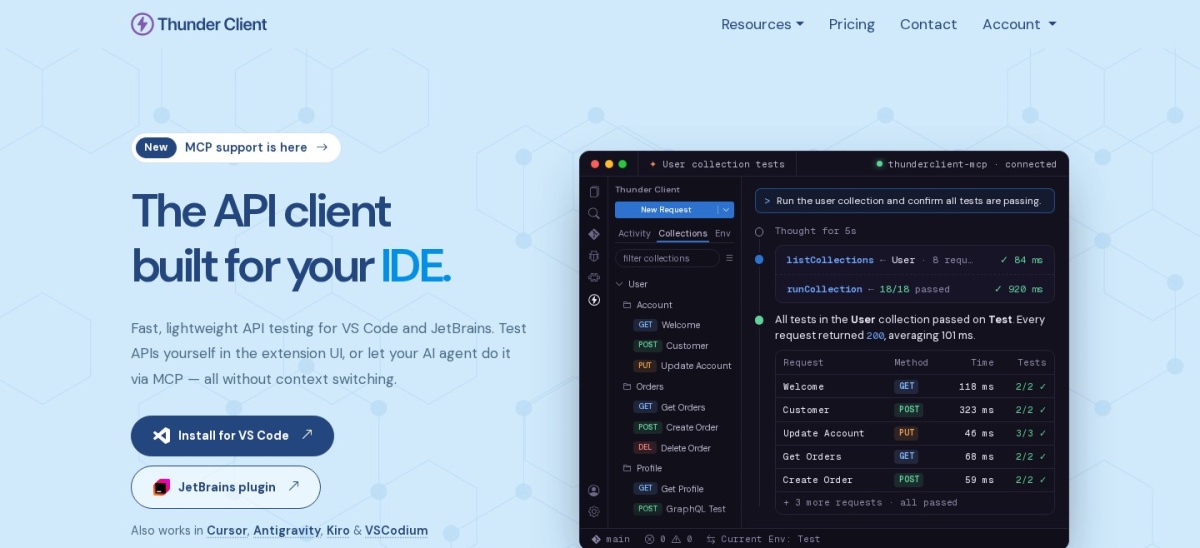
Thunder Client is a lightweight API client that runs as an extension inside VS Code and JetBrains IDEs, so you can test APIs without leaving your editor. The free plan covers REST, WebSocket, Server-Sent Events and gRPC, with local storage and a CLI for CI/CD runs.
The trade off is the free-plan cap. Free collections hold 50 requests each and local collection runs are limited, while Starter at $3 per user a month adds global environments, scripting and Git Sync. It suits developers who live in VS Code and want the cheapest paid plan here.
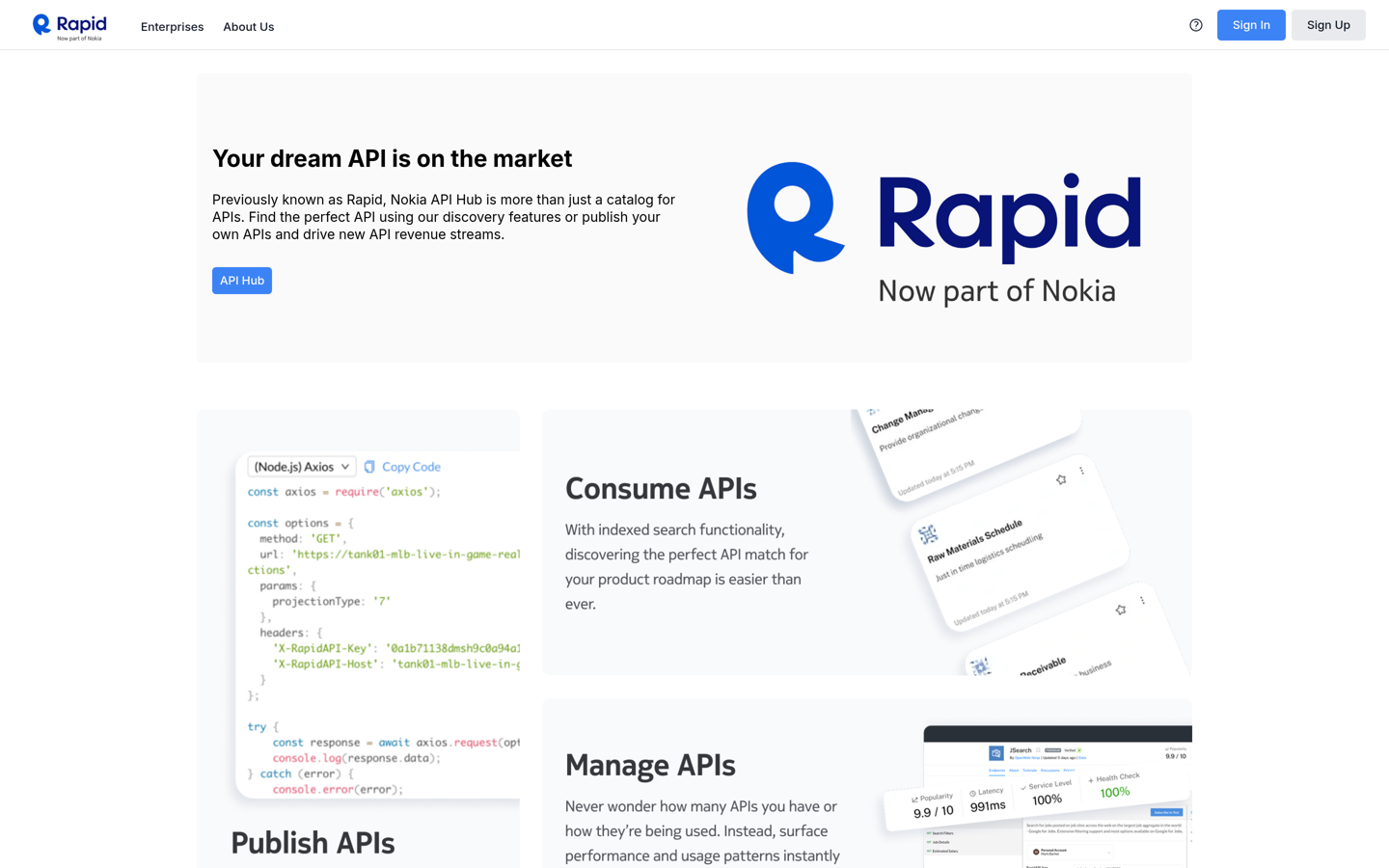
RapidAPI is an API marketplace, now part of Nokia API Hub, where you can find, test and subscribe to thousands of public APIs from your browser. You can try an API before integrating it, generate client code in several languages and publish your own APIs for others to use.
The trade off is that it is a marketplace first, not a daily API client. It has the lowest rating here at 3.5/5, and paid costs vary by API and usage, so bills are harder to predict. It suits developers who need to discover and try public APIs rather than manage private collections.
Every tool here has a free plan, and for solo use the free plan is often enough. Hoppscotch and Bruno give away the most: unlimited requests and full clients with no seat charge.
Paid plans mostly add sharing and history. Team workspaces, Git Sync for larger teams, longer change history and mock servers are the usual paywalls.
If you only send requests and read responses, stay free. Pay when your team needs shared collections, version history or mock servers, not for sending requests.
How we chose
We started from the API clients most often named as Postman replacements, then kept the 7 with a public rating on G2 and a free plan.
Prices come from each vendor's pricing page, checked on 29 November 2026. Ratings and review counts come from G2 on the same day. Where a vendor shows a sale, the list shows the regular price.
We left out tools with no public rating, including Yaak, Kreya, HTTPie and Restfox, because a rating could not be verified. No vendor paid for a place, and we do not claim to have used these tools ourselves.
How to choose a Postman alternative
Start with the protocols you call, then check the free plan against your team size.
List the protocols you actually use. REST alone is covered everywhere, but gRPC, SOAP and WebSocket narrow the field fast. SoapUI is the pick for SOAP, while Insomnia and Hoppscotch cover the widest mix.
Decide where collections should live. If your team reviews API changes like code, pick a Git-native tool such as Bruno. If you want cloud sync and sharing, Apidog or Hoppscotch fit better.
Test the free plan with your real workflow. Send your usual requests, try environments and check the free limits on collections, runs and seats before you commit to a paid tier.
Price it for your whole team. Per-seat prices from $3 to $12 a month add up fast. Multiply by your team size and compare against the free plan before paying.
FAQ
What is the best Postman alternative in 2026?
Hoppscotch is the best Postman alternative for most developers. It is rated 4.9/5 on G2 from 84 reviews, runs in a browser with nothing to install, and its free personal plan has no seat limit. Apidog is the stronger pick if you also need API design, mocking and docs in one place.
What is the best free alternative to Postman?
Hoppscotch has the most generous free plan, with unlimited collections and requests and no seat limit on personal workspaces. Bruno is the best free pick for Git-based teams, since its open-source edition stores collections as plain files with no account needed.
How much do Postman alternatives cost?
All 7 tools in this list have a free plan. Paid plans start at $3 a user a month for Thunder Client and run to $12 a user a month for Insomnia, or $36 to $144 a year. SoapUI Open Source and RapidAPI cost nothing for their core use.
Which Postman alternative is best for small teams?
Apidog fits small teams best, with a free plan for up to 4 users and Basic at $9 a user a month after that. Hoppscotch is the cheapest team option, since shared workspaces start at $6 a seat a month with annual billing.
Is Bruno better than Hoppscotch?
Bruno is better if you want collections in Git and a fully offline client with no account. Hoppscotch is better if you want the highest-rated free plan and a browser client with no install. Hoppscotch leads on rating at 4.9/5 against Bruno's 4.7/5.
Is there a Postman alternative that works inside VS Code?
Thunder Client runs inside VS Code and JetBrains IDEs, so you can test APIs without leaving your editor. Its free plan covers REST, WebSocket and gRPC, and Starter costs $3 a user a month with annual billing.
Can I import my Postman collections into these tools?
Yes. Bruno, Hoppscotch, Insomnia and Apidog all import Postman collections, so you can move your existing requests across without rebuilding them. Check the import result, since environments and scripts sometimes need small fixes.
SaaS SEO and WordPress specialist with about 8 years of experience. Rakib compares WordPress plugins, themes, hosting and software using public pricing, documentation and user reviews. See how we rank.