Fivetran is the best Informatica integration alternative for most teams, with 700+ fully managed connectors, a free plan to 500,000 monthly active rows and a 4.3 out of 5 G2 rating. Airbyte is the cheapest managed start at $20 a month with a free self-hosted edition, while Hevo Data is the easiest no-code pick for small teams.
How we make this list: we compare pricing pages, product documentation and public user reviews, then re-check every price before each update. No product paid for a place. Disclosure.
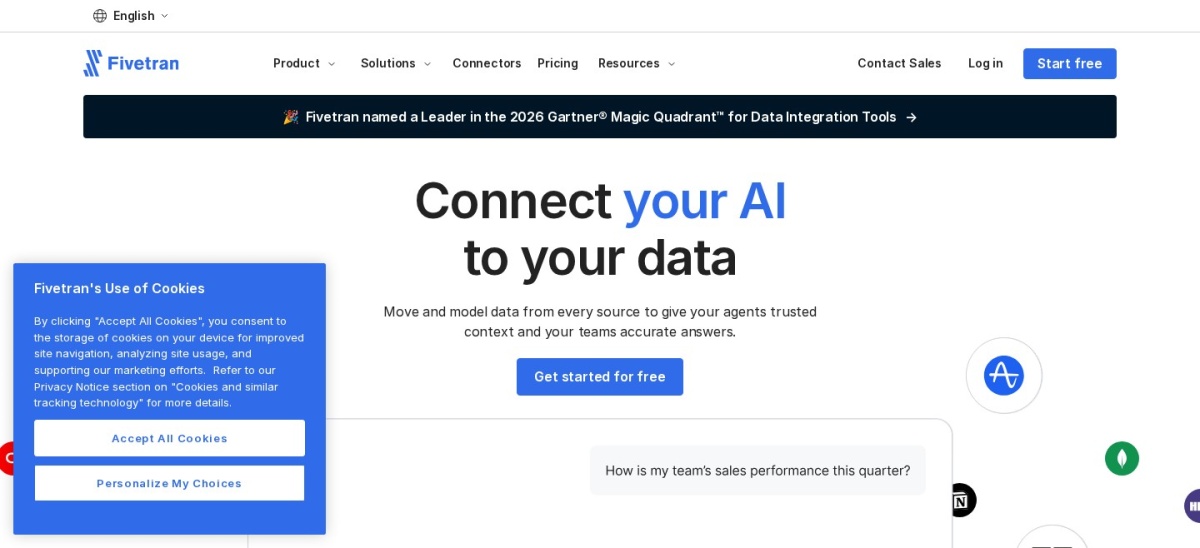
Fivetran is the most managed option, with 700+ connectors and a free plan to 500,000 monthly active rows.
Airbyte is the cheapest managed start at $20 a month, with a free self-hosted Core edition for teams that want control.
Hevo Data is the clearest no-code pick for small teams, with a free plan to 1 million events a month.
Skyvia has the highest G2 rating in this list at 4.8 out of 5 from 326 reviews, with paid plans from $99 a month.
Prices run from free to $1,999 a month for Integrate.io, while Matillion is quote-only and SnapLogic starts at $9,995 a year.
What should you look for in Informatica integration alternatives?
Informatica's strength is breadth: one platform covers integration, data quality, cataloguing and governance. Most alternatives cover integration alone, so teams that lean on the wider suite should check what they would lose before they switch.
Managed ELT tools such as Fivetran and Airbyte move data into a warehouse with little upkeep, but they do not replace Informatica's application integration or master data management. Our guide on adding a custom REST API endpoint shows the same split in miniature: moving data and connecting apps are different jobs.
Pricing models differ so much that a shortlist is not enough. Fivetran bills monthly active rows per connection, Airbyte sells credits, Hevo counts events and Estuary charges per gigabyte, so price the same workload on each tool before you commit.
Free plans are real but narrow. Fivetran covers 500,000 monthly active rows, Hevo covers 1 million events a month and Estuary covers 10 GB a month, which is enough to prove a pipeline before any paid tier starts.
Fivetran is a fully managed ELT platform with more than 700 pre-built connectors for SaaS apps, databases, files and events. The free plan covers up to 500,000 monthly active rows, and paid connections start with a $5 monthly base charge per connection plus usage.
The trade off is usage-based billing. Monthly active rows are billed per connection, so costs rise with each new source, and annual contracts start at $12,000. It suits teams that want Informatica's reliability without operating any infrastructure.
What we like
700+ fully managed connectors
Free plan to 500,000 monthly active rows
15-minute syncs on Standard
Largest review base in this list
Watch out for
Usage billing is hard to predict
Annual contracts start at $12,000
Transformations are metered separately
Paid plans add faster syncs, enterprise connectors and higher support tiersVisit fivetran.com
02
Airbyte
4.4/5on G2 (78 reviews, checked Nov 2026)
Paid from$20/mo
Best for the lowest managed start
Connectors700+
Free planCore, self-hosted
Fastest sync1 hour (Standard)
BillingCredits, $5 each
airbyte.com
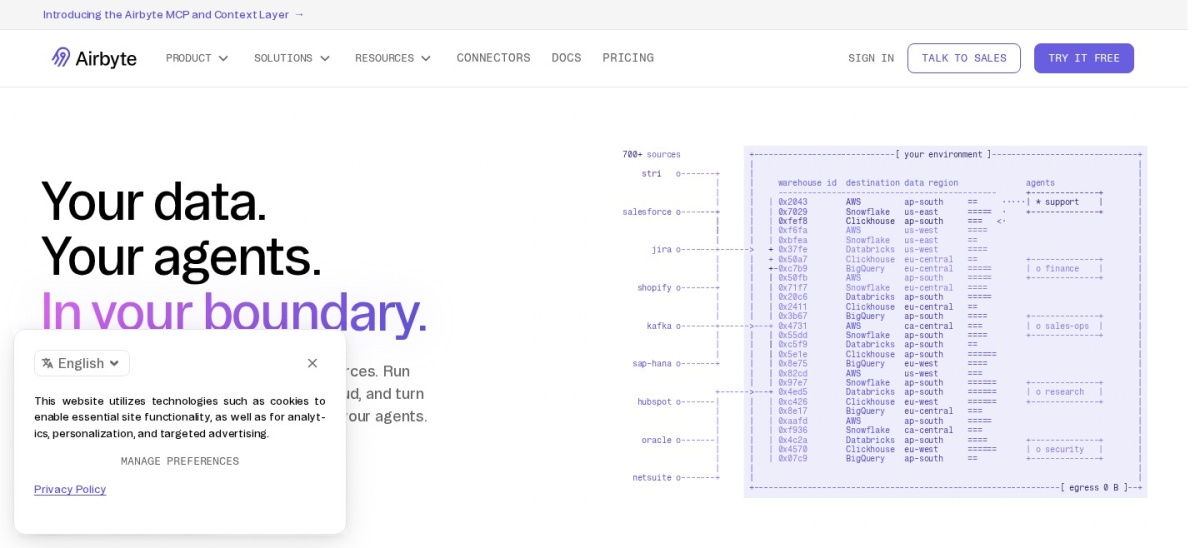
Airbyte homepage, captured Nov 2026.
Airbyte is an open-source data integration platform with more than 700 connectors that moves data from databases, APIs and SaaS apps into warehouses and lakes. Core is free to self-host, and Cloud Standard starts at $20 a month with 5 credits included.
The trade off is sync speed on the entry plan. Standard syncs at most hourly, and 15-minute syncs need the $189-a-month Plus plan. It suits teams that want open-source freedom without running a cluster.
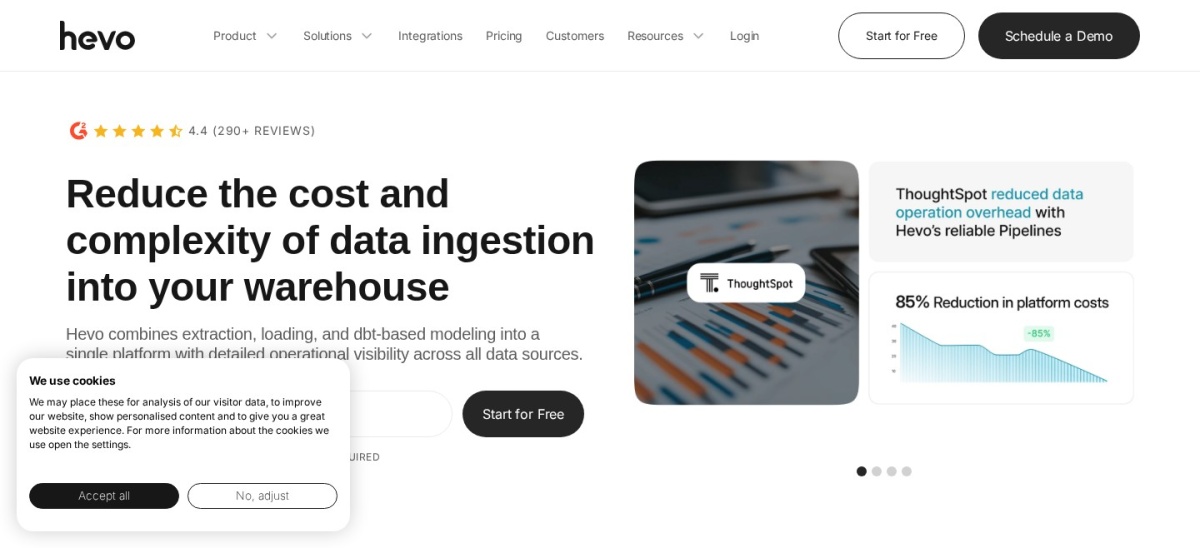
Hevo Data is a no-code ELT platform with 210+ sources that loads data into a warehouse and models it with dbt. The free plan covers 1 million events a month, and Starter starts at $265 a month for 5 million events, with hourly scheduling and up to 10 users.
The trade off is the event meter. Every record inserted, updated, or deleted counts as one event, so busy sources use the quota fast, and streaming pipelines need a higher plan. It suits small teams that want fixed tiers and pipelines without code.
What we like
No-code pipelines
Free plan to 1 million events a month
Real-time change data capture
dbt integration included
Watch out for
Event meter counts deletes too
Streaming needs a higher plan
Starter limited to 10 users
Professional adds unlimited users and APIs from $750 a monthVisit hevodata.com
04
Matillion
4.4/5on G2 (81 reviews, checked Nov 2026)
PricingCustom/yr
Best for warehouse-native transformation
Sources150+
WarehousesSnowflake, BigQuery, more
Free trial14 days, 500 credits
PricingCredits, $2 each
matillion.com
Matillion homepage, captured Nov 2026.
Matillion is a cloud-native data integration platform built for teams that transform data inside Snowflake, BigQuery, Redshift and Databricks. Its visual pipelines push transformations down into the warehouse, and pricing is credit-based from $2 a credit, with a 14-day trial of 500 credits.
The trade off is price clarity. Plans are Developer, Teams and Scale, all by quote, so the bill depends on credit use and there is no low fixed tier. It suits data teams that already live in a cloud warehouse and want transformation beside loading.
Skyvia is a no-code cloud data integration platform with 200+ connectors for ETL, replication, reverse ETL and two-way sync between apps and databases. The free plan covers 10,000 records a month with 2 scheduled integrations, and Basic starts at $99 a month for daily runs.
The trade off is speed by tier. Hourly syncs need the $199-a-month Standard plan, and each module is billed separately, so a team using several modules pays more than the headline price. It suits RevOps and small IT teams that need quick app syncs without code.
What we like
Highest G2 rating in this list, 4.8 out of 5
Free plan to 10,000 records a month
Two-way sync between apps
No-code visual mapping
Watch out for
Hourly syncs need Standard
Modules are billed separately
Large jobs can run slowly
Standard adds hourly syncs and advanced mapping at $199 a monthVisit skyvia.com
06
SnapLogic
4.4/5on G2 (413 reviews, checked Nov 2026)
Starts at$9,995/yr
Best low-code enterprise alternative
BuildingLow-code, prebuilt Snaps
AIAI-assisted pipelines
PricingBasic from $9,995/yr
CoverageData, apps and APIs
snaplogic.com
SnapLogic homepage, captured Nov 2026.
SnapLogic is a low-code integration platform that builds pipelines from prebuilt connectors called Snaps, with AI help for design and mapping. It covers data, application and API integration in one platform, and G2 lists its Basic plan at $9,995 a year.
The trade off is the entry price. At nearly $10,000 a year for Basic, it is priced for enterprises, and the vendor site itself gives no price list. It suits large teams that want business users building integrations without code.
Rivery is a cloud ELT platform, now sold by Boomi as Boomi Data Integration, with 200+ connectors and SQL and Python steps for transformation. Base costs $0.90 per BDU credit on monthly billing, with 1 environment, 2 users, and a 60-minute minimum sync.
The trade off is the credit bill. Database replication costs 1 credit per 100 MB, while API tables cost 0.5 credit per table on every run, so frequent API syncs add up fast. It suits teams that want loading, transformation and orchestration without stitching tools together.
What we like
ELT, orchestration and reverse ETL in one place
SQL and Python transformation steps
Native reverse ETL support
Built-in PII detection and masking
Watch out for
Credit costs grow with sync frequency
Higher plans have no published price
Only 1 environment on Base
Professional adds Python steps, a second environment and 15-minute syncsVisit rivery.io
08
Stitch
4.4/5on G2 (68 reviews, checked Nov 2026)
Starts at$100/mo
Best simple ELT for small teams
Sources140+
Standard$100/mo, 5M rows
Destinations1 on Standard
Trial14-day trial
stitchdata.com
Stitch homepage, captured Nov 2026.
Stitch is a cloud ELT service from Qlik that loads data from 140+ sources into a warehouse using the open Singer standard. Standard starts at $100 a month for 5 million rows, with 1 destination, 10 standard sources, and 5 users.
The trade off is scope. Stitch only extracts and loads, so transformation needs another tool, and the site now points new buyers toward Qlik Talend Cloud. It suits teams with simple needs, one warehouse, and a small set of sources.
Estuary is a real-time data platform with 200+ connectors that combines log-based change data capture with batch pipelines. The free Developer plan covers 10 GB a month and 2 connectors, and Cloud costs $0.50 per gigabyte moved plus $100 a month per connector instance for the first six.
The trade off is double metering. The gigabyte rate applies at capture and again at each materialization, so one destination bills roughly twice the changed data. It suits teams that need sub-minute database replication without running Kafka themselves.
What we like
Real-time log-based CDC
Free 10 GB a month Developer plan
Transparent per-gigabyte price
No Kafka to run
Watch out for
Gigabytes billed at capture and materialization
200+ connectors, smaller catalog
$100 per connector instance adds up
Cloud removes the 10 GB cap and adds a 99.9% uptime SLAVisit estuary.dev
10
Integrate.io
4.4/5on G2 (213 reviews, checked Nov 2026)
Starts at$1,999/mo
Best for one flat predictable bill
Connectors200+
Free trial14-day trial
Fastest sync60 seconds
BillingFlat $1,999/mo
integrate.io
Integrate.io homepage, captured Nov 2026.
Integrate.io is a low-code data pipeline platform with 200+ connectors for ETL, ELT, change data capture, and reverse ETL. Core costs a flat $1,999 a month with unlimited data volume, pipelines, and connectors, and pipelines can run as often as every 60 seconds.
The trade off is the entry price. There is no low-cost tier, so small teams pay the full flat fee even for a few pipelines, and the platform is built for business users rather than heavy custom code. It suits mid-size teams that want one fixed bill and no overage charges.
What we like
Flat $1,999 a month, no overages
Unlimited volume and pipelines
60-second pipeline frequency
Reverse ETL included
Watch out for
No low-cost tier
Built for business users, less custom code
14-day trial only, no free plan
The flat Core plan already includes unlimited volume, pipelines, and connectorsVisit integrate.io
When to stay with Informatica instead of switching
Stay with Informatica if data quality, cataloguing and governance sit in the same platform as your pipelines. No tool in this list replaces that whole suite, and rebuilding it from separate tools costs more than the licence you save.
Stay if your pipelines run on-premises or across hybrid estates with strict lineage rules. Informatica's PowerCenter and IDMC deployments fit regulated estates that cloud-only ELT tools do not cover.
Switch when the bill or the setup time is the problem. If your team moves data into one cloud warehouse and rarely touches the wider suite, a managed tool such as Fivetran or Airbyte buys that time back.
How we chose
We started from the tools most often named as Informatica replacements in vendor and independent comparisons, then kept the ten with a public G2 rating, a live product and a clear deployment story.
Prices come from each vendor's pricing page or, where the vendor publishes no price, from G2's vendor-supplied pricing, checked on 29 November 2026. Ratings and review counts come from G2 on the same day. Where a vendor shows a sale, the list shows the regular price.
We left out tools with no usable public rating, including Qlik Talend Cloud, whose G2 listing shows only 13 reviews, and warehouses such as Snowflake that move no data on their own. No vendor paid for a place, and we do not claim to have used these tools ourselves.
How to choose an Informatica integration alternative
Start with what Informatica does for you today, then match the replacement to that job, not to the whole suite.
Name the job Informatica does for you. Warehouse loading points to Fivetran or Airbyte, live replication points to Estuary or Hevo, and low-code app integration points to SnapLogic.
Decide how much operations you will accept. Free self-hosted tools still cost engineering time. If your team cannot run a cluster, pick a managed plan and price the same workload first.
Check the connector list for your sources. A tool with 700 connectors can still miss the one source you need. Confirm your databases, SaaS apps and file formats before the trial.
Run one real pipeline on the free plan. Move a small source end to end, watch the sync speed and the bill, and only then compare the paid tiers.
FAQ
What is the best Informatica integration alternative?
Fivetran is the best Informatica integration alternative for most teams. It offers 700+ fully managed connectors, 15-minute syncs and a free plan to 500,000 monthly active rows, and it is rated 4.3 out of 5 on G2 from 857 reviews.
How much do Informatica integration alternatives cost?
Prices run from free to $1,999 a month. Airbyte Cloud starts at $20 a month, Fivetran from a $5 base charge per connection, Stitch at $100 a month, Hevo Starter at $265 a month, SnapLogic Basic at $9,995 a year and Integrate.io at a flat $1,999 a month. Matillion is quote-only.
Is there a free alternative to Informatica?
Yes. Airbyte Core is free to self-host with 700+ connectors, Fivetran has a free plan to 500,000 monthly active rows, Hevo has a free plan to 1 million events a month, Skyvia has a free plan to 10,000 records a month and Estuary has a free Developer plan to 10 GB a month.
Which Informatica alternative is best for beginners or small teams?
Hevo Data is the easiest start for small teams, with no-code pipelines and a free plan to 1 million events a month. Skyvia is simpler still for app-to-app syncs, while Airbyte suits small teams with an engineer who can self-host Core.
Fivetran vs Airbyte: which is better as an Informatica replacement?
Fivetran is better if you want the most managed option, with 700+ connectors, 15-minute syncs and almost no maintenance, but annual contracts start at $12,000. Airbyte is better if you want an open-source tool you can self-host, with Cloud from $20 a month.
Which Informatica alternative is best for real-time replication?
Estuary is the strongest pick for real-time replication, with log-based change data capture, sub-100-millisecond latency and a free Developer plan to 10 GB a month. Hevo Data also offers change data capture, with hourly scheduling on its Starter plan.
Do these alternatives cover data quality and governance like Informatica?
Most do not. Matillion and Qlik Talend Cloud come closest, with data quality and lineage features, while Fivetran, Airbyte and Stitch focus on moving data reliably. Teams that need Informatica's governance suite should shortlist Matillion first.
SaaS SEO and WordPress specialist with about 8 years of experience. Rakib compares WordPress plugins, themes, hosting and software using public pricing, documentation and user reviews. See how we rank.