Lindy is the best Gumloop alternative for most teams, with a 4.9 out of 5 G2 rating and AI teammates that work in Slack and email from $29.99 a month. Pick n8n for self-hosted workflows at $20 a month, or Make for the cheapest visual builder at $12 a month.
How we make this list: we compare pricing pages, product documentation and public user reviews, then re-check every price before each update. No product paid for a place. Disclosure.
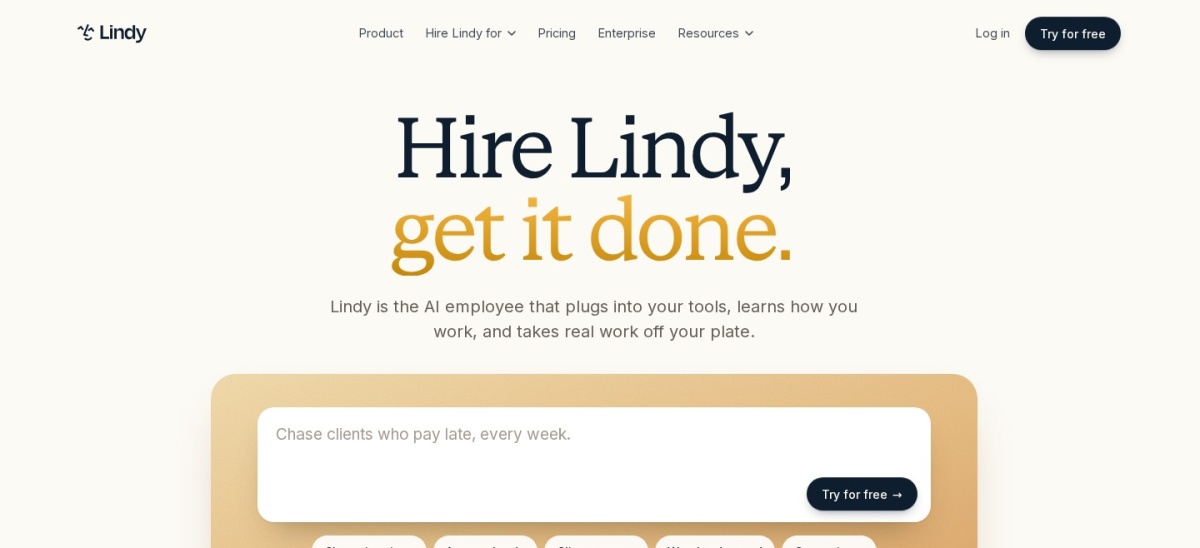
Lindy has the highest G2 rating here at 4.9 out of 5 from 171 reviews, and its Team plan starts at $29.99 a month for 3,000 credits.
n8n charges per whole workflow run, not per step, and its free Community Edition runs on your own server with no execution cap.
Make is the cheapest full workflow builder here: Core costs $12 a month billed annually for 10,000 credits, with a free plan of 1,000 credits.
Gumloop itself has no free plan, only a 14-day trial, while 7 of these 9 alternatives let you start free.
Paid entry prices run from $10 a month for Bardeen to $99 a month for Pipedream, so the billing unit matters more than the headline price.
What should you look for in Gumloop alternatives?
The billing unit decides the real cost. Gumloop Pro costs $37 a month for 20,000 credits, and one credit is a slice of model spend, so a long agent chat can burn through the allowance fast.
A free plan changes the shortlist. Gumloop offers only a 14-day trial, while Zapier, Make, Activepieces, Dify, Bardeen, Pipedream and n8n all have a free way to start, so you can run a real task before paying.
Match the build style to the team. Lindy and Relevance AI hand work to an agent you describe in plain words, while n8n, Make and Zapier ask you to draw the workflow step by step.
Self-hosting is a real dividing line. Our guide on connecting an AI model to WordPress shows how much control you keep when the model runs on your own stack, and n8n, Activepieces and Dify offer that here.
Check the review base before trusting a score. Lindy, n8n, Make and Zapier each have hundreds of G2 reviews, while Relevance AI, Dify and Pipedream have 20 or fewer.
Lindy is an AI teammate that works inside Slack, email, meetings and your calendar instead of on a node canvas. You describe a task in plain words, Lindy learns how you work, and its 40-plus built-in skills cover inbox triage, scheduling, research and follow-ups.
The trade off is the meter. Lindy charges $29.99 per seat a month for a shared pool of 3,000 credits, and voice calls draw on the same pool, so a small team can outgrow one seat fast. It suits founders and ops leads who want an assistant, not another builder to learn.
What we like
Highest G2 rating in this list at 4.9 out of 5
Works where the team already works: Slack and email
40-plus built-in skills, so setup is fast
$50 in free credits to try it before paying
Watch out for
Per-seat pricing grows with every teammate
No free plan, only a 7-day trial
Voice calls drain the shared credit pool fast
Extra seats and credits cost more; voice shares the same poolVisit lindy.ai
02
n8n
4.7/5on G2 (327 reviews, checked Nov 2026)
Paid from$20/mo
Best for self-hosted AI workflows
Free planYes, self-hosted
Executions2,500 a month
AI nodesYes, plus code
Paid planStarter, $20/mo
n8n.io
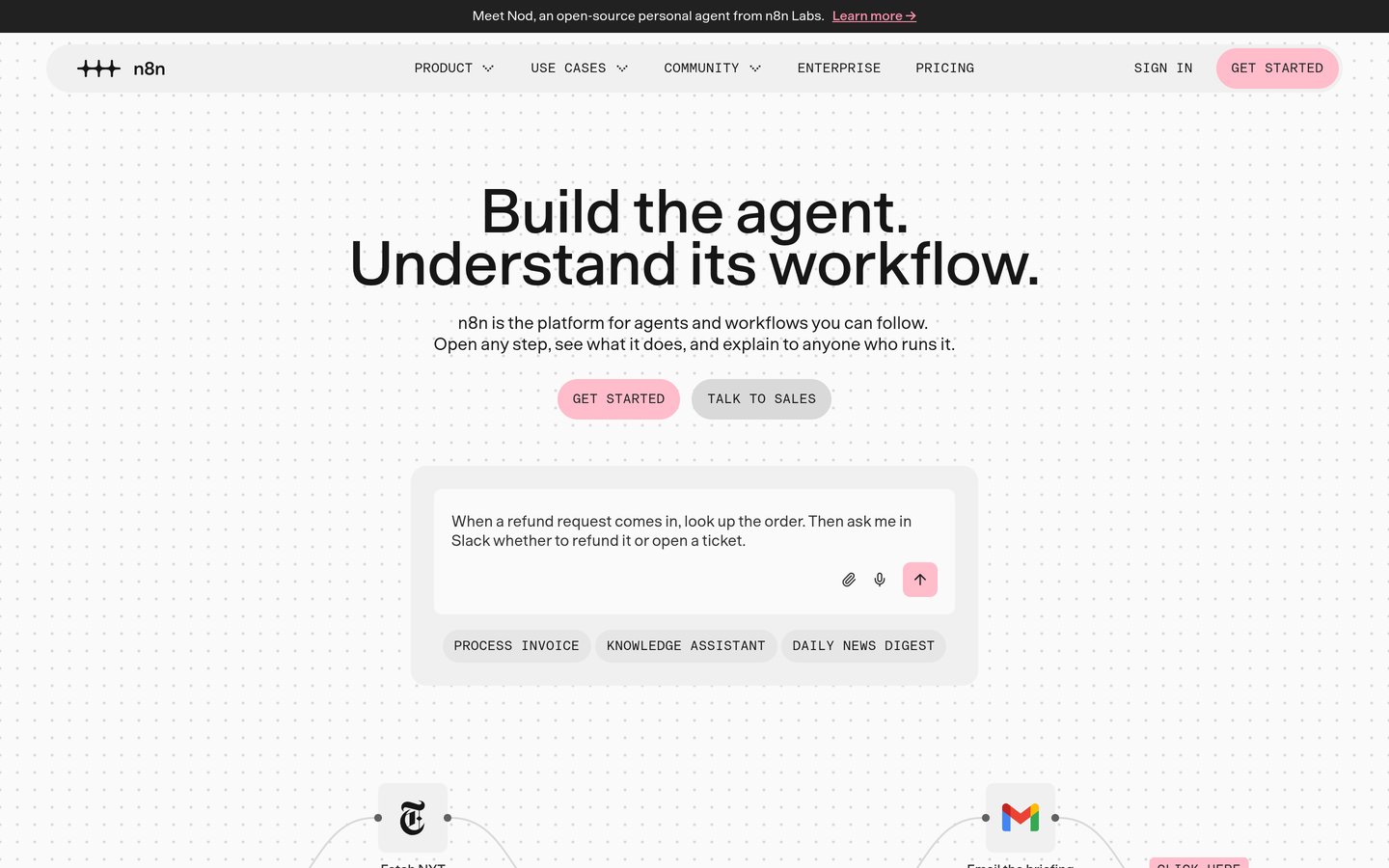
n8n homepage, captured Nov 2026.
n8n is a source-available workflow platform where AI nodes sit beside code steps on a visual canvas. The free Community Edition runs on your own server with unlimited executions, and cloud Starter costs $20 a month billed annually for 2,500 executions.
The trade off is skill. n8n needs more technical setup than Lindy or Zapier, and the cloud plans have no permanent free tier, only a trial. It suits technical teams that want data in-house and pay per whole workflow run, not per step.
What we like
Pay per workflow run, however many steps it has
Self-hosting keeps data on your own server
Code nodes allow custom logic and API calls
Free Community Edition with no execution cap
Watch out for
Steeper learning curve than no-code rivals
Running it yourself needs engineering time
Cloud Starter caps at 2,500 executions a month
Pro at $50 a month adds 10,000 executions and more projectsVisit n8n.io
03
Make
4.6/5on G2 (336 reviews, checked Nov 2026)
Paid from$12/mo
Best value visual builder
Free plan1,000 credits a month
Apps3,500+
AI in scenariosYes, Maia assistant
Paid planCore, $12/mo
make.com
Make homepage, captured Nov 2026.
Make is a visual automation platform for building scenarios that connect apps, data and AI models on one canvas. The free plan includes 1,000 credits a month, and Core costs $12 a month billed annually for 10,000 credits, with an AI assistant called Maia that plans and builds scenarios.
The trade off is metering. A credit is usually one module action, so long scenarios with AI steps burn credits faster than n8n's per-run billing. It suits ops builders who want branching logic and a low entry price.
What we like
Cheapest full workflow builder in this list
Visual canvas with routers, filters and branching
3,500-plus apps to connect
Free plan covers a first real scenario
Watch out for
AI modules use credits fast on long scenarios
Per-action metering is harder to forecast than per-run
Team roles need the $38 a month Teams plan
Pro at $21 a month adds priority runs and log searchVisit make.com
04
Zapier
4.5/5on G2 (2,173 reviews, checked Nov 2026)
Paid from$19.99/mo
Best for the largest app library
Free plan100 tasks a month
Apps9,000+
AI agentsYes, Zapier Agents
Paid planProfessional, $19.99/mo
zapier.com
Zapier homepage, captured Nov 2026.
Zapier is the most established automation platform here, connecting apps with trigger-and-action Zaps, plus AI agents that run on top of them. The free plan covers 100 tasks a month and 400 agent activities, and Professional starts at $19.99 a month billed annually.
The trade off is per-task pricing. Every successful action in a Zap counts as a task, and agent activities are a separate meter, so multi-step workflows get expensive. It suits teams that want the widest app library and the simplest start.
What we like
Largest app library in this list at 9,000-plus apps
Easiest start for non-technical teams
Free plan with agent activities included
Agents layer onto Zaps you may already run
Watch out for
Per-task pricing climbs fast on long workflows
Agent activities are metered separately from tasks
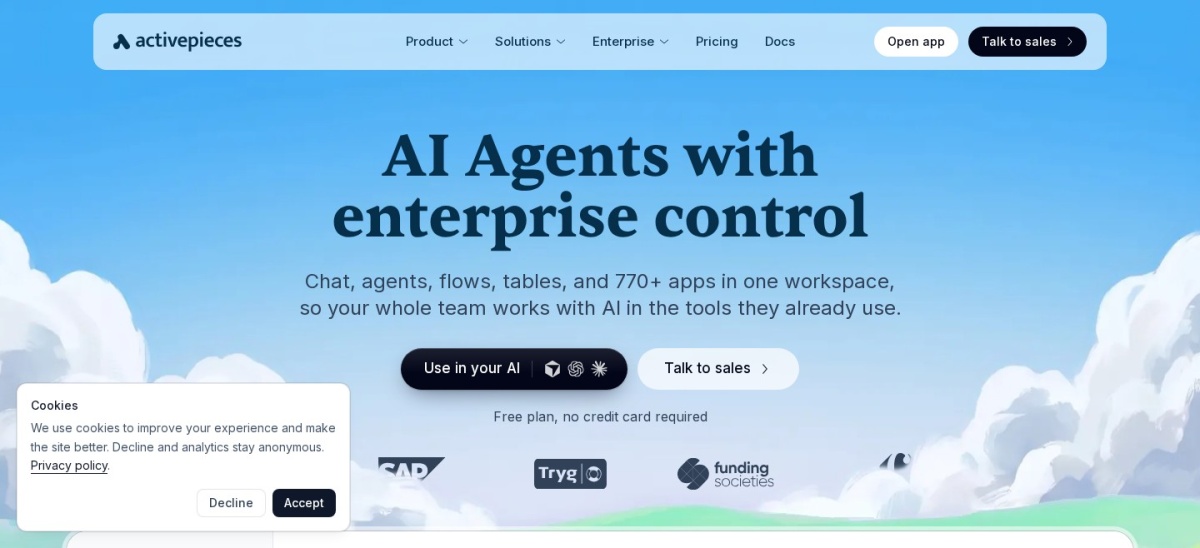
Activepieces is an open-source automation platform with a drag-and-drop flow builder, AI steps and 770-plus apps. The free plan includes 1,000 credits a month, Plus costs $20 a month for 10,000 credits, and the Community Edition runs on your own server.
The trade off is reach. Its piece library is far smaller than Zapier's, and single sign-on only arrives on the $200 a month Team plan. It suits small teams that want open-source control without n8n's learning curve.
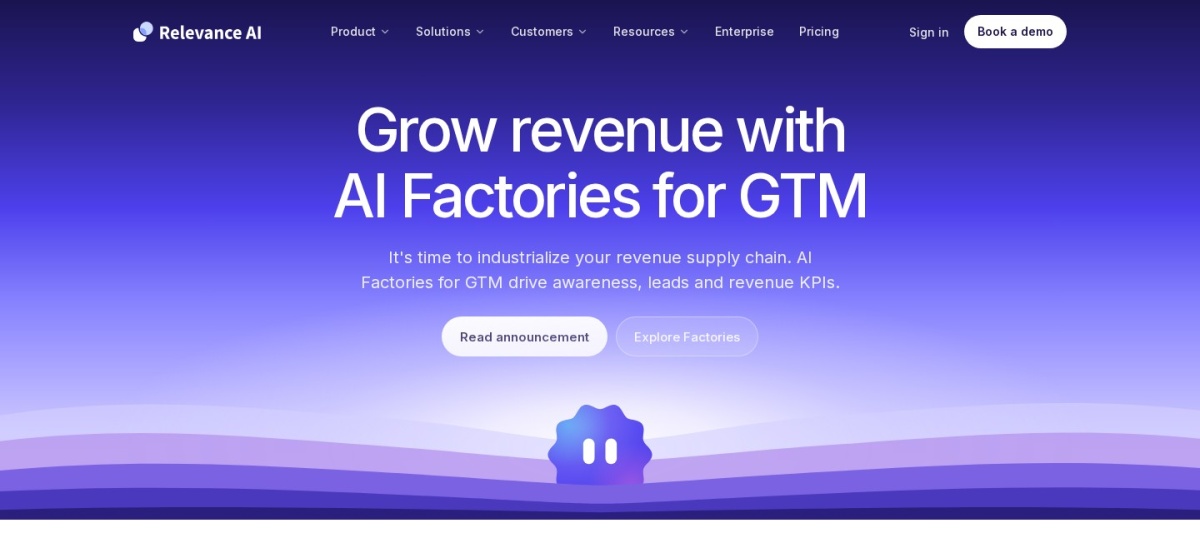
Relevance AI is a low-code platform for building AI agents and multi-agent teams called Workforces, the closest shape to Gumloop in this list. Pro costs $19 a month billed annually for 2,500 Actions and $20 of Vendor Credits a month, and you can bring your own LLM keys.
The trade off is the jump. Team costs $234 a month billed annually, more than 12 times Pro, and the free plan was retired, so there is no free way in. It suits sales and ops teams running agents across departments.
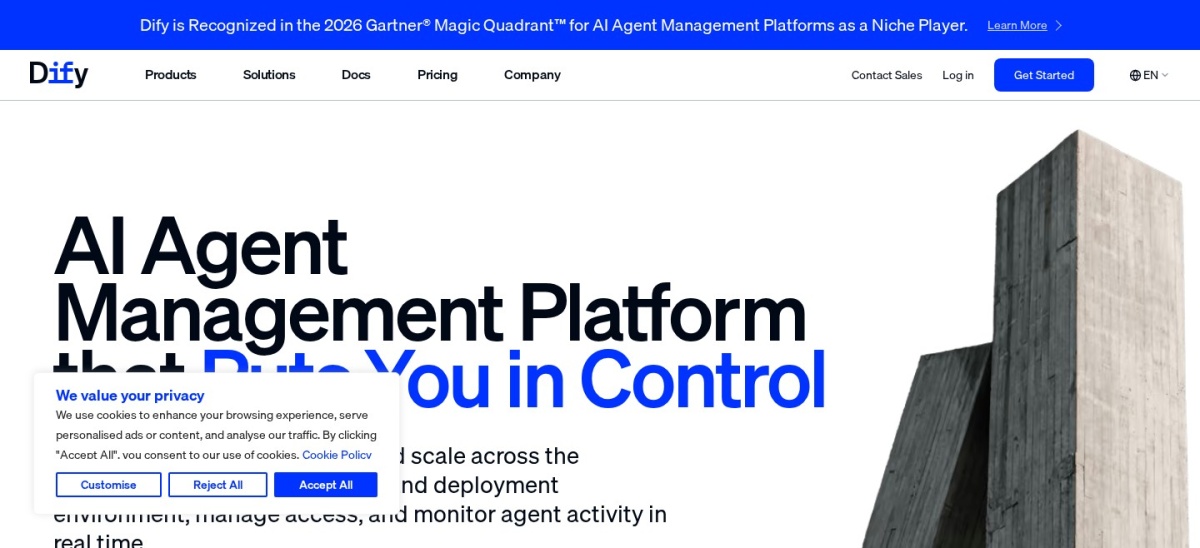
Dify is an open-source platform for building LLM apps, chatbots and retrieval-augmented workflows with a visual builder. The free Sandbox lets you build before paying, Professional costs $590 per workspace a year, and Dify was named a Niche Player in the 2026 Gartner Magic Quadrant for AI Agent Management Platforms.
The trade off is audience. Dify leans more developer than Gumloop, and its 4.1 G2 rating from 20 reviews is the lowest here. It suits AI engineers and product teams building LLM apps, not general ops automation.
What we like
Open source with self-hosting
Strong RAG and prompt orchestration tooling
Free Sandbox to build before paying
Gartner-recognized in 2026
Watch out for
Needs more technical skill than rivals here
Only 20 G2 reviews, a thin base
Priced per workspace, so costs add up
Higher tiers are quoted per workspace above ProfessionalVisit dify.ai
08
Bardeen
4.8/5on G2 (36 reviews, checked Nov 2026)
Paid from$10/mo
Best for browser scraping and lead lists
Free credits100 a month
Browser extensionYes, Chrome
ScrapingYes, premium on paid
Paid planBasic, $10/mo
bardeen.ai
Bardeen homepage, captured Nov 2026.
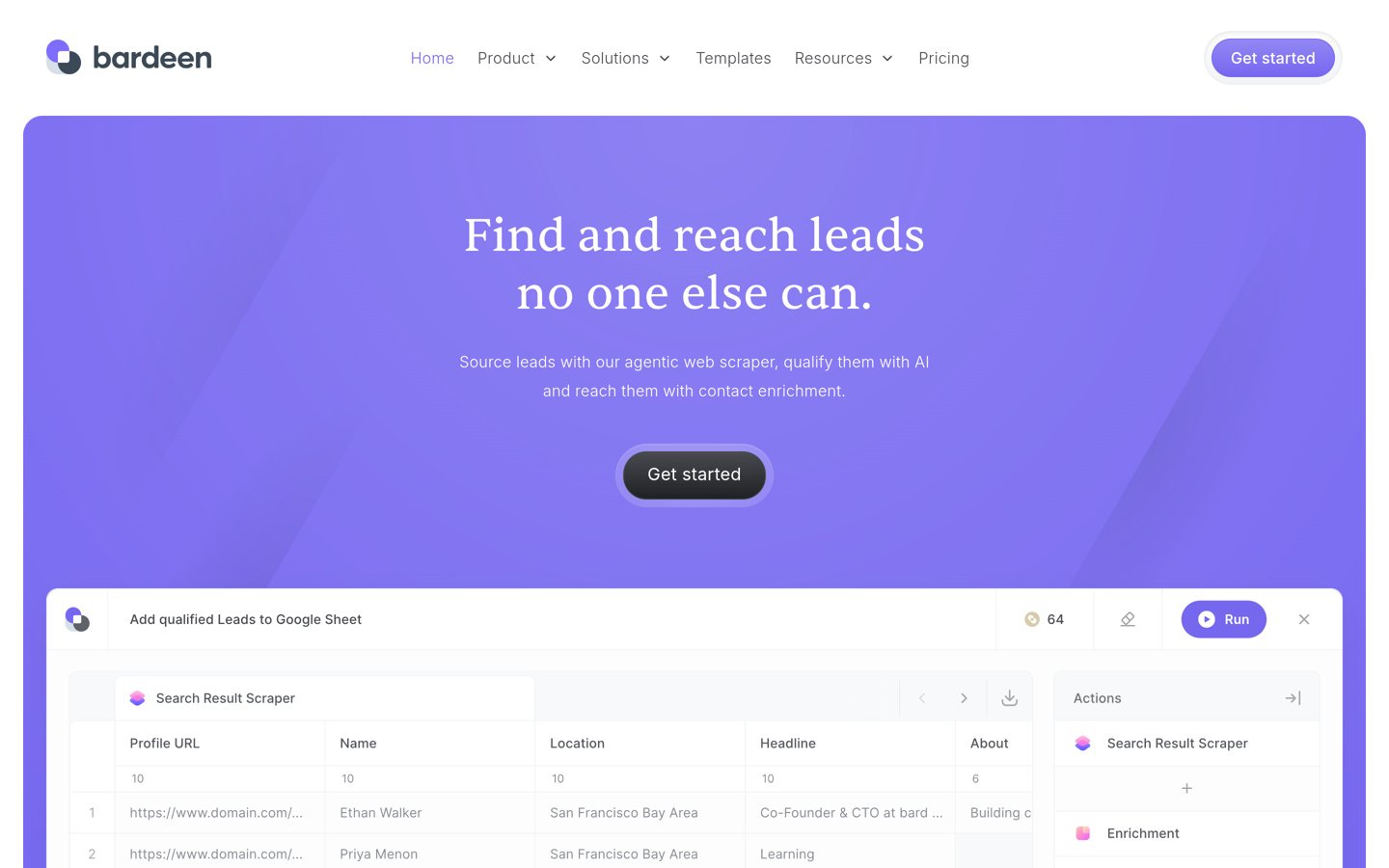
Bardeen is a browser-based AI automation tool that runs as a Chrome extension, scraping websites, enriching leads and moving data to Sheets, Airtable or Notion. Every account gets 100 free credits a month, and Basic costs $10 a month for 100 more.
The trade off is the meter. Credits are charged per output row, and enrichment costs three credits a row, so a big prospect list gets pricey fast. It suits sales and recruiting teams building lead lists from the web.
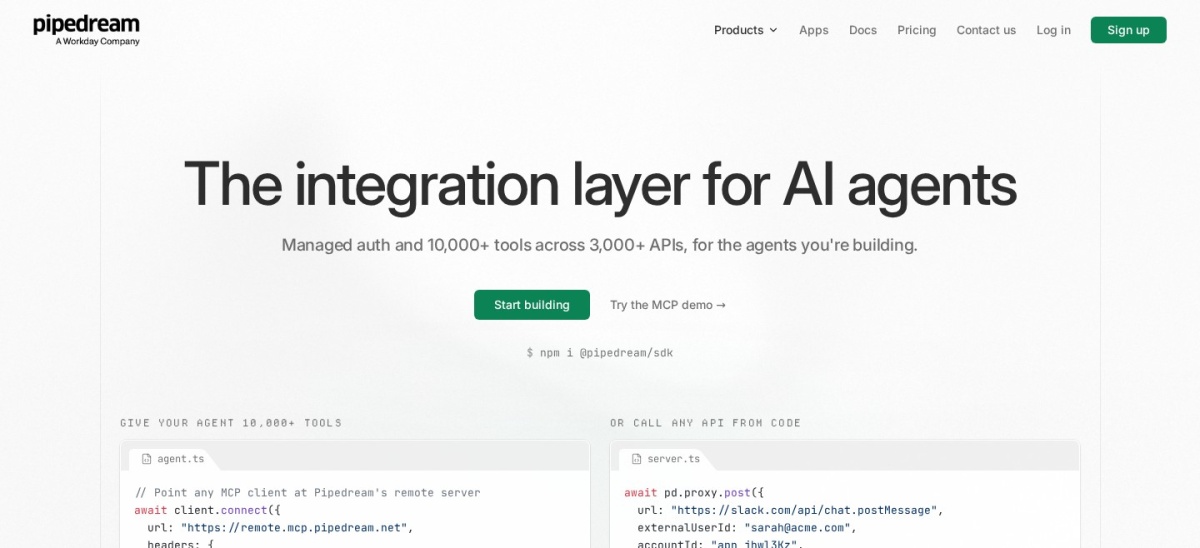
Pipedream is a code-first automation platform where workflows are written in code and call 3,000-plus APIs, with an MCP server so AI agents can use them as tools. It is free for development, and Startup costs $99 a month billed annually.
The trade off is audience and price. Pipedream needs a developer, has the highest entry price here, and is now part of Workday, so its roadmap sits inside a larger company. It suits developers wiring agents to APIs.
Billing units: why the prices do not compare directly
A dollar buys a different unit on each platform. Gumloop Pro is $37 a month for 20,000 credits, Lindy sells 3,000 credits a seat, Make sells 10,000 credits for $12, and n8n sells 2,500 whole workflow runs for $20.
An n8n execution can hold fifty steps, a Make credit is usually one step, and a Gumloop credit is a slice of model spend. Run the same real task through your top two and compare invoices, not rate cards.
Free plans help here. Seven of these nine tools have a free way to start, so a one-week pilot with a real workflow tells you more than any pricing page.
How we chose
We started from the tools buyers compare with Gumloop most often: AI agent platforms, visual automation builders and code-first workflow tools, then kept nine with published pricing and a public rating.
Prices come from each vendor's pricing page or pricing documentation, checked on 29 November 2026, and show the regular price, not a sale. Ratings and review counts come from G2 on the same day. Where a vendor lists prices in euros, the list shows the matching US dollar figure.
We left out Relay.app, which closed in September 2026, and Flowise, which reached end of life on 31 August 2026. No vendor paid for a place, and we do not claim to have used these tools ourselves.
How to choose a Gumloop alternative
Start with one real workflow, then match the tool to how that work gets done.
Name the job first. An inbox assistant, a data pipeline and a scraping list are three different products. Lindy fits the first, n8n or Make the second, Bardeen the third.
Run the same task on two free plans. Zapier, Make, Activepieces, Dify, Bardeen and Pipedream all have free plans, and n8n has a free self-hosted Community Edition. Compare what one real run costs in each.
Check the billing unit, not just the price. Per-run, per-step, per-credit and per-seat pricing behave very differently at volume. See how to connect an AI model to WordPress for what running models yourself involves.
Confirm the app you need is connected. Zapier lists 9,000-plus apps and Pipedream 3,000-plus APIs, while Activepieces lists 770-plus. A missing connector ends a shortlist fast.
FAQ
What are the best Gumloop alternatives in 2026?
Lindy is the best Gumloop alternative for most teams, with a 4.9 out of 5 G2 rating and AI teammates that work in Slack and email. n8n suits technical teams that want self-hosting, and Make is the cheapest visual builder at $12 a month.
Is there a free alternative to Gumloop?
Yes. Gumloop has no free plan, only a 14-day trial, while Zapier, Make, Activepieces, Dify, Bardeen and Pipedream all have free plans or free tiers, and n8n has a free self-hosted Community Edition. Start on one of those before paying.
Which Gumloop alternative is cheapest?
Bardeen has the cheapest paid plan at $10 a month for its Basic plan, though it is a browser scraping tool, not a general workflow builder. For full workflow automation, Make Core at $12 a month billed annually is the cheapest entry here.
Lindy vs n8n: which is better?
Lindy is better if you want an AI assistant that works in Slack and email with little setup, and it holds a 4.9 G2 rating. n8n is better if you want self-hosting, code control and per-run pricing, and it costs $20 a month for cloud Starter.
Which Gumloop alternative is best for beginners?
Zapier is the easiest start, with the largest app library and a free plan covering 100 tasks a month. Make is the next best pick for beginners who want a visual canvas and a lower price at $12 a month.
Can I self-host a Gumloop alternative?
Yes. n8n, Activepieces and Dify all offer self-hosted editions: n8n has a free Community Edition, Activepieces has a free Community Edition, and Dify is open source. Self-hosting keeps your data on your own server but needs technical setup.
Why do teams leave Gumloop?
Teams usually leave over billing and access. Gumloop meters model cost, tool calls and compute minutes plus an 8% orchestration fee, which is hard to forecast, and it has no free plan, only a 14-day trial on Pro at $37 a month.
SaaS SEO and WordPress specialist with about 8 years of experience. Rakib compares WordPress plugins, themes, hosting and software using public pricing, documentation and user reviews. See how we rank.