Matomo is the best of the Google Tag Manager alternatives for most teams, with a free self-hosted tag manager and hosted plans from $26 a month, rated 4.2 out of 5 on G2. Piwik PRO fits privacy-first teams in Europe, while Tealium iQ suits large enterprises that need governance.
How we make this list: we compare pricing pages, product documentation and public user reviews, then re-check every price before each update. No product paid for a place. Disclosure.
Matomo is the only full tag manager here that is free to self-host, with hosted Cloud plans from $26 a month for 50,000 hits.
Piwik PRO bundles its tag manager with analytics and consent tools, but the free Core plan ended in February 2026 and Business starts at €36 a month.
Tealium iQ is the enterprise standard at 4.3 out of 5 from 493 G2 reviews, but pricing is quote-only and setup takes months.
Segment and RudderStack replace tags with event pipelines: Segment Team costs $120 a month, RudderStack Growth costs $265 a month.
Stape is the cheapest server-side route at $20 a month, though it still runs GTM containers rather than replacing them.
How do you pick the right Google Tag Manager alternative?
A tag manager is only as good as the tags it runs. The best replacement for Google Tag Manager is the one your team can actually maintain, so start from who will build and debug the tags, not from the feature list.
Privacy is the main reason teams leave GTM. If your data must stay in the EU or on your own servers, a self-hosted option like Matomo or an EU-hosted suite like Piwik PRO matters more than any extra feature.
Server-side tools change the job, not just the vendor. Stape and JENTIS move tag execution off the browser, which improves data quality but adds hosting and maintenance work. Our guide on adding Google Tag Manager to WordPress shows how the client-side setup works today.
Price spreads are wide. Four tools here have a usable free tier, while the enterprise tag managers are quote-only and can cost thousands a year once services are added.
List prices in each vendor's currency, checked Nov 2026
Tealium iQCustom
mParticleCustom
JENTISCustom
StapeFREE$240
MatomoFREE$312
Piwik PRO€432
SegmentFREE$1,440
RudderStackFREE$3,180
The 8 best Google Tag Manager alternatives
01
Matomo
4.2/5on G2 (97 reviews, checked Nov 2026)
Paid from$26/mo
Best Google Tag Manager alternative overall
Free planYes, self-hosted
Tag ManagerBuilt in
Cloud planFrom $26/mo
Data hostingSelf-hosted or cloud
matomo.org
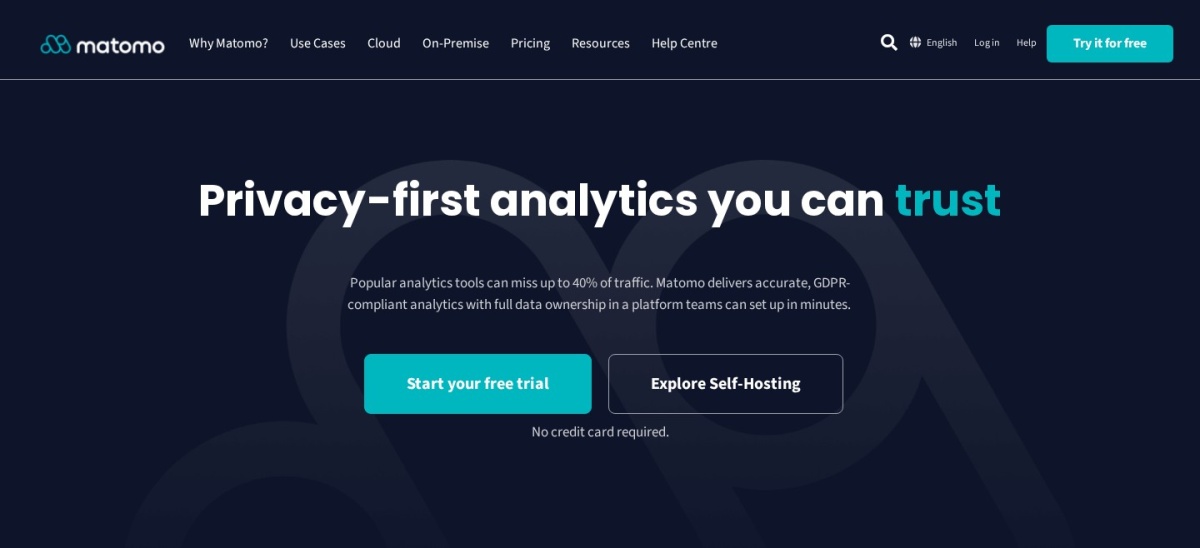
Matomo homepage, captured Nov 2026.
Matomo is an open-source analytics platform with a built-in tag manager that runs on your own server or on Matomo Cloud. The free On-Premise version includes the tag manager, analytics and consent tools with no data sampling, and Cloud starts at $26 a month for 50,000 hits.
The trade off is upkeep. Self-hosting is free but you run updates, backups and security yourself, and Cloud prices rise with traffic, so a high-traffic site pays more than $26 a month. It suits teams that want full data ownership without a Google account.
What we like
Free to self-host, with no licence cost
Tag manager included, not an add-on
No data sampling and full data ownership
EU hosting option on Cloud plans
Watch out for
Self-hosting needs setup and upkeep
Cloud price rises with monthly hits
Lowest G2 rating in this list at 4.2 out of 5
Cloud adds hosting, updates and support from $26 a monthVisit matomo.org
02
Piwik PRO
4.5/5on G2 (49 reviews, checked Nov 2026)
Starts at€36/mo
Best for privacy-first teams in Europe
Free planNo, 30-day trial
Tag ManagerBuilt in
Business plan€36/mo
Data hostingEU cloud in Sweden
piwik.pro
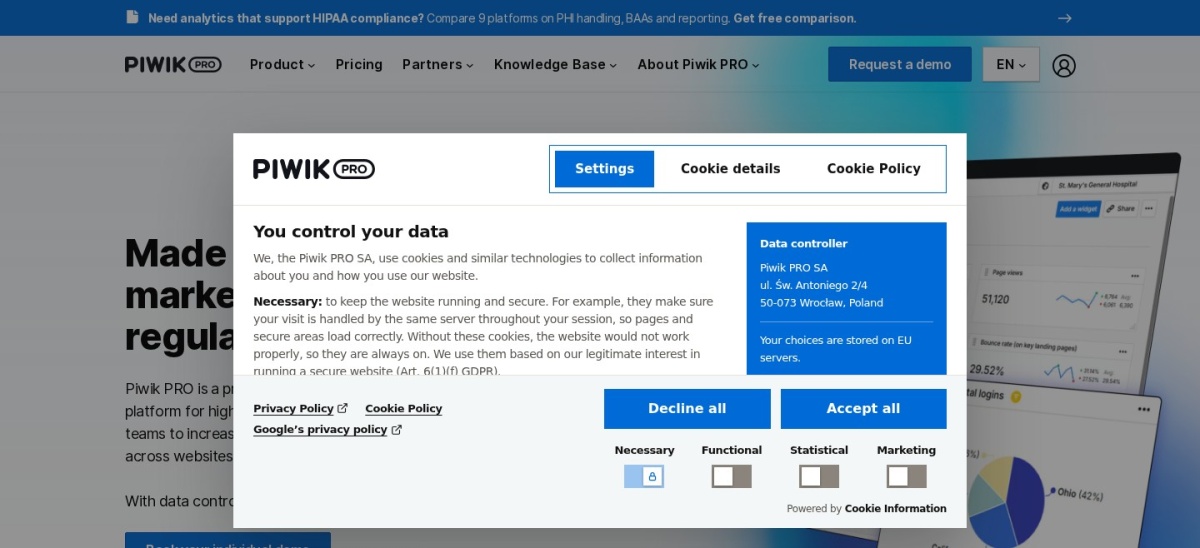
Piwik PRO homepage, captured Nov 2026.
Piwik PRO is a privacy-first analytics suite that bundles Analytics, Tag Manager, a consent manager and data activation in one contract. Business starts at €36 a month for up to 2 million actions across 20 domains, with 25 months of data retention and EU hosting in Sweden.
The trade off is that there is no free plan. The free Core plan ended in February 2026, and subscription fees rise 4% each year on renewal. It suits regulated teams in healthcare, government and finance that need GDPR compliance built in.
What we like
Tag manager, analytics and consent in one suite
EU hosting with a choice of data region
25 months of data retention on Business
Rated 4.5 out of 5 on G2
Watch out for
No permanent free plan
Prices rise 4% a year on renewal
Priced in euros, not dollars
Enterprise adds unlimited actions and dedicated support from €366 a monthVisit piwik.pro
03
Tealium iQ
4.3/5on G2 (493 reviews, checked Nov 2026)
PricingCustom/mo
Best for large enterprises
Free planNo
Tag ManagerTealium iQ
IntegrationsHundreds of connectors
PricingQuote only
tealium.com
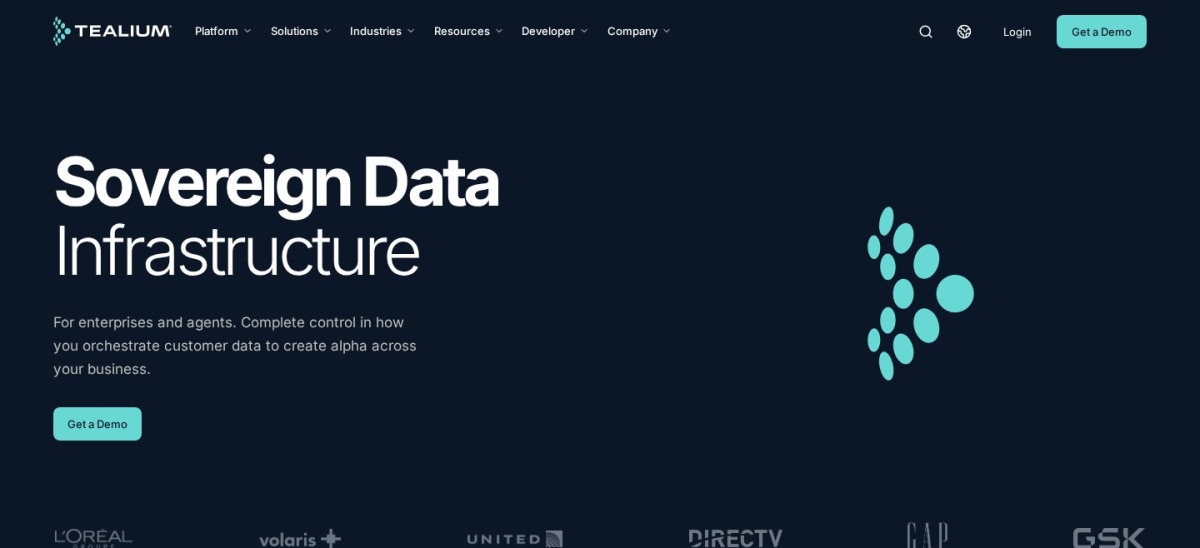
Tealium iQ homepage, captured Nov 2026.
Tealium iQ is the tag manager inside Tealium's Customer Data Hub, built for enterprises that run hundreds of tags across many sites and apps. It offers versioning, approval workflows and hundreds of pre-built connectors, and it holds 493 G2 reviews.
The trade off is cost and complexity. Pricing is quote-only, reviewers report an average implementation time of about 4 months, and the learning curve is steep for small teams. It suits large marketing and data teams that need governance over speed.
What we like
Deep review base, with 493 G2 reviews
Strong governance, versions and approvals
Hundreds of pre-built connectors
Real-time data collection and activation
Watch out for
No published prices, quote only
Implementation averages about 4 months
Steep learning curve for small teams
Paid plans add AudienceStream, EventStream and premium supportVisit tealium.com
04
Twilio Segment
4.5/5on G2 (568 reviews, checked Nov 2026)
Paid from$120/mo
Best for routing data to many tools
Free planYes, 1,000 MTUs
Team plan$120/mo
Destinations700+
Sources2 on free, unlimited on Team
segment.com
Twilio Segment homepage, captured Nov 2026.
Twilio Segment is a customer data platform that collects each event once and routes it to more than 700 destinations, which replaces much of the tag work GTM does. Its free Developer tier covers 1,000 monthly tracked users and 2 sources, and Team starts at $120 a month for 10,000 users.
The trade off is the meter. Costs rise with monthly tracked users, and features like Protocols and Personas sit behind the custom-priced Business tier. It suits SaaS teams that already send the same events to analytics, ads and CRM tools.
What we like
Largest review base in this list, at 568
700+ destinations from one event stream
Free tier needs no credit card
Strong developer experience and docs
Watch out for
Free tier caps at 1,000 users and 2 sources
Key features gated behind Business
Usage-based pricing is hard to predict
Team adds 10,000 users and unlimited sources at $120 a monthVisit segment.com
05
RudderStack
4.7/5on G2 (52 reviews, checked Nov 2026)
Paid from$265/mo
Best open-source pipeline for data teams
Free planYes, 250K events/mo
Growth plan$265/mo
Destinations200+ cloud
Warehouse sync30 min on Growth
rudderstack.com
RudderStack homepage, captured Nov 2026.
RudderStack is an open-source customer data platform that streams events to your warehouse and on to more than 200 destinations. The free plan covers 250,000 events a month, 16 SDK sources and warehouse destinations, and Growth starts at $265 a month for 1 million events.
The trade off is engineering effort. RudderStack needs solid technical resources to run well, and reviewers warn that pricing scales sharply at high event volumes. It suits warehouse-first data teams that want to own their event pipeline.
mParticle is a mobile-first customer data platform that collects events across web and apps, builds audiences and forwards data to analytics and ad tools. It now sits inside Rokt after a 2025 acquisition, and it is rated 4.4 out of 5 from 175 G2 reviews.
The trade off is opaque pricing. mParticle publishes no prices and bills on a credit-based model, so costs are hard to model before a sales conversation. It suits media, retail and fintech teams with large mobile audiences and complex identity needs.
Stape is a managed hosting platform for server-side Google Tag Manager containers, with plugins for Shopify, WordPress and other platforms. Its free plan covers 10,000 requests a month, and Pro costs $20 a month for 500,000 requests, or $17 a month billed annually.
The trade off is that Stape does not replace GTM. It moves your GTM container server-side, so you still build tags in GTM and still need someone who knows it. It suits teams that know GTM and want first-party tracking without running their own servers.
What we like
Cheapest paid plan in this list at $20 a month
Free tier for testing server-side tracking
Setup wizard and templates for common platforms
EU hosting option for privacy-conscious teams
Watch out for
Still runs GTM, so it is not a full replacement
Only 11 G2 reviews, a thin base
Request-based pricing is hard to estimate upfront
Business adds 5 million requests at $100 a monthVisit stape.io
08
JENTIS
5/5on G2 (2 reviews, checked Nov 2026)
PricingCustom/mo
Best for EU consent-first tracking
Free planNo
PricingQuote only
HostingManaged EU hosting
Tag managerOwn, replaces GTM
jentis.com
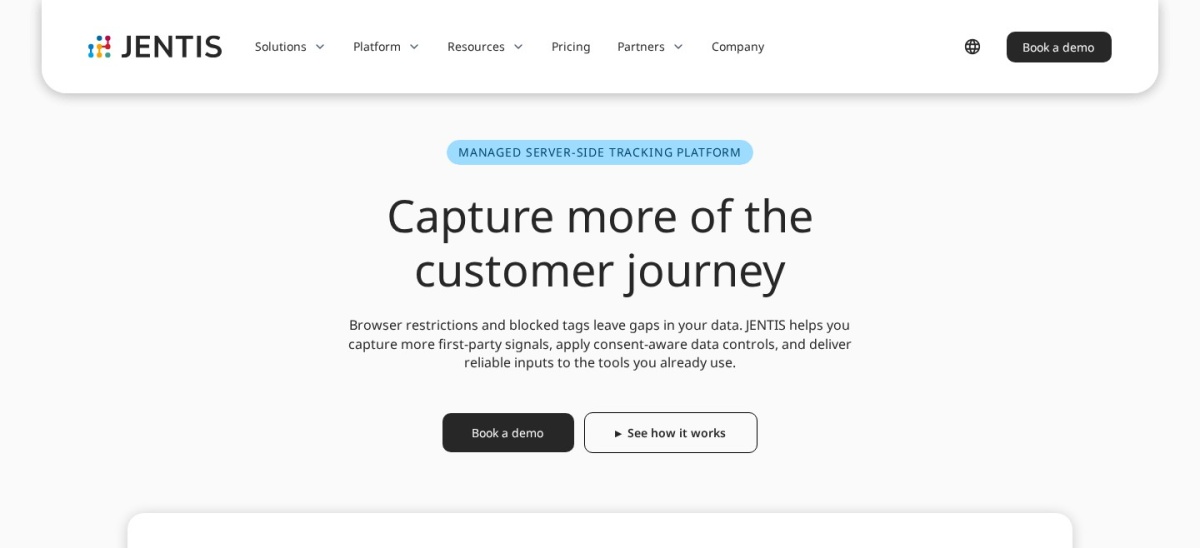
JENTIS homepage, captured Nov 2026.
JENTIS is an Austrian server-side tracking platform with its own tag manager, so it replaces GTM instead of hosting it. It fuses client-side and server-side tracking, enforces consent per destination and runs on managed, auto-scaling EU infrastructure.
The trade off is evidence and price. JENTIS holds 5.0 out of 5 on G2 from only 2 reviews, publishes no prices, and tags must be rebuilt in its own tool. It suits larger EU organisations that want consent handling at the core of their tracking.
What we like
Own tag manager, a true GTM replacement
Consent enforced per destination
Managed EU hosting with data sovereignty
Rated 5.0 out of 5 on G2
Watch out for
Only 2 G2 reviews, a very thin base
No published prices, quote only
Migration means rebuilding tags and triggers
Professional adds AI activation, raw data access and Cloud ChoiceVisit jentis.com
Server-side vs client-side: what actually changes
Client-side tag managers run tags in the visitor's browser. Matomo, Piwik PRO and Tealium iQ all work this way, and they are the closest like-for-like swaps for GTM.
Server-side tools move tag execution to a server you control. Stape hosts your GTM container server-side, while JENTIS replaces GTM with its own server-side tag manager. Data quality improves because ad blockers and browser limits see less, but you take on hosting and maintenance.
Event pipelines are a third shape. Segment, RudderStack and mParticle collect events once and route them onward, which can remove tags entirely for analytics and ads, but they are data platforms first and tag managers second.
Pick the shape before the vendor. If the team is small and the site is one domain, a client-side manager is enough. Server-side only pays off when data loss from blockers and consent banners is already costing money.
How we chose
We started from the tag managers and data platforms most often named as GTM replacements in G2 comparisons and vendor docs, then kept eight with a public rating and a real tag or event-routing product.
Prices come from each vendor's pricing page, checked on 29 November 2026, or are marked Custom where the vendor publishes no prices. Ratings and review counts come from G2 on the same day. Where a vendor shows a sale price, the list shows the regular price.
We left out tools with no standalone public rating, such as Adobe Experience Platform Tags, and tools with only one G2 review, such as Commanders Act. No vendor paid for a place, and we do not claim to have used these tools ourselves.
How to choose a Google Tag Manager alternative
Start with who will own the tags, then match the tool to your privacy and budget limits.
List who builds and debugs tags. If marketers must ship tags without developers, pick a visual tag manager like Matomo or Tealium iQ. If engineers own tracking, an event pipeline like RudderStack may fit better.
Check where the data must live. EU or regulated teams should shortlist Matomo, Piwik PRO and JENTIS, which offer self-hosting or EU hosting with consent controls built in.
Price the volume you actually send. Free tiers cap at 10,000 requests on Stape, 250,000 events on RudderStack and 1,000 users on Segment, so check your monthly volume before choosing on price alone.
Run one tag flow end to end first. Move a single conversion tag to the new tool and check it arrives in your analytics before migrating the rest. See how to track WooCommerce sales in GA4 for what good event data looks like.
FAQ
What is the best Google Tag Manager alternative?
Matomo is the best Google Tag Manager alternative for most teams, with a free self-hosted tag manager and hosted plans from $26 a month. Piwik PRO fits privacy-first teams in Europe, and Tealium iQ suits large enterprises that need governance.
Is there a free alternative to Google Tag Manager?
Yes. Matomo is free to self-host with its tag manager included, Stape offers free server-side hosting for 10,000 requests a month, and Segment and RudderStack both have free tiers. Free plans cap volume, so check your monthly traffic first.
How much do Google Tag Manager alternatives cost?
Prices run from free to quote-only. Stape Pro costs $20 a month, Matomo Cloud starts at $26 a month, Piwik PRO Business starts at €36 a month, Segment Team costs $120 a month, and Tealium iQ, mParticle and JENTIS are priced by quote.
Which Google Tag Manager alternative is best for privacy?
Matomo and Piwik PRO are the strongest privacy picks here. Matomo can be self-hosted so data never leaves your server, while Piwik PRO offers EU hosting in Sweden with consent tools built in. JENTIS adds consent enforcement per destination.
Matomo vs Piwik PRO: which should I choose?
Choose Matomo if you want a free self-hosted tag manager and full data ownership at the lowest cost. Choose Piwik PRO if you want analytics, tag management and consent in one supported contract with EU hosting, and you can pay from €36 a month.
Do I still need Google Tag Manager if I use Stape?
Yes, in a way. Stape hosts your server-side GTM container, so you still build and maintain tags inside GTM. It is a hosting change, not a replacement. Matomo, Piwik PRO, Tealium iQ and JENTIS replace GTM entirely.
SaaS SEO and WordPress specialist with about 8 years of experience. Rakib compares WordPress plugins, themes, hosting and software using public pricing, documentation and user reviews. See how we rank.