React Native is the best of the Flutter alternatives for most teams: it is free, renders truly native components, and is rated 4.5/5 on G2 from 144 reviews. Pick Ionic for web teams and FlutterFlow if you want a visual builder that still outputs Flutter code.
How we make this list: we compare pricing pages, product documentation and public user reviews, then re-check every price before each update. No product paid for a place. Disclosure.
React Native is the top pick: free, rated 4.5 out of 5 on G2 from 144 reviews, with truly native interface components.
Ionic is free and works with Angular, React or Vue, but new sales of its paid Appflow cloud service ended in February 2025.
FlutterFlow is the only no-code builder here that hands you real Flutter source code, from $29 a month billed yearly.
Six of the eight tools are completely free, so the dearest paid plan in this list is Adalo at $624 a year.
Kotlin Multiplatform shares logic, not interfaces, so teams still build two native interfaces and need Xcode skills for iOS.
How do you choose the best Flutter alternatives?
Flutter draws every pixel itself, so leaving it means choosing a different trade-off, not a copy. The alternatives below split into native frameworks, web-based frameworks and no-code builders.
Language is the first filter. JavaScript teams fit React Native or Ionic, Kotlin teams fit Kotlin Multiplatform, and teams with no developers fit FlutterFlow or Adalo.
Free frameworks cost nothing in licences. React Native, Ionic, Kotlin Multiplatform, Framework7, NativeScript and Cordova all cost $0, and you own everything you build.
Performance matters most on older phones. Our guide on optimizing WordPress for mobile speed shows the same rule: a fast app keeps users, and a slow one loses them.
Check the paid layer, not just the framework. Cloud builds, live updates and store publishing are where the bills appear, and some vendors have wound those services down.
React Native is Meta's free, open-source framework for building mobile apps with JavaScript and React. It renders truly native interface components, shares most code between iOS and Android, and offers Fast Refresh to see edits at once. A large community and many libraries support it.
The trade off is native work. Complex features, upgrades and some libraries still need Swift, Kotlin or Java, and version upgrades can take effort. It suits JavaScript teams that want native performance without learning a second language.
What we like
Largest review base here: 4.5 out of 5 on G2 from 144 reviews
Truly native interface components
Huge community and library ecosystem
Free and open source, from Meta
Watch out for
Some features still need native Swift or Kotlin code
Ionic is a free, open-source framework that builds mobile, desktop and web apps from web technology. It works with Angular, React or Vue, uses Capacitor to reach native device features, and ships one codebase to the App Store, Google Play and the web. The framework itself costs nothing.
The trade off is the paid cloud layer. Ionic stopped selling Appflow to new customers in February 2025, and existing customers keep access only until 31 December 2027, so teams must plan their own builds. It suits web teams that already know HTML, CSS and JavaScript.
What we like
Rated 4.4 out of 5 on G2 from 154 reviews
One codebase covers mobile, desktop and web
Works with Angular, React or Vue
Free framework with a large component library
Watch out for
Appflow cloud service is winding down
Web-based apps can feel less native than Flutter
Plugin updates can introduce build bugs
Framework is free; Appflow is closed to new customersVisit ionic.io
03
FlutterFlow
4.5/5on G2 (30 reviews, checked Nov 2026)
Paid from$29/mo
Best no-code builder with code export
BuilderVisual, no-code plus code
OutputFlutter and Dart code
Free plan2 projects
Paid planBasic, $29/mo billed yearly
flutterflow.io
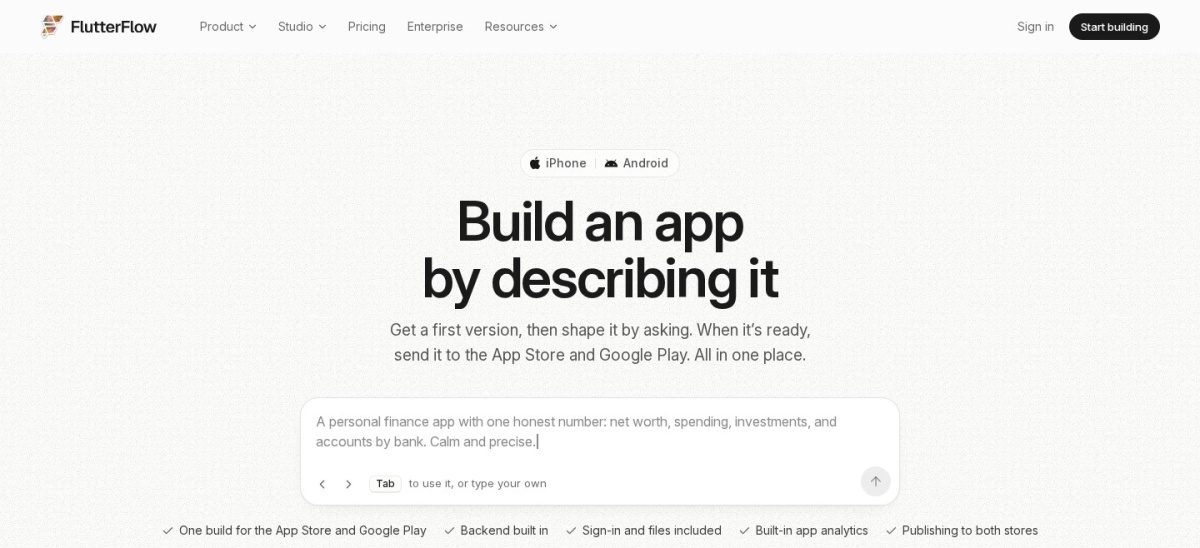
FlutterFlow homepage, captured Nov 2026.
FlutterFlow is a visual builder that creates real Flutter apps without writing code line by line. It offers a drag-and-drop canvas, Firebase and Supabase connections, and code download on paid plans. The free plan covers 2 projects with a free AI allowance.
The trade off is price. Basic costs $29 a month billed yearly, or $39 month to month, and full features such as code download and store deployment need a paid plan. It suits founders and small teams that want a working app fast.
What we like
Generates real Flutter source code you can keep
Rated 4.5 out of 5 on G2 from 30 reviews
Firebase and Supabase built in
One-click deployment to both stores on paid plans
Watch out for
Code download needs a paid plan
Pricing changed recently, so older $30 quotes are stale
Kotlin Multiplatform is JetBrains' free, open-source way to share code across platforms. It shares business logic, networking and data code in Kotlin, while each platform keeps its own native interface. Compose Multiplatform adds shared interface code for teams that want it.
The trade off is double interface work. Teams still build separate iOS and Android interfaces, and the iOS side needs comfort with Xcode and Swift interop. It suits Android-first teams and firms that refuse to compromise on native interface quality.
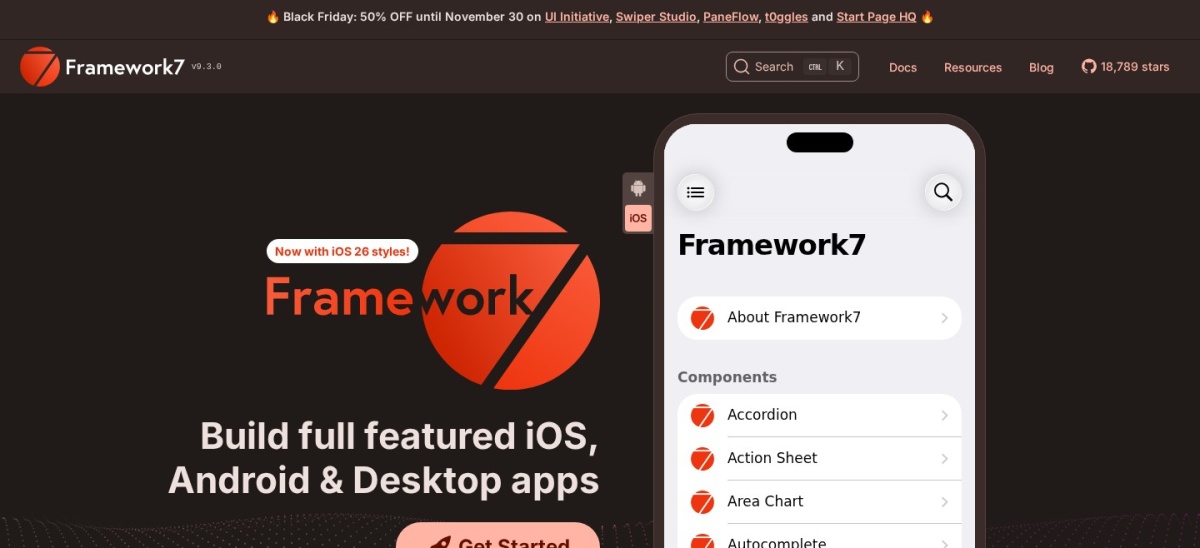
Framework7 is a free, open-source HTML framework for building iOS, Android and desktop apps. It ships ready-made interface components in iOS and Material styles, works with plain JavaScript or Vue and React, and pairs with Capacitor or Cordova for store builds. Version 9.3.0 is current.
The trade off is scope. Framework7 covers the interface only, so teams must add their own build, packaging and native plugin layer. It suits web developers who want a polished, native-looking interface without learning a new language.
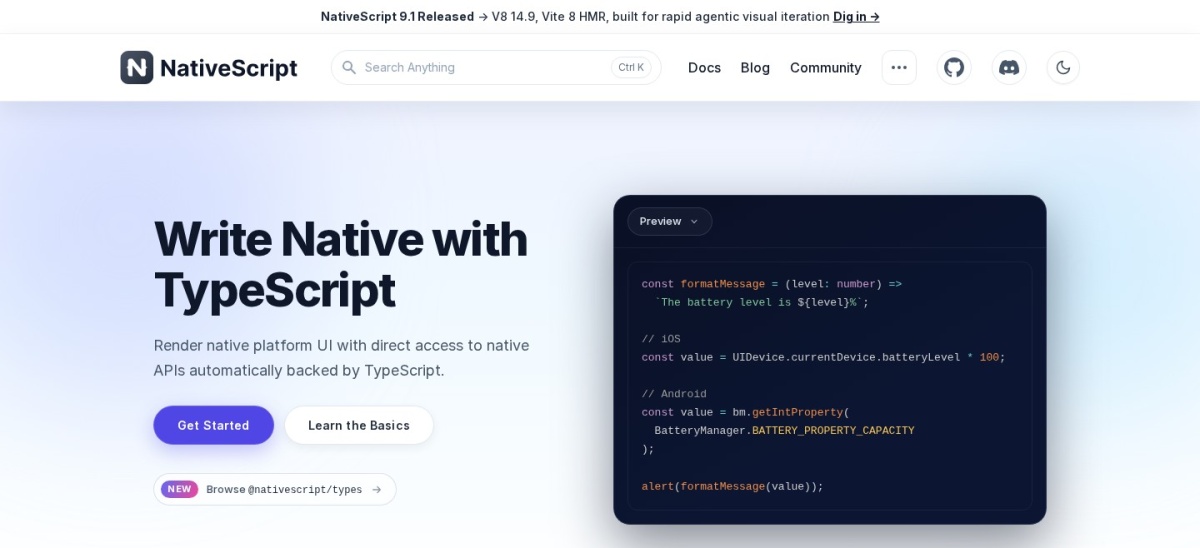
NativeScript is a free, open-source framework for building native mobile apps with JavaScript or TypeScript. It renders native interface elements, gives direct access to native platform APIs without plugins, and version 9.1 adds Vite 8 hot module replacement. There is no licence fee.
The trade off is a smaller community. NativeScript has far fewer reviews and plugins than Flutter or React Native, so answers and ready-made pieces can be harder to find. It suits TypeScript teams that want direct native API access.
What we like
Direct access to native APIs without plugins
Truly native interface elements
TypeScript-first development
Free and open source
Watch out for
Only 17 G2 reviews, the thinnest sample here except Adalo
Apache Cordova is a free, open-source framework that wraps HTML, CSS and JavaScript apps in a native container. It targets iOS, Android and more from one codebase and reaches device features through a large plugin system. Cordova is the oldest tool in this list.
The trade off is age. Cordova is mature and little changed, plugin maintenance varies, and newer frameworks offer better performance and tooling. It suits simple apps and teams with existing web code that need a quick store presence.
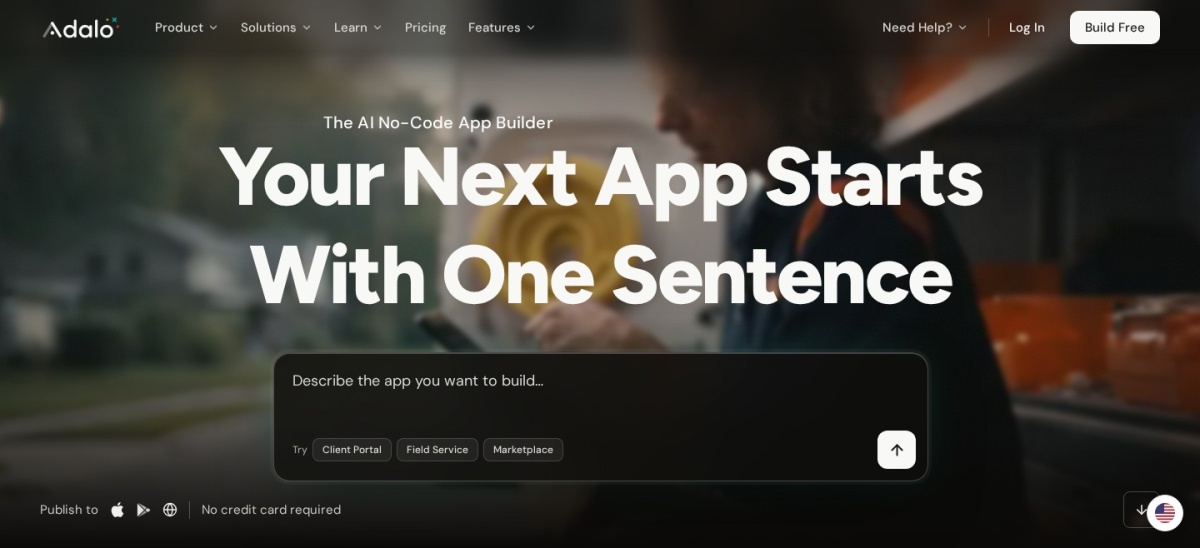
Adalo is a no-code builder for database-driven apps on iOS, Android and the web. It offers a drag-and-drop canvas, an AI assistant that drafts apps from a sentence, and built-in data, payments and push. The free plan allows test apps with 500 records each.
The trade off is lock-in and scale. Adalo does not export source code, and G2 reviewers warn that large or fast-growing apps can outgrow it. Builder costs $52 a month billed yearly, or $65 month to month, with a $30 first month for new Builders. It suits founders testing a simple app idea.
What we like
Easiest builder in this list to start with
Rated 4.4 out of 5 on G2 from 7 reviews
Built-in database, payments and push
Publishes to both stores without code
Watch out for
No source code export, so you cannot leave easily
Only 7 G2 reviews, a very small sample
Scaling past a few thousand users is hard
Builder adds store publishing, custom domains and pushVisit adalo.com
Free vs paid: what you give up
Free frameworks give you the code and the control. React Native, Ionic, Kotlin Multiplatform, Framework7, NativeScript and Cordova all cost $0, and you own everything you build.
Paid builders give you speed. FlutterFlow and Adalo let non-developers ship an app in days, but the monthly bill starts at $29 and $52 billed yearly, and Adalo keeps your code.
The hidden cost is the build layer. Cloud builds, live updates and store submission are where money appears, so check those prices before you pick a framework.
For a first app, start free. Pick a framework that matches the language your team already knows, and only pay when the app earns money or needs store publishing.
How we chose
We started from the frameworks and builders most often named as Flutter alternatives, then kept only those with a published rating on G2 and a pricing page or free licence we could check.
Prices come from each vendor's pricing page, checked on 29 November 2026. Ratings and review counts come from G2 on the same day. Where a vendor shows a sale, the list shows the regular price.
We left out Expo because it has no G2 rating for its developer platform, Capacitor because its G2 page holds a single review, and .NET MAUI because it has no standalone G2 listing. No vendor paid for a place, and we do not claim to have used these tools ourselves.
How to choose a Flutter alternative
Start with the language your team already knows, then check how native the result must feel.
Match the language to your team. JavaScript points to React Native or Ionic, Kotlin points to Kotlin Multiplatform, and no-code points to FlutterFlow or Adalo. Do not learn a new language only to switch frameworks.
Decide how native the interface must feel. React Native and NativeScript render truly native components, while Ionic and Framework7 wrap web views. Check on a real phone before you commit.
Check the paid layer, not just the framework. Cloud builds, live updates and store publishing carry the real cost. Ionic's Appflow, for example, is closed to new customers.
Plan your exit before you build. FlutterFlow exports Flutter code, but Adalo does not export code at all. If you may outgrow a builder, pick one that lets you leave.
FAQ
What are the best Flutter alternatives in 2026?
React Native is the best Flutter alternative for most teams. It is free, renders truly native components and is rated 4.5 out of 5 on G2 from 144 reviews. Ionic fits web teams best, and FlutterFlow fits founders who want a visual builder.
What is the cheapest Flutter alternative?
Six tools in this list are free: React Native, Ionic, Kotlin Multiplatform, Framework7, NativeScript and Apache Cordova. The cheapest paid pick is FlutterFlow, where Basic costs $29 a month billed yearly, or $351 a year.
Is there a free alternative to Flutter?
Yes. React Native, Ionic, Kotlin Multiplatform, Framework7, NativeScript and Apache Cordova are all free and open source. They give you a full framework with no licence fee, so you pay only with learning time and build setup.
Which Flutter alternative is best for beginners?
Adalo is the easiest for non-developers, because it is a drag-and-drop builder with an AI assistant and no code at all. For developers, Ionic is the gentlest start, since it uses plain HTML, CSS and JavaScript.
React Native vs Ionic: which is better?
React Native is better for most teams because it renders truly native components and has the largest review base here. Ionic is better for web teams that already know HTML, CSS and JavaScript and want one codebase for mobile, desktop and web.
What is the best no-code Flutter alternative?
FlutterFlow is the best no-code Flutter alternative. It builds real Flutter apps visually, connects to Firebase and Supabase, and lets you download the Flutter source code on paid plans. Adalo is simpler, but it does not export code.
SaaS SEO and WordPress specialist with about 8 years of experience. Rakib compares WordPress plugins, themes, hosting and software using public pricing, documentation and user reviews. See how we rank.