Merge is the best Finch API alternative for most teams. Its unified HRIS and payroll API covers hundreds of systems, is rated 4.7/5 on G2 from 253 reviews, and starts at $650 a month with the first three linked accounts free. Pick Kombo for European HR depth, or Nango if you want a free tier from $50 a month.
How we make this list: we compare pricing pages, product documentation and public user reviews, then re-check every price before each update. No product paid for a place. Disclosure.
Merge is the broadest direct swap, with one API for HRIS, payroll, ATS, accounting, CRM and ticketing from $650 a month.
Kombo is the strongest pick for European HR systems, with a 4.8 G2 rating, the highest of any unified API here.
Apideck holds the highest G2 rating at 4.9, and reads data in real time instead of storing a copy.
Nango is the cheapest entry: a free tier, pay-as-you-go from $50 a month, and a self-hosted option.
Pinwheel, Truework and Plaid solve a different job — worker-permissioned income and employment verification — so shortlist them only for that.
How do you pick the right Finch API alternative?
The first split is who gives permission. Finch reads data from the employer's HR and payroll systems with the employer's authorisation, so a true replacement is a unified API such as Merge or Kombo that does the same job.
The second group works the other way round. Pinwheel, Truework and Plaid read the worker's own payroll account with the worker's permission, which fits lending, tenant screening and earned wage access, not employer-side HR features.
Price is the hardest part to compare, because vendors charge for different things. Merge bills per linked account, Apideck per consumer, Nango by usage, and six of the nine publish no price at all, so model your real connection count before you shortlist.
Coverage claims hide the gaps that matter. Every vendor counts integrations differently, so bring a list of the exact HR and payroll systems your customers use and check each one, including whether the connection is live or assisted. Our guide on creating a custom REST API endpoint in WordPress shows how much of the plumbing a unified API is meant to remove.
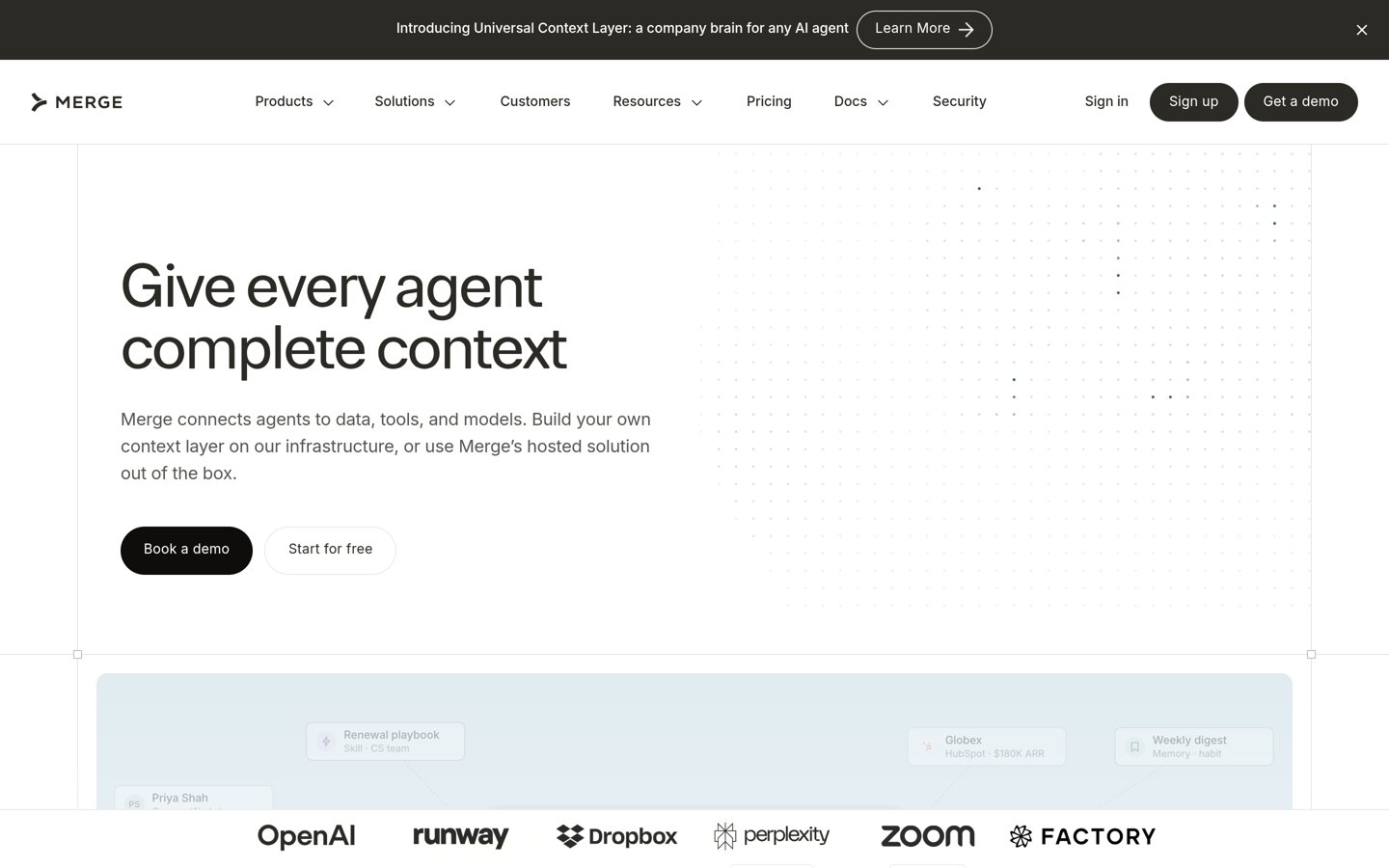
Merge is a unified API platform that gives your product one API for HRIS, payroll, ATS, accounting, CRM and ticketing, instead of one integration per app. Launch is free for the first three production linked accounts, then $650 a month for up to ten, and it holds a 4.7 rating on G2 from 253 reviews.
The trade off is the per-account meter. Each linked account past the first ten costs $65 a month, so the bill climbs fast once hundreds of employers connect. It suits B2B products that need several categories through one vendor.
What we like
One API across HR, payroll, ATS and more
Free for the first 3 production linked accounts
Mature logs and issue detection
Largest review base here, 253 G2 reviews
Watch out for
$65 a month per extra linked account
Deep US payroll writes are narrower than Finch
Key features gated to Professional and Enterprise
Professional and Enterprise add custom mappings and faster syncsVisit merge.dev
02
Kombo
4.8/5on G2 (88 reviews, checked Nov 2026)
PricingCustom/yr
Best for European HR and payroll depth
CategoriesHRIS, ATS, payroll, learning
Employee writesCreate records in dozens of systems
Free planProof of Concept, free
Paid planCustom quote
kombo.dev
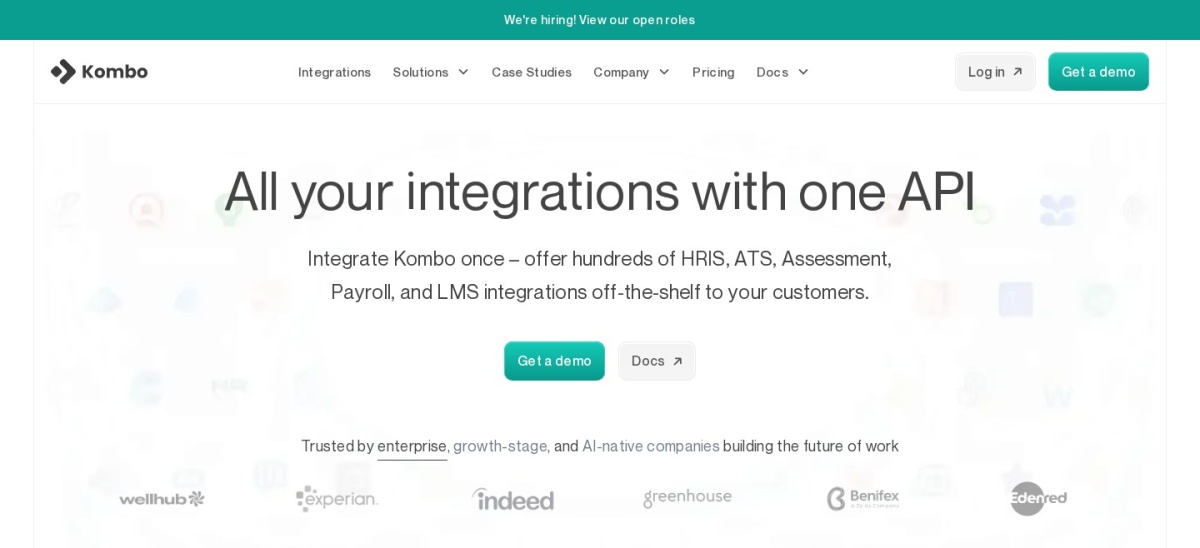
Kombo homepage, captured Nov 2026.
Kombo is a unified API for HRIS, ATS, payroll and learning systems, built with European HR tools in mind. It supports creating employee records across dozens of HR systems, which several rivals cannot do, and it holds a 4.8 rating on G2 from 88 reviews.
The trade off is pricing. Every paid plan is priced by quote after a free proof of concept, so budgeting needs a sales conversation. It suits teams selling outside the US, or any product where HR depth matters more than category breadth.
What we like
Strongest European HRIS and payroll coverage here
Employee-record writes across dozens of systems
Custom fields on standard plans
Highest-rated unified API here at 4.8
Watch out for
No published prices, quote only
US payroll deduction writes are thinner than Finch
Younger company than Merge
Paid plans are custom; start with the free proof of conceptVisit kombo.dev
03
Apideck
4.9/5on G2 (61 reviews, checked Nov 2026)
Paid from$599/mo
Best for real-time, pass-through reads
ModelReal-time pass-through
Free tier2,500 API requests
Unified APIs on Launch2
Paid planLaunch, $599/mo
apideck.com
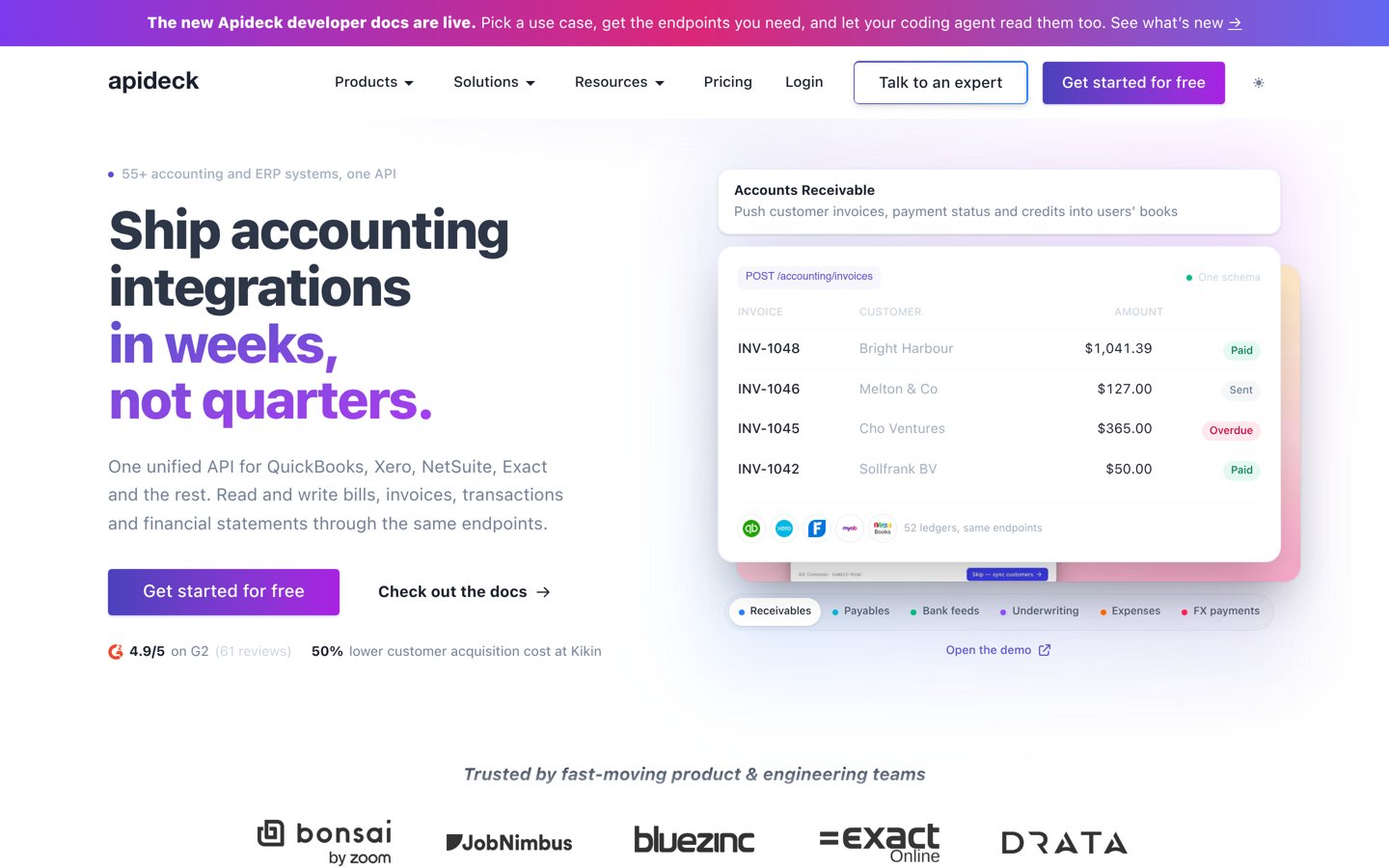
Apideck homepage, captured Nov 2026.
Apideck is a unified API that passes requests through to the source system in real time instead of storing a synced copy of your customers' data. Launch costs $599 a month, covers 2 unified APIs and 25 consumers, and it holds a 4.9 rating on G2 from 61 reviews.
The trade off is the price and the category ceiling. HRIS plus ATS needs the $1,299 Scale plan, and real-time reads inherit the source system's speed and downtime. It suits teams uneasy about a vendor warehousing payroll data.
Nango is an open-source integration platform you can run hosted or self-host, with syncs defined in code and access to raw provider APIs when the unified model runs out. The free tier covers 10 connections, paid plans start at $50 a month, and it holds a 4.5 rating on G2 from 67 reviews.
The trade off is the work you keep. Your engineers build and maintain the sync logic per provider, which is the labour Merge and Kombo charge to remove. It suits technical teams that want control of the integration layer and a low starting price.
What we like
Free tier and pay-as-you-go from $50 a month
Self-hosting for strict security reviews
Open source with 13,300 GitHub stars
Raw API access when the model runs out
Watch out for
Your team builds each provider sync
HR and payroll catalogue is smaller than the specialists
Best for payroll verification and deposit switching
Main jobsVerification, deposit switching
Data modelWorker-permissioned payroll
Free planNo, demo via sales
Paid planCustom quote
pinwheelapi.com
Pinwheel homepage, captured Nov 2026.
Pinwheel is a payroll connectivity API used by banks and lenders to verify income and employment and to switch a worker's direct deposit into a new account. Deposit switching is the differentiator: moving the paycheck is what turns a downloaded banking app into a primary account.
The trade off is the shape of the product. It is a worker-permissioned payroll tool, not a unified HR API, so employer-side HRIS reads are out of scope. It suits fintech and lending products where the worker, not the employer, grants access.
Truework is a verification platform that confirms income and employment through payroll and employer data, with the consent and audit trail regulated lenders require. It holds a 4.7 rating on G2 from 53 reviews, and pricing is usage-based by quote.
The trade off is scope. Truework proves a worker's job and pay for a specific decision, so it cannot feed a product that needs raw HRIS data day to day. It suits mortgage, auto and personal lenders, and background screening firms.
Best for verification inside a wider fintech stack
Main jobIncome and employment checks
Wider platformBank, assets, transactions
Free planNo, sandbox access
Paid planBundled, by quote
plaid.com
Plaid homepage, captured Nov 2026.
Plaid is the banking-data platform whose Plaid Check products verify a worker's employer, income and tenure through payroll connections. It holds a 4.2 rating on G2 from 65 reviews, and employment sits beside bank, asset and transaction data under one contract.
The trade off is focus. Employment is one product line in a banking platform, so payroll coverage and field depth trail the specialists. It suits lenders already on Plaid for bank data who want one vendor for employment checks too.
What we like
One vendor for bank and employment data
Familiar consent flow for US consumers
Large, established platform
Sandbox for development
Watch out for
Employment depth trails the specialists
Pricing is bundled and sales-led
No HRIS-style employer data at all
Employment checks are priced inside a Plaid contractVisit plaid.com
08
Codat
4.6/5on G2 (28 reviews, checked Nov 2026)
PricingCustom/yr
Best unified API if accounting data matters too
Main categoriesAccounting, commerce, banking
HRIS coverageNot a focus
Free planNo, trial on request
Paid planCustom quote
codat.io
Codat homepage, captured Nov 2026.
Codat is a unified API that standardises accounting, commerce and banking data behind one model, with white-label connection flows for lenders and fintechs. It holds a 4.6 rating on G2 from 28 reviews, and pricing is by quote.
The trade off is the fit. Codat is accounting-led, so HRIS and payroll depth is not its focus, and it only earns a place here for products that need financial data beside employment data. It suits lenders and spend platforms that read ledgers first.
What we like
Strong accounting and commerce coverage
White-label connection flow
4.6 G2 rating from 28 reviews
Real-time access to client records
Watch out for
HRIS and payroll are not its focus
No published prices, quote only
Uniformity varies by source system
Paid plans are custom; talk to sales for volumesVisit codat.io
09
Rutter
4.7/5on G2 (16 reviews, checked Nov 2026)
PricingCustom/yr
Best unified API for commerce-led fintech
Main categoriesCommerce, accounting, payments
Platforms covered60+ B2B platforms
Free startYes, no card
Paid planCustom quote
rutter.com
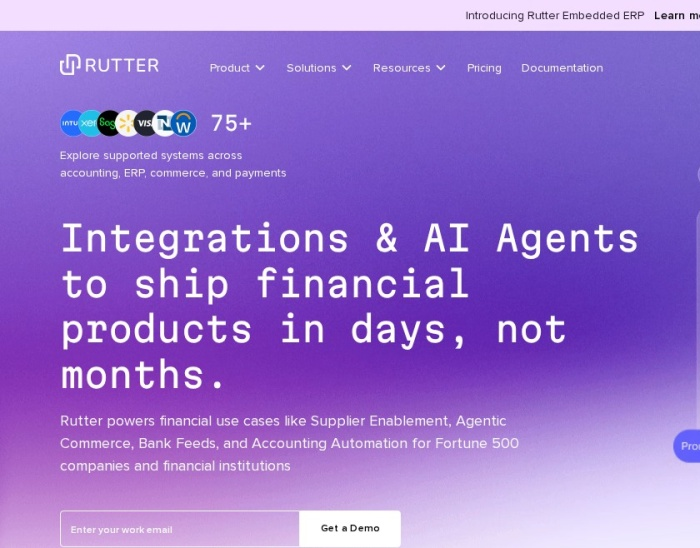
Rutter homepage, captured Nov 2026.
Rutter is a unified API for commerce, accounting, payments and ads data, built for fintechs that read ledgers beside storefront and payment platforms. It holds a 4.7 rating on G2 from 16 reviews, and it is free to start without a card.
The trade off is the same as Codat: HRIS and payroll are not what Rutter is built for, so it only fits teams whose employment-data need sits beside commerce data. It suits fintech products that already live in Rutter's categories.
What we like
Free to start with no card required
One model across 60+ platforms
White-label OAuth flow
4.7 G2 rating
Watch out for
Only 16 G2 reviews
HRIS and payroll are not its focus
Paid pricing is by quote
Paid plans are connection-based subscriptions by quoteVisit rutter.com
Unified APIs vs verification APIs: which job are you hiring for?
A unified API replaces Finch directly. It reads employer systems with employer permission and returns structured HR and payroll data your product can build features on, day after day.
A verification API answers one question at one moment: does this person work here, and what do they earn. That is the right shape for a loan decision, and the wrong shape for a benefits platform.
Many products end up needing one of each. A lender that also sells to employers, for example, may run Merge for employer data and Truework for borrower checks, under two contracts.
Decide the permission model first, then compare coverage and price inside that group. Comparing Merge with Pinwheel on price alone misses the point, because they do not do the same job.
How we chose
We started from every unified API and employment-data platform shortlisted against Finch in 2026 comparisons, then kept those with a verifiable rating on G2 and a live product.
Prices come from each vendor's pricing page or its vendor-provided G2 listing, checked on 29 November 2026. Ratings and review counts come from G2 on the same day. Where a vendor shows a sale, the list shows the regular price.
We left out Argyle, Truv and Noyo because no verifiable public user rating exists for them, and Codat and Rutter are flagged as accounting-led fits. No vendor paid for a place, and we do not claim to have used these tools ourselves.
How to choose a Finch API alternative
Start with whose permission your product runs on, then match coverage and price inside that group.
Decide employer-side or worker-side first. If your customer is the employer, shortlist Merge, Kombo, Apideck and Nango. If your user is the worker proving income, shortlist Pinwheel, Truework and Plaid.
Check your exact provider list. Bring your top fifty HR and payroll systems to the evaluation and confirm each one is covered natively, with live or assisted connections.
Test the data, not the demo. Connect a real employer or payroll account in staging and check sync freshness, deduction fields and what happens when a provider changes its login flow.
Price at your year-two connection count. Per-account and per-consumer meters cross over quickly as customers grow, so model the bill at real volumes, not launch volumes.
FAQ
What is the best Finch API alternative in 2026?
Merge is the best Finch API alternative for most teams. Its unified HRIS and payroll API covers hundreds of systems, is rated 4.7 out of 5 on G2 from 253 reviews, and starts at $650 a month with the first three linked accounts free.
How much do Finch API alternatives cost?
Published starting prices run from $50 a month at Nango, to $599 a month at Apideck and $650 a month at Merge. Kombo, Pinwheel, Truework, Plaid, Codat and Rutter price by quote or usage, so bring your connection volumes to the sales conversation.
Is there a free Finch API alternative?
Yes, in part. Nango has a free tier covering 10 connections, Merge is free for your first three production linked accounts, and Apideck offers a free tier of 2,500 API requests. None of the nine is free at production scale.
Which Finch API alternative is best for small teams?
Nango is the best pick for small technical teams, with a free tier and pay-as-you-go pricing from $50 a month. Merge is the better pick if you want a hosted platform and can use its free first three accounts.
Merge vs Kombo: which is better as a Finch alternative?
Merge is better for breadth, covering HR, payroll, ATS, accounting and CRM through one API from $650 a month. Kombo is better for depth, with stronger European HRIS coverage and a 4.8 G2 rating, but its pricing is by quote.
What is the best Finch alternative for income verification?
Pinwheel is the best pick for payroll verification with direct deposit switching, while Truework is the best pick for employer-verified checks with an audit trail for lenders. Both are worker-permissioned, so neither replaces Finch for employer-side HRIS reads.
Which Finch API alternative is best for European payroll and HR systems?
Kombo is the best pick for European payroll and HR systems, with deeper coverage of European HRIS and payroll tools than the US-first vendors. Merge also covers many European systems inside its HR category, so check your exact provider list during evaluation.
SaaS SEO and WordPress specialist with about 8 years of experience. Rakib compares WordPress plugins, themes, hosting and software using public pricing, documentation and user reviews. See how we rank.